Summary

  1. Business owners in Caracas guarding shops with dogs, man sayspublished at 11:48 GMT 6 January

    Ahmed Adan
    BBC World Service

    Wilmer* in Caracas tells BBC World Service shop owners are not allowing many people to enter their businesses - letting five in at a time, while using dogs to guard the shop.

    “They let a group of five get into the store, do the purchase and get out, and then let the next five people come in, because they don’t want a bunch of people in the store; they might break out into chaos, robbing everything. That has happened before, and they are trying to prevent that.”

    He adds that the food available in shops is currently at a high price, while people are queuing in long lines.

    “A package of one kilogram of cornflour, a very popular food here, used to cost $1 to $1.15 and today costs $3 to $3.20.”

    “People like me, I didn’t even go out. I can’t afford that, and nothing even worried me enough to leave my bedroom today.”

    *His name has been changed due to his fear of backlash from authorities.
  2. Checkpoints, armed patrols and phone checks in Caracaspublished at 11:27 GMT 6 January

    Daniel Pardo
    BBC News Mundo

    In Venezuela, one thing seems certain: repression did not end with Maduro's seizure. It intensified.

    In the streets of Petare, Caracas, there are "hooded men with guns patrolling, checking people's WhatsApp statuses," community leader Katiuska Camargo tells me.

    Dozens of military checkpoints have sprung up in the city. Foreign journalists are unable to enter.

    The Union of Journalists and Media Workers reported that 14 journalists were detained on Monday morning, though they were later released.

  3. US operation in Venezuela 'undermines international law' - UN human rights bodypublished at 10:58 GMT 6 January

    The US operation in Venezuela "undermined a fundamental principle of international law," the UN's high commission for human rights (OHCHR) has said.

    Addressing reporters in Geneva, Ravina Shamdasani, spokeswoman for the OHCHR said "states must not threaten or use force against the territorial integrity or political independence of any state".

    The criticism follows a UN Security Council emergency meeting yesterday, where some of America’s allies also took a stance against Trump’s military operation.

    Among them, France was the most outspoken. Deputy permanent representative, Jay Dharmadhikari, said Maduro's capture by the US ran "counter to the principle of peaceful dispute resolution and runs counter to the principle of the non-use of force".

    This morning, for the fourth day in a row, China repeated its opposition to Trump’s “reckless” actions.

    Chinese Foreign Ministry spokesperson Mao Ning said that China stands “ready to work with countries in the region… to jointly maintain peace and stability”.

    Maduro has historically considered China an ally.

  4. Armed police patrol streets of Caracas overnight, interior minister sayspublished at 10:30 GMT 6 January

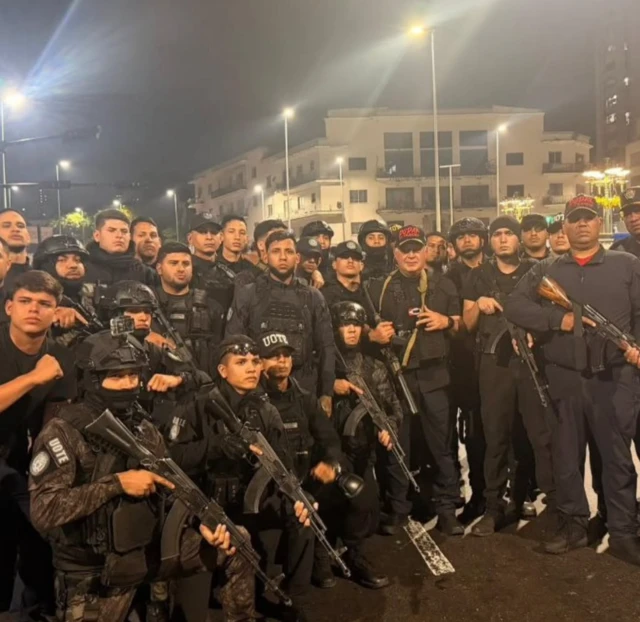
    Lots of men with guns stand on the streets at night time posing for a photoImage source, Instagram / @minjusticia_ve
    Image caption,

    Interior Minister Diosdado Cabello is shown right-of-centre wearing a black cap with red writing on it

    Photos posted by the Venezuelan interior minister on Monday night show armed police deployed on the streets of Caracas, as part of security arrangements in the city.

    Diosdado Cabello is seen in photos posted on Instagram, posing with security force members, many of whom are holding automatic guns.

    In one video, the security members can be seen shouting "loyal always, traitors never!"

    One of the posts says the minister toured some areas of the Venezuelan capital on Monday night to monitor the security forces.

  5. Europe faces an 'awkward' situation following Greenland threatspublished at 10:05 GMT 6 January

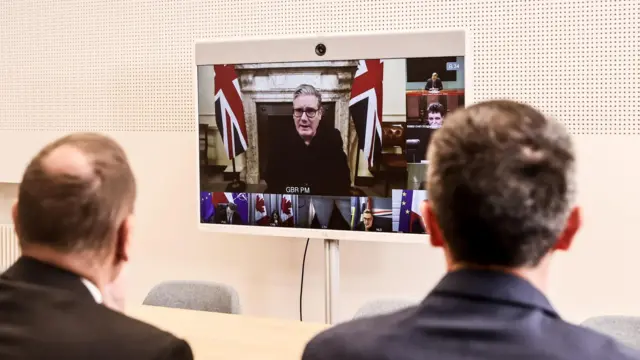
    UK Prime Minister Keir Starmer speaks via videoconference at the Coalition of the Willing in December 2025. He's on a television screen surrounded by other people in the video call. In the foreground are two European leaders listening in.Image source, EPA/Shutterstock
    Image caption,

    Keir Starmer speaks via videoconference at the Coalition of the Willing in December 2025

    We've been reporting on the UK response to the US operation in Venezuela, with Health Secretary Wes Streeting telling the Today programme earlier Prime Minister Keir Starmer was choosing his language "carefully".

    BBC's Europe Editor Katya Adler also told the programme continental leaders were facing an increasingly "awkward" and "intense" atmosphere as they try to "manage rather than confront" US President Donald Trump.

    "At the moment we are living in the age of big power politics - China, Russia, the US - and the EU particularly just looks like it's watching from the sidelines," Adler said.

    That's as European leaders will meet American representatives in Paris today for a meeting of the Coalition of the Willing, a body working for peace in Ukraine.

    But this desire to work closer with the US is overshadowed by Trump's threats to annex Greenland, which could "jeopardise the sovereignty of a fellow EU country, or another NATO member ally".

    There's been no joint statement from European countries standing with Denmark, and for a while a "deafening silence" from the big powers in London, Paris and Berlin - until Keir Starmer said it's up to Denmark and Greenland to decide its future on Monday.

    So it's a "very awkward situation" for Europe, Adler said.

  6. Capture of Maduro was 'morally right' - Badenochpublished at 09:40 GMT 6 January

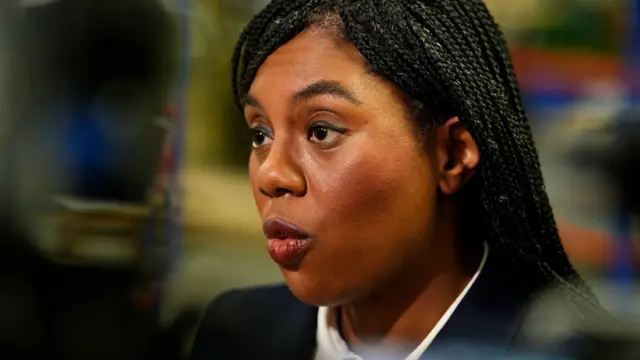
    Kemi Badenoch up close and looking to the left of the image. She is wearing a white collared shirt with a black blazer and her hair is down. The background is blurry.Image source, PA Media

    Venezuela was a "gangster state" and it was "morally right" for the US to send troops and seize its then president Nicolás Maduro, Tory leader Kemi Badenoch said earlier.

    "President Trump rightly pointed out how destabilising Venezuela is for the region, drug running, human trafficking, harbouring terrorists," she told the Today programme.

    "We can't just sit back and say there is nothing we can do all the time."

    However, when asked it about Greenland, she said "it is not for sale" and that "we shouldn't even be presenting any kind of ambiguity".

    "I think Venezuela is different. I wish there had been another way but I cannot… say anything except I’m glad Maduro is gone," Badenoch said.

  7. Political repression intensifies in Venezuela despite Maduro's removalpublished at 09:24 GMT 6 January

    Mimi Swaby
    Global affairs reporter

    The remaining figures of the ousted president’s regime are intact and now intensifying their crackdown on any political dissidence.

    This is something many Venezuelans were expecting and feared - it's nothing new. Thousands of opposition supporters and figures were arrested - many still jailed - after the disputed presidential election in 2024.

    The Union of Journalists and Media Workers in Venezuela has reported that at least 14 journalists were detained on Monday - 13 from international agencies and one from national media. They have all since been released - one has been deported.

    Alongside an increased military and police presence, armed citizen militias - at the order of the government - are reportedly combing the streets squashing any celebrations of the US’s operation. Public support for the opposition could easily lead to arrest.

    Thousands of images have been shared online of Venezuelans holding signs denouncing Delcy Rodriguez as the interim president. Some have protested by clanging pots from pans from their homes.

    However, many in the country are scared to take to the streets or publicly express US support, fearing heavy-handed repercussions.

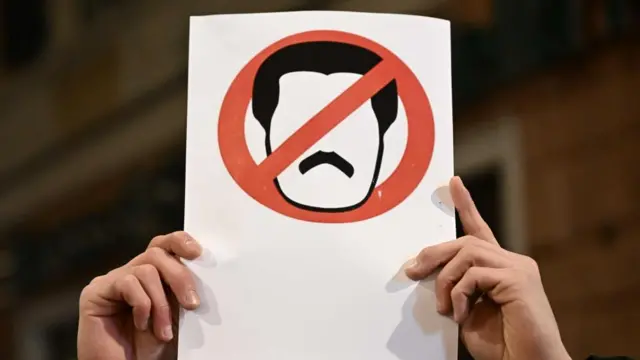
    a pair of hands hold up a white sign with a cartoon outline of Maduro's face in a red circle and 'strike through' lineImage source, EPA
    Image caption,

    An anti-Maduro protester taking place in a demonstration in Italy. Meanwhile many in Venezuela fear taking to the streets

  8. 'Inside our homes, we are happy,' Caracas student tells BBCpublished at 09:02 GMT 6 January

    "There's doubt on the street," one student from Caracas tells the BBC.

    While the "majority of the country" is "very happy", Marcelo Vera Cruz tells the Newsday programme that "uncertainty" remains.

    "Just like most of the country doesn't want Maduro, it’s the same about Delcy Rodríguez... there [are] still a lot of people that are still in power that will continue to subject people to an autocratic regime."

    He says people have "doubt" about what Trump will do, adding: "I think most people think and believe that it's the same old story with a different name."

    However, he says he can't see people celebrating Maduro's capture on the streets of Caracas because they would be pursued by "the state, by the intelligence, by the cops or by the paramilitary groups".

    "Inside our homes, yes, we are happy," Marcelo says. "I can assure you that over 80% of the country is happy for what happened. But for our own safety we can't just go out and celebrate."

    Marcelo hopes for a leader "chosen by an election process that was accepted by the majority of the country".

  9. UK PM 'choosing his words carefully' on Venezuela, minister sayspublished at 08:40 GMT 6 January

    UK Prime Minister Sir Keir Starmer is "choosing his words carefully and wisely" on Venezuela "to try and influence how events unfold from here on," a senior government minister says.

    "The prime minister has judged what he says and when he says it with one overriding consideration, which is how to make a challenging situation better not worse," Wes Streeting tells the BBC, and to do so "in the interest of the people of Venezuela, who have the right to choose their own leaders".

    He says he appreciates that others have been "more strident" in criticising the US operation - including a senior MP in Sir Keir's own Labour party, who said it was a breach of international law - but Streeting says the PM "has a different responsibility".

    "He's not a commentator, he's a world leader," he adds.

    • As a reminder, Sir Keir said the UK had "long supported a transition of power in Venezuela" in the immediate aftermath of the US operation. He said the UK "shed no tears about the end of [Maduro's] regime" and reiterated his "support for international law".
    • Read Chris Mason's analysis here.
  10. Who is María Corina Machado - Venezuela's opposition leaderpublished at 08:28 GMT 6 January

    Tiffany Wertheimer
    Live editor

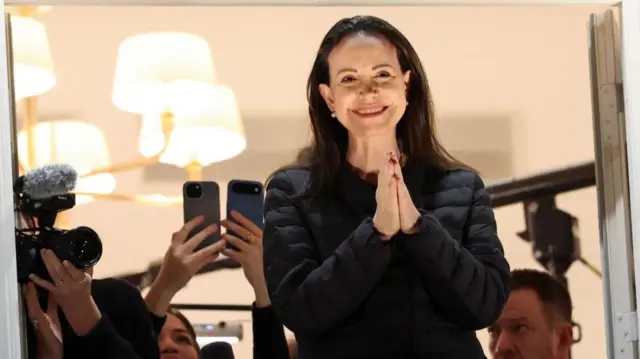
    Machado standing on a balcony, wearing all black, smiling and with her hands in a prayer position.Image source, Reuters
    Image caption,

    Machado appeared on a hotel balcony after she arrived in Norway to collect her Nobel Peace Prize

    María Corina Machado, 58, is considered one of the most respected voices in Venezuela's opposition and has long denounced Nicolás Maduro's government as "criminal".

    She was barred from running in the 2024 election but continued to campaign for the candidate who replaced her on the ballot, Edmundo González. Maduro was declared the winner, even though polling station tallies showed that González had won by a landslide.

    She has been threatened with arrest many times, and because of this, the mother of three spent most of last year living in hiding. She had sent her adult children overseas for their own safety, and didn't see them for about two years.

    Machado was awarded 2025's Nobel Peace Prize for "her struggle to achieve a just and peaceful transition from dictatorship to democracy" in Venezuela, and her journey to collect the award in Norway was quite extraordinary.

    The covert trip, which was dangerous and complicated, saw Machado wear a disguise, get through 10 military checkpoints without being caught, and sail away on a wooden skiff from a coastal fishing village.

    She has vowed to return to Venezuela, despite knowing "exactly the risks" - although that comment was made before the US seized Maduro.

  11. 'I'm a president and prisoner of war' - Maduro's first court appearancepublished at 08:06 GMT 6 January

    Madeline Halpert
    Reporting from court

    Media caption,

    What it was like in the courtroom at Maduro's hearing

    The sound of clanking leg shackles could be heard before Venezuelan leader Nicolás Maduro walked through the doorway of a New York City courtroom on Monday.

    He then told packed rows of reporters and the public that he had been "kidnapped".

    During the dramatic 40-minute arraignment on Monday afternoon, Maduro and his wife, Cilia Flores, pleaded not guilty to drugs and weapon charges.

    "I'm innocent. I'm a decent man," Maduro said, with Flores adding that she was "completely innocent".

    Maduro was expressionless during the proceedings, even at the end, when a man watching from the public area suddenly shouted that Maduro would "pay" for what he had done.

    "I'm a president and prisoner of war," he shouted in Spanish towards the man, who was then escorted out of the room in tears.

    Flores was much quieter, with bandages near her eyes and forehead for injuries her lawyers said she sustained during their weekend arrest.

  12. Why did the US attack Venezuela and seize its president?published at 07:37 GMT 6 January

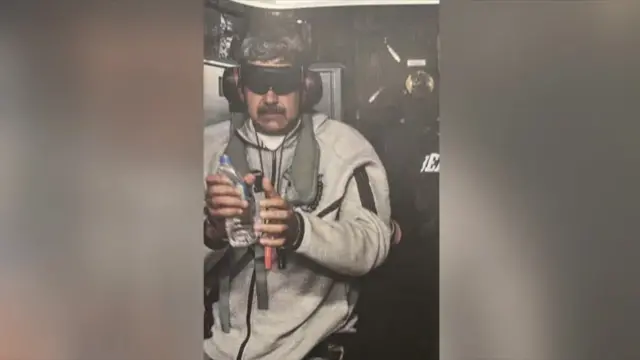
    Maduro with ear defenders and a blindfold onImage source, Donald Trump
    Image caption,

    Trump posted this photo of Maduro, saying it showed the captured leader on the USS Iwo Jima

    Donald Trump blames Nicolás Maduro for the arrival of hundreds of thousands of Venezuelan migrants in the US.

    Without providing evidence, he has accused Maduro of "emptying his prisons and insane asylums" and "forcing" its inmates to migrate to the US.

    But Trump has also focused on fighting the influx of drugs - especially fentanyl and cocaine - into the US.

    Two Venezuelan criminal groups - Tren de Aragua and Cartel de los Soles - have been designated as Foreign Terrorist Organisations and Trump alleges the latter is led by Maduro himself.

    Analysts have pointed out that Cartel de los Soles is not a hierarchical group but a term used to describe corrupt officials who have allowed cocaine to transit through Venezuela.

    Maduro has vehemently denied being a cartel leader and has accused the US of using its "war on drugs" as an excuse to try to depose him and get its hands on Venezuela's vast oil reserves.

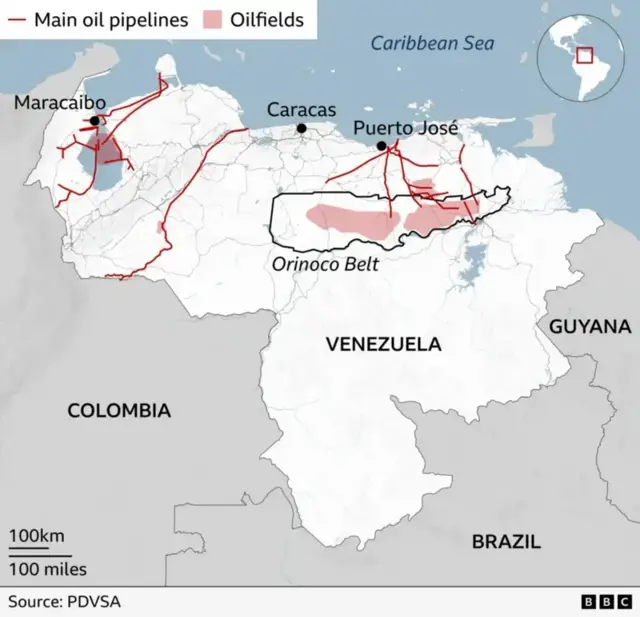
    Venezuela has the world's largest proven crude oil reserves and profits from the oil sector finance more than half of its government budget. However, its exports have been hit by sanctions and a lack of investment and mismanagement within Venezuela's state-run oil company.

    You can read more here.

    Map showing oil pipelines in Venezuela
  13. Watch: Machado says US operation will go down in history as justice defeating tyrannypublished at 07:26 GMT 6 January

  14. Trump's action in Venezuela 'a huge step for humanity', says opposition leaderpublished at 07:02 GMT 6 January

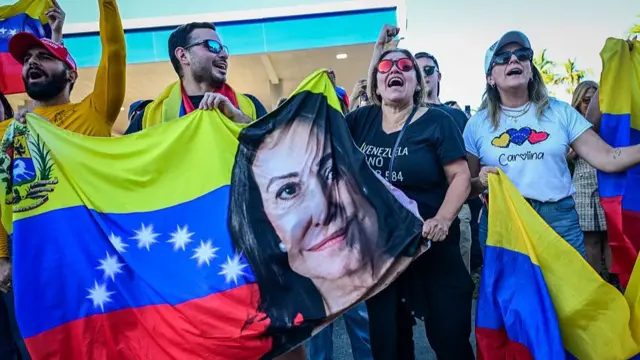
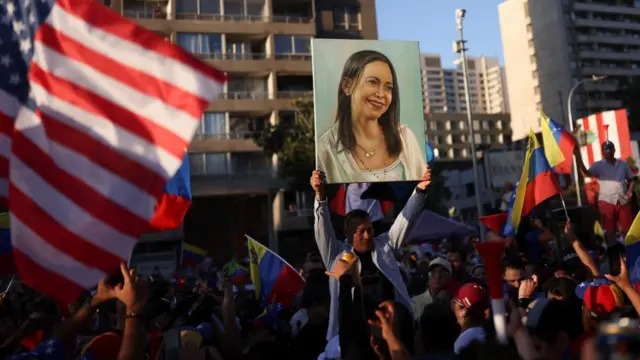
    People hold a Venezuelan flag with a picture of opposition leader, Nobel peace laureate Maria Corina Machado as they react to the newsImage source, GIORGIO VIERA/AFP via Getty Images

    It's now three days since US forces stormed Nicolás Maduro's Caracas compound, seizing the Venezuelan president and his wife.

    A few hours ago, the country’s opposition leader María Corina Machado, who lived in hiding for months last year, said she was grateful for Donald Trump‘s action in Venezuela, calling it a “huge step for humanity, for freedom”.

    The Nobel Peace Prize winner told Fox News that the new interim president Delcy Rodríguez - who had been Maduro’s vice-president - “can’t be trusted”.

    She spoke hours after Maduro had pleaded not guilty to various drug trafficking and weapons offences in a New York court. During that 30-minute hearing, Maduro said he was a "kidnapped president" and a "prisoner of war" and declared that he was "still president" of Venezuela.

    Stay with us as we bring you the latest updates today.

  15. Maduro appears in court, lawmakers briefed - today's main developmentspublished at 03:05 GMT 6 January

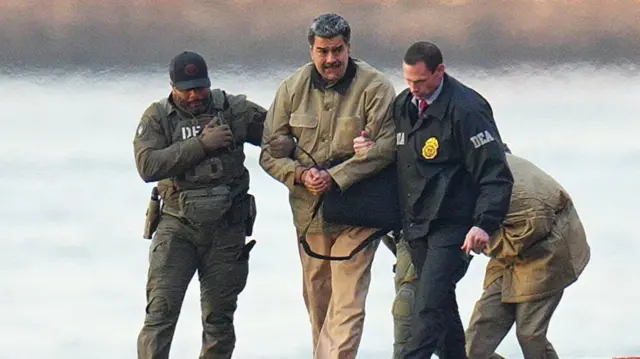
    Nicolas Maduro is seen in handcuffs after landing at a Manhattan helipad, escorted by heavily armed federal agents as they make their way into an armoured car en route to a Federal courthouse in ManhattanImage source, Getty Images

    It's just gone 23:00 in Caracas, while Washington is an hour behind. Here are today's main developments:

    • Venezuela's Nicolás Maduro says "I am still president" as he pleads not guilty to drug trafficking and other charges in his first appearance at a New York court
    • He and his wife Cilia Flores were seized from their Caracas compound on Saturday and flown to the US as part of a special forces operation - here's what happened
    • Monday's hearing ended with a tense exchange between a member of the public and Maduro, who said he was a "prisoner of war", our reporter in court said
    • Earlier, dramatic images showed the pair being transferred to the courthouse in handcuffs, surrounded by armed officers
    • Maduro's Vice President Delcy Rodríguez, while being sworn in as Venezuela's interim president today, praised Maduro and his wife as "heroes"
    • Back in the US, Trump officials, including Secretary of State Marco Rubio and Defence Secretary Pete Hegseth, briefed top US lawmakers on Venezuela.
    • After the briefing, Chuck Schumer, the top Democrat in the US Senate, characterises the plan to run Venezuela as "vague, based on wishful thinking, and unsatisfying".
    • House Speaker Mike Johnson, the top Republican in the House of Representatives, asserts that the US is "demanding a change of how a regime rules" not carrying out a regime change and that Trump was within the authority given to him by the US Constitution
    • Trump insists during a news interview that the US is not at war with the country and that the person ultimately in charge of Venezuela is "me"

    We're pausing our live coverage now, but you can catch up on the latest here.

  16. Machado says she wants to return 'as soon as possible'published at 02:46 GMT 6 January

    Machado goes on to say she is "planning to go back" to Venezuela "as soon as possible".

    The Venezuelan opposition leader has been in hiding for many months, which she says was "more useful" while it was unsafe for her to return.

    Machado goes on to talk about an "escalation just today" with "14 journalists detained" in Venezuela. She says interim president "Delcy Rodríguez can’t be trusted" and that the next transition for Venezuelans must move forward.

    The opposition leader spoke only briefly to host Sean Hannity.

  17. Machado 'grateful' for Trump's actions in Venezuelapublished at 02:38 GMT 6 January

    Speaking to host Sean Hannity, Machado says she believes Donald Trump deserved the Nobel Peace Prize.

    She says the US President has proven this to the world with his actions in Venezuela, calling it a "huge step for humanity".

    The opposition leader reiterates how "grateful we are for his actions".

  18. We defeated Maduro by a landslide, Machado sayspublished at 02:32 GMT 6 January

    Venezuela's opposition leader María Corina Machado is speaking to Fox News, reflecting on the election where she went up against Nicolas Maduro.

    Speaking about Maduro, she says "he absolutely controlled the system and the electoral council" and says how it was impossible to carry independent elections in Venezuela. But "we defeated him by a landslide", she says.

  19. María Corina Machado to speak about Maduro capturepublished at 02:18 GMT 6 January

    Venezuelans hold a painting of Maria MachadoImage source, Reuters

    We are expecting to hear from Venezuela's opposition leader María Corina Machado who will give an interview to Fox News.

    Machado was expected to talk with Fox News host Sean Hannity after 22:00 Caracas time (02:00 GMT), according to the Con Venezuela campaign team. We will bring you the latest once it kicks off.

    In a statement, external on X earlier, Machado thanked Donald Trump on behalf of Venezuelans, and his "administration for their firmness and determination in upholding the law".

    "The freedom of Venezuela is near, and soon we will celebrate on our land," she said.

  20. Plan to run Venezuela 'based on wishful thinking', says Schumerpublished at 02:08 GMT 6 January

    Chuck Schumer, the top Democrat in the US Senate, has just issued a full statement reacting to the briefing with Rubio.

    "While this briefing was very extensive and long, it posed far more questions than it ever answered," said the New York senator. "Their plan for the US running Venezuela is vague, based on wishful thinking, and was unsatisfying.

    "I did not receive any assurances that we would not try to do the same thing in other countries. And in conclusion, when the United States engages in this kind of regime change and so-called nation building, it always ends up hurting the United States. I left the briefing feeling that it would again."