Summary

  1. Military patrols in Caracas - and civilians' phones being checkedpublished at 16:38 GMT 6 January
    Alice Cuddy
    Reporting from Cúcuta, on the Colombia-Venezuela border

    We've been hearing from people in Venezuela since Maduro’s seizure, most of whom have asked to remain anonymous for their safety.

    In the capital Caracas, a 34-year-old entrepreneur on Monday night described in his area "military patrols on every corner and groups of armed civilians [who are] supporting the government causing fear among the population".

    People are acting with "caution here because of how the government behaves towards civilians”.

    "We fear what they will do to us and that there will be reprisals," the entrepreneur said.

    A man in the city today said that on the surface “everything is working as normal", with shops and businesses running, but civilians’ phones are being checked.

    Another man living in Caracas said he was too scared to speak by phone or message today.

  2. The Greenland question, Venezuela's oil and global orderpublished at 16:08 GMT 6 January

    Our correspondents have now wrapped up answering your questions about the US action in Venezuela and its global ramifications. Thanks for following. Before we move on, here's a selection of a few more:

    • Diplomatic Correspondent Paul Adams is asked about Greenland - and whether it's next when it comes to US aggression? He says there's "no immediate prospect" of a kind of military operation on Greenland, and that Trump brushed it away when asked on Air Force One a few days ago.
    • South America Correspondent Ione Wells is asked why Venezuela is not rich from its oil. She replies they may not be feeling the benefits due to widespread economic mismanagement in the last couple of years, as well as corruption and a lack of investment in the country.
    • The panel is asked whether the world order is now dead. Paul Adams says there have been fears of this since Donald Trump returned to the White House. He says Trump has expanded the area around America that is seen as vital to the US' national interest.
    The words 'your voice' in white writing against a red background
  3. Why Maduro and Trump have long been foespublished at 15:50 GMT 6 January

    You've asked about when Maduro first came to power and what his relationship has been like with Donald Trump.

    South America correspondent Ione Wells explains that Maduro first came to power in 2013 when his predecessor Hugo Chavez died. She adds that Maduro has long been a foe of Donald Trump due to three main reasons.

    Firstly, millions of people have left Venezuela since Maduro came to power, many moving to the US.

    Trump has also accused Maduro of being head of a criminal trafficking organisation. Something Maduro denies.

    The US also does not believe the 2024 election in Venezuela was true or fair and that it does not recognise Maduro as president.

    'Your voice' in white writing against a red background
  4. No consensus on legality of Venezuela actionpublished at 15:46 GMT 6 January

    Diplomatic Correspondent Paul Adams is asked what the consensus is in terms of the legality of Trump's strike - under international and domestic law.

    Adams says there's no consensus.

    In international law, the UN charter says it's illegal to use force against territory of another country unless there's some kind of direct threat.

    But US domestic law gives federal agents approval to conduct arrests against wanted suspects pretty much anywhere in the world.

    The words 'your voice' in white against a red background
  5. Why did the US carry out an operation in Venezuela?published at 15:42 GMT 6 January

    Our experts are now answering your questions on the US strikes on Venezuela - as a reminder, you can watch live at the top of this page.

    First up, it's chief presenter Sumi Somaskanda, reporting from the Colombia-Venezuela border. She's asked why the US operation happened.

    She explains that US officials saw Maduro as the head of a drug trafficking cartel, and deemed that he was responsible for trafficking drugs directly into the US.

    But then Trump "changed the narrative" by talking more about oil - Somaskanda says Trump referred to "stolen oil and stolen land".

    It's not entirely clear what he means by this, but when Venezuela nationalised its oil companies, lots of American companies operating in the country lost out - and Trump's saying they should be reimbursed.

    The words 'your voice' appear in white against a red background.
  6. 'We caught them a little by surprise'published at 15:32 GMT 6 January

    Bernd Debusmann Jr
    Reporting from Washington DC

    The room erupted with applause and a standing ovation for Trump's mention of his "amazing military achievement in Venezuela."

    Trump acknowledged that "many, many" people were killed during the operation, specifically citing Cubans.

    The president is clearly overjoyed at how the operation went, saying that "we caught them a little by surprise" after the lights of Caracas were shut down.

    He is also taking swipes at his political opponents, accusing the "radical left" of paying people to protest the toppling of Maduro. It's a frequent talking point, but the White House has not provided any firm evidence to that effect.

    He added that "nobody can take us" promising to ramp up defence production.

    Most of the lawmakers seem to be enjoying this. From my viewpoint in the back of the room, I can see Ohio Republican Jim Jordan smiling broadly.

  7. Our correspondents answer your questions on Venezuelapublished at 15:31 GMT 6 January

    We're about to go live to the BBC's South America correspondent Ione Wells, chief Presenter Sumi Somaskanda, who is at the Colombia-Venezuela border, and diplomatic correspondent Paul Adams.

    They'll be answering your questions on the complicated situation unfolding in Venezuela since Saturday's US operation.

    We'll bring you a selection of the Q&A, but you can watch it in full at the top of the page.

    The words 'YOUR VOICE' appear in white writing against a red background.
  8. Trump praises 'successful' night as he speaks to Republicanspublished at 15:21 GMT 6 January

    Bernd Debusmann Jr
    Reporting from Washington DC

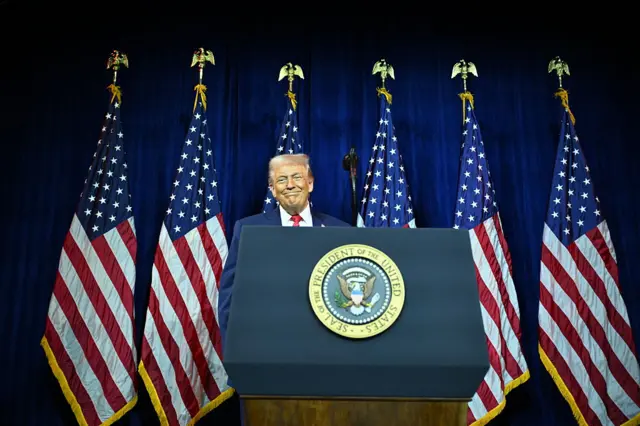
    Trump at podium with flags behind him.Image source, Mandel NGAN / AFP via Getty Images

    I'm at the Trump-Kennedy Center, where the president is clearly in a triumphant mood.

    After coming on stage to the sound of Lee Greenwood's "Proud to be an American", Trump quickly dived into what he perceives to be his successes in the nearly one year since he returned to the White House.

    He soon alluded to Venezuela, saying that the US has a "successful" night just a few days ago.

    Much of the beginning of his speech, however, has focused on the death of California Republican Doug LaMalfa.

  9. Donald Trump addressing Republicans in Washingtonpublished at 15:16 GMT 6 January

    The US president is speaking in Washington DC at the newly renamed Trump-Kennedy Center for the Performing Arts.

    It is not a Venezuela-focused news conference, but we're listening in to see if Trump says anything about the recent US action in Venezuela, which resulted in the seizure of Nicolás Maduro. If he does, we'll bring you those lines right here.

    You can follow along by tapping watch live at the top of this page.

  10. 'Initially people were happy, but now people are scared of what might happen'published at 14:56 GMT 6 January

    Ahmed Adan
    BBC World Service

    We've been speaking to people about what it's like in Venezuela since the US operation. Earlier we reported on the experiences of Wilmer* in Caracas and Angela* in Guayana City.

    Pedro*, in the north-western coastal city of Maracaibo, has been able to go outside and buy bread, but says already there is a price increase of about 30%.

    “It wasn’t normal shopping," he told the BBC. "Initially people were happy, but now people are scared of what might happen, and nobody is talking about what happened.”

    Agreeing with what Pedro said, Wilmer and Angela both said that, because of guards’ presence in many places, people are not discussing what's going on.

    “We smile, you know; that’s all we can do,” says Wilmer.

    And Angela says that “people in the supermarket that I went to were quiet because everyone is scared to talk about what happened, and guards are outside.”

    *Names have been changed due to fears of a backlash from authorities.

  11. Analysis

    Who's actually in charge in Venezuela?published at 14:31 GMT 6 January

    Ione Wells
    South America correspondent

    Donald Trump might keep insisting that the US is “in charge” of Venezuela, but in reality, the Venezuelan government is still very much in power.

    Delcy Rodríguez is the acting president, many of Nicolás Maduro’s ministers are still in post, and the powerful military is, so far, staying loyal to her.

    Trump has issued serious threats to Rodríguez - that if she doesn’t do “the right thing” (i.e. what the US wants) she could face the same fate as Maduro, or worse.

    Many expected Trump to back the opposition to take charge, but in some ways the current set-up is more convenient for him.

    The Venezuelan government will now undoubtedly be nervous about what could happen to them if they don’t at least somewhat comply.

    Trump isn’t in charge, but he does have a lot of influence.

  12. BBC Verify

    Gunshots heard near Venezuela presidential palace overnightpublished at 14:10 GMT 6 January

    By Jake Horton

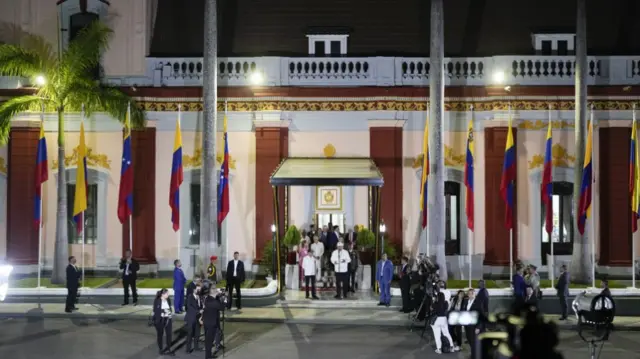
    A press conference outside a regal building with lots of Venezuelan flags on the ground parallel to the building. A few reporters are stood on the pavement with cameras as a group of people stand at the door, giving the press conference.Image source, Bloomberg via Getty Images
    Image caption,

    Maduro holding a press conference outside Miraflores Palace in 2024

    Tensions remain high in the capital, Caracas, where gunshots were reported overnight near the presidential palace.

    Yesterday Delcy Rodríguez was sworn in as Venezuela’s interim president, but the security situation still remains unclear after the US seized President Nicolás Maduro and said it would run the country.

    Several videos posted on social media overnight show armed men on the streets as apparent gunshots are heard ringing out.

    We’ve verified one video filmed near Miraflores Palace in which you can hear gunshots, but it’s not immediately clear what they were in response to.

    We’ve located another video to a plaza about 650m from the palace, in which you can hear someone ask in Spanish, “What happened?”

    A man who appears to be a security official replies: “Drones, drones”.

    This suggests that the gunshots may have been in response to a drone sighting, although we can’t independently confirm this was the case.

  13. European leaders issue statement as Venezuela surfaces Greenland issuepublished at 13:57 GMT 6 January

    Media caption,

    'We need Greenland from the standpoint of national security,' Trump says

    The US military intervention in Venezuela has resurfaced the issue of Greenland's future.

    Trump has repeatedly said the US "needs" the whole island for national security reasons (the US already has a military base there), while Greenland's leaders have repeated that it is not for sale.

    Earlier today BBC's Europe Editor Katya Adler described how European leaders are facing an increasingly "awkward" and "intense" atmosphere as they try to "manage rather than confront" Trump.

    After top Trump aid Stephen Miller told CNN that "nobody's going to fight the US over the future of Greenland", European leaders issued a strongly-worded joint statement saying only Greenland and Denmark can decide its future.

    "Greenland belongs to its people. It is for Denmark and Greenland, and them only, to decide on matters concerning Denmark and Greenland."

    The statement, which was signed by the leaders of the UK, France, Germany, Italy, Poland, Spain and Denmark, says "European allies are stepping up" and that Nato has made clear that the Arctic region is its priority.

  14. What's Trump up to today?published at 13:37 GMT 6 January

    Bernd Debusmann Jr
    Reporting from the White House

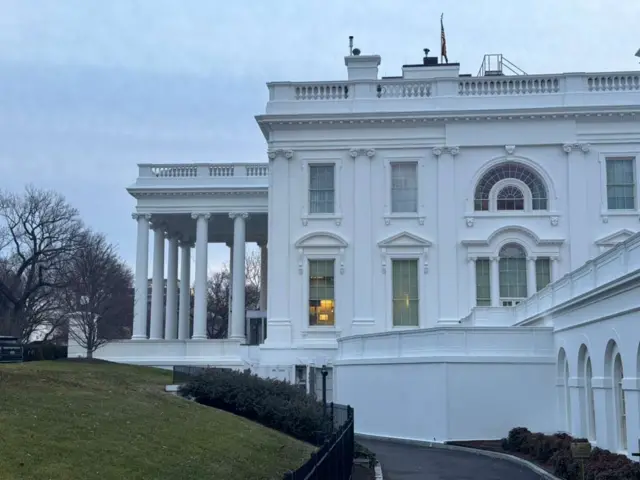
    Exterior of the White HouseImage source, Bernd Debusmann Jr/BBC News

    Good morning from a cold and quiet White House, where reporters and staff are starting to trickle in to prepare for the day ahead.

    With the world's eyes still firmly fixed on Venezuela, we have not seen President Trump on-camera since he returned to Washington from Florida on Sunday.

    In a few hours, Trump is scheduled to travel to the newly renamed Trump-Kennedy Center for the Performing Arts to deliver remarks at a retreat for Republican members of the House of Representatives.

    The White House press pool - which today includes the BBC - will be tagging along. That event will be broadcast.

    At 14:30 local time (19:30 GMT), Trump is expected to hold an unspecified policy meeting in the Oval Office back at the White House.

    This is also listed as closed, although similar meetings often open up to the media.

    Stay with us for more updates.

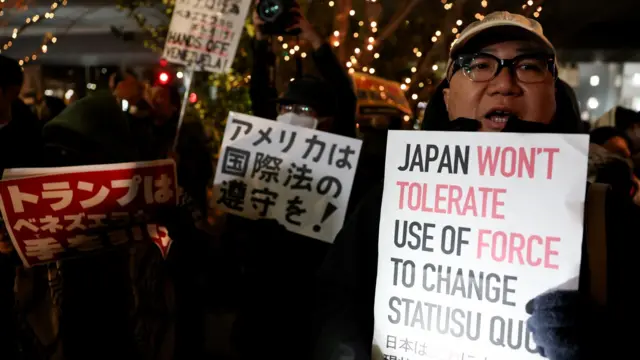
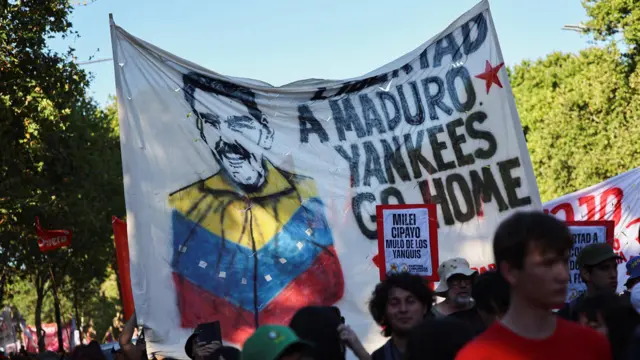
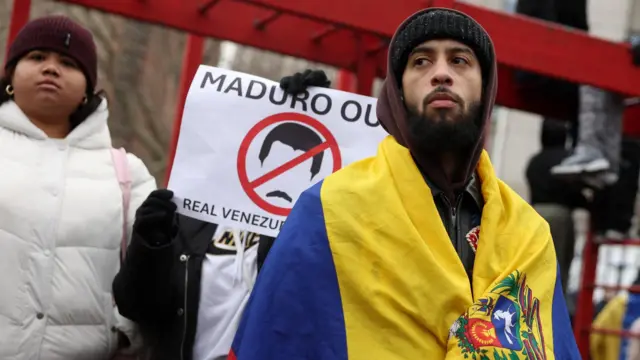
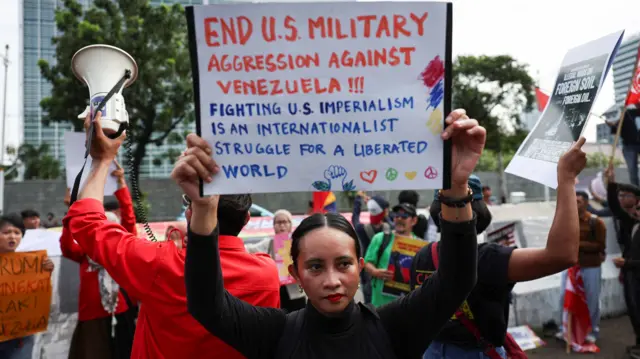
  15. Protests across the world respond to Maduro's capturepublished at 13:11 GMT 6 January

    There were protests and demonstrations in several countries last night, many taking place outside US embassies.

    Some were critical of the US decision to capture Maduro, while others supported it, calling for freedom for Venezuela.

    Protestors hold signs in English and Japanese, reading 'Japan won't tolerate use of force to change status quo'Image source, Reuters
    Image caption,

    Activists outside the US embassy in Tokyo condemned the US military operation

    A banner with Maduro and the Venezuelan flag on, reading 'Freedom to Maduro, Yankees go home'Image source, Reuters
    Image caption,

    In Buenos Aires, Argentina, protesters hold a banner saying "Freedom to Maduro, Yankees go home"

    A protestor in New York City wrapped in the Venezuelan flag. Another holds a sign saying 'Maduro out', with a black and white outline of his face surrounded by a red stop symbol.Image source, Reuters
    Image caption,

    A demonstrator in New York City holds a sign which reads "Maduro out"

    A protester holds up a sign saying "End US military aggression against Venezuela"Image source, Reuters
    Image caption,

    A protester outside the US embassy in Jakarta, Indonesia, calls for an end to "US military aggression"

  16. What do you want to know about the situation in Venezuela?published at 12:57 GMT 6 January

    This is a complicated and ongoing story, so our correspondents and experts are here to answer your questions.

    The BBC's South America Correspondent, Ione Wells; Chief Presenter Sumi Somaskanda, who is at the Colombia-Venezuela border and Diplomatic Correspondent Paul Adams are ready for your questions.

    Ask them in the following ways:  

    Please read ourterms & conditions andprivacy policy

    In some cases a selection of your comments and questions will be published, displaying your name and location as you provide it unless you state otherwise. Your contact details will never be published.

    'YOUR VOICE' in white writing against a red background
  17. Many Venezuelans are too scared to leave homepublished at 12:53 GMT 6 January

    Mimi Swaby
    Global affairs reporter

    Victoria lives in the centre-west of Venezuela. She hasn't left home since Saturday, despite the state of commotion - a national emergency - being lifted.

    She tells me she is too scared to go outside, in case something happens. Victoria says the streets are practically empty, and many shops remain shut due to the uncertainty.

    Nobody wants to risk encountering armed police.

    But what scares her more are the armed civilian groups that are "stopping people and checking their phones to see if you have content related to the situation". And if so, "taking you to prison", she says.

    Venezuelans "are happy that January third was the beginning of the end of this government," she adds, "but there are still many government figures in charge, and repression, intimidation, and fear remain in each of us."

    As we've been reporting, dozens of military checkpoints have sprung up in Caracas, and foreign journalists are unable to enter the capital city.

  18. Who said what on Venezuela overnight?published at 12:42 GMT 6 January

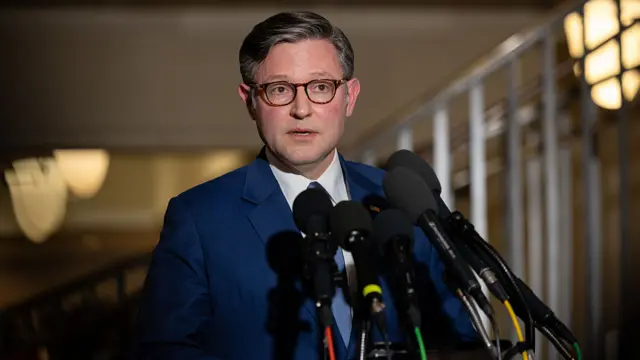
    Mike Johnson speaking in front of microphones. He's wearing a suit and tie and glasses.Image source, Anadolu via Getty Images
    Image caption,

    Speaker of the House Mike Johnson says the US is not occupying Venezuela

    US President Donald Trump

    Venezuela opposition leader María Corina Machado

    • Speaking to Fox News, Machado said she was "grateful" for Trump's actions
    • Machado said she wants to go back to Venezuela "as soon as possible," after being in hiding for months
    • She added that interim president Delcy Rodríguez "can’t be trusted"

    US House of Representatives Speaker Mike Johnson

    • Speaking to the media after a meeting at the US Capitol, Johnson said the US is not at war: "We do not have US armed forces in Venezuela, and we are not occupying that country"
    • He also stressed: "This is not a regime change", explaining that the move is instead a "demand for change of behaviour by a regime"
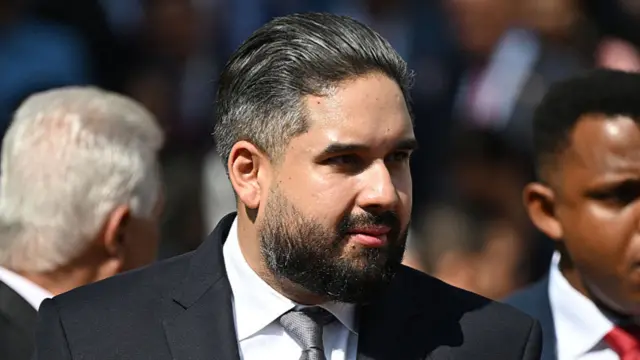
    Nicolás Maduro Guerra wearing a suit and tie, stood outside and looking away from the cameraImage source, AFP via Getty Images
    Image caption,

    Nicolás Maduro Guerra spoke for the first time after his parents were taken into custody

    US House minority leader Hakeem Jeffries

    Venezuelan congressman Nicolás Maduro Guerra, Maduro's son

  19. Venezuelan opposition calls for release of all political prisonerspublished at 12:18 GMT 6 January

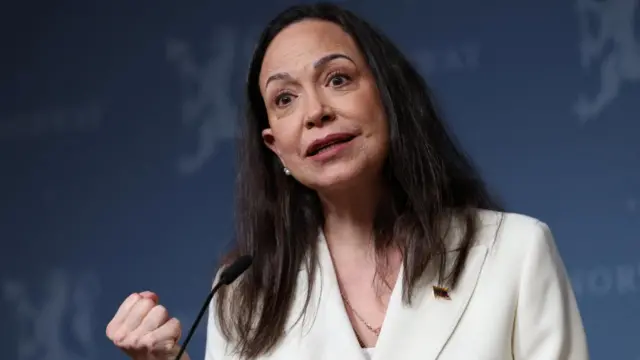
    Machado wearing a white jacket and speaking at an event.Image source, Reuters

    Opposition leader María Corina Machado's movement has demanded for the release of all political prisoners in a post on X.

    "Those who unjustly hold the civilian and military political prisoners should free them immediately," reads a statement from the Vente Venezuela movement.

    Machado has reposted the statement on X.

  20. 'Military on the streets, some guarding supermarkets' in Guayana Citypublished at 12:03 GMT 6 January

    Ahmed Adan
    BBC World Service

    Angela*, who's in Guayana City, in Bolivar State, Venezuela, says that in the last two days, she saw few people in the streets, and there were no cars.

    “On Saturday, supermarkets were full of people, and there were long lines. But today, the situation is calm, and there are more people in the streets," she tells BBC World Service.

    "You can see some military in the streets, some of them guarding supermarkets, because owners are scared of theft or robbery. And the guards on the streets are preventing riots or violence.”

    She adds that “she, her family and friends are all scared to go out”.

    *Her name has been changed due to a fear of backlash from authorities.