Summary

  • Our coverage on this page has ended. For the latest developments, head to our new live page here.

  • Iran's Islamic Revolutionary Guard Corps Navy says the Strait of Hormuz will remain closed from this evening until the US blockade on Iranian ports is lifted

  • It says the continuing US blockade is a "breach of the ceasefire" and warns that ships approaching the vital shipping channel "will be targeted"

  • On Friday, Iran opened the Strait of Hormuz, but Donald Trump said the US naval blockade "will remain in full force until our transaction with Iran is 100% complete" - here's how the situation has evolved

  • Earlier today, Trump told reporters in the Oval Office that Iran's leaders want to close the strait, but the US won't let them "blackmail us"

  • Three ships have reported attacks in the region, the UK Maritime Trade Operations says

  • It's hard to keep up with what's really happening in the Strait of Hormuz, writes our correspondent, and this casts doubt on Trump's claim of an imminent deal

  1. Israeli strikes killed 13 in Tyre, southern Lebanon, just before ceasefirepublished at 11:47 BST 17 April
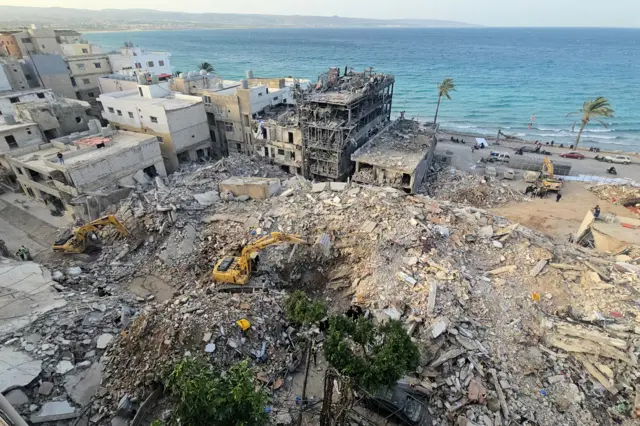
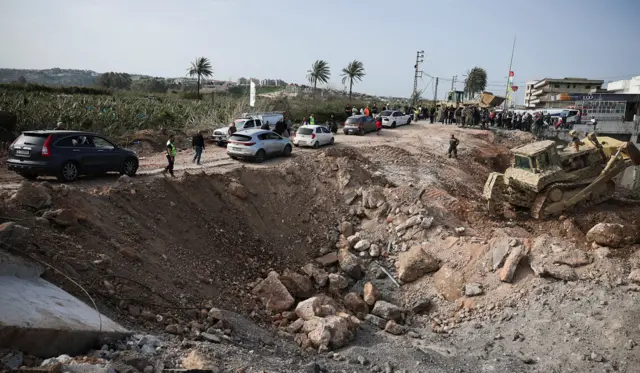
    A crater of rubble is seen from the air with diggers operating next to residential buildings adjacent to the sea in Tyre, LebanonImage source, Kawnat Haju / AFP via Getty Images

    Israeli forces hit the city of Tyre in Lebanon last night, killing 13 people and wounding 35, according to state-run media National News Agency.

    Earlier this morning search teams were still searching for 15 missing people under the rubble, it added.

    The strikes took place just before the 10-day ceasefire with Israel came into effect at midnight last night, AFP said, quoting a city official source.
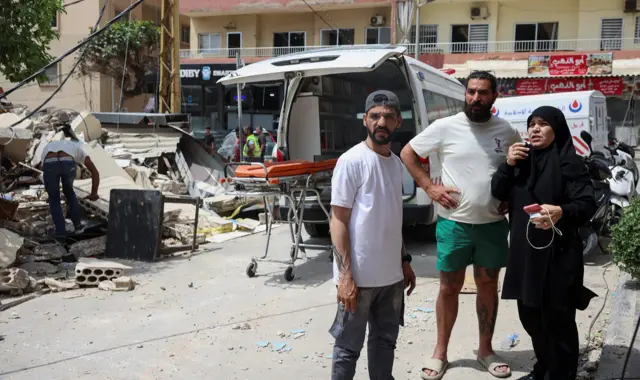
    People stand in front of an ambulance with a stretcher loaded into it next to people clearing rubble in Tyre on Friday.Image source, Louisa Gouliamaki / Reuters

  2. Starmer says he will do all he can to help open the Strait of Hormuzpublished at 11:31 BST 17 April

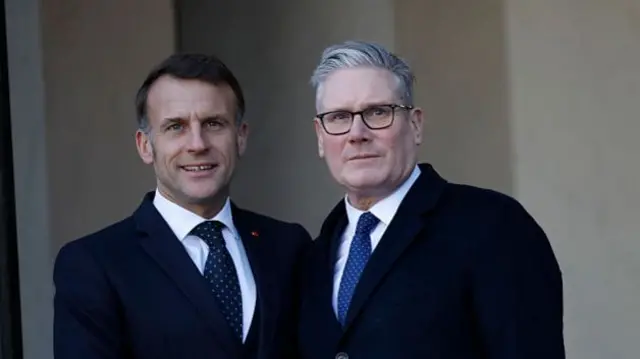
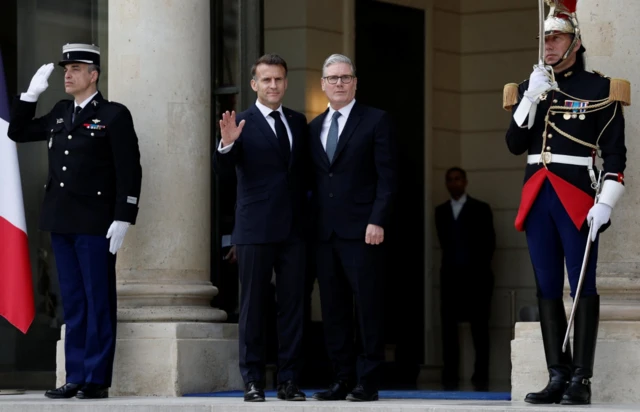
    French President Emmanuel Macron welcomes Britain's Prime Minister Keir Starmer for a lunch meeting at the Elysee PalaceImage source, Reuters

    Keir Starmer has just arrived at the Élysée Palace in Paris, and moments before meeting Emmanuel Macron, Starmer insisted he would “do everything I can” to alleviate the impact of the Iran war on the public and reopen the Strait of Hormuz.

    Starmer said: “It is very important that we build a coalition of countries around the principle that the ceasefire should be permanent, there should be a deal, and that the Strait of Hormuz is open.

    "It is in all of our interests to do that, because what’s happening in the war in Iran is affecting each of our economies. That’s why countries are coming together.

    "Everybody is clear that in order for that to happen, we need a diplomatic and political limb, we need a logistics and economic limb, and we need some military planning, and that is what we’re coming together to do today."

    This afternoon Starmer and Macron are chairing a virtual meeting of around 40 countries, aimed at establishing a multi-lateral mission to restore the safe passage of shipping through the Strait of Hormuz.

  3. Peace in interests of all stakeholders, Middle East expert tells BBCpublished at 11:06 BST 17 April

    Dr Lina Khatib is an associate fellow with the think tank Chatham House - with a focus on the Middle East - and she believes there is a "high likelihood" that this ten-day truce might lead to something more concrete.

    "That is because it is in the interests of all stakeholders to show success," Khatib tells BBC Radio 4's Today programme. "Of course, for the US, President Trump has already given himself credit for the ceasefire. He wants to show that he is ending wars.

    "For Israel, Prime Minister Netanyahu has said the ceasefire does not mean that Israel will withdraw from Lebanon, but he also needs to show results.

    "The same actually applies to Iran and Hezbollah. Iran has already given itself credit for the ceasefire claiming it is a result of its negotiations with the US in Pakistan.

    "So because everyone wants to show success - there is a greater opportunity for the ceasefire to hold."

  4. Watch: 'Unprecedented times' says Lyse Doucet, reporting from Iranpublished at 10:41 BST 17 April

    To think a deal between the US and Iran could be done in days seems hard to imagine, the BBC's chief international correspondent Lyse Doucet reports from Iran.

    Doucet outlines that in Iran, the leadership is still consolidating after so many top officials were assassinated during the war.

    Tehran's leadership is under pressure from hardliners within their own ranks, as well as many Iranians who want crippling sanctions lifted. But despite military and economic losses, Iran is not ready to surrender to what it sees as a deal on Washington's terms.

    Media caption,

    Iran not willing to make a deal on Washington's terms, says BBC's Lyse Doucet

  5. Hezbollah says it is keeping 'finger on trigger' in case of ceasefire violationspublished at 10:07 BST 17 April

    Hezbollah says it is keeping its "finger on the trigger" in case of any "treachery and betrayal" from Israel during the ongoing ceasefire in Lebanon.

    In a statement shared on Telegram, the Iran-backed group described its operations during the conflict thus far, saying that it carried out 2,184 operations against Israel between 2 March and 16 April.

    Hezbollah - which is proscribed a terrorist organisation by countries including the UK and US - was not involved in ceasefire talks, with Israel negotiating with the Lebanese government instead.

    Reacting to news of the truce on Thursday, Hezbollah said "any ceasefire must be comprehensive across all Lebanese territory and must not allow the Israeli enemy any freedom of movement".

    Israel agreed to a temporary ceasefire of 10 days, but Prime Minister Benjamin Netanyahu insisted that Israeli troops would remain in "security zone" in Lebanese territory for the ceasefire's duration.

  6. Northern Israel residents feel betrayed by truce, Israeli media reportspublished at 09:34 BST 17 April

    Yolande Knell
    Middle East correspondent, in Jerusalem

    Many residents of northern Israel have denounced the 10-day ceasefire which is meant to stop fighting with Hezbollah in Lebanon and stop cross-border attacks.

    Local officials say they were caught by surprise.

    “Residents of the north feel they have been betrayed once again,” David Azulay, chair of Metula local council is quoted as saying in the Yedioth Ahronoth newspaper.

    According to the same paper, the head of Mateh Asher regional council, Moshe Davidovich, warns “the price will be paid in blood, in destroyed homes and shattered communities".

    Israeli media point out that it was President Donald Trump who officially declared the ceasefire, while the Israeli PM had not yet finished notifying the security cabinet.

    In his video address on Thursday evening, Benjamin Netanyahu attempted to see off critics, telling Israelis: “We are staying in southern Lebanon within a reinforced security zone.”

    He stressed that Israel had two main goals in talks with Lebanon: disarming Hezbollah and a sustainable peace agreement.

  7. Iran welcomes Lebanon ceasefire, crediting Hezbollah 'resistance'published at 09:13 BST 17 April

    Soroush Negahdari
    Iran specialist, BBC Monitoring

    Iran has welcomed a ceasefire in Lebanon, describing it as both a diplomatic success and the result of Hezbollah’s “resistance”.

    Foreign ministry spokesman Esmail Baqaei said Tehran viewed the truce as part of a broader understanding with the United States, reached through talks mediated by Pakistan. He stressed that Iran had consistently pushed for a wider regional ceasefire.

    Senior officials also credited Hezbollah’s role, with parliament speaker Mohammad Baqer Qalibaf saying in an Arabic post on X that the agreement was “nothing but a result of the steadfastness of Hezbollah and the unity of the Axis of Resistance” – a term Tehran uses for its network of regional allied groups.

    Esmail Qaani, commander of the extraterritorial Quds Force of Iran’s Revolutionary Guards, called Hezbollah the “victor”, insisting that the deal was the result of the steadfast resilience of Lebanon’s resistance and the support of the Islamic Republic of Iran.

    Iranian state media largely echoed the line of senior officials in portraying the Lebanon ceasefire as the result of Hezbollah's "resistance" and Tehran's diplomatic pressure.

    Rolling news channel IRINN said this morning that Iran's and Hezbollah's resistance "forced" the US and Israel "to accept a 10-day ceasefire in Lebanon".

  8. BBC Verify

    Trump claims to have ended 10 wars - what is the evidence of that?published at 08:58 BST 17 April

    By Jake Horton

    When announcing a ceasefire between Israel and Lebanon yesterday, US President Donald Trump said: “It has been my Honor to solve 9 Wars across the World, and this will be my 10th.”

    He’s previously claimed to have ended eight wars and the latest war with Iran, which the US started alongside Israel, would presumably be the ninth. Israel’s campaign in Lebanon against Hezbollah is the tenth he has claimed.

    Although a ceasefire has apparently been agreed relating to Lebanon, and the Iran ceasefire has been in place since 8 April, no permanent peace deals have been made for either conflict.

    The other eight wars Trump claims to have ended, according to the White House, are ones between: Israel and Hamas, Israel and Iran, Pakistan and India, Rwanda and the Democratic Republic of Congo (DRC), Thailand and Cambodia, Armenia and Azerbaijan, Egypt and Ethiopia, and Serbia and Kosovo.

    BBC Verify has looked into this claim before and although it is reasonable for Trump to claim credit for some, such as helping to broker the Israel-Hamas ceasefire in Gaza, a number of the other “wars” lasted just days between countries with long-standing tensions. And in one case, the “war” between Egypt and Ethiopia was a diplomatic dispute over the building of a dam and there was no actual fighting to end.

    There have also been clashes between Rwanda and the DRC after they signed a peace agreement in Washington DC.

  9. Pakistan welcomes ceasefire in Lebanon, praising Trump's 'sagacious' diplomacypublished at 08:44 BST 17 April

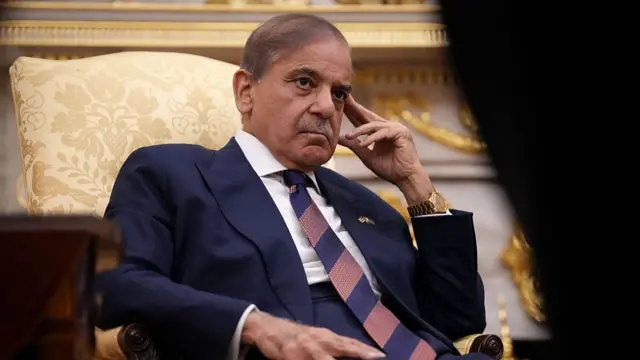
    Prime Minister of Pakistan Shehbaz Sharif looks on as U.S. President Donald Trump speaks to reporters in the Oval Office of the White House on September 25, 2025 in Washington, DCImage source, Getty Images

    Pakistan's Prime Minister Shehbaz Sharif has welcomed news of a 10-day ceasefire between Israel and Lebanon, praising President Donald Trump's "bold and sagacious diplomatic efforts".

    Sharif went on to voice his country's "unwavering support for the sovereignty and territorial integrity of Lebanon".

    Talks between Israel and Lebanon were hosted by the US in Washington this week, marking a historic step towards diplomatic relations between the neighbouring nations.

    It also comes after a collapse in talks between Iran and the US - hosted by Pakistan - last weekend. Islamabad helped negotiate the two-week ceasefire currently in effect between Iran, the US and Israel and there are reports that its army chief met Iranian officials in Tehran on Thursday as part of efforts to extend that agreement.

  10. 'Houses can be rebuilt' - Displaced people in Lebanon tell the BBC about their hopes for the ceasefirepublished at 08:32 BST 17 April

    Carine Torbey
    BBC Arabic correspondent, in Khiam

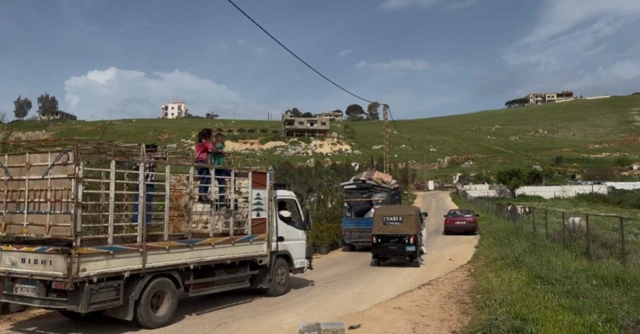
    Loaded trucks make their way along a narrow road with rolling green hills in the backdrop

    On the main entrance to the southern town of Khiam from the Bekaa, vehicles of the Lebanese army block the way.

    Israeli soldiers are still occupying parts of this strategic town and residents are barred from entering it.

    A man in his 70s was standing next to the barrier and tells me his house is just a few metres away - but he cannot get to it.

    “Hopefully soon”, he adds.

    Next, a lady from the town explains she knows her house has been destroyed.

    “It doesn’t matter," she says. "Houses can be rebuilt. And all is worthless compared to a drop of blood of a martyr,” she said in reference to Hezbollah fighters who resisted the Israeli invasion.

    On the road, we saw a loaded truck with the belongings of a family. They are returning to their town in Nabatiyeh.

    “We left it 25 days ago and we are grateful for all those who helped with ending the war."

    I asked whether he thought the ceasefire would last. He replies: "It will - thanks to those who imposed this one.”

    People cross a makeshift bridge in vehicles as crowds gather to oversee repairs to a bridge that was destroyed in an Israeli attack, in southern Lebanon on Friday.Image source, Louisa Gouliamaki / Reuters

    Image caption,

    People have been crossing alongside the bridge in al-Qasmiyeh destroyed by an Israeli attack, which was the last remaining bridge linking southern Lebanon to the rest of the country, as teams work to repair it and residents return home

  11. Macron supports ceasefire, but urges cautionpublished at 08:13 BST 17 April

    French President Emmanuel Macron has thrown his "full support" behind the ten-day truce between Israel and Hezbollah in Lebanon - but has urged some caution.

    "I also express my concern that it may already be undermined by the continuation of military operations," Macron said in a social media post.

    "I call for the safety of civilian populations on both sides of the border between Lebanon and Israel. Hezbollah must renounce its weapons. Israel must respect Lebanese sovereignty and stop the war."

    A reminder, later today in Paris the Keir Starmer and Emmanuel Macron are to chair a virtual meeting of around 40 countries, aimed at establishing a multi-lateral mission to restore the safe passage of shipping through the Strait of Hormuz.

  12. Analysis

    Ceasefire celebrations in Lebanon - but this may be a pause, not the endpublished at 07:58 BST 17 April

    Hugo Bachega
    Middle East correspondent in Beirut

    At the stroke of midnight, gunfire and fireworks in Beirut celebrated the start of the ceasefire.

    In the city of Sidon to the south, smiling crowds gathered as people tried to return home.

    And in the dark, work had already begun to repair the bridges that had been destroyed by Israel in the war.

    In the first hours of the truce, the Lebanese army said Israel had committed some violations, including the shelling of villages.Hezbollah has indicated it will abide by the ceasefire.

    The Lebanese are desperate for some respite. This war has been devastating for this country. More than 2,100 people have been killed, and over a million displaced - roughly one in five of the population.

    But more complex issues remain unsolved. Hezbollah is keeping its weapons, invading Israeli troops remain inside Lebanese territory with no timeline for their withdrawal and, according to the deal, Israel may even continue to attack Lebanon.

    This may be a pause, but not the end.

    Citizens in the city fire bullets into the sky to celebrate the ceasefire agreementImage source, Getty Images
  13. Displaced Lebanese start to return to homes as ceasefire takes holdpublished at 07:38 BST 17 April

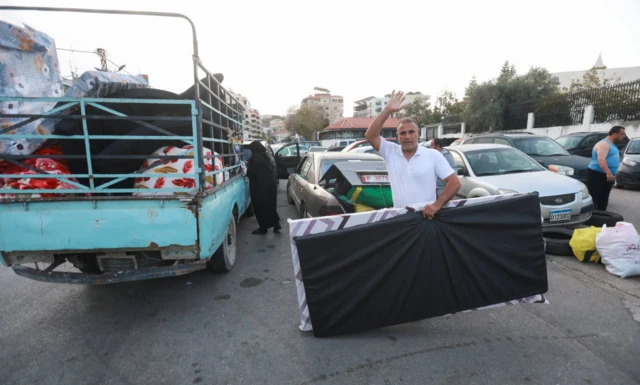
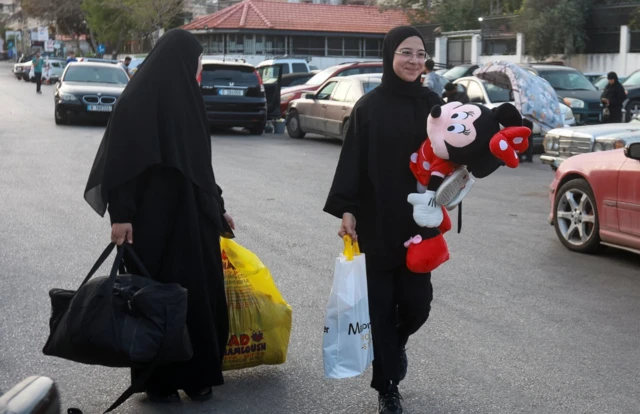
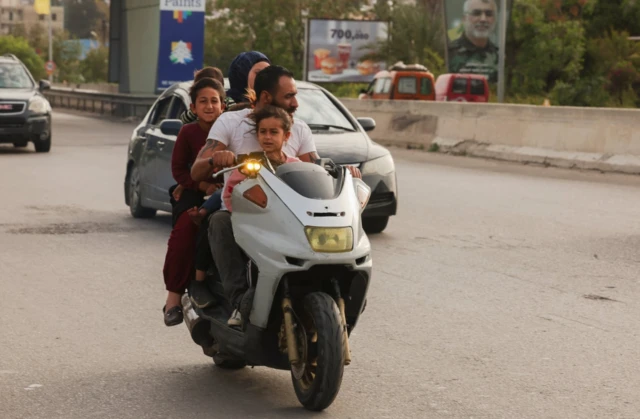
    As the ten-day truce brings a halt to six weeks of fighting between Israel and the Lebanese armed group Hezbollah, displaced people have started to return to their homes.

    Some of the latest images coming to us show scores of people walking along and driving along roads to get back towards Sidon in southern Lebanon.

    Displaced people pack their belongings, as they prepare to return to their homes after a 10-day ceasefire between Lebanon and Israel went into effect, in SidonImage source, Reuters
    Image caption,

    People pack their belongings into vehicles, as they prepare to return to their homes

    One girl clings onto a toy and a bag of belongings as she walks along a roadImage source, Reuters
    Image caption,

    One girl clings onto a toy and a bag of belongings as she walks along a road

    Five people cram onto a motorbike as it zips along a highway towards SidonImage source, Reuters
    Image caption,

    Five people cram onto a motorbike as it zips along a highway towards Sidon

  14. What we know about the ceasefire between Lebanon and Israelpublished at 07:21 BST 17 April

    Israel and Lebanon's leaders have both welcomed the truce, with Netanyahu calling it an "opportunity to make a historic peace agreement".

    The terms of the deal specify that the ceasefire is set to last 10 days, with the possibility of it being "extended by mutual agreement" if negotiations show signs of progress.

    According to further details provided by the US State Department:

    • Israel retains its "right to take all necessary measures in self-defence, at any time, against planned, imminent, or ongoing attacks"
    • Lebanon must take "meaningful steps" to prevent Hezbollah and all other "rogue non-state armed groups" from carrying attacks against Israeli targets
    • Those involved recognise that Lebanon's security forces have exclusive responsibility for Lebanon's security
    • Israel and Lebanon requested that the US continues to facilitate further direct talks with the objective of "resolving all remaining issues"

    The statement added that the truce was a "gesture of goodwill" by Israel intended to enable "good-faith negotiations towards a permanent security and peace agreement" between the two parties.

    Hezbollah have also signalled a willingness to participate in the ceasefire, but said it must include "a comprehensive halt to attacks" across Lebanon and "no freedom of movement for Israeli forces".

    You can read more details about the agreement in our explainer.

  15. Israel-Lebanon ceasefire a step toward peace deal, but fraught with complicationspublished at 06:51 BST 17 April

    Yolande Knell
    Middle East correspondent, in Jerusalem

    Hezbollah continued to fire rockets at northern Israel until just before midnight local time when the ceasefire came into effect. Israeli shelling of Lebanese villages is said to have continued for half an hour afterwards.

    But the hope is that this truce – brokered by Washington – will advance a peace deal between Israel and Lebanon, which have no diplomatic relations.

    President Trump has invited their leaders to the White House for what he described as the “first meaningful talks” between the two countries in over 40 years.

    However, Israel is insisting its forces will not withdraw from southern Lebanon where the Prime Minister said it’s creating what he called a “security zone” six miles from the border.

    Hezbollah has indicated it will stick to the ceasefire – but has also said that Israel’s ongoing occupation grants the Lebanese the right to resist – a position which could cause complications.

  16. Key developments as Trump hails 'historic' truce between Hezbollah and Israelpublished at 06:32 BST 17 April

    If you are just joining our coverage, let's quickly round-up some of the key developments in the last few hours:

    • A ten-day ceasefire has come into effect that could halt six weeks of fighting between Israel and the Lebanese armed group Hezbollah
    • Even as the truce began at midnight local time, Hezbollah continued to fire rockets into northern Israel while Israeli shelling is said to have continued for half an hour afterwards
    • Israel insists its troops will remain in areas they have occupied in southern Lebanon; while Hezbollah believes the deal gives the Lebanese the right to resist
    • Our security correspondent Frank Gardner assess the details of the ceasefire agreement - one, he writes, that is more fragile than the one between the US and Iran
    • Iran welcomed the ten-day truce, but called for a full Israeli withdrawal from Lebanon
    • President Donald Trump has expressed optimism regarding a deal to ending the conflict with Iran, saying negotiations could resume this weekend
    • Later today, around 40 countries are to take part in a meeting, chaired by the UK and France, to discuss joint efforts to restore freedom of navigation in the Strait of Hormuz
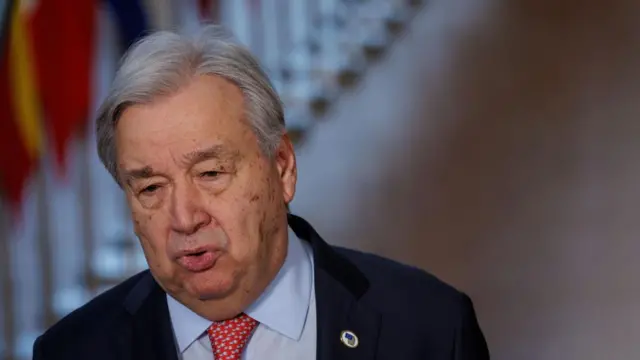
  17. UN Secretary General commends Israel-Lebanon ceasefirepublished at 06:02 BST 17 April

    A close up of António Guterres talkingImage source, EPA

    The United Nations' Secretary General António Guterres says he welcomes the ceasefire between Israel and Lebanon, and thanks the US for helping facilitate it.

    "I hope this will pave the way for negotiations towards a long-term solution to the conflict & contribute to ongoing efforts toward a lasting & comprehensive peace in the region," Guterres says in a statement.

    He also urges all parties to respect the ceasefire and to "comply with international law at all times".

  18. UK, France to chair meeting on Strait of Hormuzpublished at 05:31 BST 17 April

    French President Emmanuel Macron (L) greets British Prime Minister Keir Starmer upon his arrival at the Elysee Palace.Image source, Getty Images

    The UK and France will chair a meeting with allies later today to discuss joint efforts to restore freedom of navigation in the Strait of Hormuz.

    Tehran has effectively closed the critical waterway off Iran's coast in response to US-Israeli strikes, while the US has started its own blockade on Iranian ports, all of which have led to a surge in global energy prices.

    Around 40 countries are expected to join this afternoon's meeting, Keir Starmer's office said, adding that the leaders will "focus on supporting the fragile ceasefire in the region and [in] ensuring shipping routes are reopened and secured through the Strait for the long term".

    Starmer is expected to tell the meeting that "the unconditional and immediate reopening" of the strait "is a global responsibility", Downing Street said.

    They will also discuss the potential deployment of "a strictly defensive multinational military mission, in order to ensure freedom of navigation," according to the invitation sent by the Elysee which was seen by AFP.

  19. Trump optimistic over striking deal with Iranpublished at 05:00 BST 17 April

    Peter Bowes
    North America correspondent

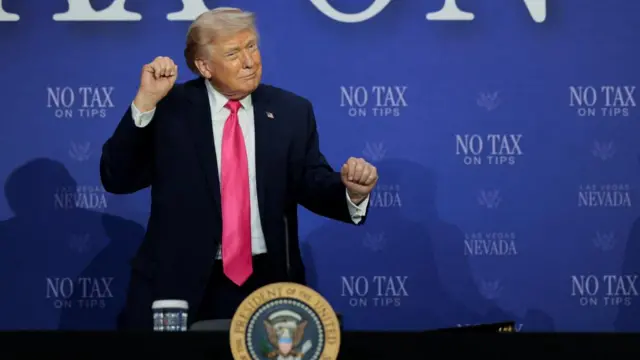
    Trump gestures during a roundtable focused on tax cuts in Las Vegas, NevadaImage source, Reuters

    President Donald Trump says Iran has agreed to hand over its enriched uranium, one of the key sticking points in negotiations to bring the war to an end.

    Fresh talks, he said, could resume as early as this weekend with Washington and Tehran "very close" to making a deal.

    Speaking at an event in Las Vegas, focusing on the US economy, the US president gave one of his most upbeat assessments of the war since it started. He said it was going "swimmingly" and should be ending soon.

    Earlier, at the White House, he said Iran had agreed not to obtain a nuclear weapon and would turn over what he called the "nuclear dust" - enriched uranium believed to be buried underground following the US-Israeli airstrikes last year. Iran has not commented on the president's claim.

    Apparently confident that a fresh round of face-to-face talks is imminent, Trump said he wasn't sure an extension to the ceasefire with Iran, which is due to expire in five days, was necessary.

  20. Israel warns residents to keep out of southern Lebanonpublished at 04:39 BST 17 April

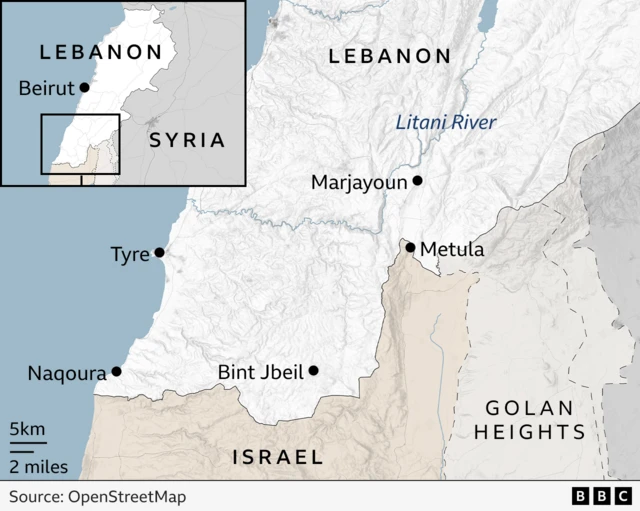
    Map showing Litani River

    The Israeli military has warned residents in Lebanon not to move south of the Litani River as its troops remain deployed there.

    On Thursday, the Lebanese army said the area south of the river, about 40km north of its border with Israel, has been cut off from the rest of the country because of Israeli strikes.

    • For context: Last month, Israeli forces were instructed to destroy crossings over the Litani river that it said were being used by Hezbollah to send reinforcements.