Summary

  1. Will Trump's Iran blockade strategy work?published at 21:42 BST 13 April

    The BBC's diplomatic correspondent James Landale says the US blockade on the Strait of Hormuz may persuade China - which gets a large amount of its oil from Iran - to apply pressure on Tehran to end the war.

    "Iran listens to China," Landale tells the BBC's Global News Podcast.

    "China has an interest in this conflict ending and returning stability to the international market," he explains.

    Will Trump's blockade strategy work? Find out more in this video from the podcast., external

  2. Iran now sees Strait is their leverage, not nuclear, expert sayspublished at 21:30 BST 13 April

    Nada Tawfik
    Reporting from Washington DC

    Experts on US-Iran relations have been sharing their takeaways from the last few days and how this could ultimately end.

    Trita Parsi of the Quincy Institute believes the most likely scenario could be that the two countries do not reach an agreement, but a new status quo is created with the US walking away and Iran charging for passage of the Strait of Hormuz.

    Both sides would in that scenario claim victory. However, he says that wouldn’t be ideal for Iran, which would benefit more from a deal with sanctions relief. Reconstruction, Trita Parsi says, would be impossible without sanctions lifted and the ability to re-establish economic ties with Europe and Asia.

    Robert Malley, who served as US special envoy for Iran from 2021 to 2023, says what’s difficult for Iranian decision makers is how to trust that in any deal, if they give up part of their enriched uranium, that President Trump won’t renege and reimpose sanctions.

    Meanwhile, Narges Bajoghli with Johns Hopkins University says with the US blockade, President Trump has just put himself in a position where he will now take the fall for the rise in prices and shortages. She says Iran now sees the Strait of Hormuz, rather than their nuclear program, as its greatest leverage.

  3. EU still unclear on the nature of Trump's blockade, foreign policy chief tells BBCpublished at 21:18 BST 13 April

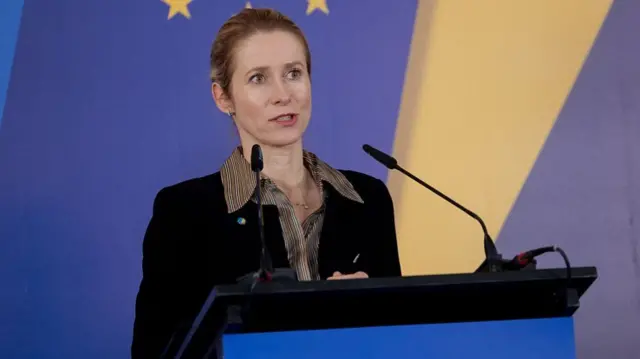
    Kaja Kallas speaks at a podium. She wears a black jacket and striped shirt.Image source, Getty Images

    The European Union does not support any action that curtails free navigation through the Strait of Hormuz, EU Foreign Policy Chief Kaja Kallas told the BBC nearly six hours into a US blockade of Iranian ports.

    Speaking to the BBC's Sumi Somaskanda, Kallas says she's still not sure what the US blockade entails.

    "It's not entirely clear what is the action by the US," she said when asked if she supports Trump's measure.

    She emphasised that the EU does not support any tolls or blocks on a route that has in the past "been open for anybody".

    EU member states will also be willing to aid once there is a cessation of hostilities in the region.

    "It has to be clear there is no danger," she said.

    Echoing calls from other world leaders, Kallas said there needs to be a diplomatic solution to the war - and that "mutual respect" between the countries has to exist to reach a deal.

    She said other countries in the region should be at the negotiating table as "because they know Iran better than anybody".

    Asked whether Trump wants the EU to have a seat at the table, she said: "President Trump has been very clear what he thinks about the European Union, so I guess that's your answer."

  4. Can war be resolved by 'revenge' against global economy? - Iranian spokespersonpublished at 21:04 BST 13 April

    The conflict between the US and Iran has been called an "illegal war of choice" by the spokesperson for the Iranian ministry of foreign affairs.

    Esmaeil Baqaei asks in a post on X whether the conflict could be won through "a revenge of choice against global economy".

    He adds: "Is it ever worthwhile to cut off one’s nose to spite one’s face?"

    His comments come after the beginning of the US imposed naval blockade of ships entering or leaving Iranian ports.

    Donald Trump announced the measure in the early hours of Monday following repeated efforts to negotiate the full reopening the Strait of Hormuz with Iran.

    The announcement and failed peace talks over the weekend preceded European stock markets opening lower on Monday, while oil prices stayed high.

  5. German shipping giant not sending ships to Strait of Hormuzpublished at 20:49 BST 13 April

    Jonathan Josephs
    Business reporter

    The German shipping giant Hapag-Lloyd has told the BBC that they remain unwilling to send their ships through the Strait of Hormuz in light of the US blockade.

    The company still has six ships stuck in the Persian Gulf and says it still lacks information on how the “safe and secure passage of commercial vessels can and will be organized”.

    Concerns around risks from sea mines, Iranian attacks and potential fees remain unaddressed.

    A spokesman for the company reiterated that the highest priority is the safety and security of the crews and vessels rather that navigating the waterway.

  6. Deputy PM tells Vance it's 'vital' shipping flows freely in Strait of Hormuzpublished at 20:31 BST 13 April

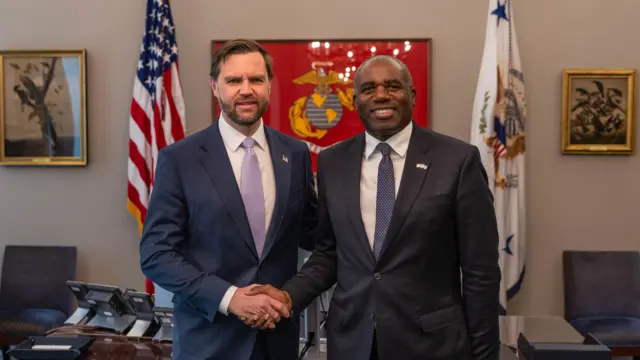
    Lammy and Vance smiling and shaking hands while facing forward. They stand in an office in front of the US flag and a desk behind themImage source, UK Government

    In a meeting today between deputy Prime Minister David Lammy, US vice-President JD Vance and Secretary of State Marco Rubio, the US and UK discussed the developments in the Middle East.

    A statement from Lammy's office says they also discussed security in the Strait of Hormuz, adding that the UK government "is focused on supporting and sustaining the ceasefire and turning it into a lasting agreement".

    "It is vital that shipping flows freely again through the Straits of Hormuz," it adds, stating that Lammy underscored the UK's efforts in achieving this.

    It comes a day after Prime Minister Keir Starmer said the UK will not be involved in enforcing the US military blockade of Iranian ports.

  7. Israeli military reviews incident following reports strike injured Red Cross workerpublished at 20:16 BST 13 April

    In response to reports of a strike on a Lebanese Red Cross centre in southern Lebanon on Monday, the Israel Defense Forces (IDF) says the "incident is under review".

    In a statement, the IDF says it struck a Hezbollah target in the Bint Jbeil area of southern Lebanon on Monday, and reports were received "regarding a Red Cross team injured in the strike".

  8. Hezbollah leader rejects talks between Lebanese government and Israelpublished at 19:50 BST 13 April

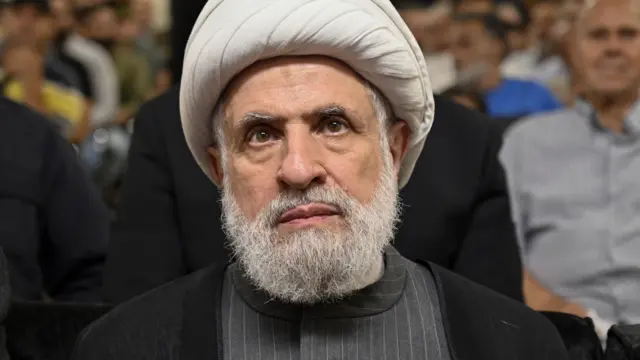
    Sheikh Naim Qassem listens to a speech of then-Hezbollah leader Hassan Nasrallah (not pictured) via a screen at a memorial ceremony for senior Hezbollah commander, in a suburb outside Beirut, Lebanon, 19 June 2024Image source, EPA-EFE/REX/Shutterstock

    Hezbollah's leader Naim Qassem has rejected talks between Israel and the Lebanese government, describing them a "fruitless".

    It comes ahead of Lebanese officials travelling to Washington to negotiate with Israeli and US officials on Tuesday.

    The Lebanese government banned the Iran-backed Hezbollah's military activities in early March, days after the start of war with Israel, with Lebanese President Joseph Aoun criticising the group for dragging the country into the wider regional war.

    In Qassem remarks, reported by the IRGC-affiliated Tasnim news agency, he says "all of Lebanon" is the target for Israel, adding it is the responsibility of the Lebanese government to "mobilise the army".

    He asks the Lebanese government: "You say you want a ceasefire, but what are they saying, and what leverage do you have?"

    "Our decision in the resistance is to neither calm down nor surrender," he says.

  9. Watch: How US blockade of Iranian ports works - and its riskspublished at 19:34 BST 13 April

    Media caption,

    Watch: How US blockade of Iranian ports works - and its risks

    How will US forces be able to block Iran's ports?

    They likely won't take the risk of sending their ships too close to Iran's coastline, BBC's Security Correspondent Frank Gardner says. They'll instead likely use satellite and commercial intelligence to track ships and interdict them.

    But that could pose some problems - including raising oil and gas prices and to the US's allies in the region.

    Take a listen to how Trump's plan might take effect, and what the potential outcomes may be.

  10. New figures suggest Iran shipped almost 60 million barrels of oil last monthpublished at 19:14 BST 13 April

    Dearbail Jordan
    Business reporter

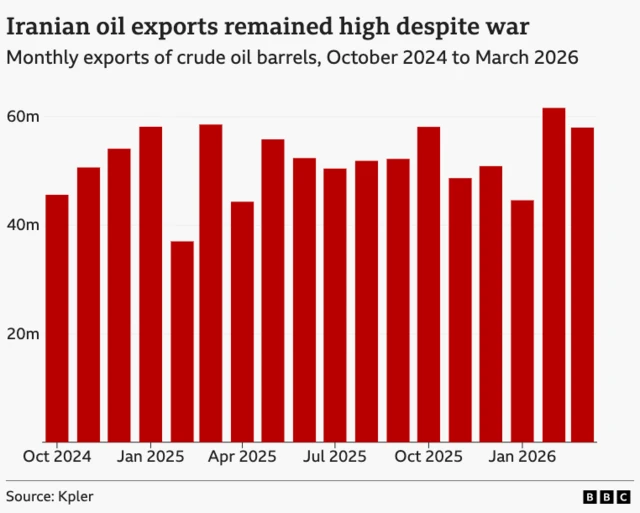
    Graph showing Iran's monthly exports of crude oil barrels since October 2024

    The US-Israel war with Iran began six weeks ago but Tehran had one of its biggest months for oil exports during March. New figures show that Iran exported 57.9 million barrels of last month, according to shipping analysts at Kpler.

    That’s during the same period as the key Strait of Hormuz shipping route was virtually closed to most vessels under the threat of attack by Iran.

    US Central Command now says that it will blockade “the entirety of the Iranian coastline” in the Strait of Hormuz, including its ports and oil terminals.

  11. No country has right to blockade Strait of Hormuz, says UN Maritime chiefpublished at 19:04 BST 13 April

    Oliver Smith
    Business reporter

    The head of the organisation responsible for the safety and security of global shipping has said no country has the legal right to blockade the Strait of Hormuz.

    Arsenio Dominguez, Secretary-General of the International Maritime Organisation (IMO), said whilst the US blockade “appeared to be very specific to accessing Iranian ports”, legally speaking there was no basis for any country to block the waterway.

    “In accordance with International Law, countries don’t have the right to blockade an international strait that is used for international navigation,” he told journalists in a briefing at the IMO headquarters in London this afternoon.

    Mr Dominguez also said that even though very few ships were making it through the Strait before the blockade, the latest ‘blockage’ by the US “doesn’t provide any solutions to the crisis we have”.

    “20,000 seafarers can’t transit. The global economy continues to be affected, and that until the root causes are addressed, we are all still suffering from it,” he said.

    “The additional blockade doesn’t help in finding a solution to the conflict.” He added: “I would ask everyone to play by the rules.”

  12. BBC Verify

    First ship to cross Strait of Hormuz since blockade trackedpublished at 18:50 BST 13 April

    By Thomas Spencer

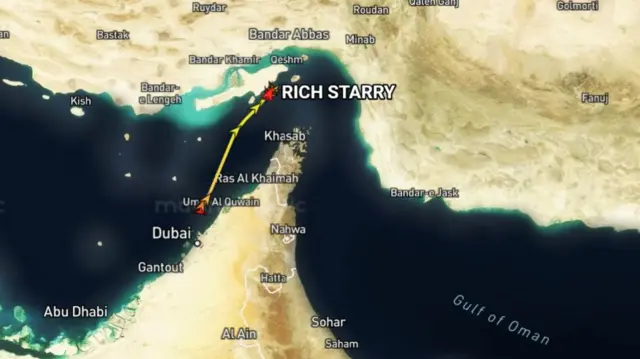
    BBC Verify has identified what appears to be the first ship to transit the Strait of Hormuz since the US imposed a blockade on on Iran-linked tankers and Iranian ports.

    According to ship tracking data provided by MarineTraffic, the container ship Paya Lebar is heading to Dubai in the United Arab Emirates having departed from India.

    Another vessel, the tanker Rich Starry, turned around during its approach the Strait, its tracking data on MarineTraffic shows. It is not clear if the US-sanctioned vessel was attempting to pass through and exit via the Gulf of Oman.

    A screenshot showing the path of Rich Starry, it heads north towards the Iranian side of the Strait of Hormuz then turns back on itselfImage source, MarineTraffic
    Image caption,

    A screenshot showing the path of Rich Starry, which turned around as it approached the Iranian side of the Strait of Hormuz

  13. Maritime expert says 'flurry of ships' passed through Strait of Hormuz over the weekendpublished at 18:44 BST 13 April

    Paul Adams
    Diplomatic correspondent

    Donald Trump’s claim that 34 ships passed through the Strait of Hormuz yesterday echoes what maritime experts are saying.

    Richard Meade, editor-in-chief of Lloyds List, says about 30 traceable ships (meaning vessels with their automatic identification equipment switched on) passed through over the weekend, making it the busiest period for traffic through the Strait since the war with Iran began.

    “It looked like there was a sort of a flurry of ships trying to get out in the wake of the ceasefire,” Meade says.

    But in the wake of Donald Trump’s blockade announcement, observers say they have seen a number of vessels turning around, apparently unwilling to risk being intercepted by the US navy.

    Meade described the current situation as “a kind of Catch-22.”

    “You may be allowed under the US, but you're probably stuck by the Iranians and vice versa.”

  14. A surprise appearance but few answers from Trumppublished at 18:37 BST 13 April

    Bernd Debusmann Jr
    reporting from the White House

    We've just wrapped up a surprise appearance by Donald Trump, who called today's White House press pool to watch a delivery of McDonald's to mark his "no tax on tips" policy.

    Trump answered several questions, in which he sounded optimistic about the prospect of a negotiated settlement with Iran and on the effectiveness of the newly imposed naval blockade.

    His comment that at the moment there is "no fighting" will likely be welcomed by those - including many of his supporters - who have lost the appetite for an extended conflict in the Middle East.

    On talks, which he said he's "sure" will be successful, Trump appears to be opening the door to more negotiations in the hopes that an agreement will be made with Iran.

    So far, however, Iranian officials have publicly decried the administration's demands as "maximalist", and there have so far been no plans for further in-person talks.

  15. The key lines from Trump's news conferencepublished at 18:18 BST 13 April

    Hours after the imposition of US naval blockade on maritime traffic to and from Iranian ports, Trump held an unscheduled news conference outside the White House.

    Iran was one of several topics he covered. Here are the key bits:

    On Iran

    Trump said Iranian leaders want to make a deal, and he had received calls from "the appropriate people" this morning. He said he was "sure" the Iranians would agree.

    He also said the blockade was ordered to stop Iran "blackmailing the world". Other countries would also aid in the blockade, he said, but didn't specify who.

    On the Pope

    Trump refused to apologise for his comments about Pope Leo after earlier today calling the pontiff "very weak on crime and other things". This had come after the Pope criticised Trump's threats against Iran.

    On his deleted social media post

    The president spoke briefly about a now-deleted post on Truth Social, which included an edited picture of him depicted as a Christ-like figure. He says the image was meant to show him as a doctor healing people.

    Media caption,

    Trump on controversial Jesus-like post: 'It's supposed to be me as a doctor'

  16. Trump says timeline to deal with Iran war unchangedpublished at 17:54 BST 13 April

    Trump says his timeline to deal with this conflict has not changed.

    "Right now, there's no fighting," he says. "Right now we have a blockade, they're doing no business," he says, referring to the Iranians.

    "I didn't like seeing boats come out, if they were doing business with Iran," he says, seemingly in reference to vessel traffic in the Strait of Hormuz during the ceasefire.

    The Iranians are currently doing no business in the strait, Trump says, and "we're going to keep it that way, very easily".

    That it appears to be it from the president for now. We'll recap the key lines for you shortly.

  17. Trump refuses to apologise to Pope Leopublished at 17:51 BST 13 April

    Trump says he will not apologise to Pope Leo, after the US president criticised the religious leader earlier today, after the pontiff had himself condemned the president's threats against Iran.

    He says the Pope is "very weak on crime and other things", claiming he is "just responding" to the Pope's criticism.

    He says he has "nothing to apologise for - he's wrong".

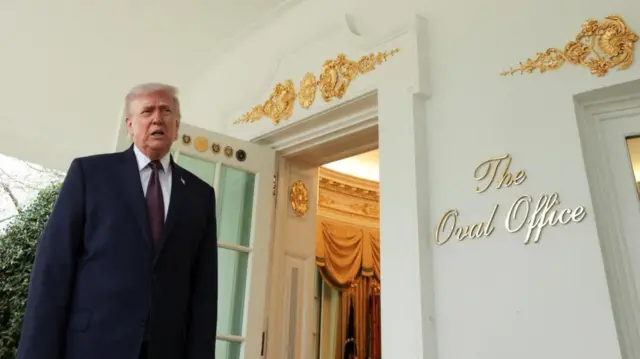
    Trump outside the Oval OfficeImage source, Reuters
  18. President pushed on naval blockadepublished at 17:49 BST 13 April

    Trump is asked about the naval blockade of Iran, which came into force just shy of three hours ago.

    He says Iran is "really blackmailing the world", and he won't let that happen.

    The US doesn't use the Strait of Hormuz, he says, because it has its own oil and gas, adding that ships are heading to the US to "load up" on American oil.

    He adds that Iranian leaders want to make a deal, and says he was called this morning by "by the appropriate people" seeking an agreement.

  19. Iran would like to make a deal very badly - Trumppublished at 17:48 BST 13 April

    Trump is asked about the potential for further talks between the US and Iran, after their delegations failed to reach a deal in Pakistan at the weekend.

    "They'd like to make a deal, very badly."

    "Iran will not have a nuclear weapon," he says - which remains a key sticking point between the two sides.

    "We agreed to a lot of things, but they didn't agree to that."

    But he's "sure" that the Iranians will agree in the end. "If they don't agree, there's no deal," Trump says.

  20. President says deleted post depicted him as 'doctor, not Christ-like figurepublished at 17:46 BST 13 April

    Trump begins with a controversial image he shared on Truth Social earlier today appearing to show him as a Christ-like figure. It has since been deleted.

    He says the image was depicting him as a doctor "making people better", rather than as a Jesus-like figure.

    He accuses the media of having "come up" with that narrative.