Summary

  • US President Donald Trump has urged Iranian anti-government protesters to "keep protesting", saying "help is on its way"

  • We don't know what "help" he is leaning towards, and when that might come, writes our reporter from the White House

  • Trump has recently floated the possibility of intervention in the country - his national security team is expected to meet today to discuss the options

  • Thousands of people are feared dead after a crackdown on weeks of anti-government protests in Iran. Iranians describe terrible levels of death and destruction in their first calls to family abroad in days

  • An Iranian security official tells news agency Reuters that the death toll could be around 2,000 people, including security personnel

  • One protester, Erfan Soltani, will reportedly be "executed tomorrow", with a human rights group saying they "have never witnessed a case move so quickly"

  • While some people in Iran are now able to call people outside the country, an ongoing internet blackout is making it difficult to verify information from inside

Media caption,
Mortuary videos shows violent government crackdown in Iran
  1. 'There's nothing we can do' - money transfer business stops operations in blackoutpublished at 09:52 GMT 12 January

    Ashkan runs a company in the UK which allows individuals and organisations to transfer money between UK and Iranian accounts, and says it has had to stop all operations because of the internet blackout - with him being unable to reach teams based in Iran.

    He's asked us not to name it to avoid putting his clients at risk.

    "Even the internal servers in Iran won't work," Ashkan tells the BBC. "The shutdown is so severe that even the banking system doesn't operate."

    He adds that this service is "essential" for transferring money for personal and humanitarian purposes.

    "Yesterday we had an enquiry from the Red Cross. They were asking us to get cash to their office in Tehran, but there's literally nothing we can do," he says.

    BBC Your Voice banner. Your voice is written in graffitti style writing in white on a red background.
  2. Why it's difficult to report on what's happening in Iranpublished at 09:27 GMT 12 January

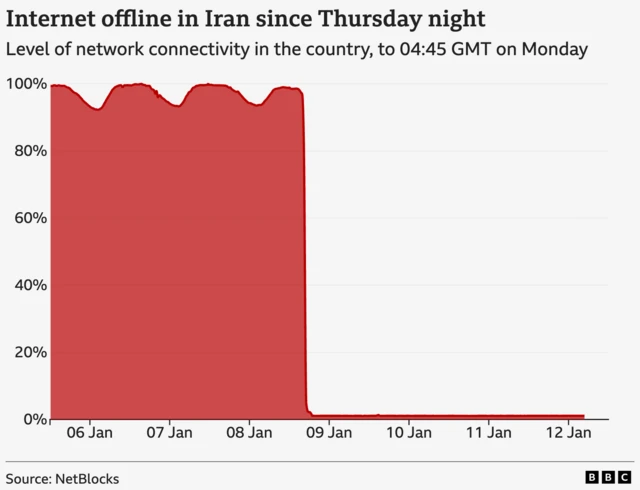
    The internet blackout in Iran has entered its 84th hour, according to internet tracking agency NetBlocks in its latest update at 04:36 GMT this morning.

    According to web security firm Cloudflare, widespread service disruptions have been continuing since Thursday.

    While internet blackouts aren’t unusual in Iran, Amir Rashidi, director of internet security and digital rights at the non-profit Miaan Group, last week told the BBC he has never seen conditions like this.

    One internet researcher, Alireza Manafi, says the only likely way to connect to the outside world was via Starlink satellite, but warned users to be cautious as such connections could potentially be traced by the government.

    The BBC and most other international news organisations are unable to report from inside Iran, and the blackout means gathering accurate, timely information about the unfolding situation in Iran has become difficult.

    A US-based organisation, the Human Rights Activist News Agency, has been providing updates on the death toll of both protesters and security forces, which is says it collects from "various sources" - while BBC Persian has spoken to the families of several people killed.

    A chart showing internet connectivity in Iran since 5 January. The line alternates between around 90% and 100% connectivity until the evening of Thursday 9 January when it suddenly plummets to around 1%, where it still remains. The source of the data is NetBlocks.
  3. Iran will not strike first, but is prepared for war - foreign ministerpublished at 09:10 GMT 12 January

    Soroush Negahdari
    BBC Monitoring

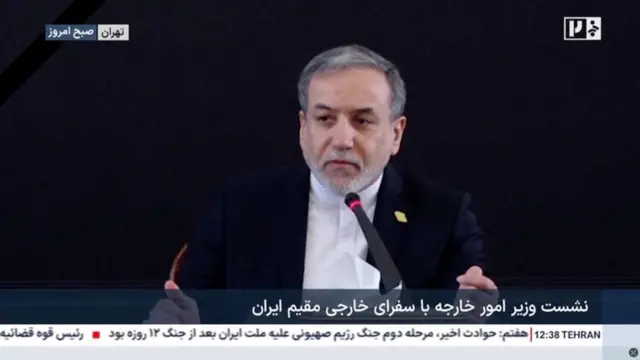
    Scrrengrab from Iranian TV of foreign minister giving speech.Image source, Reuters

    Iran’s foreign minister says Tehran does not plan pre-emptive military action, but is fully prepared for war if attacked.

    Addressing foreign ambassadors in Tehran, Abbas Araghchi says the Islamic Republic “does not seek war”, while warning adversaries against any “miscalculation”.

    He says Iran is “even more prepared” than during its 12-day conflict with Israel in June.

    Araghchi also defends ongoing “restrictions” amid the unrest - an apparent reference to the fourth consecutive day of a total internet shutdown and communications blackout. He says these will continue “until we make sure there are no more threats”.

    The foreign minister says the recent unrest has shifted from protests to what he describes as “terrorist operations”, echoing the official line advanced by Iranian media and the security apparatus last week.

    He adds that Iran remains open to negotiations, but only on what he describes as fair, dignified and equal terms - reiterating Tehran’s stance on talks with Washington since the conflict in June.

  4. Iranian state TV claims counter-protesters condemn 'terrorist' actionspublished at 08:58 GMT 12 January

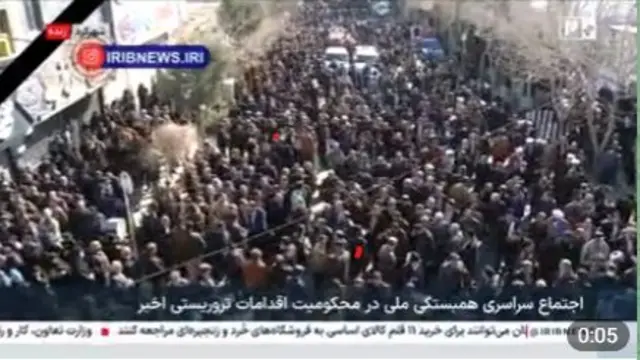
    Iran's state media network, Islamic Republic of Iran Broadcasting, is broadcasting what it says are protests against the actions of the anti-government demonstrations.

    According to IRIB, the pro-government demonstrations are in several locations, including in Ilam, where anti-government protests recently occurred, and Zanjan.

    The footage shows the streets filled with crowds, with one translated post on the network's Telegram channel describing the demonstrators turning out in solidary against recent "terrorist actions".

    We reported earlier today that BBC Persian has seen text messages inviting people to attend pro-establishment rallies held today across country.

    BBC Monitoring last week reported the state broadcaster on Friday intensified its rhetoric against anti-government protesters, whom it earlier referred to as "rioters".

    As a reminder, our teams in London and across the region, including BBC Persian, are working to obtain and verify information from inside Iran, amid an ongoing internet blackout. Earlier we counted 180 white shrouds at a morgue after protests in Tehran.

    Footage showing a street packed with demonstrators.Image source, IRIB
  5. Iranians in UK can't contact relatives as internet blackout continuespublished at 08:37 GMT 12 January

    The BBC has spoken to Iranians in the UK who are unable to contact their relatives due to the ongoing internet blackout.

    One British-born Iranian says he attended protests in London yesterday, as all his extended family live in Iran.

    He's worried about his grandma, who lives on her own. "We're reliant on her surviving on her own, and with care from neighbours," he says.

    Another British-Iranian in Scotland says he's been trying to contact his father, who is based in Iran, but receives an automated message - which he believes the Iranian government is using to screen calls.

    "I imagine that everyone who has relatives in Iran is getting the same message," he tells the BBC. "You can't even verify that your family member is OK."

    Alborz, 19, moved to the UK when he was young. He says he can't talk to his relatives in Iran directly.

    Instead, they've set up "consulates and other private lines" to keep communications open - but believes "this is not the norm for Iranian families."

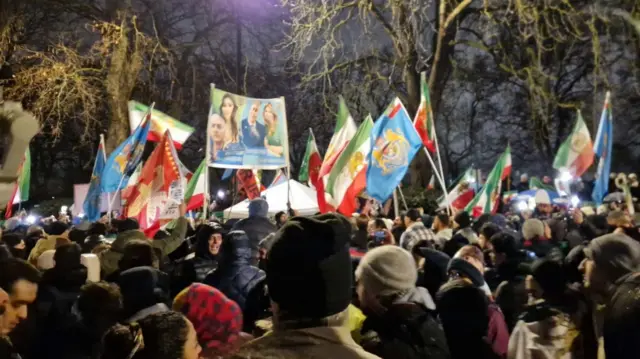
    A protest in Whitehall, central London, on Sunday nightImage source, PA Media
    Image caption,

    A protest in Whitehall, central London, on Sunday night

  6. Iran can't address economic causes of protests - US diplomatpublished at 08:05 GMT 12 January

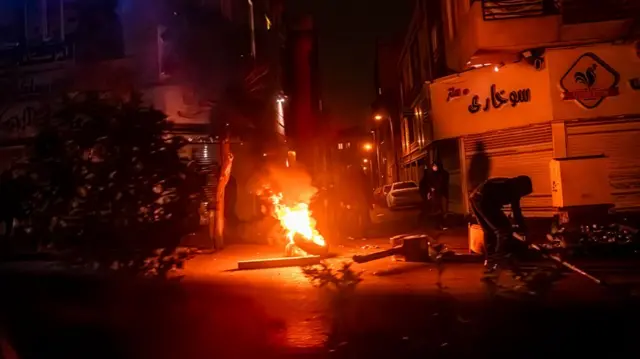
    A protest in Tehran on 9 January. Image shows a a tyre on fire in a street at nightimeImage source, Khoshiran / Middle East Images / AFP via Getty Images)
    Image caption,

    A protest in Tehran on 9 January. The nationwide protests started in Tehran's Grand Bazaar against the failing economic policies in late December

    Iran's government has been "unable to provide the basics of life", says David Satterfield, a former US ambassador in the Middle East, and a former Middle East Envoy to President Joe Biden.

    Those basics are "water, fuel, electricity, and food at rates that is affordable - not just by lower economic classes, but by the upper and upper-middle classes as well," he tells BBC Radio 4's Today programme.

    "The regime doesn't have the resources to address the sources of the protests.

    "If it is about cultural events as in [the protests in] 2022 the regime can - and did - relieve the sanctions on women, the dress codes ease, the covering of hair was no longer enforced by religious police.

    "But if what you are after here is a living wage, a non-depreciating currency, fuel, electricity, water - that is not something the regime can easily pivot to."

  7. Iranian state TV trying to project 'calm' situationpublished at 07:47 GMT 12 January

    Ghoncheh Habibiazad
    Senior reporter, BBC Persian

    It's very difficult to get an accurate picture of what's happening inside Iran right now, but the BBC has received information from sources inside who had been able to connect to the internet momentarily using Elon Musk's satellite internet Starlink and other methods.

    Three sources who the BBC talked to in the capital Tehran said that the crackdown on the protests in the past week has been intense.

    Meanwhile, state TV and other Iranian outlets are trying to project that the situation is "calm" since last night in the capital.

    BBC Persian has seen text messages inviting people to attend pro-establishment rallies held today across country, while some from inside have said that they can't send messages themselves.

    The internet blackout has continued for more than three days, according to internet tracking agency NetBlocks.

    The BBC had been tracking the scale of protests before and after internet shut down, with protests spreading to almost all provinces and at least 70 cities.

  8. US military looking at 'very strong options' in Iran - Trumppublished at 07:23 GMT 12 January

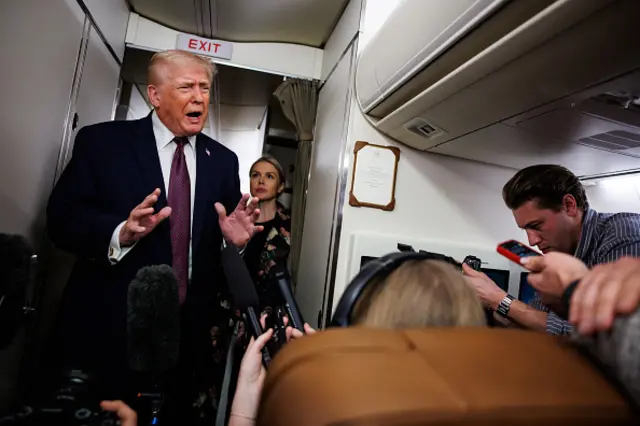
    US President Donald Trump takes questions from the members of the press aboard Air Force OneImage source, Getty Images

    As we mentioned in our opening post, President Donald Trump says Iran's leadership has called to "negotiate" following his threats of military action in response to the killing of protesters.

    The US president spoke to reporters on board Air Force One, saying a meeting was being set up - but added he may have to act before any meeting.

    "They're starting to, it looks like," Trump said, when asked if Iran had crossed his "red line" of protesters being killed.

    "We're looking at it very seriously. The military is looking at it, and we're looking at some very strong options. We'll make a determination."

    Last week, Trump warned Iran that he would intervene if demonstrators were killed.

    "I tell the Iranian leaders: you better not start shooting, because we’ll start shooting, too," he said at a meeting with oil executives in the White House on Friday.

    You can watch Trump's comments in our pinned clip at the top of the page.

  9. BBC counts at least 180 shrouds and body bags at morgue after protestspublished at 07:09 GMT 12 January

    Lyse Doucet
    Chief international correspondent

    In Iran protesting has a cost – and it is measured by the rising number of the dead.

    Videos have emerged of a makeshift open air morgue just outside Tehran where people came searching, in grief, for their loved ones.

    The BBC was able to count at least 180 white shrouds and dark body bags as refrigerated trucks kept pulling up with more.

    The government has also been burying its own – the coffins of security forces and civilians were carried by crowds in what state TV says were at least 10 provinces.

    Iran blames the US and Israel for their deaths. The government has called on Iranians to come out on the streets today to show their support.

    It will also be watching whether its crackdown has given some protesters second thoughts about continuing their action.

    Media caption,

    Video shows rows of body bags as protests continue in Iran

  10. With hundreds of protesters reportedly killed in Iran, Trump considers military optionspublished at 07:04 GMT 12 January

    Protests that began in Tehran over the collapse of the Iranian currency on 28 December, before spreading to towns and cities nationwide, have led to more than 500 deaths, says a US-based observer group.

    The rule of Iran's Supreme Leader, Ayatollah Ali Khamenei, is at stake - with demonstrators angry at crippling price rises, alongside social and political restrictions enforced by the government.

    Now US President Donald Trump has repeated his threats to intervene, saying on Sunday that Iranian officials had called him "to negotiate" - but added "we may have to act before a meeting".

    He has not elaborated on what military options he is considering. He will reportedly be briefed on Tuesday on specific options.

    Iranian leaders have described demonstrators as a "bunch of vandals", and called on their supporters to take part in pro-government marches on Monday. Iran has also warned that both Israeli and US military and shipping centres in the region would become legitimate targets if the US attacked.

    An internet blackout means reporting from Iran is difficult - but our team in London and the region, including the BBC's Persian service, will bring you the latest lines on this page.

    Media caption,

    Watch: Protesters and security forces clash in Iran protests