Summary

  • US President Donald Trump has urged Iranian anti-government protesters to "keep protesting", saying "help is on its way"

  • We don't know what "help" he is leaning towards, and when that might come, writes our reporter from the White House

  • Trump has recently floated the possibility of intervention in the country - his national security team is expected to meet today to discuss the options

  • Thousands of people are feared dead after a crackdown on weeks of anti-government protests in Iran. Iranians describe terrible levels of death and destruction in their first calls to family abroad in days

  • An Iranian security official tells news agency Reuters that the death toll could be around 2,000 people, including security personnel

  • One protester, Erfan Soltani, will reportedly be "executed tomorrow", with a human rights group saying they "have never witnessed a case move so quickly"

  • While some people in Iran are now able to call people outside the country, an ongoing internet blackout is making it difficult to verify information from inside

Media caption,
Mortuary videos shows violent government crackdown in Iran
  1. BBC Verify

    Verified videos show 'rows and rows' of dead bodies in Tehran mortuarypublished at 18:39 GMT 12 January

    By Merlyn Thomas

    Norway-based human rights group Iran Human Rights says nearly 648 protesters have been killed in Iran since protests began. They warn the true figure could be much higher.

    Despite the government imposed internet blackout, several videos - believed to have been filmed on Friday - have emerged showing rows and rows of dead bodies in a mortuary in Tehran.

    What appear to be friends and family members are seen walking through the rows to identify their loved ones.

    We’ve blurred images from these videos because they’re too graphic to show, but by using the footage we’ve been able to count at least 180 bodies from just one mortuary.
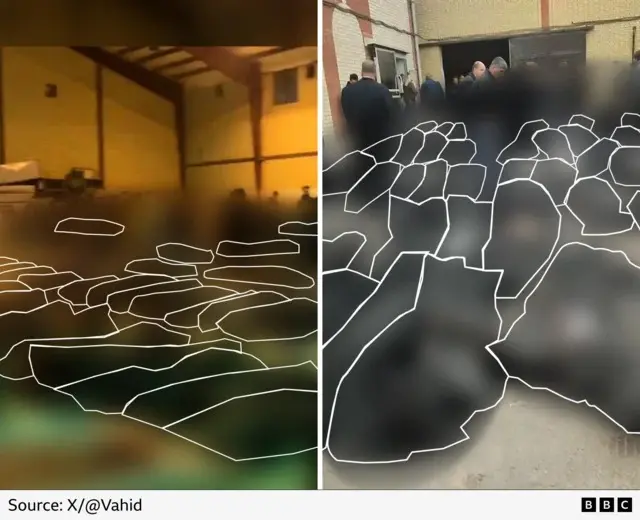

    Two pictures side by side. They are blurred on the floor with white outlines showing where bodies have been laid down.
  2. Analysis

    Khamenei’s message was one of victorypublished at 18:30 GMT 12 January

    Ghoncheh Habibiazad
    Senior reporter, BBC Persian

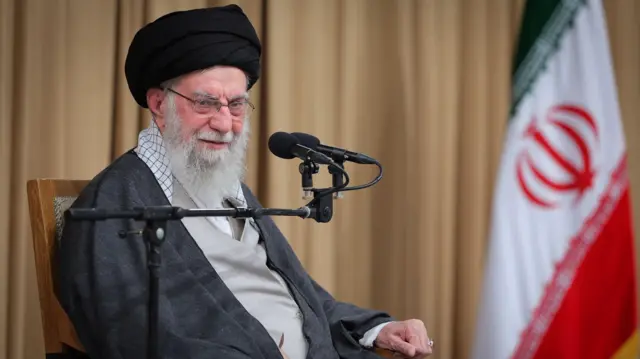
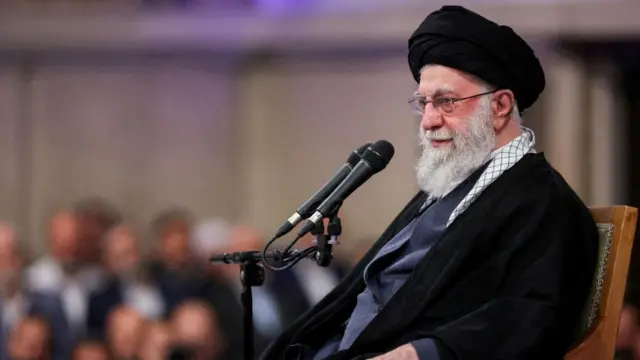
    Khamenei sits in a chair with a microphone in front of himImage source, EPA

    The message from Supreme Leader Ayatollah Ali Khamenei following pro-establishment rallies today pointed the finger directly at “American politicians”.

    He did not mention US President Donald Trump specifically, marking a shift from his speech three days ago in which he said the US president would be “brought down”.

    State media said large crowds gathered in several cities following calls for pro-government demonstrations. BBC Persian has seen text messages inviting people inside the country to attend these demonstrations, while also warning them not to take part in anti-government protests.

    Khamenei’s message was one of victory. He described the day as “historic” and said it had “thwarted the plans of foreign enemies”.

    However, those with limited access to the internet inside the country paint a different picture. They say that some people around them are mourning their loved ones. At least 648 protesters have been killed, according to Norway-based rights group Iran Human Rights.

    Many Iranian websites remain inaccessible from outside Iran.

    Meanwhile, the website of the Iranian Supreme Leader and Telegram channels run by some Iranian outlets are still active, projecting an image of Iran to the outside world that most Iranians themselves cannot access because of internet restrictions.

  3. Iranian foreign minister warns UK 'to avoid interfering in Iran's affairs'published at 18:08 GMT 12 January

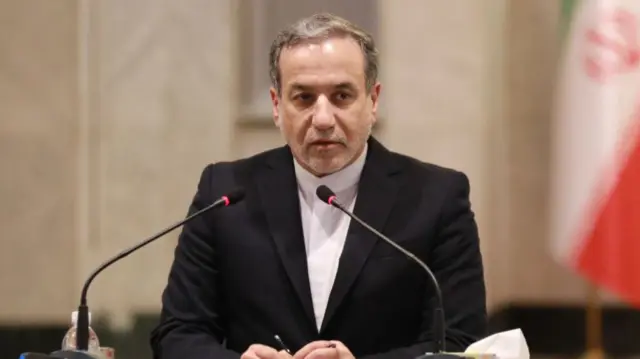
    Seyed Abbas AraghchiImage source, Getty Images

    As we've just reported, UK Foreign Secretary Yvette Cooper told her Iranian counterpart Abbas Aragchi in a phone call to "immediately end the violence" against protesters.

    In response, Aragchi says he has warned the UK to "avoid interfering in Iran's internal affairs", following his call with Cooper this evening.

    During the call, the Iranian foreign minister says he also urged Cooper to protect members of Iran's embassy in London.

    If the UK cannot do this, he warns, "Iran would be left with no choice but to consider evacuating our personnel".

  4. UK foreign secretary tells Iranian counterpart to end violence against protesterspublished at 17:56 GMT 12 January

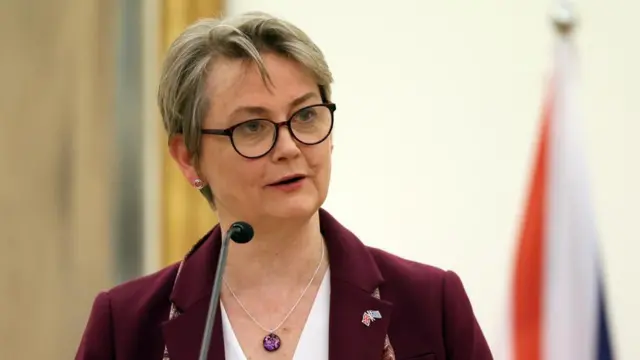
    Yvette Cooper.Image source, EPA

    We've just heard from UK Foreign Secretary Yvette Cooper, who says she has told her Iranian counterpart, Abbas Araghchi, that his government must end its violence against protesters.

    In a post on X, she says: "The killing & brutal repression of peaceful protesters in Iran is horrific.

    "I have spoken to Foreign Minister Araghchi and told him directly: the Iranian government must immediately end the violence, uphold fundamental rights and freedoms, and ensure British nationals are safe."

  5. Analysis

    Trump must decide whether to follow through on his threatpublished at 17:40 GMT 12 January

    Paul Adams
    Diplomatic correspondent

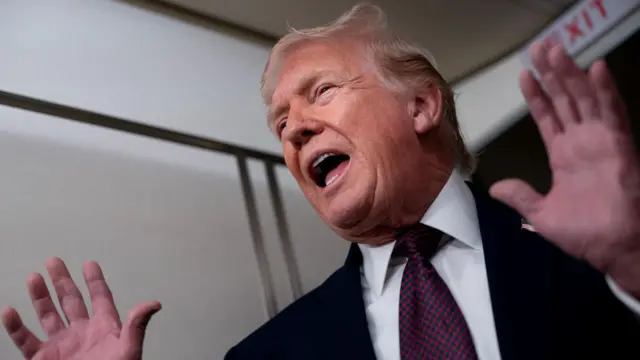
    Donald Trump holds his hands up in a close-up photoImage source, Reuters

    Donald Trump faces a dilemma in Iran - act decisively and risk triggering unforeseen domestic and regional consequences, or stand by while Iranian protesters are gunned down and risk losing face.

    It’s been ten days since he warned that the US was “locked and loaded and ready to go”, telling Iranian protesters the United States would “come to their rescue” if the Iranian authorities reacted with violence.

    At the time, there was little sign of a widespread, violent crackdown from Iranian security forces. That has clearly changed.

    So the president must now decide whether to follow through on his threat, and how.

    That will be the focus of a meeting with top military and security officials, scheduled to take place tomorrow.

    The president has given few clues as to the nature of his response, except to tell reporters that he’s “looking at some very strong options".

    But he’s also hinted that regime change is on his mind.

    “Iran is looking at FREEDOM, perhaps like never before,” he posted on social media on Saturday. “The USA stands ready to help!!!”

    But he says the Iranian authorities reached out over the weekend, wanting to negotiate - Trump didn’t say what about.

    The president said the two sides were working on arranging a meeting - but wanting to maintain pressure and an aura of unpredictability, Trump said he might be compelled to act first.

  6. Iran's supreme leader issues warning to US politicans to 'end deceit'published at 17:28 GMT 12 January
    Breaking

    Iran's Supreme Leader Ayatollah Ali Khamenei says today's pro-government rallies "came as a warning to American politicans to end their deceit".

    Khamenei says it has been a "historic day" as he adds that these "vast gatherings filled with firm resolve thwarted the plans of foreign enemies that were meant to be carried out by domestic mercenaries".

    He adds that the "Iranian nation is a powerful one, is aware and knows its enemies and is present in every scene".

    Iran's Supreme Leader Ayatollah Ali Khamenei sitting behind a microphone as he speaks during a meeting in TehranImage source, West Asia News Agency via Reuters
  7. Hundreds killed in Iran protest crackdown as US considers 'very strong options' to intervene - a recappublished at 17:16 GMT 12 January

    If you're just joining us, here's the latest developments in Iran:

    • At least 648 protesters have been killed in Iran following a deadly crackdown on anti-government demonstrations, according to a Norway-based human rights group
    • US President Donald Trump has warned the US is considering "very strong options" to intervene as a result. Iran's foreign minister says his country "does not seek war” but is fully prepared for one if attacked
    • A widespread internet blackout is making it difficult to accurately report what’s happening in Iran. Our reporter spoke to someone via the Starlink satellite service who says "the world should know what’s happening to us inside"
    • Protests started over two weeks ago over a worsening economic situation - here's how we got here
    • Among those killed in the protests are 26-year-old football referee Amir Mohammad Koohkan and 23-year-old student Rubina Aminian
  8. At least 648 protesters killed in Iran, says human rights grouppublished at 17:05 GMT 12 January

    At least 648 protesters in Iran have been killed, according to Norway-based human rights group Iran Human Rights (IHRNGO).

    This includes nine people under the age of 18, IHRNGO says.

    It adds that thousands have been injured since protests began on 28 December.

    Yesterday, US-based Human Rights Activist News Agency said 544 people had been killed.

    The BBC and most other international news organisations are unable to report from inside Iran, and the blackout means gathering accurate, timely information about the unfolding situation in Iran has become difficult.

  9. How is Iran shutting off the internet - even Starlink?published at 17:00 GMT 12 January

    Laura Cress
    BBC World Service

    Iran’s national internet blackout is now in its fifth day - with the monitoring organisation NetBlocks posting that connection levels to the outside world remain at 1% of normal levels.

    This isn’t the first digital outage the country has faced, but internet infrastructure experts, including Doug Madory, believe it to be near-unprecedented in its severity and accuracy.

    Madory and some other analysts believe the government has built a kill switch system, able to cut power to most but whitelist it for others.

    This means that while the Iranian public have remained largely without internet, others, like Iran’s supreme leader Ayatollah Ali Khamenei, have still been able to post on X.

    There are also reports the government has deployed "jammers" - reportedly of military grade - to shut down access to Starlink, Elon Musk’s satellite-based service.

    The service was used by protesters during the 2022 Mahsa Amini demonstrations.

    That doesn’t mean Musk’s system, which uses GPS to locate satellites, has suffered a complete loss in the country - shutdowns have been localised - but many areas have still faced near blackouts.

  10. BBC Verify

    What has the UK government said about Iran's IRGC?published at 16:54 GMT 12 January

    By Anthony Reuben

    For context: Demonstrators gathered outside Downing Street yesterday calling for Iran's Islamic Revolutionary Guard Corps (IRGC) to be banned as a terrorist organisation.

    Successive UK governments have been highly critical of the IRGC, with Conservative Foreign Secretary James Cleverly imposing sanctions on the organisation as a whole as well as individuals involved with it in 2022 and 2023.

    But he stopped short of proscribing the IRGC as a terrorist organisation, telling MPs, external at the time it “would mean that we could have no direct diplomatic relations with Iran”.

    The current Labour government commissioned a review from the independent reviewer of terrorism and state threats legislation, Jonathan Hall, which was published last May.

    It recommended the government should create a new terrorist designation that is more suited to state actors such as the IRGC.

    The government has said, external it is “committed to taking forward his proposals as soon as parliamentary time allows”.

    Business Secretary Peter Kyle has said that legislation is needed because the law does not currently allow the IRGC to be proscribed.

  11. How did Iran's collapsing currency spark protests?published at 16:45 GMT 12 January

    Sarah Jalali and Ghoncheh Habibiazad
    BBC Monitoring and BBC Persian

    Iran’s economic issues mainly stem from a combination of Western sanctions as well as domestic corruption and mismanagement by the authorities.

    Iran has seen fluctuations in its currency.

    On 28 December, when the protests started, the Iranian rial hit a record low of 1.45 million to the US dollar.

    This led to the shopkeeper protests on the same day. Protesters demanded that the government stabilise exchange rates, whose unpredictable fluctuations have brought trade to a standstill.

    The protests continued, despite efforts by President Massoud Pezeshkian, who said on 31 December that he would amend his budget, which had previously focused on more public spending.

    By 1 January, President Pezeshkian called for the formal end of Iran’s controversial multi-rate currency system, whereby Iran had a preferential exchange rate for state bodies and importers, who would now be required to source foreign currency at free-market rates, in order to curb “corruption and rent-seeking” enabled by exchange-rate disparities.

    By 3 January the government announced plans for an “economic relief package” of cash handouts to provide citizens with a monthly payment equivalent to around £5 for four months.

    With the internet outage and the lack of access, it is difficult to assess the current state of Iran’s economy.

  12. Who is Reza Pahlavi, and could he take over Iran?published at 16:39 GMT 12 January

    BBC's Diplomatic Correspondent Caroline Hawley says what could happen following a regime fall has been in many people's minds.

    The key problem in Iran is that because of the political repression in the country, there is no formal opposition.

    A new plea in protests is a call for the restoration of the monarchy and the return of Reza Pahlavi, exiled son of the late Shah of Iran.

    He is a controversial and unpopular figure with many Iranians.

    Pahlavi himself has called for people to take to the streets - and they did. He has since outlined a 100-day plan for an interim administration.

    Pahlavi insists this new confidence stems from lessons learned in exile and from what he calls the "unfinished mission" his father left behind.

    Red background with white text on it saying 'your voice'.
  13. Could US intervention in Iran move at remarkable speed?published at 16:06 GMT 12 January

    It is put to diplomatic correspondent Paul Adams that, going by recent actions by the US, that any intervention in Iran could move "at remarkable speed".

    Adams answers that this is an administration that is "buoyed up" by recent successes, with Trump speaking of the US's "unrivalled military prowess".

    However, he says Trump has also recently referred to the US's ill-fated 1980 military operation Eagle Claw, in which the US attempted to rescue American diplomats held in Tehran after the Iranian revolution.

    "That operation ended in disaster as helicopters collided in the Iranian desert. That is a spectre which still hangs over America when it comes to dealing with Iran," he says.

    "It will be something this president is aware of, and will be one of many reasons why he will be thinking hard."

    Your voice banner
  14. What weapons does Iran have left in its arsenal?published at 16:02 GMT 12 January

    Paul Adams is next asked what kind of weapons arsenal Iran is likely to have left following conflicts in 2025, including US strikes.

    Adams says that the intelligence assessments since then indicate that the damage done to Iran was "very significant, but not necessarily terminal".

    He says Iran's nuclear programme and "entire military structure" is "quite diffuse", with elements of it remaining very well protected.

    However, he says Iran remains "in a very weak position", and while the US does not have "huge" military resources in the region, "it has enough".

    "We know it can do things at a distance to deliver more blows... certainly the ability to destroy barracks [and] launch symbolic attacks that could kill or target elements of the Iranian leadership," he adds.

    Your voice banner
  15. Is Trump seeing this as an opportunity to topple Iran's regime?published at 16:00 GMT 12 January

    Back to diplomatic correspondent Paul Adams now, who is asked if US President Donald Trump is seeing this as an opportunity to topple Iran's regime?

    Trump's main worries have been Iran's nuclear ambitions and to curb Iranian activities in the Middle East, Adams explains.

    Trump has posted on social media over the weekend, writing that the US is "ready to help", and called Iran's leaders "violent".

    The idea of removing leadership is on his mind, Adams says, but he thinks there will be plenty of voices around Trump advising him to be careful if he does go down that route.

    The Trump administration would be careful, because the consequences of regime change would be extremely complex, Adams adds.

    A red banner with the words Your Voice across it in white lettering
  16. How are people using Starlink?published at 15:56 GMT 12 January

    The next question focuses on how people are communicating during the blackout in Iran - we have more on this in our previous post.

    Starlink is one way in which people have been able to bypass the internet shutdown, so how are they using it and what's the risk?

    Siavash Ardalan from BBC Persian explains that some of the messages received from people inside Tehran have come through Starlink.

    However, you have to have a Starlink receptor in order to do that, he explains, and not everyone has one.

    A law passed by the parliament a few months ago does say those using it could face between six months to two years imprisonment, but it depends on what you are using it for.

    If the government links your activity to espionage, or activities that they deem as threatening, then authorities in Tehran may issue the death sentence, Ardalan adds.

    Your voice banner
  17. What is the impact of the internet blackout?published at 15:52 GMT 12 January

    Caroline Hawley is next asked what impact the internet blackout is having on people in Iran.

    She says both the internet blackout, but also the phone lines being cut, have led to people being "terrified" as they are unable to get in touch with loved ones.

    "It is designed to keep Iranians from talking to each other so it makes it harder for them to organise."

    She says she has speaking to a woman over an encrypted app who has now told her to delete their entire conversation.

    "She has never, ever sounded that scared," Hawley adds.

    Your voice banner
  18. How are the protests being portrayed in Iran?published at 15:50 GMT 12 January

    The next question, which goes to BBC Persian journalist Siavash Ardalan, is about how the protests are being portrayed by the Iranian government.

    He says the government had said they recognised the protests on the first day, as they were carried out by shopkeepers.

    But then it "morphed into something bigger" and the turned into being against the system.

    The government's narrative so far has been that it would sit down and talk with what it calls the genuine protesters, Ardalan explains.

    He adds that the regime separated these from what it calls rioters, which they are now calling armed people trained to sow discord in the country.

    The government now says innocent security forces are being killed by the protesters, Ardalan says.

    A red banner graphic that says Your Voice on it in white writing
  19. What is Donald Trump saying and will he intervene?published at 15:45 GMT 12 January

    Paul Adams
    Diplomatic correspondent, reporting from Washington

    The next question is centred on Donald Trump, here's the answer from diplomatic correspondent Paul Adams:

    Before the latest reports of mass casualties emerged US President Donald Trump warned that there could be an American response. This would be dependant on how Iranian authorities responded.

    Trump has spoken about his desire to "rescue protesters," and aboard Air Force One on his way to Washington yesterday he said he was looking at some "very strong options", presumably military options.

    He is expected to receive a briefing on those options tomorrow.

    Trump also told reporters Tehran had reached out to Washington to try and negotiate, although he did not specify what exactly the negotiations would be about.

    He said the two sides were working to arrange a meeting, but, according to Trump, the US may have to act before the meeting takes place.

    So, clearly, that's a strong warning that America might be poised to take action fairly soon.

    Your Voice written in white with a red background
  20. Is this the biggest threat to Iran's Islamic Republic since its inception?published at 15:40 GMT 12 January

    Diplomatic correspondent Caroline Hawley is asked if these protests pose the biggest threat to Iran's Islamic Republic since its inception in 1979.

    She says the regime is facing a "huge threat" and says it clearly feels as if it is "fighting for its life", while using what she has been told is "unprecedented force" to try and control the streets.

    She says there have been many cycles of unrest previously - including in 2009 over disputed elections, in 2019 over fuel prices and in 2022 over women's rights.

    But she says these protests, which began as economic, have "spiralled" to people expressing their anger over "everything they hate about the Islamic republic".

    She says its hard to tell the full picture, due to the internet blackout, and that the Iranian regime is trying to control the narrative, release pictures of their own supporters on the streets.

    Your voice banner