Summary

  1. Starmer: I've made hard-edged decisions on defence spendingpublished at 13:00 BST 12 June
    Breaking

    Keir Starmer says he’s taken "hard-edged decisions" to increase defence spending and feels it is his "duty" to carry on as prime minister.

    Speaking exclusively to BBC political editor Chris Mason, he says he does not want to "plunge" the country into the "chaos" of a leadership election but "if it does happen, I will fight".

    In his first interview since the resignation of his Defence Secretary John Healey over the Defence Investment Plan, he says he has taken "hard-edged" decisions as PM to increase defence spending, citing cuts to overseas aid, and said it will be the "number one priority at every spending review".

    In the next few posts, we'll bring you more from Chris Mason's interview with the PM.

  2. Is defence your priority?published at 12:43 BST 12 June

    That's the question Nicky Campbell asked listeners on Radio 5 Live this morning.

    Robin in Cobham says: "I think it's everybody's [priority] but it's how we go about it". He says it is "unaffordable for us to be a global power" but the UK "can and should be a credible regional power".

    That said, he thinks the threat of "conventional warfare on our shores has never been lower", calling Russia "the second-best army in Eastern Europe, let alone in Europe".

    Annie in Halstead doesn't think the government has done "nearly enough". She says that "career politicians and five-year terms are exacerbating this problem" as long-term vision "isn't baked in".

    Lee in Sheffield says "without defence of the realm, it's pointless talking about education, health [and] benefits".

    And Jill in Norwich references John Healey's comments to Putin in April this year, after Russian submarines carried out covert operations in the Atlantic. "We see you," the former defence secretary said at the time. "It appears that is about all we can do," says Jill.

  3. BBC Verify

    The number of soldiers, ships, and fighter jets has fallenpublished at 12:16 BST 12 June

    By Adam Durbin and Thomas Spencer

    Since the end of the Cold War in 1990, the British Army has gone from having 153,000 regular soldiers to 73,790 today - only just above the 73,000 minimum recommended in last year’s strategic defence review.

    As well as the regular Army there have been reductions across the military over the same period:

    • Army reservists have gone from 76,000 to 25,770
    • The Royal Navy has fallen from 48 major combat ships (13 destroyers, 35 frigates), to 13 (seven frigates and six destroyers)
    • The Royal Air Force has dropped from more than 300 combat jets to 144

    It is important to note, however, that these newer fighter jets - 107 Eurofighter Typhoons and at least 37 F-35 Lightning IIs - are technologically superior to those in use 36 years ago.

    And uncrewed aircraft systems, also known as drones, now form an element of the UK's military air capabilities. These did not exist in 1990.

    Experts say the UK needs to invest considerably more in this military technology. Read more of BBC Verify’s analysis of the state of the UK military here.

  4. It's hard to watch the political dispute on defence, ex-marine sayspublished at 12:06 BST 12 June

    One ex-marine has been speaking to BBC Radio 5 Live and says defence is "one of [his] priorities", adding he feels it's "a complex situation".

    Del, who is based in Bridgend, tells the programme's Nicky Campbell that watching the political dispute around the issue is "difficult for us watching from the sidelines".

    Describing himself as "an apolitical pragmatist", he says he has "massive respect" for John Healey and Al Carns, praising the latter for his military service.

    "They had enough of someone like a pretend chancellor in Rachel Reeves calling the tune to Starmer," he adds.

  5. BBC Verify

    How does defence compare with other government spending?published at 11:49 BST 12 June

    By Anthony Reuben

    BBC Verify has received lots of questions from readers about how spending on defence compares with other areas that the government spends money on.

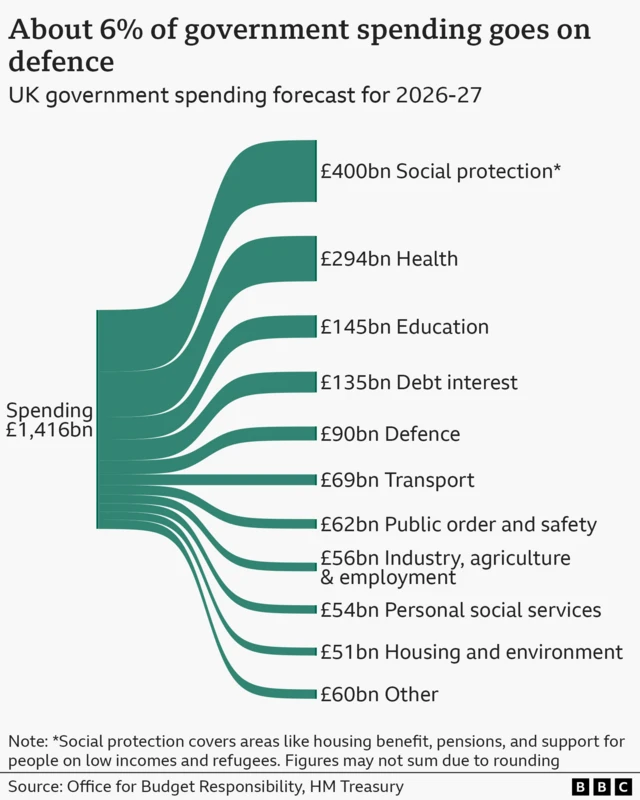
    This chart breaks down what the Treasury is planning to spend in the 12 months from April this year.

    A diagram showing total UK government spending broken down by category, with each category represented by a red flow out of the total. Total spending is forecast to be £1,416 billion in 2026-27. The breakdown is as follows (figures may not sum due to rounding): Social protection £400 billion Health £294 billion Education £145 billion Debt interest £135 billion Defence £90 billion Transport £69 billion Public order and safety £62 billion Industry, agriculture and employment £56 billion Personal social services £54 billion Housing and environment £51 billion Other £60 billion

    The largest category is what the Treasury calls “social protection”, which covers things like the state pension and working-age benefits. More than £150bn of that £400bn is expected to be spent on the state pension.

    If you add health spending on to social protection you have already covered about half of what the government is expected to spend.

    Next comes education at £145bn and then debt interest payments of £135bn on the money the government borrows.

    That is before you reach defence spending at £90bn - which is about 6% of the government’s spending plans.

  6. 'We are at war every day,' former MP who served with Nato sayspublished at 11:33 BST 12 June

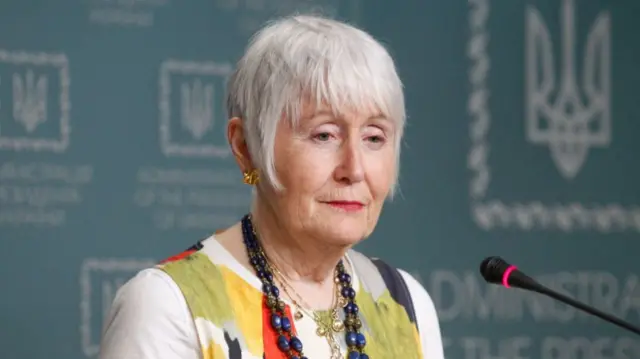
    Madeleine Moon pictured in 2019 during a press conference, wearing a colourful green, red, white and black top with navy blue beaded necklaceImage source, Getty Images

    This morning we've heard from former MP Madeleine Moon, who also served as president of the Nato Parliamentary Assembly, on BBC Radio 5 Live.

    She tells the programme's Nicky Campbell that the UK has been "living a lie" on defence "for a long time".

    Asked whether she can conceive of the UK being at war in the next 10 years, she references cyber attacks and says: "Nicky, we are at war every day."

    She adds: "Defence is not just a case of skies, water and boots on the ground" - she describes it as multi-layered.

    Moon continues by saying defence has been underfunded for a long time and is now "so weak".

  7. Defence of our nation is first duty of government - Dan Jarvispublished at 11:18 BST 12 June
    Breaking

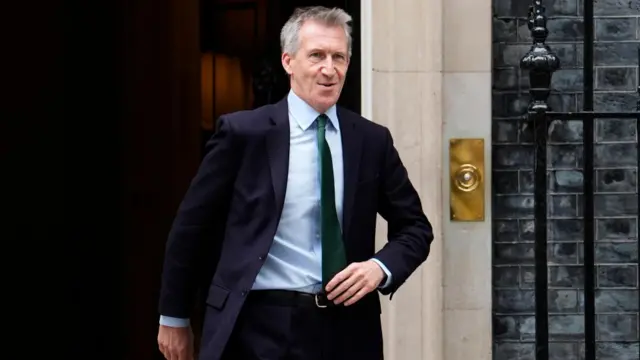
    Newly appointed Defence Secretary Dan Jarvis leaving 10 Downing Street this morningImage source, PA Media

    The newly-appointed Defence Secretary Dan Jarvis has shared his first comments since taking up his new role, calling defence "the first duty of government".

    Writing on X, he says: "Our Armed Forces carry out that duty every day with professionalism, courage, and extraordinary skill. It is a huge honour and a privilege to serve alongside them again."

    Images released earlier showed him meeting with the PM this morning.

  8. BBC Verify

    How much has the UK's defence spending changed?published at 10:59 BST 12 June

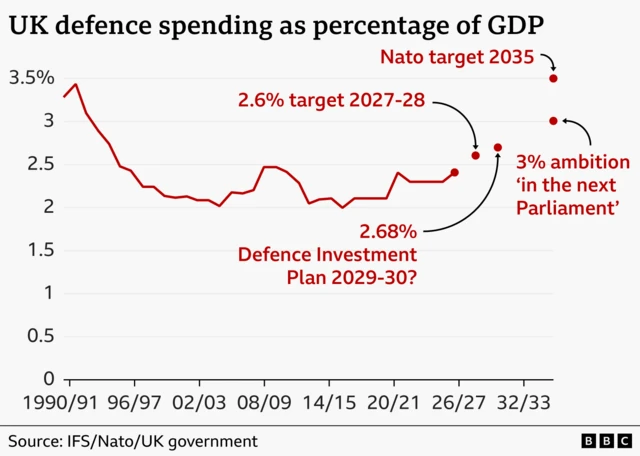
    Graph showing UK defence spending as a percentage of GDP

    By Ben Chu

    On 25 February 2025, Prime Minister Keir Starmer announced that UK defence spending would rise to 2.5% of GDP in 2027, funded by aid spending being cut from 0.5% of GDP to 0.3% in the same year.

    And the government said that, including spending on the UK’s security and intelligence agencies, the overall defence budget would reach 2.6% of GDP by 2027.

    The UK’s estimated Nato-qualifying defence spending - which is the spending that the military alliance counts as meeting its members’ commitments - was 2.3% of GDP in 2024 and 2.4% in 2025.

    In February 2025, Starmer also stated an "ambition" to increase defence spending to 3% of GDP "in the next parliament".

    At a summit in The Hague in June 2025, the UK and other Nato members committed to spending 3.5% of GDP spending on defence by 2035.

    John Healey’s resignation letter suggests the planned defence investment plan intends to increase defence spending in 2030 to 2.68% of GDP.

    That implies an 0.08% increase on the existing 2027 commitment of 2.6% of GDP - around £2.4bn in today’s money.

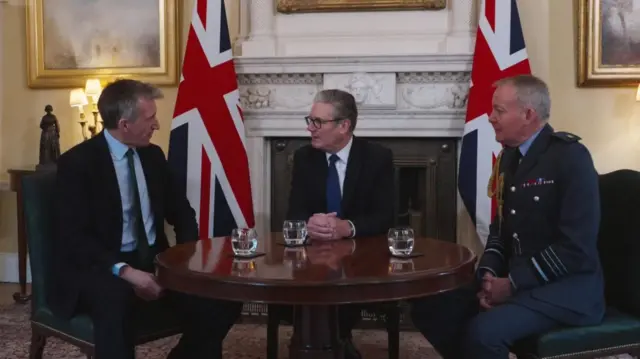
  9. Starmer meets with new defence secretary at Downing Streetpublished at 10:44 BST 12 June

    Dan Jarvis, left, Keir Starmer, centre, and Richard Knighton, right, chat as they sit around a table at Downing StreetImage source, Downing Street

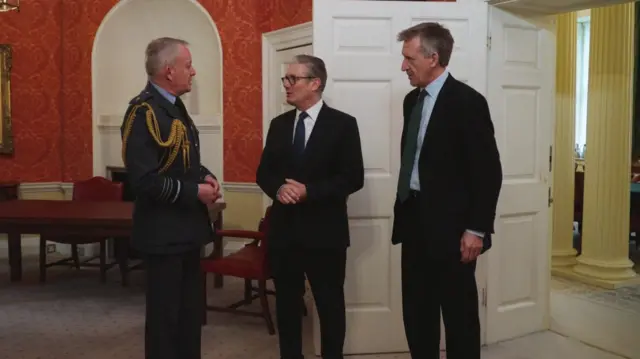
    We can now bring you pictures showing Prime Minister Keir Starmer meeting with his new defence secretary at Downing Street this morning.

    As we've reported, Dan Jarvis replaced John Healey last night, following Healey's resignation amid a government dispute over military spending.

    Also attending the meeting was Chief of Defence Staff Sir Richard Knighton.

    Richard Knighton, left, Keir Starmer, centre, and Dan Jarvis, right, are standing chatting inside a room at Downing StreetImage source, Downing Street
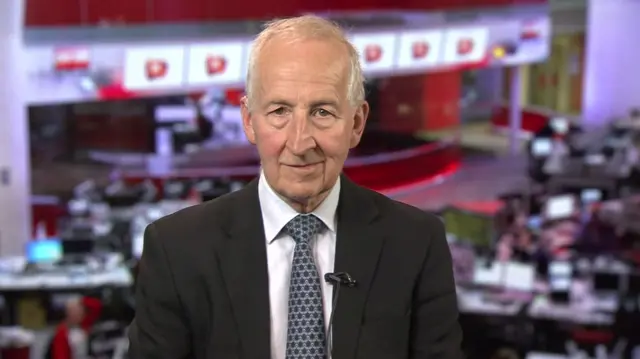
  10. PM has 'not been able to deliver the resources' - former national security advisorpublished at 10:39 BST 12 June

    Lord Peter Ricketts sits in the New Broadcasting House newsroom, facing the camera as he speaks to BBC Breakfast

    Lord Peter Ricketts, who served as national security advisor to former Prime Minister David Cameron, also spoke with BBC Breakfast this morning.

    He says that Dan Jarvis "has a mountain to climb" as the new defence secretary.

    The retired diplomat and life peer, who also served in the Foreign Office under Tony Blair, says John Healey's "devastating resignation letter" quitting as defence secretary made clear that Prime Minister Keir Starmer has "not been able to deliver the resources".

    Lord Ricketts says the dilemma facing Jarvis is - will he accept the settlement, which Healey says might put personnel at risk, or has he extracted more money from the Treasury as the price for becoming defence secretary?

    He says the government needs to lay out a new defence investment plan with "more money", and warns that Britain is no longer seen as a "credible" leader on defence spending in Europe.

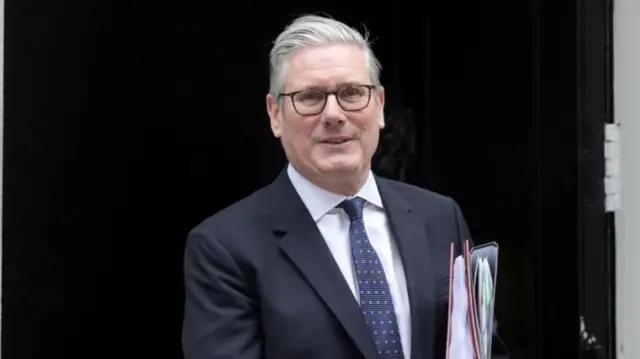
  11. Starmer says he is confident military will have resources to 'keep us safe'published at 10:13 BST 12 June

    Keir Starmer smiles as he steps out of Downing Street holding two foldersImage source, PA Media

    As a reminder, Prime Minister Keir Starmer said last night that he was "proud of our record on funding" in a letter to John Healey following his resignation as defence secretary.

    Starmer also insisted the defence investment plan would "provide the resources our military needs to keep us safe".

    The PM is yet to publicly respond to the resignation of Al Carns as armed forces minister, which came late yesterday evening.

    Meanwhile, a Treasury source says Chancellor Rachel Reeves will do what is "right and needed to keep the country safe".

    They add: "You can see that from her actions – a record uplift in defence spending at the spending review, and then working alongside the PM to deliver billions more to fund the defence investment plan in full."

  12. PM will be rethinking resources for defence investment plan, says Carnspublished at 09:56 BST 12 June

    Al Carns says he is "pretty sure" the prime minister will be rethinking the defence investment plan, following the resignations of Carns and former Defence Secretary John Healey.

    He tells BBC Breakfast that Keir Starmer will be thinking about resources and looking at some innovative ways to raise more money over a period of time to deliver for the armed forces.

    "I can almost guarantee that discussion is going on," he says, although he adds that "whether it changes or not is down to the prime minister".

    Carns says there needs to be a "really honest and frank conversation with the population" about military spending, and then courageous decisions must be made to keep the country and its allies safe.

  13. Military could find itself in difficult position in two to three years - Carnspublished at 09:27 BST 12 June

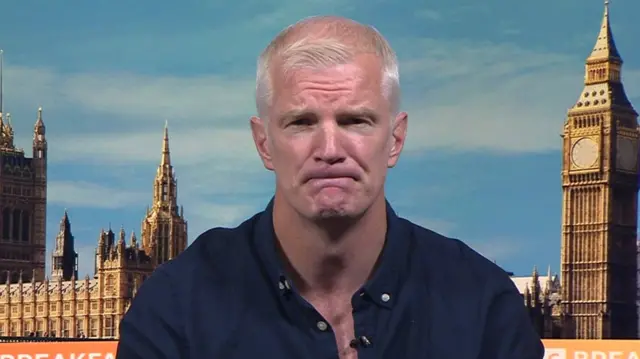
    Al Carns wears a dark blue shirt. He is sat in front of a picture of Westminster with BBC Breakfast branding underneath it

    Al Carns is continuing his morning media round, explaining why he quit yesterday as armed forces minister - he's just been talking to BBC Breakfast.

    He says the military could find itself in a difficult position in "the next two to three years should we be tested".

    "In the next three to five years there will be a geographically constrained contest at some point that will probably involve us, allies or our partners," he says.

    Carns warns the UK could find itself in conflict with an adversary in "some shape or form".

  14. Two more ministers resign in protest - how we got herepublished at 09:16 BST 12 June

    As we've been covering, two government ministers resigned during a chaotic eight-hour period on Thursday.

    John Healey quit as defence secretary, and Al Carns quit as armed forces minister, amid a government dispute over military funding.

    Here's how their resignations unfolded:

    Monday, 8 June

    Healey says he was presented with the government's defence investment plan in full for the first time - it lays out proposed military funding over the next decade.

    Thursday, 11 June

    12:09 (all times in BST) - Healey publicly announces he is stepping down as defence secretary, posting his resignation letter on X. He says he has "no other option" but to resign because funding falls "well short of what is required for defence and the country at this dangerous time".

    13:34 - Carns says there are "issues" facing the defence department "that do not lend themselves to easy answers". He says the world is "getting more dangerous" and his boss, Healey, carried that weight with "discipline and decency".

    At around 14:00 - A government source defends the prime minister, telling the BBC: "This country is safer because of the decisions Keir Starmer has made and we will continue to act in our national interest."

    Just after 18:00 - Starmer defends his funding plans in a letter to Healey, saying his plan will "provide the resources our military needs to keep us safe” and that he was "sorry" to see him go.

    20:18 - Carns announces his resignation as armed forces minister, writing in a letter to Starmer that "it has become clear to me that the change I had pushed for is not going to come", and the UK cannot keep up with the changing “character of conflict”.

    21:03 - Number 10 announces that government minister Dan Jarvis has been appointed to replace Healey as defence secretary.

  15. Business secretary asked: Can PM pass defence plan in current state?published at 09:04 BST 12 June

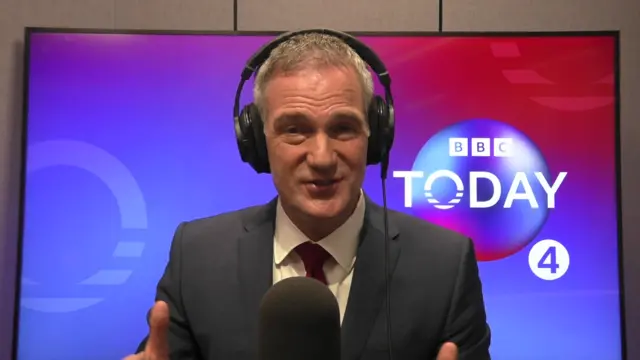
    Business Secretary Peter Kyle speaks to BBC Radio 4's Today programme

    We've just heard from Business Secretary Peter Kyle on BBC Radio 4's Today programme, following his appearance on BBC Breakfast earlier.

    He says the defence investment plan is "not yet entirely finalised" and will be released shortly before the upcoming Nato summit.

    The Today programme's Anna Foster asks: if the plans aren't finalised, does that mean the funding may yet be increased?

    Kyle says they are being finalised, and "the review is coming to its conclusion".

    Foster pushes again, saying Healey resigned because he felt the plans weren't good enough - and that only more money would change that. Is it now impossible for the PM to put the plan through in its current state?

    Kyle says he can't argue about the review before it becomes public, but the government drives "a hard bargain when it comes to financing".

  16. Who is Dan Jarvis, the new defence secretary?published at 08:56 BST 12 June

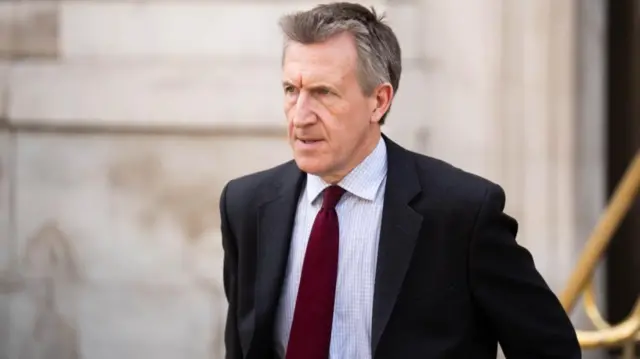
    Dan Jarvis, who has short grey hair, has a serious expression as he leaves the Cabinet Office wearing a grey suit, checked blue and white shirt and dark red tieImage source, PA Media

    Barnsley North MP Dan Jarvis has held a ministerial position in the Home Office - as minister for security - since Starmer named his first cabinet after Labour entered government in 2024.

    His tenure has seen him stand firm against backlash from MPs over the proscription of Palestine Action, and announce a package of measures to tackle espionage threats to the UK.

    He has also held a second junior minister role at the Cabinet Office since September last year.

    Unlike former Defence Secretary John Healey, Jarvis comes from a military background, having been commissioned into the Parachute Regiment and deployed to Kosovo, Northern Ireland, Iraq and Afghanistan, rising to the rank of major.

    Jarvis was awarded an MBE for his service in the British Army in 2011 - the same year he entered parliament as an MP.

    In 2018 he became the first mayor of South Yorkshire, stepping down from the role in 2022.

  17. New Defence Secretary Dan Jarvis arrives at Downing Streetpublished at 08:51 BST 12 June
    Breaking

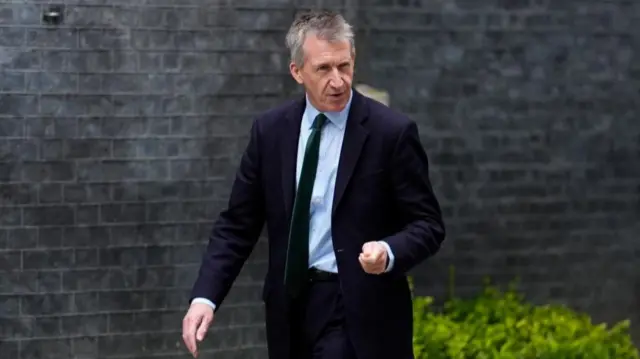
    Dan Jarvis looks towards the camera as he walks pastImage source, PA Media

    We've just got images through of new Defence Secretary Dan Jarvis arriving at Downing Street.

    He was appointed to the role last night following John Healey's resignation.

  18. Army has lost faith in Starmer, says Badenochpublished at 08:47 BST 12 June

    Conservative Party leader Kemi Badenoch delivers a speech in Westminster, against a blue backgroundImage source, PA Media

    Conservative leader Kemi Badenoch says the resignations of John Healey and Al Carns show the Army has "lost all faith" in Keir Starmer.

    In a post on X this morning, Badenoch says Starmer cannot continue as prime minister because he does not "command the respect of our military".

    "Britain's national security must come before Keir Starmer's ego," she adds. "The Prime Minister's time is up."

  19. Carns says service to country comes ahead of ambitionpublished at 08:32 BST 12 June

    Al Carns is asked if he is planning to run to be the next Labour leader.

    He says his whole career has been about service, and if he was ambitious he would not have gone into politics.

    Carns, who is a former marine, adds that he left the military because he wanted to make change.

    The UK, he says, is at a pivotal moment and "we will see what happens in the future".

    His interview with the Today programme has now wrapped up.

  20. Carns reflects on 'argument around welfare'published at 08:26 BST 12 June

    The Today programme's Amol Rajan pushes Al Carns: all policies are trade-offs - did he make constructive suggestions?

    Carns says the government has "got to find more money" and where that comes from is down to the PM. "There is an argument around welfare," he says.

    The former armed forces minister, who quit yesterday, says the government needs to ensure it offers help, but not handouts.

    He criticises collective bureaucracy, saying it is difficult to move things forward at the pace required.

    He says: until we change way we govern, no government is going to deliver the speed of change required needed to "sort the country out".