Summary

  1. Analysis

    Trump at a crossroads as US weighs tough options in Iranpublished at 07:41 GMT 22 March

    Anthony Zurcher
    North America correspondent
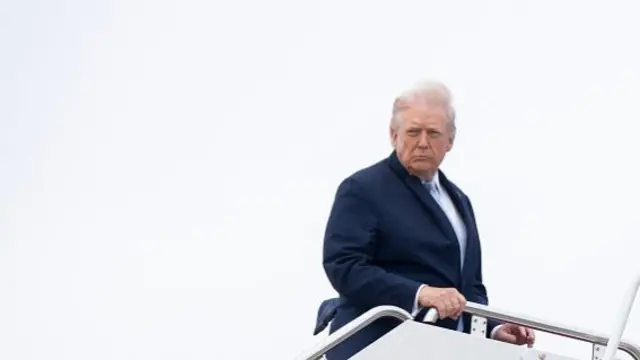
    Donald Trump looks over his shoulder as he boards Air Force OneImage source, Getty Images

    Three weeks after the joint US-Israeli war against Iran began, the conflict has reached a fuzzy state of mixed messages and uncertainty, with Donald Trump's public comments often seemingly contradicted by realities on the ground.

    The war is "very complete, pretty much", President Trump has said, but new American ground forces - including a Marine expeditionary unit - are moving into the region.

    It is "winding down", but US and Israeli bombing and missile strikes on Iranian targets continue unabated.

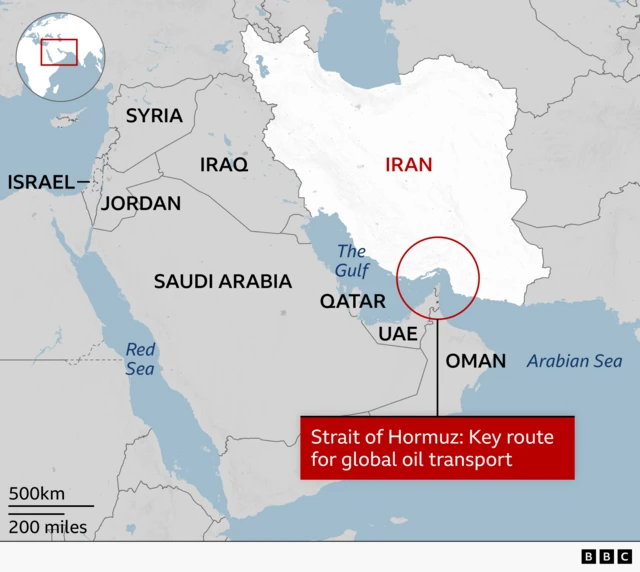
    Opening the Strait of Hormuz, the geographic choke point through which 20% of the world's oil export travels, is a "simple military manoeuvre", but for now only Iranian-approved ships are transiting the waters.

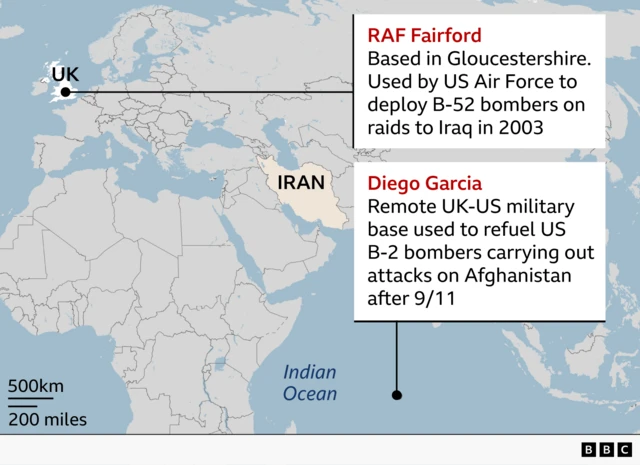
    The Iranian military is "gone", but drones and missiles are still striking targets in the region and targets have extended as far as the joint US-UK base in Diego Garcia.

    In a Saturday evening post on Truth Social, Trump threatened an escalation, warning that if Iran didn't "fully open, without threat" Hormuz in 48 hours, the US military would begin targeting Iranian power plants, "starting with the biggest".

    The day before, however, he had used his social media website to provide a numbered list of American military objectives for the Iran war, which he said the US was "getting really close" to fulfilling.

    The items, comprising his most detailed statement on the subject since the war began, included degrading or destroying Iran's military, its defence infrastructure and its nuclear weapons programme, as well as protecting American allies in the region.

    Not included was the goal of securing the Strait of Hormuz, which Trump said should be the responsibility of other nations that are more dependent on oil exports from the Gulf.

  2. Iran launches new wave of missiles towards Israelpublished at 07:34 GMT 22 March

    Iran has launched a new wave of missiles towards Israel, Iranian state broadcaster Irib.

    Meanwhile, the Israel Defense Forces says that it's working to intercept the threat and a precautionary message has been sent to mobile phones in the relevant areas.

  3. One person killed in northern Israel, emergency services saypublished at 07:28 GMT 22 March

    One person has been killed after a fire engulfed two vehicles in northern Israel, Israeli emergency services say.

    The blaze broke out near northern Galilee, after Israel reported strikes from Lebanon towards the north of the country.

    Israel Defense Forces has said in a post on the Telegram messaging app that "a launch from Lebanon toward a community along the northern border was identified. There is damage and there are wounded".

  4. UAE and Saudi Arabia say they've intercepted attacks this morningpublished at 06:50 GMT 22 March

    Azadeh Moshiri
    South Asia correspondent

    Countries in the Gulf have been responding to multiple attacks, as the war in the Middle East continues to threaten daily life here.

    The United Arab Emirates and Saudi Arabia say they've intercepted attacks this morning, with two missiles falling in an "uninhabited" area, according to Saudi Arabia. People who remain in the region are those who trust the air defence systems.

    The UAE keeps a tight grip on information - filming any attacks or damage is illegal, but it says most attacks have been intercepted.

    As Iran renews its threats to energy infrastructure, leaders here are weighing their options. Saudi Arabia has been the most vocal in its threats to respond militarily. But that carries great risk.

    The war could escalate further and inflict greater damage on their economies. Iran has also threatened desalination facilities, vital to the Middle East’s water security.

    Still, Gulf leaders have said there is room for diplomacy as this war continues to put energy supplies in jeopardy.

  5. Iranian missiles exact new human cost on Israelpublished at 06:30 GMT 22 March

    Sebastian Usher
    Reporting from Arad

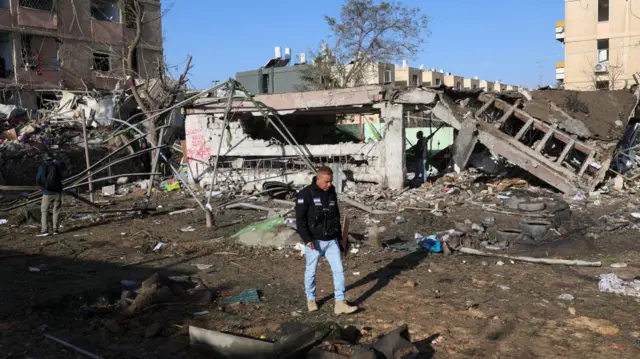
    A man walks near a destroyed building following a night of Iranian missile strikes which injured dozens of Israelis.Image source, Reuters
    Image caption,

    Destruction in Dimona, southern Israel

    Three weeks into the war, Iranian missiles have exacted a new human cost on Israel.

    In the town of Arad, residents say the blasts they heard late on Saturday evening were terrifying. The missile impact badly damaged several buildings, leaving a deep crater. More than 80 people were rushed to hospital.

    Not far away, the town of Dimona had experienced a similar strike from a missile that had evaded Israel's sophisticated air defence system. A number of people were injured there, too.

    The town is near the facility where Israel has for many decades developed its nuclear weapons capability, though it's never been officially acknowledged. Israeli Prime Minister Benjamin Netanyahu called it a "very difficult evening in the battle for our future".

    In his latest comments, President Trump has said that Iran's power plants will be obliterated if the Strait of Hormuz isn't reopened within the next 48 hours. Global energy prices have soared due to the closure of the waterway.

    Tehran has said it will target all American energy infrastructure in the region should the president carry out his threat.

  6. Israel surveys damage morning after Iranian strikespublished at 06:07 GMT 22 March

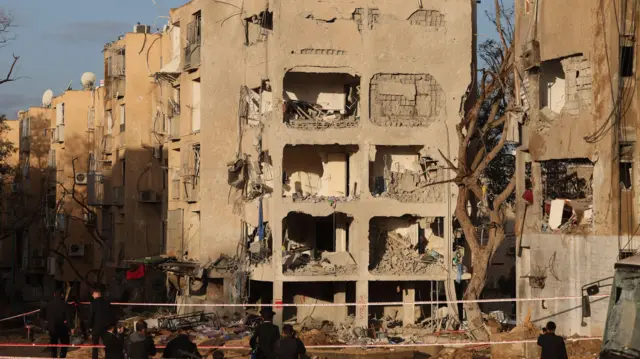
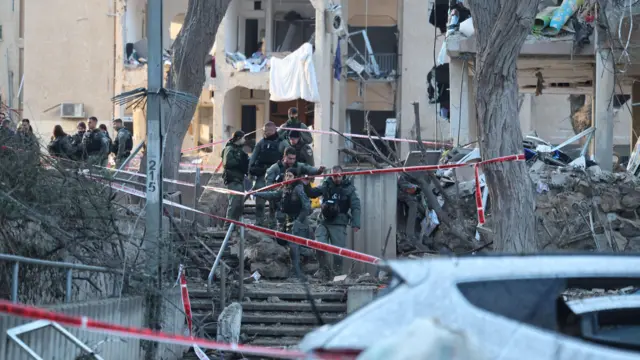
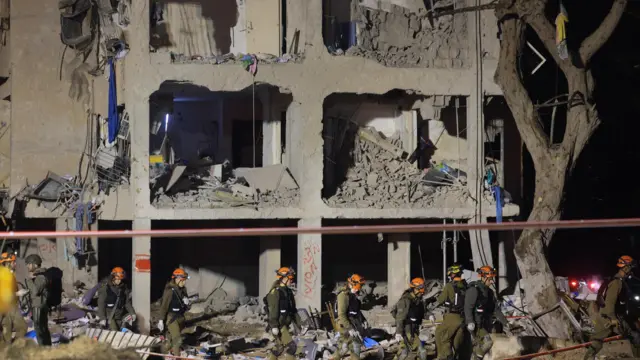
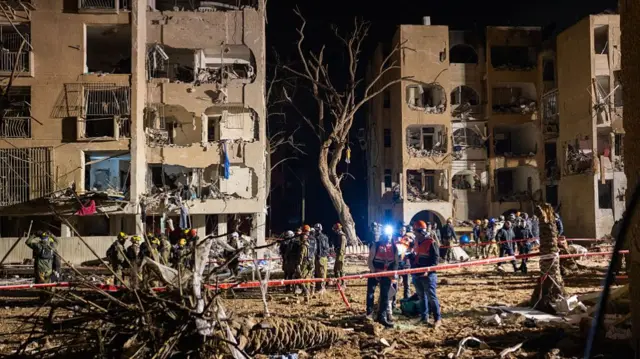
    We're getting photos now of emergency personnel working near the site of destroyed buildings in Arad, southern Israel, which was targeted by Iranian missiles last night.

    At least 88 people were injured in the Iranian attack on Arad, according to Israeli emergency services.

    Security personnel work at the site of damage after Iranian missile barrages struck residential buildingsImage source, Reuters
    People look on at the scene of a direct hit of an Iranian missile in Arad, Israel, 22 March 2026.Image source, EPA
    Security personnel work at the site of damage after Iranian missile barrages struck residential buildingsImage source, EPA
  7. Energy infrastructure considered civilian objects, former ICC chief prosecutor sayspublished at 05:52 GMT 22 March

    Tom Bateman
    US State Department correspondent

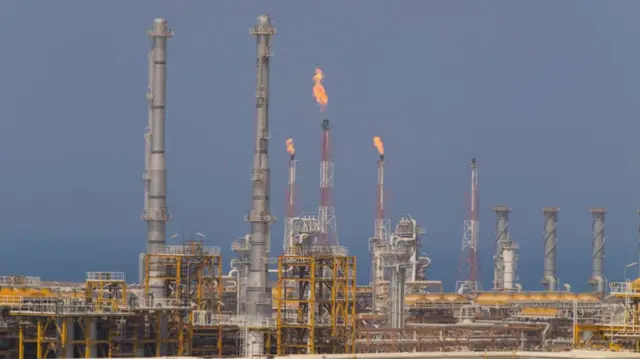
    A view of a part of the phase 19 of the South Pars gas field in Assalooyeh on Iran's Persian Gulf coast 1,400 km (870 miles) south of TehranImage source, Getty Images

    Earlier, I interviewed Luis Moreno Ocampo, the first chief prosecutor at the International Criminal Court (ICC), about the conduct of the countries involved in the war.

    One question I asked him is pertinent given Trump’s threat to destroy Iranian power plants if Iran doesn’t reopen the Strait of Hormuz.

    This isn’t the first threat by Trump to bomb Iran’s energy infrastructure - on Thursday he threatened to “massively blow up” the South Pars gas field. Iran and Israel have both been striking oil or gas facilities in an escalating war on energy sites.

    Ocampo spoke of the precedent prohibiting the targeting of such sites unless they have a clear military purpose.

    He said countries are likely to try to use a variety of claims to try to justify their targeting (for example claims the sites could generate revenue for state or military institutions). But such sites are still considered civilian objects due to their critical importance in providing fuel for heating, cooking and electricity generation.

    Ocampo points to arrest warrants issued by the ICC in 2024 for Russia’s defence minister and military chief for attacks on Ukrainian electricity infrastructure, a frequent tactic by Moscow during its war on Ukraine.

    Neither the US nor Israel nor Iran are members of the ICC.

  8. Destruction in Tehran after more than three weeks of strikespublished at 05:37 GMT 22 March

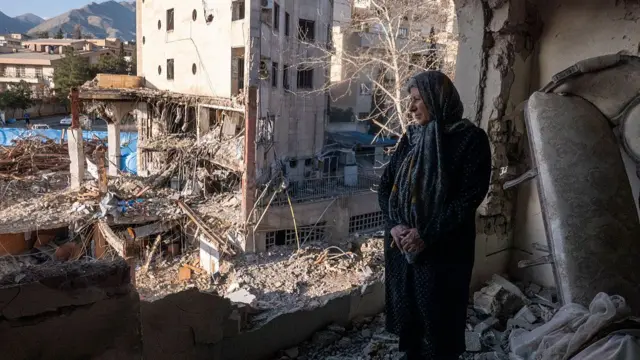
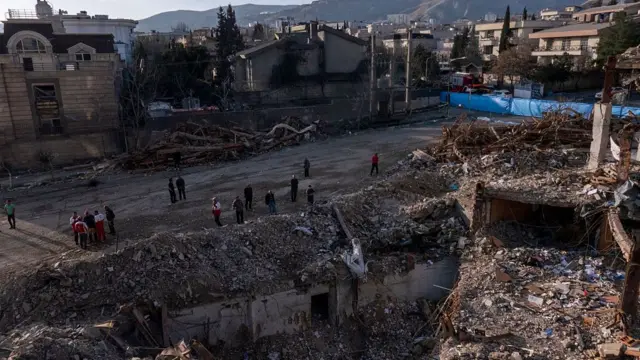
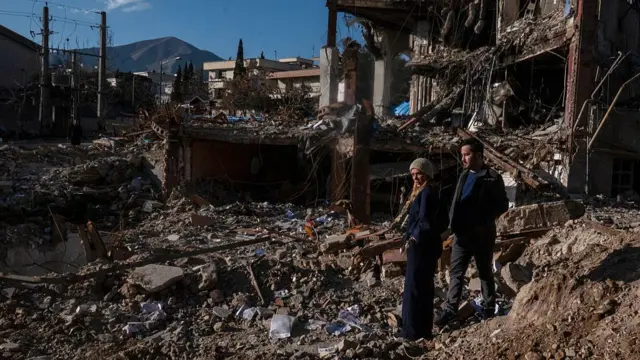
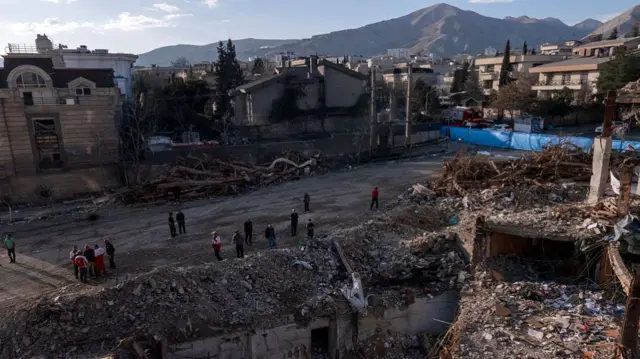
    Pictures taken on Saturday show damage in Shahrak-e Gharb, a neighbourhood in Tehran, after a residential and commercial building was hit by a strike on 16 March.

    The Iranian capital has been battered by strikes since war broke out on 28 February, just over three weeks ago.

    The IDF says it launched a new wave of strikes on the city overnight.

    A woman looks out from her destroyed apartment in the remains of a residential and commercial building in the Shahrak-e Gharb neighbourhood of Tehran, Iran.Image source, Majid Saeedi/Getty Images
    Civilians look upon the remains of a residential and commercial building in the Shahrak-e Gharb neighbourhood of Tehran, Iran.Image source, Majid Saeedi/Getty Images
    Civilians look upon the remains of a residential and commercial building in the Shahrak-e Gharb neighbourhood of Tehran, Iran.Image source, Majid Saeedi/Getty Images
  9. Three ballistic missiles launched towards Riyadh, officials saypublished at 05:16 GMT 22 March

    A short while ago, Saudi Arabia's Ministry of Defense said it had detected three ballistic missiles launched in the direction of Riyadh, the nation's capital.

    A spokesperson for the ministry said that it had intercepted one of those missiles, while the other two fell into an uninhabited area.

  10. Iranian strike hits near Israeli nuclear facilitypublished at 04:53 GMT 22 March

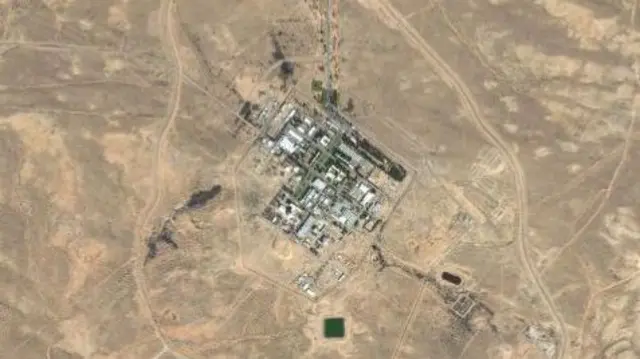
    A satellite image shows a small grid of grey buildings in the desert.Image source, Maxar
    Image caption,

    A satellite image of the Shimon Peres Negev Nuclear Research Facility, taken in 2020

    As a reminder, an Iranian missile strike hit the town of Dimona in southern Israel on Saturday, approximately 13km (8 miles) from a nuclear research facility.

    Though the International Atomic Energy Agency (IAEA) has said it was not aware of any damage to the facility following the attack, the director general has warned that the "maximum military restraint should be observed, in particular in the vicinity of nuclear facilities".

    The Shimon Peres Negev Nuclear Research Center - located in the Negev desert - is often referred to colloquially as the "Dimona reactor". It is long accepted as holding Israel's undeclared arsenal of nuclear weapons.

    Officially, the site is said to focus solely on research. But for around six decades, it has been an open secret that Israel developed a nuclear bomb there, even if each succeeding government has maintained a position of ambiguity over this.

    It has meant that Israel is the only nuclear power in the Middle East. So, any indication that it is being targeted is taken with the utmost seriousness by Israel.

    Iranian state TV said the strike was in response to a reported attack on Iran's Natanz nuclear facility earlier on Saturday.

    Read more about the impact of the strikes on Israel here.

  11. Heavy damage in Israel after Iranian strikespublished at 04:25 GMT 22 March

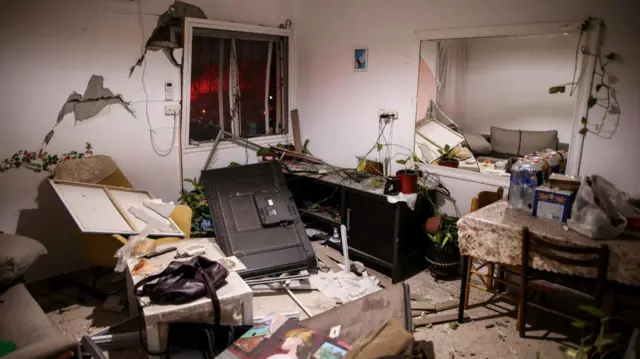
    On Saturday, an Iranian missile struck Arad, a small town in southern Israel, after air defence systems failed to intercept the projectile.

    Emergency services in Israel said 88 people were taken to hospital after the strike, and said 10 of those were seriously injured.

    Dozens more people were injured in the southern Israeli city of Dimona, just 13km from a nuclear facility.

    Israeli Prime Minister Benjamin Netanyahu described it as a "very difficult evening" for the country.

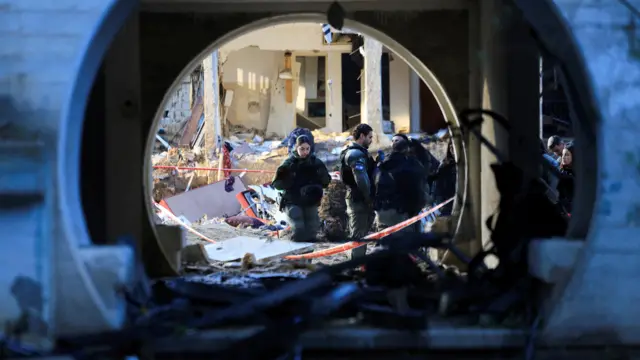
    Israeli soldiers work at the scene of damage after Iranian missile barrages struck residential buildings in Arad.Image source, Reuters
    A damaged room at an impact site after Iranian missile barrages struck residential buildings in Arad.Image source, Reuters
    Emergency workers gather in the early hours of March 22, 2026 at the site of an Iranian missile strike hours earlier in Arad, Israel. Dozens were wounded in the strike, which Israel's air-defence system failed to intercept.Image source, Getty Images
  12. 'Nothing worse than being forced from home,' Iranians tell BBCpublished at 03:54 GMT 22 March

    BBC Persian

    Civilians and emergency workers look upon the remains of a residential and commercial building on March 21, 2026 in the Shahrak-e Gharb neighbourhood of Tehran, Iran.Image source, Getty Images
    Image caption,

    Destruction in Tehran, pictured on 21 March

    Iranians inside the country have been speaking with BBC Persian about their experiences during the war.

    One woman in Tehran has said that, in her view, "nothing is worse than being forced to leave your home". She says that she hasn't had to leave for now, but "I am still afraid, I won’t pretend I’m not, but at least I have my own belongings around me".

    She says her thoughts are with those who had to leave: "For those who have lost their homes and become displaced, that is terrible. ... Honestly, I hope everyone who has been forced from their homes anywhere in the world can one day return. Losing your home is worse than the war itself."

    One man tells the BBC that Iranians are "waiting for the day when we can celebrate freedom in our own homeland". He adds: "We believe that, after years of resistance and struggle, that day will mark the end of the evil king’s corrupt rule", referring to Iran's supreme leader.

    • BBC Persian is the Persian language service of BBC News, used by 24 million people around the world - the majority in Iran - despite being blocked and routinely jammed by Iranian authorities.
  13. Attempted strike on Diego Garcia happened late on Thursday night into Friday morning, BBC understandspublished at 03:44 GMT 22 March

    Damian Grammaticas
    Political correspondent

    Missiles targeting the joint UK-US base on Diego Garcia were fired by Iran sometime during the period late on Thursday night into Friday morning, the BBC understands.

    Initial information had been limited only to the fact the incident had happened before Friday afternoon when UK government ministers met in London to discuss the war.

    At that meeting ministers agreed the US could use UK airbases to carry out missions protecting shipping in the Strait of Hormuz as part of defensive actions against Iranian attacks.

    Before then US use of British bases had been restricted to preventing Iranian missile attacks on UK interests and allies in the Middle East.

    The image is a labelled map showing parts of Europe, Africa, and the Middle East, highlighting connections between the UK, Iran, and military bases used by the United States.  - UK: Marked with a black dot over southern Britain (Gloucestershire) - Iran: Shaded and labelled in the Middle East.  Two information boxes appear on the right:  - RAF Fairford: - Located in Gloucestershire, England. The text explains it was used by the US Air Force to deploy B-52 bombers during raids on Iraq in 2003. - Diego Garcia: - Remote UK–US military base in the Indian Ocean. The text states it was used to refuel US B-2 bombers carrying out attacks on Afghanistan after 9/11.  Additional map details:  - A scale shows 500 km / 200 miles. - The BBC logo appears in the bottom right corner.  Overall, the graphic illustrates strategic military locations linked to US operations in the Middle East.
  14. Strait of Hormuz - why is it significant?published at 03:37 GMT 22 March

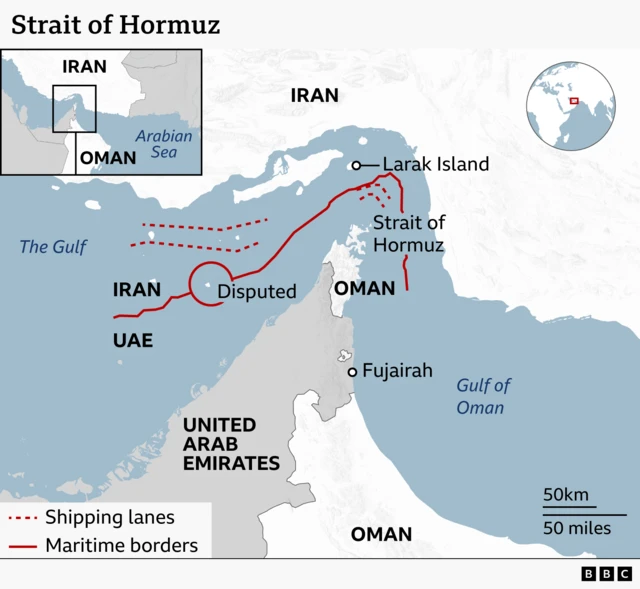
    The Strait of Hormuz, a narrow shipping route in the Gulf region, is one of the world's most important shipping routes. Bounded to the north by Iran and to the south by Oman and the United Arab Emirates (UAE), the Strait of Hormuz connects the Gulf with the Arabian Sea. The strait is deep enough for the world's biggest crude oil tankers, and is used by the major oil and gas producers in the Middle East - and their customers.

    As a reminder, Iran has effectively blocked the Strait of Hormuz, one of the world's busiest oil shipping channels, since the US and Israel attacked the country on 28 February.

    Bounded to the north by Iran and to the south by Oman and the United Arab Emirates (UAE), the waterway - only about 50km (31 miles) wide at its entrance and exit, and about 33km wide at its narrowest point - connects the Gulf with the Arabian Sea.

    About 20% of the world's oil and liquefied natural gas (LNG) usually passes through the strait, with oil coming not only from Iran but other Gulf states such as Iraq, Kuwait, Qatar, Saudi Arabia and the UAE.

    What is the impact of closing the strait?

    About 3,000 ships usually sail through the strait each month but this has dramatically decreased recently, with Iran threatening to attack tankers and other ships.

    At least 21 vessels have been hit or targeted, or have reported attacks, since the start of the war, according to an AFP news agency tally on 18 March.

    Global fuel prices have soared in the wake of the war. Crude oil has risen above $100 a barrel - up almost 70% this year and nearly 50% from a year ago.

    You can read more about why the Strait of Hormuz matters so much here.

  15. Trump's new 48-hour deadline for Iran: What we knowpublished at 03:36 GMT 22 March

    Map of the Strait of Hormuz

    President Donald Trump issued Iran with a 48-hour deadline to re-open the Strait of Hormuz, after which he says the US will "obliterate" Iranian power plants.

    In peacetime, around 20% of the world's oil and liquefied natural gas (LNG) shipments passes through the strait, making it critical for global energy supplies.

    Trump posted on his Truth Social platform at 23:44 GMT on 21 March, meaning Iran has until 23:44 GMT on 23 March (03:14 in Tehran on 24 March), to meet the US president's demand.

    He posted: "If Iran doesn’t FULLY OPEN, WITHOUT THREAT, the Strait of Hormuz, within 48 HOURS from this exact point in time, the United States of America will hit and obliterate their various POWER PLANTS, STARTING WITH THE BIGGEST ONE FIRST!"

    Tehran says it will target US-linked energy sites across the Gulf region if it is attacked, according to Iranian state media.

    Iran's blockade and attacks on ships in the Strait has seen oil prices soar over recent weeks.

  16. Trump says US will ‘obliterate’ Iran’s power plants if Strait of Hormuz not openedpublished at 03:35 GMT 22 March

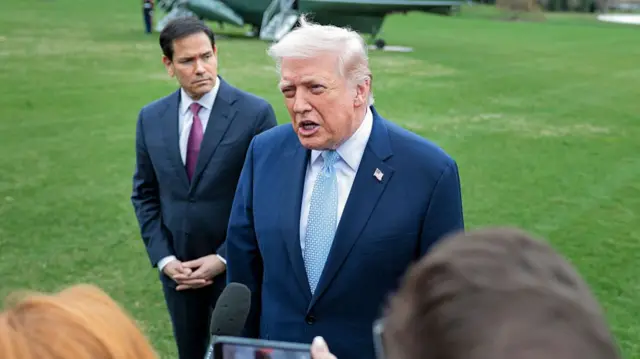
    President Donald Trump stops to speak to reporters while departing the White House on 20 March.Image source, Heather Diehl/Getty Images

    Our live coverage of conflict in the Middle East continues, following a new warning from President Donald Trump that the US will "obliterate" Iran’s power plants if it does not open the Strait of Hormuz within 48 hours.

    • Iran has responded that it will retaliate against all US-linked energy infrastructure in the Middle East if its power plants are attacked
    • Earlier on Saturday, Trump also remarked that he had achieved his war aims "weeks ahead of schedule", and insisted that although Iran wanted to "make a deal", he did not
    • More than 100 people have been injured after strikes on the towns of Dimona and Arad in southern Israel - the target appears to have been a nuclear facility 13km away from the city of Dimona
    • Prime Minister Benjamin Netanyahu said it was a "very difficult evening" for Israel after the attacks on the country's south, adding that "we are determined to continue to strike our enemies on all fronts"
    • Overnight, the IDF said it had launched a new wave of strikes on Tehran, which followed an attack on Iran's Natanz nuclear facility
    • The UAE says it has responded to new Iranian missile and drone attacks, while Qatar's defence ministry says it is searching for a helicopter that crashed off its coast during "routine duty"

    Stay with us as we bring you the latest developments.