Summary

  1. Iran launches further strikes towards Israelpublished at 13:32 GMT 22 March

    More missiles have been launched towards Israel from Iran, a further Telegram update from the IDF says.

    The Israeli military says it is working to intercept the threat, and that a precautionary alert has been sent to mobile phones in the relevant areas.

    The Iranian state broadcaster, IRIB, also reports that a new wave of missile attacks has begun.

    Separately, the UAE's defence ministry says it has intercepted four ballistic missiles and 25 drones launched from Iran on Sunday.

    In total, the UAE's air defences have now intercepted 345 ballistic missiles, 15 cruise missiles, and 1,773 drone since "the start of Iran's blatant aggression", it says in a post on X.
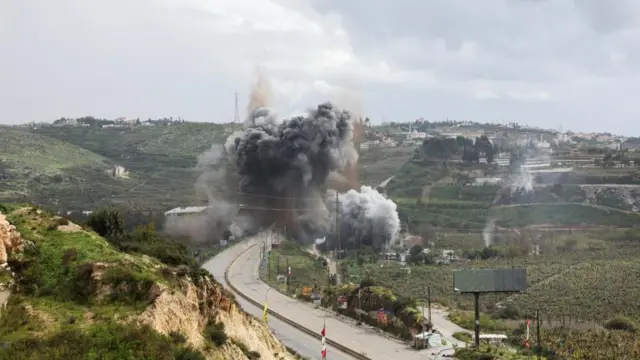

  2. Israel launches fresh strikes on Lebanonpublished at 13:18 GMT 22 March

    In a mountain region, smoke rises after an air strike.Image source, Reuters
    Image caption,

    Smoke rises after a strike on southern Lebanon

    The Israel Defense Forces says it has launched fresh strikes on southern Lebanon targeting Hezbollah.

    In a statement shared on Telegram, it says ground and air forces were involved in the operation.

    In a separate update earlier on Sunday, the IDF said it had killed nine members of the Iran-backed group on Saturday evening.

    Lebanon was drawn into the US-Israel war against Iran when Iran-backed Hezbollah fired missiles into Israel. Israel responded with air strikes and later sent ground troops into the south of the country.

    Meanwhile, Israeli Defence Minister Israel Katz has told forces to destroy bridges over the Litani River – which is used by Hezbollah - saying he wants troops to escalate the destruction of homes in targeted villages.

    Air strikes destroyed two bridges over the river linking southern Lebanon with the rest of the country earlier this week, the IDF said.

  3. IRGC thinking ‘beyond just the region’ following Trump deadlinepublished at 12:54 GMT 22 March

    Ghoncheh Habibiazad
    Senior reporter, BBC Persian

    Iran's Islamic Revolutionary Guard Corps (IRGC) intelligence unit says in a post on X - published by the IRGC affiliated Fars News Agency - that it is thinking "beyond just the region”.

    The post explains that this refers to a “red target bank” of technological and political targets in response to threats against power plants, suggesting that action could be taken “in less than 48 hours”.

    This follows a threat from President Trump to “obliterate” Iranian power plants if the Strait of Hormuz does not reopen before a 48-hour deadline he has set expires.

    The post also lists several achievements the IRGC claims to have made during the war, including what it describes as the “consolidation of power in the Strait,” and “control of global energy.”

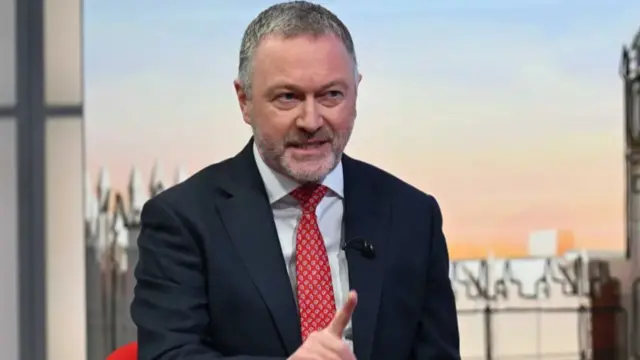
    The UK’s Housing Secretary Steve Reed has told the BBC that there was “no assessment” Iran could strike London, as we reported earlier.

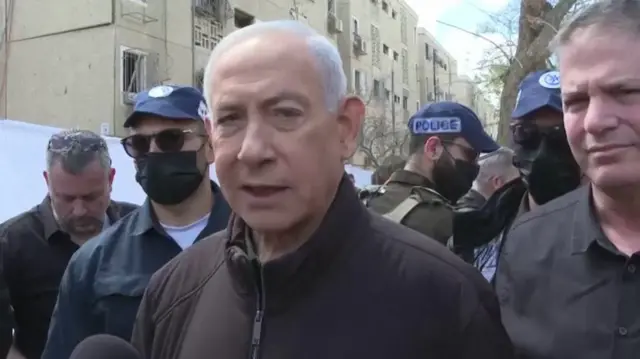
  4. Netanyahu urges the Israeli public not to be 'complacent' and head to shelters when alerts issuedpublished at 12:34 GMT 22 March

    Israeli prime minister Benjamin Netanyahu in AradImage source, AP

    More from Arad in southern Israel where Prime Minister Benjamin Netanyahu has visited on Sunday.

    More than 80 people there were injured by Iranian missiles which struck the town on Saturday.

    Netanyahu says it was a "miracle" no one was killed and urges the Israeli public not to be "complacent" - saying they need to go into shelters during missile alerts.

    "There was a full ten minutes from the alert until the missile fell,” he says.

    “The missile fell here, between the buildings. And if everyone had gone during those minutes into the protected spaces, into the shelters beneath every building here, no one would have been harmed."

    "Do not be complacent, do not be indifferent,” he continues.

    “When you hear the first alert, go immediately to the protected space.”

  5. No assessment Iran could strike London, UK minister sayspublished at 12:09 GMT 22 March

    Paul Seddon
    Politics reporter

    Housing Secretary Steve Reed

    There is "no assessment to substantiate" Israel's claim that Iran has long-range missiles capable of reaching London, a UK cabinet minister says.

    Housing Secretary Steve Reed tells the BBC there is "no specific assessment that the Iranians are targeting the UK - or even could if they wanted to", after the Israel Defense Forces (IDF) said on Saturday that Tehran had weapons that could reach up to 4,000km (2,485 miles).

    It comes after it emerged Iran targeted the joint US-UK military base on the Chagos Islands in the Indian Ocean, which is around 3,800km from Iran.

    Reed refuses to say how close the missiles came to the British territory, saying he could not share "operational details".

    Iran fired two ballistic missiles at Diego Garcia - one of which failed and fell short while the other was intercepted - overnight into Friday.

  6. Attack on Arad narrowly misses apartment buildingspublished at 12:01 GMT 22 March

    Sebastian Usher
    Middle East regional editor, in Arad

    More now on the attack on Arad in southern Israel, which took place on Saturday night.

    The attack narrowly missed three apartment buildings, leaving a huge crater nearby.

    I am with Moishe Siel in Arad. He tells me that "there are dozens of injured people, but if the missile had hit the building itself, we would have dozens of dead people because the devastation would be complete."

    Moishe works for One Heart, an NGO that works during civil emergencies, and adds: "People would die from the impact and from the building falling on them. So this is a lot of luck, I'm not religious so I wouldn't say a miracle."

    He refers to the strikes as "failures" of the country’s air defence system, which he calls "very alarming."

  7. 'We saw tonnes of people bleeding,' paramedic says after missile strike on Aradpublished at 11:46 GMT 22 March

    Gabriela Pomeroy
    Live reporter

    Naram ZaidImage source, MDA

    Naram Zaid is a paramedic who was called to the scene of the missile strike on the Israeli town of Arad at 22:00 local time (20:00 GMT) on Saturday.

    “When I arrived I saw a building on fire," she says, telling me her main worry was that people would be trapped inside.

    Naram, who works for the Israeli emergency services, Magen David Adom, says she saw “a lot of children with head and chest injuries” after being crushed by objects inside the building.

    "We saw tonnes of people bleeding," she tells me.

    “I was trying to reassure a ten-year-old girl with head injuries, with blood on her face from broken glass," as she was carried out of the destroyed building by a police officer.

    "She was refusing to get into the ambulance as her parents were still inside the building. We waited for them to be evacuated from the destroyed apartment block and then we sent them all to hospital.”

  8. Iran will 'irreversibly destroy' vital infrastructure if power plants are targeted, says parliament speakerpublished at 11:19 GMT 22 March

    The speaker of the Iranian parliament, Mohammad-Bagher Ghalibaf, has threatened to destroy vital infrastructure across the Gulf region in an “irreversible manner” if the US and Israel target the country’s power plants.

    In a post on X, Ghalibaf says vital infrastructure, energy and oil facilities throughout the region will be considered "legitimate targets".

    The speaker goes on to warn that the price of oil will rise "for a long time".

  9. Fifteen people injured in strikes targeting Israel, says ambulance servicepublished at 10:55 GMT 22 March

    Israeli emergency services Magen David Adom says 15 people have been injured following strikes targeting Israel.

    A spokeswoman says a 53-year-old man is in “moderate condition”, while the 14 others are in a “mild condition.”

    The 15 injured are being treated in hospital, it says, while adding an update will follow.

  10. 'We heard a massive loud boom and the house shook,' Israeli in Arad tells BBCpublished at 10:27 GMT 22 March

    Gabriela Pomeroy
    Live reporter

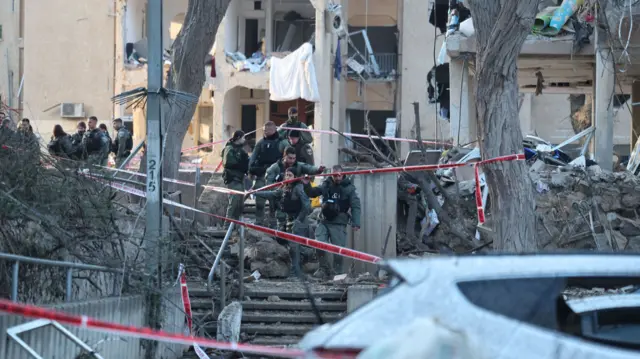
    Israeli security, rescue, and paramedics work at at the scene of a direct hit of an Iranian missile in Arad, Israel, 22 March 2026.Image source, EPA

    We’ve been talking to people on the ground in the southern Israeli town of Arad, where an Iranian missile hit last night - injuring 84 people.

    Aubrey Isaacs, a teacher and tour guide - originally from Glasgow - says the walls of his house shook when a missile hit a building which is five minutes’ walk away.

    "We heard a massive loud boom sound and the house shook. We realised that it had been a missile hit, because we normally hear the booms of the interceptions. But this time it was very different sound."

    He says the sounds of ambulances and helicopters were ringing out through the night, and he later found out that a friend's home was destroyed in the attack.

    "This is a quiet desert town and the damage has been immense," he says.

  11. Six people die after Qatar helicopter crash, defence ministry sayspublished at 10:18 GMT 22 March

    Six people have died following a helicopter crash in Qatar, says the country's defence ministry.

    Qatar had said early on Sunday that the helicopter was on "routine duty" and had a technical malfunction.

    "Search efforts have resulted in finding six our of seven who were on board," the ministry says in a statement shared on X.

    In a later statement, the country's defence ministry says the dead included two Turkish civilians and one Turkish soldier.

    For context: Qatar has been affected by Iranian strikes in recent weeks and its main gas facility was hit by Iran in the week. However, it is unclear whether this helicopter incident is linked to the Iran war.

  12. 'I'm terribly worried... without electricity Iran will be destroyed,' woman in Tehran tells BBCpublished at 09:39 GMT 22 March

    Ghoncheh Habibiazad
    Senior reporter, BBC Persian

    It’s still very difficult to contact those inside Iran amid the internet outage, but some manage to find ways to bypass the government-imposed restriction.

    “I was caught off guard because I expected him [Trump] to draw a line between the government and the people and not to go after what belongs to the people,” a thirty-something man in Karaj - a city near Tehran - tells BBC Persian.

    “I’m terribly worried, because without electricity Iran will be destroyed and will become everyone's nightmare,” a woman in her twenties in Tehran says.

    “Anyone inside Iran also knew that when the Islamic Republic is drawn into conflict, it will block the strait, fire missiles at its neighbours and even their infrastructure," a man in his twenties in Tehran says.

    "[Iran] won’t surrender, instead it will continue to fire every last missile and bullet it has; so did the US not know this or expect it?”

    • BBC Persian is the Persian language service of BBC News, used by 24 million people around the world - the majority in Iran - despite being blocked and routinely jammed by Iranian authorities.
  13. Buildings gouged out by blasts in the Israeli town of Aradpublished at 09:33 GMT 22 March

    Sebastian Usher
    Middle East editor, reporting from Arad

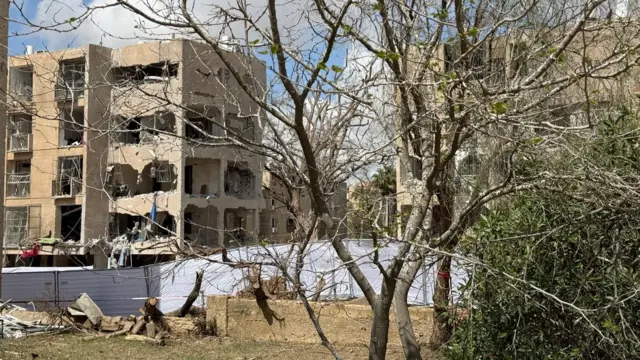
    The scene in Arad on Sunday morning
    Image caption,

    The scene in Arad on Sunday morning

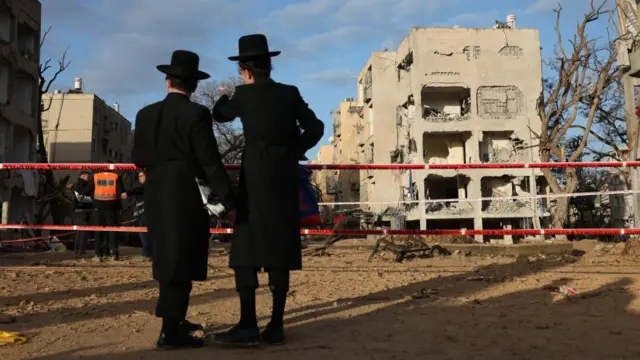
    Here in Arad, the outside walls of two residential apartment buildings have been gouged out by the impact on Saturday night.

    Crowds of dark-suited men are staring at the damage in this ultra-orthodox town in the Negev Desert.

    The ability of Iran still to be able to inflict this kind of damage inside Israel is a reminder of the human cost of the war.

    Urgent investigations are taking place to ascertain how the missiles breached Israel’s air defence system.

    But, as in the 12-day war last summer, Israelis know that the system is not infallible.

    As then, such attacks are more likely to harden the public’s resolve rather than weaken it.

  14. People survey damage after Iranian missiles hit southern Israelpublished at 09:24 GMT 22 March

    Residents look on at the scene of a direct hit of an Iranian missile in Arad. A building can be seen damaged to the right of the pairImage source, EPA/Shutterstock
    Image caption,

    Residents in Arad survey the aftermath of the Iranian attack

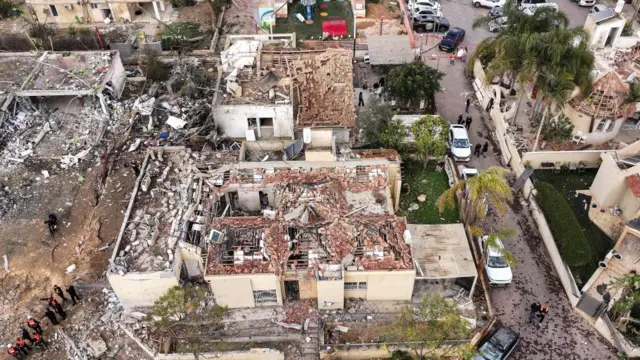
    New images show damage in the Israeli cities of Dimona and Arad overnight, after the Iranian missile strike that we mentioned in our previous post.

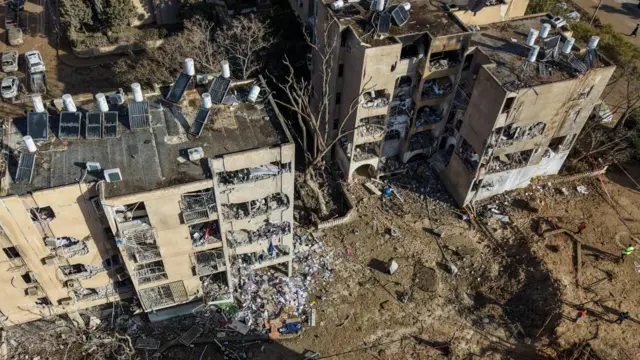
    A strike in Arad badly damaged several buildings, leaving a deep crater.

    A drone view shows a crater in a residential neighbourhood. An apartment block has also been damaged and debris is spread on the streetImage source, Reuters
    Image caption,

    A residential block was damaged in Arad

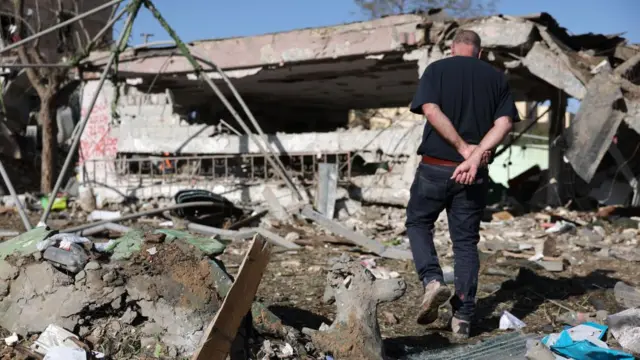
    Dimona experienced a similar strike from a missile that had evaded Israel's sophisticated air defence system. A number of people were injured there, too. The city is about 13km (eight miles) from the Negev Nuclear Research Center.

    A man seen walking through rubble after a missile hit Dimona, he is wearing dark clothes an has his hands behind his backImage source, EPA
    Image caption,

    A man walks through the rubble in Dimona

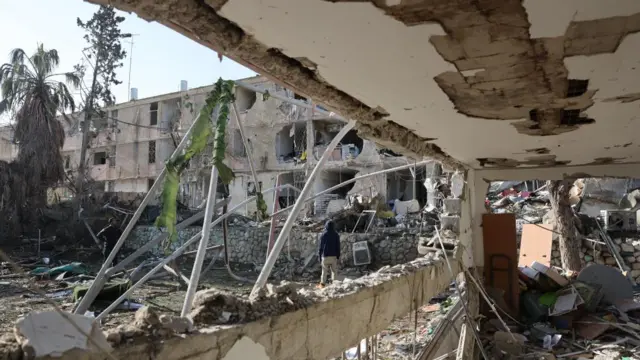
    People look on at the scene of a hit of an Iranian missile in a residential neighborhood in DimonaImage source, EPA
    Image caption,

    The shattered remains of a residential neighbourhood in Dimona

  15. Iranian missiles injure more than 160 in Israeli towns near nuclear site, officials saypublished at 09:00 GMT 22 March

    A drone view shows several destroyed buildings. The roof tiles of the buildings have pealed away showing the wooden structures underneathImage source, Reuters
    Image caption,

    A residential neighbourhood in Dimona following a night of Iranian missile strikes

    We've seen an updated toll on the number of people injured in the Iranian missile strikes on the southern Israeli towns of Dimona and Arad, which we reported earlier.

    More than 160 people have been injured, some seriously, according to Israeli emergency officials.

    They say 84 people are being treated in Arad and another 78 in Dimona, after ballistic missiles hit the towns, which are close to a nuclear facility, on Saturday evening.

    The International Atomic Energy Agency (IAEA) says it is not aware of any damage to the nuclear research facility located about eight miles (13km) outside Dimona.

    Iranian state TV earlier said the strikes were in response to an attack on Iran's Natanz nuclear facility on Saturday. The IAEA says "no increase in off-site radiation levels" has been reported there.

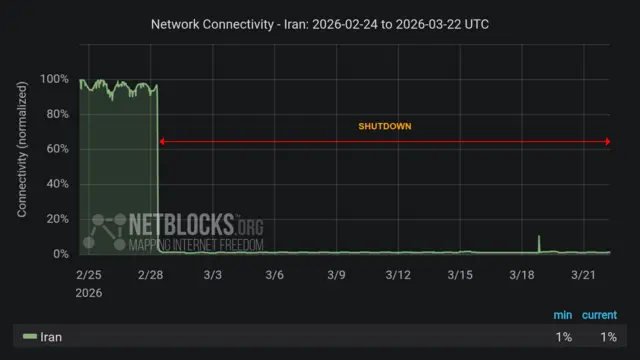
  16. Internet blackout in Iran enters 23rd daypublished at 08:51 GMT 22 March

    A graphic shows the internet connectivity plummeting on 28 February and remaining just above 0% since thenImage source, NetBlocks

    An internet blackout imposed by the Iranian regime has entered its 23rd day, internet monitoring group NetBlocks reports.

    The blackout is the longest recorded shutdown in Iran's history and surpassed the blackout imposed during protests in January on Thursday.

  17. Analysis

    How will Iran respond to Trump's 48 hour deadline to open Strait of Hormuz?published at 08:35 GMT 22 March

    Azadeh Moshiri
    South Asia correspondent, reporting from Dubai

    President Donald Trump holds a thumb up to the cameras as he arrives in West Palm Beach, Florida, on FridayImage source, Reuters

    So far, Iran has said it would respond with attacks on US-linked energy infrastructure in the Gulf. It has also said ships in the Strait of Hormuz that are not linked to "enemies" will have safe passage if they co-ordinate with Iran.

    Iranians I've kept in-touch with inside the country haven't been surprised by the attacks here in the Gulf, nor Iran's chokehold on shipping.

    One man, who still hopes the regime will be overthrown, says "what other card do they have to play?"

    Lifting its effective blockade of the Strait of Hormuz would mean Iran giving up its main leverage in this war.

    If Donald Trump were to follow through on his threat to attack power plants, it would have devastating consequences for Iran.

    But, for decades, the Iranian government has shown it is willing to sustain high levels of damage to its economy and suffering amongst its people, in order for the regime and its "revolutionary values" to survive.

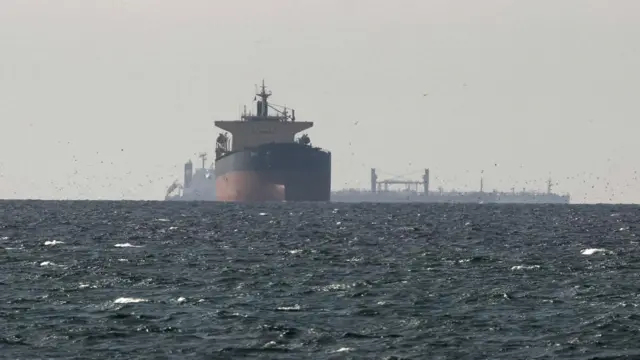
    Cargo ships in the Gulf, near the Strait of HormuzImage source, Reuters
    Image caption,

    Cargo ships pictured in the Gulf near the Strait of Hormuz earlier this month

    It has suffered through Western sanctions and unleashed brutal crackdowns, as seen earlier this year. Thousands of people were killed amid nationwide protests in January.

    This week, the government carried out the first hangings in relation to the demonstrations, executing three men accused of killing police officers.

    The men had confessed under torture and were not offered a fair trial, according to rights groups.

    Iranian leaders may also be willing to call Trump's bluff, and hope in the meantime pressure on Gulf countries will have them urge the US to show restraint.

    Iran's Foreign Minister Abbas Araghchi has claimed countries have approached Iran to find a solution. Oman has been the most vocal about diplomacy.

    There is a lot at stake for Gulf countries, whose economies are built around energy, and for some tourism and their image of safety is crucial.

    Yet they now see Iran as a profound threat to their way of life, and how they choose to respond will have a significant bearing on how this war unfolds.

  18. Iran is charging $2m from ships passing through Strait of Hormuz - Iranian MPpublished at 08:31 GMT 22 March

    Ghoncheh Habibiazad
    Senior reporter, BBC Persian

    Iranian Member of Parliament Alaeddin Boroujrrdi has claimed on state TV today that some of the ships that pass through the Strait of Hormuz are being charged "with a $2 (£1.5) million fee" by Iran.

    He has said that a “new governing regime” is being imposed in the Strait and “war has costs”, adding this shows the “authority and right that the Islamic Republic of Iran possesses”.

    The BBC has not been able to independently verify the claim of the toll by the Iranian MP.

  19. Explosion near cargo ship close to UAE overnight, UK maritime group sayspublished at 08:22 GMT 22 March

    More now from near the Strait of Hormuz.

    An explosion has been reported overnight in close proximity to a cargo ship, 15 nautical miles north of Sharjah in the United Arab Emirates, according to United Kingdom Maritime Trade Operations.

    The master of the bulk carrier reported an explosion "from an unknown projectile" near the vessel.

    All crew are reported to be safe, the UKMTO adds.

  20. Iranian official says Strait of Hormuz open to all except Iran's enemiespublished at 08:06 GMT 22 March

    Iran's representative to the UN's International Maritime Organization says the Strait of Hormuz remains open to all shipping except vessels linked to "Iran's enemies", the Iranian semi-official Mehr news agency has reported.

    Ali Mousavi, Tehran's representative to the IMO, says passage through the narrow waterway is possible by co-ordinating security and safety arrangements with Tehran.

    "Diplomacy remains Iran's priority. However, a complete cessation of aggression as well as mutual trust and confidence are more important," Mousavi says, adding that Israeli and US attacks against Iran were at the "root of current situation in Strait of Hormuz".

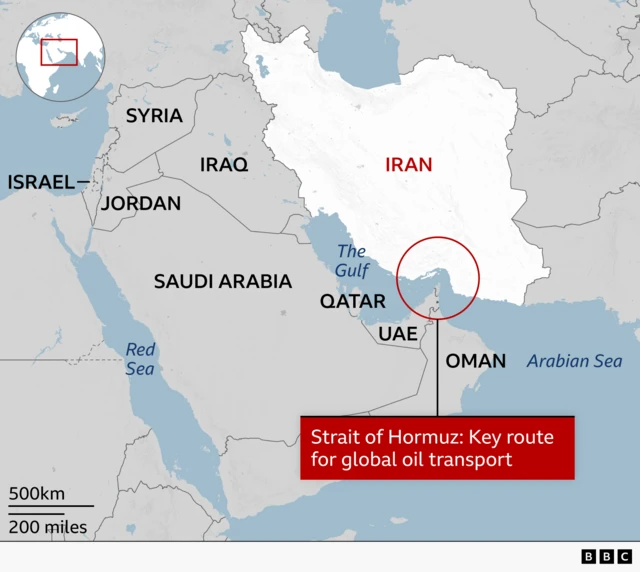
    For context: There have been periodic attacks by Iran on ships passing through the Strait of Hormuz since the US-Israel war with Iran began on 28 February.

    Map showing where the Strait of Hormuz is in the Gulf of Oman, a key route for global oil transport. The strait lies between Iran and the peninsula of the United Arab Emirates and Oman. The map also shows countries in the wider Middle East region including Saudi Arabia, Iraq, Jordan and Israel