Summary

  1. HMS Dragon starts operations tonight, UK defence secretary sayspublished at 18:57 GMT 23 March
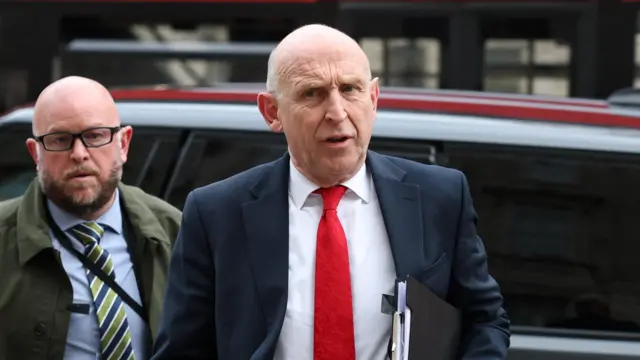
    British Defence Secretary John Healey walks outside the Cabinet Office, on the day Prime Minister Keir Starmer holds an emergency "COBRA" meeting on the economic fallout amid the U.S.-Israeli conflict with Iran, in London, Britain, March 23, 2026.Image source, Reuters

    Earlier we reported that UK Defence Secretary John Healey this afternoon updated MPs in the House of Commons about the war in the Middle East.

    We can bring you a bit more on that now.

    HMS Dragon - has arrived in the eastern Mediterranean and "tonight begins operation and integration into Cyprus' defence", Healey has said.

    The warship, a Type 45 destroyer, left Portsmouth on 11 March to help defend RAF Akrotiri, which was hit by an Iranian-made drone earlier this month.
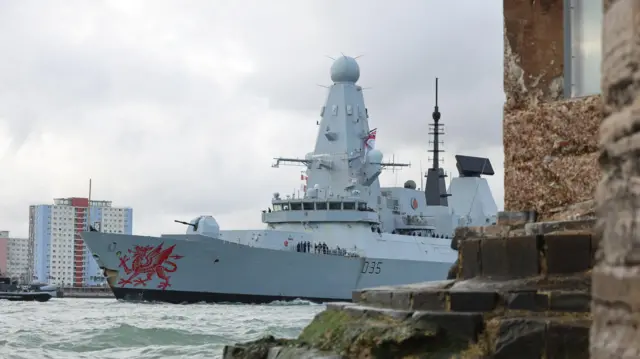
    HMS DragonImage source, Chris Sellars/UK MOD Crown via Reuters
    Image caption,

    Royal Navy warship HMS Dragon pictured departing Portsmouth on 10 March for the eastern Mediterranean

    Strait of Hormuz - Healey says UK military planners have been deployed to US Central Command, following a commitment made on Friday, external - along with 29 other nations - "to contribute to appropriate efforts to ensure safe passage" through the vital shipping passage.

    The UK is determined to "play a leading role in securing the Strait", Healey says.

    Support for Gulf allies - the UK will "soon deploy" lightweight multiple launchers to Bahrain, Healey says.

    It will also send the Rapid Sentry air defence missile system to Kuwait, that has "already proved highly effective" to UK forces shooting down drones in the region, he adds.

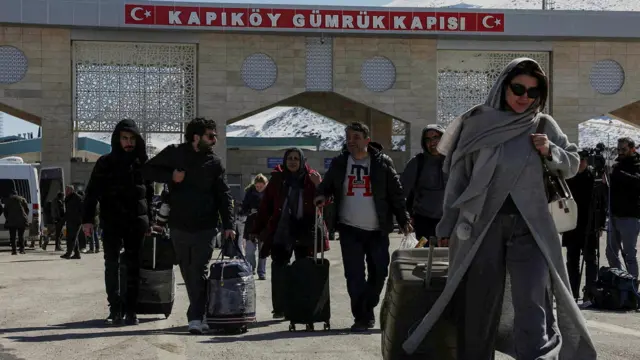
  2. Iranians reflect on entering Persian new year amid US-Israeli bombardmentpublished at 18:37 GMT 23 March

    BBC Persian

    Iranians make their way after crossing into Turkey at the Kapikoy Border Gate in the eastern Van province, Turkey, March 3, 2026.Image source, Reuters
    Image caption,

    Iranians pictured making their way into Turkey through the Kapikoy border crossing earlier this month

    Prior to today's reports that US-Iran talks are resuming, BBC Persian spoke to Iranians at the Kapikoy border crossing in eastern Turkey.

    Some of them are reflecting on entering the Persian new year, which began on 20 March, while their country faces US-Israeli bombardment.

    "It will still take time for normality to return, but hopefully we’ll get there," says one Iranian woman from Karaj, northern Iran.

    She says that, although her home wasn't affected, she heard "terrifying sounds" of explosions and "many casualties".

    Another woman from Tabriz, a city in north-west Iran, says she "didn’t have as much excitement" as past years: "We were sad, but at the same time we still had hope for life."

    She says that, while residential buildings are damaged, the city's cafes, shops and restaurants have been busy during a "relatively normal" new year.

    The same goes for Salmas, in Iran's West Azerbaijan province, says one man: "People there were doing well, buying and selling, everything was normal. They celebrated the new year and received their holiday bonuses."

    But another man from Qotur, a city in the same province, says: "Although there is no fighting near our area, it still affects people; people are not at ease."

  3. More than 1,000 killed in Lebanon since start of Israeli offensive, health ministry sayspublished at 18:27 GMT 23 March

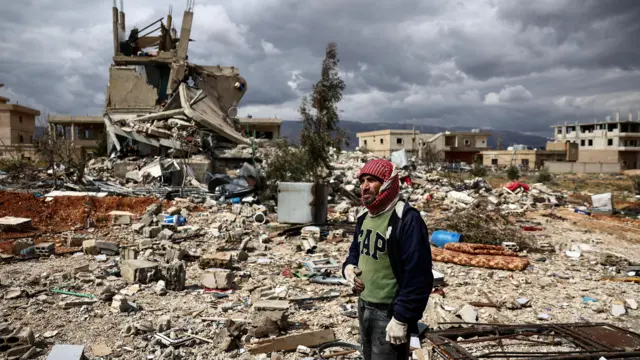
    A man stands next to debris caused by an Israeli strike in Chaat LebanonImage source, Reuters
    Image caption,

    A man surveys damage in Chaat, a town in northern Lebanon, as Israel continues its offensive against Hezbollah

    Newly released figures show the number of people killed in Lebanon since Israel began its operations in the country has risen to 1,039, according to Lebanon's health ministry.

    That's up from the 1,029 people reported killed in an update on Sunday.

    The health ministry says a further 2,876 people have been wounded - 90 of whom sustained injuries in the past 24 hours.

    It follows statements from Israeli military officials on Sunday, which say plans for the expansion of ground and air attacks against Hezbollah have been approved.

    Israeli officials say the aim is to protect communities in northern Israel from Hezbollah attacks.

    But a joint statement from the leaders of France, the UK and Germany warns a significant Israeli ground offensive could have "devastating humanitarian consequences" in Lebanon.

    The BBC is unable to independently verify these figures.

  4. UK government Cobra meeting ends in Londonpublished at 18:17 GMT 23 March

    Chris Mason
    Political editor reporting from Westminster

    The government’s contingencies committee COBR (Cobra) has finished its latest meeting.

    UK Prime Minister Keir Starmer earlier told MPs that the meeting, which was attended by Bank of England Governor Andrew Bailey and senior ministers, would assess how to deal with cost of living pressures arising out of the war in Iran.

  5. Analysis

    A day that looked dismal for major world economies now has a glimmer of hopepublished at 18:05 GMT 23 March

    Anthony Zurcher
    North America correspondent reporting from Memphis

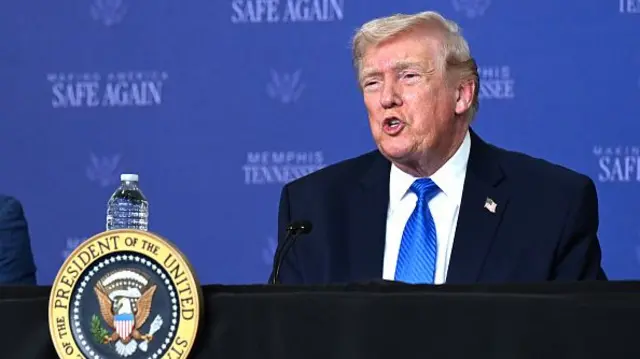
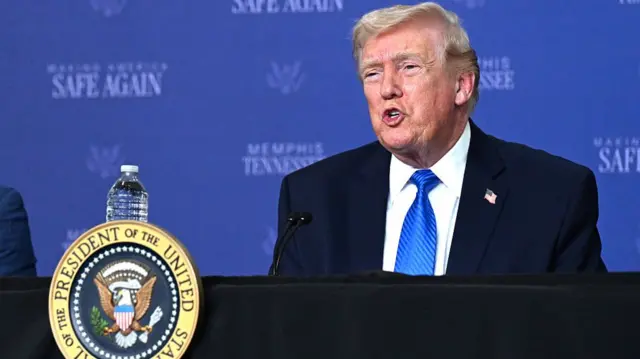
    Donald TrumpImage source, Getty Images
    Image caption,

    Donald Trump speaking in Memphis today

    A day that began with the prospect of impending US strikes on Iranian energy sites and the threat of further escalation in the conflict has taken a turn towards negotiation.

    The US and Iran are having “very, very good discussions”, Trump says.

    “Iran has one more opportunity to end its threats to America and its allies,” he said. “We hope they take it.”

    Trump’s optimism was a continuation of the upbeat tone he struck in an early morning post on his Truth Social platform, and in comments to those of us in his travelling press pool prior to departing Florida for Tennessee.

    It’s still unclear exactly how extensive the US-Iranian talks have been so far, but the president indicates they have included assurances that Iran will not pursue a nuclear weapons programme.

    Even the prospect of talks has been enough to send US stock market surging and global oil prices dropping.

    What had been shaping up to be a dismal day for major world economies now has a glimmer of hope.

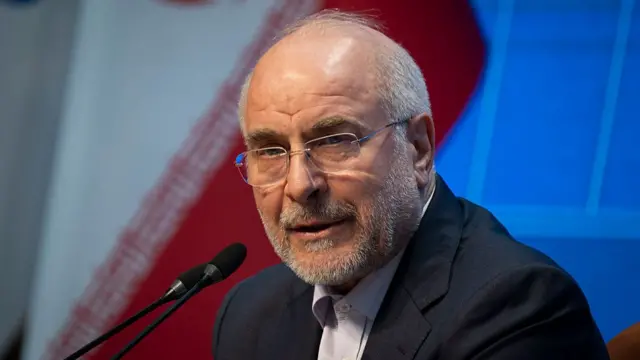
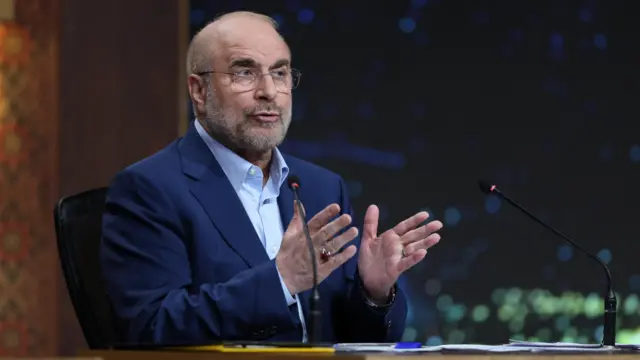
    Iranian Parliament Speaker, Mohammad Bagher Ghalibaf, speaks with the media in a media conference at a conference hall in the Iranian Parliament building in Tehran, Iran, on December 2, 2025.Image source, Getty Images
    Image caption,

    A post earlier today on an X account affiliated with Iran's parliament speaker, pictured here in December, denied talks have been happening between Iran and US

    Iranian state media outlets are citing Trump’s Truth Social post as evidence that he was backing down in the face of Iranian threats, however.

    The Strait of Hormuz still appears largely closed to international shipping, and the president has only given a five-day extension to his deadline for Iran to allow full access.

    Monday may have provided the first indication of a real breakthrough. But it could also be the move of a president who had put himself into a difficult spot has only bought himself a bit more time.

  6. Red Cross warns events in Middle East risk reaching 'point of no return'published at 17:51 GMT 23 March

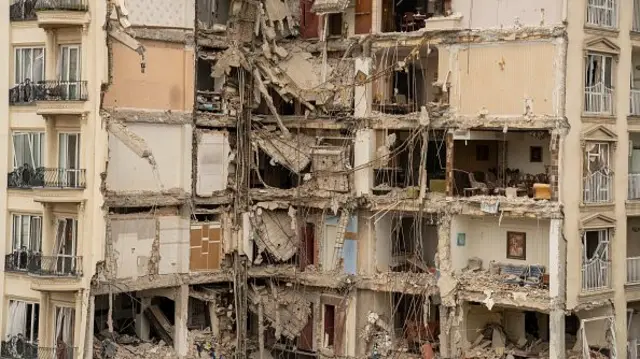
    A damaged residential building with blown out wallsImage source, Getty Images
    Image caption,

    A damaged residential building after a strike in Tehran

    "What we have seen in recent days in the Middle East risks reaching a point of no return," a new statement from the president of the International Committee of the Red Cross (ICRC) warns.

    Mirjana Spoljaric Egger says "war on essential infrastructure is war on civilians" and adds "we are seeing energy, fuel, water and health-care infrastructure damaged and destroyed".

    "Most alarming" is the potential damage to nuclear sites, she says, which "could trigger irreversible consequences".

    "Respecting the dignity of civilians is the basis for de-escalation and political solutions from which peace and stability can be built," the ICRC president adds.

  7. Israeli military claims to have struck Iranian IRGC security HQpublished at 17:44 GMT 23 March

    The Israel Defense Forces says it has struck the main security headquarters of Iran's Islamic Revolutionary Guard Corps (IRGC), as part of a "wave of strikes" on Tehran.

    "The headquarter was used by the IRGC to synchronize unit activities and to conduct situational assessments. It was also responsible for directing the Basij Battalions," the IDF claims in a statement.

    Israel's military adds: "Prior to the strike, steps were taken to mitigate harm to civilians, including the use of precise munitions, aerial surveillance, and additional intelligence."

  8. Analysis

    Latest head-spinning developments highlight unpredictability of this warpublished at 17:24 GMT 23 March

    Daniel Bush
    Washington correspondent

    President Donald Trump said earlier that the US and Iran were making "major" progress in negotiations. Iran, meanwhile, denied that talks were even taking place.

    The head-spinning developments highlight how fluid, fast-moving - and unpredictable - the war has become as the US-Israeli military campaign pushes past the three-week mark.

    The new focus on a negotiated settlement represents an abrupt shift, and suggests the White House is closely watching the markets - which calmed on Monday - and concerned about continued disruption to the global oil supply.

    The exact status of the US-Iran talks is far from clear.

    Trump is known for pushing counterparts in negotiations by publicly claiming talks are under way, even if the other side hasn't agreed.

    Iran is known for publicly denying that it’s in talks with Washington, even when they are taking place behind the scenes. Iran's leadership vacuum has further complicated the picture.

    For now, Trump has given Iran a five-day window to reach some sort of an agreement, so in theory the clock is ticking.

    Of course, Trump has also set numerous diplomatic deadlines in the past, only to blow past them or announce new ones.

  9. 'Would be a good thing' to not have to 'annihilate' Iran, says US presidentpublished at 17:22 GMT 23 March

    More now from Donald Trump, who earlier suggested that if talks with Iran did not go well, the US would "keep bombing our little hearts out".

    Now, the US president says: "We were planning tomorrow on shooting down some of their power plants... hopefully we won't have to do it".

    "I think there's a very good chance we're going to end up with a deal, he goes on," adding: "We're giving it five days and then we're going to see where it takes us."

    "At the end of this period it could very well end up being a very good deal for everybody. As good as if we went all the way and just literally annihilated the place, which if we don't have to do that would be a good thing not a bad thing."

  10. Trump: Iran has 'one more chance' at peacepublished at 16:59 GMT 23 March

    Bernd Debusmann Jr
    Reporting from the White House

    Trump at lecternImage source, Getty Images

    Donald Trump is currently speaking in Memphis, Tennessee, where he's due to deliver remarks on crime-fighting efforts.

    Before doing so, he gives a brief update on the war in Iran, saying the US is now working to determine whether a "broader agreement can be reached".

    "My whole life has been a negotiation but with Iran, we've been negotiating a long time," Trump says. "This time, they mean business." He adds that he believes Iran has agreed they will not have a nuclear weapon.

    Trump then says - not for the first time - that a substantial portion of Iran's leadership has been killed since the beginning of the war. He also says Iran has "one more chance" at peace, without giving more detail on who the US is negotiating with.

    "We hope they take it," Trump says. "Either way, America and the entire world will be much safer and [it] will be a much safer planet."

    Earlier, Iran's parliamentary speaker Mohammad-Bagher Ghalibaf denied the talks had happened, calling it "fake news".

  11. UK Foreign Office summons Iranian ambassador after two arrested for spyingpublished at 16:50 GMT 23 March
    Breaking

    Syed Ali Mousavi, Iran's ambassador to the UK, has been summoned by the Foreign Office over Tehran's "reckless and destabilising actions" in Britain and overseas.

    A statement from the Foreign, Commonwealth and Development Office (FCDO) says it follows the decision to charge two men on suspicion of providing assistance to a foreign intelligence service.

    Nematollah Shahsavani, 40, and Alireza Farasati, 22, were arrested earlier this month in an investigation linked to Iran, and are alleged to have carried out reconnaissance of targets - including Britain's oldest synagogue.

    A little earlier, Defence Secretary John Healey also confirmed that Iran fired two missiles at the UK-US Diego Garcia military base on Friday.

  12. Iran says it hit sites in Israel and three US military basespublished at 16:42 GMT 23 March

    Iran's Islamic Revolutionary Guard Corps (IRGC) says it has hit sites in Israel and three US military bases.

    In a statement shared by the IRGC-affiliated Tasnim news agency, it says that drones targeted sites in the "north, center, and south" of Israel.

    It also says its hit three US military bases: Ali Al Salem in Kuwait, one in Al-Kharj in Saudi Arabia, and Al Dhafra in the United Arab Emirates.

    Neither the Israeli military, Kuwait, Saudi Arabia or the United Arab Emirates have so far confirmed the IRGC's statement.

  13. BBC Verify

    Verified video shows massive explosion at Iranian naval basepublished at 16:30 GMT 23 March

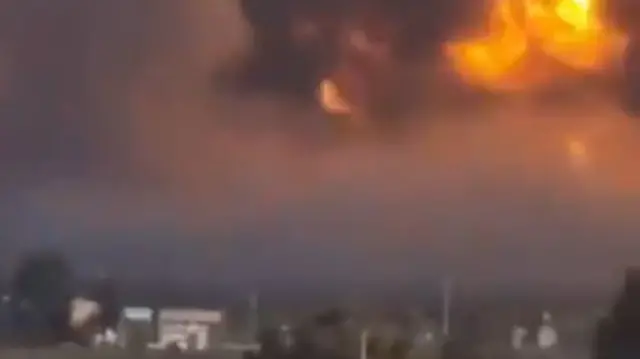
    A screengrab from the video showing a massive fireball erupting from the naval baseImage source, X

    By Sarah Jalali

    We have verified striking footage showing a large explosion at an Iranian naval facility in the south of the country earlier today.

    The video shows flames and thick plumes of black smoke rising from the Iranian navy base at Sirjan.

    Seconds later, a further explosion sends a large fireball and thick clouds of smoke into the air.

    We verified the footage by matching the location of the naval base with satellite imagery and also checked Nasa’s Firms system, which picked up heat signatures at the site.

    It is not clear who carried out the strike on the base, which is some 270km (168 miles) from the Gulf coast.

  14. Sirens sound in Bahrainpublished at 16:18 GMT 23 March

    Bahrain's interior ministry says sirens are sounding in the country.

    "Citizens and residents are urged to remain calm and head to the nearest safe place," it posts on X.

  15. Who is the Iranian parliament speaker?published at 16:09 GMT 23 March

    Ghoncheh Habibiazad
    Senior reporter, BBC Persian

    Iranian presidency candidate Mohammad Bagher Ghalibaf during a TV debate ahead of the presidential elections, in Tehran, Iran, 20 June 2024.Image source, EPA
    Image caption,

    Mohammad-Bagher Ghalibaf during a TV debate in 2024

    In our last post we reported comments from an X account attributed to Iran's Parliament Speaker, Mohammed-Bagher Ghalibaf, denying that negotiations have been taking place with the US.

    Mohammad-Bagher Ghalibaf is a conservative Iranian politician with a military background, who has been the speaker of Iran’s parliament since May 2020.

    Born in 1961, Ghalibaf joined the Islamic Revolutionary Guard Corps (IRGC), Iran’s revolutionary military, in 1980 and became one of its commanders during the Iran–Iraq War.

    Ghalibaf has stood unsuccessfully for president four times, coming fourth in 2005 and second in 2013. He withdrew his candidacy in 2017 before the election and came third in the 2024 early election.

    Yesterday a post from his X account said that “alongside military bases, those financial entities that finance the US military budget are legitimate targets”.

    Ghalibaf has been accused of using his past role as an IRGC commander to hide corruption scandals during his time as Tehran’s mayor.

  16. Iran's parliament speaker denies talks took place with US officialspublished at 16:04 GMT 23 March
    Breaking

    Over the last hour or so, several news outlets have reported that Donald Trump's special envoy Steve Witkoff and Jared Kushner have been negotiating with Iran's parliament speaker, Mohammad-Bagher Ghalibaf, citing sources.

    Now, an X account attributed to Mohammad-Bagher Ghalibaf posts that no negotiations with have taken place with the US.

    It adds that "fake news" has been used to "manipulate" the oil markets, and that the Iranian people "demand complete and remorseful punishment of the aggressors".

  17. Iran fired two missiles at UK-US Diego Garcia military base on Friday - British defence secretary confirmspublished at 15:56 GMT 23 March

    UK Defence Secretary John Healey is currently addressing MPs in the House of Commons - you can watch live at the top of this page.

    John Healey confirms Iran fired two missiles at the joint UK-US Diego Garcia military base, in the Indian Ocean, on Friday.

    "In the early hours of Friday morning, two Iranian missiles were launched in the direction of Diego Garcia," he says.

    "One fell short of its target, the other was brought down short of its target," he says. "Neither got close to Diego Garcia."

    "The UK was not required to take action and normal operations continue," Healey adds.

    The attack had been widely reported over the weekend, with UK Foreign Secretary Yvette Cooper condemning "reckless Iranian threats".

  18. Trump's comments suggest he's preparing ground for de-escalation, former UK ambassador to Iran sayspublished at 15:52 GMT 23 March

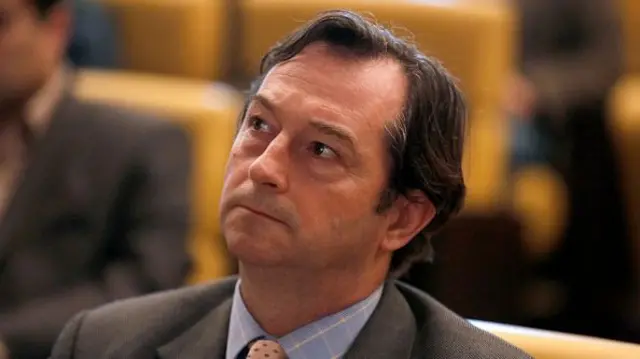
    Nicholas HoptonImage source, AFP via Getty Images

    With Donald Trump announcing he's postponed threatened strikes on Iran after "productive" talks, and Tehran denying that any talks have happened, Nicholas Hopton - former UK ambassador to Iran - says that "both sides are unreliable interlocutors".

    Hopton, who held the post from 2016 to 2018, thinks it is "encouraging that at least the president of the United States seems ready to start talking and negotiating towards an end of this war".

    This "suggests that he's preparing the ground perhaps for some kind of de-escalation", he tells BBC Radio 5 Live.

    However, Hopton says that "the most likely outcome" to the conflict is an "inconclusive one", where future flare-ups are possible.

    With the US demanding Iran gives up its nuclear programme, while Tehran wants sanctions relief and to keep the Islamic Republic in place, Hopton says that "neither side is going to fully achieve the objectives they have described".

  19. Wall Street joins market rebound after Trump postpones strikespublished at 15:25 GMT 23 March

    Nick Edser
    Business reporter

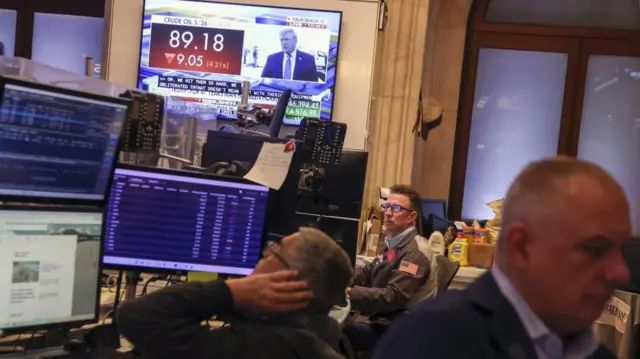
    A TV screen shows live footage of US President Donald Trump speaking as traders work on the floor of the New York Stock Exchange (NYSE) after the opening bell in New York, New York, USA, 23 March 2026.Image source, EPA

    US stocks on Wall Street joined in the markets rebound on Monday, as investors reacted to Donald Trump’s comments that there have been talks between the US and Iran about a "total resolution" to the conflict in the Middle East.

    The S&P 500, Dow Jones and Nasdaq indexes were all up by more than 2% even though Iran's foreign ministry denied such talks had taken place, according to the BBC's US partner CBS.

    Earlier on Monday, stock markets in Europe reversed early losses, and London’s FTSE 100 is currently up 1%.

    The price of Brent crude oil is currently hovering around the $100-a-barrel mark, whereas earlier today it had risen above $113 (£84).

    "Markets have been taken on a wild ride, as investors have swung from deep pessimism to giddy optimism about the trajectory of the war with Iran,” said Susannah Streeter, chief investment strategist at Wealth Club.

    However, she adds: “Clinging to President Trump’s words is fraught with risks, given how hopes have already risen and then been dashed over the last four weeks.”

  20. BBC Verify

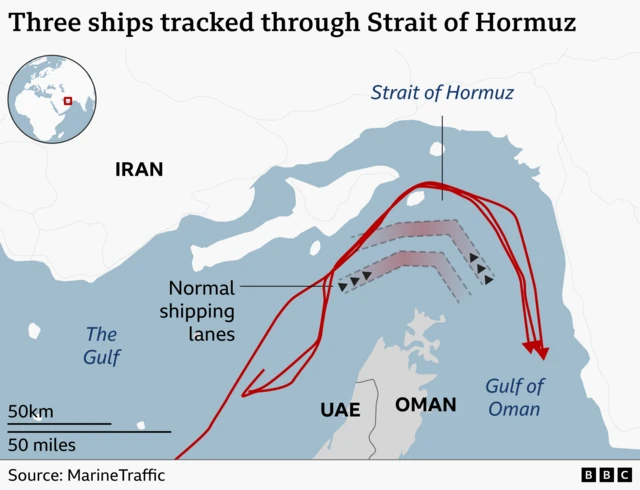
    Three ships tracked through Strait of Hormuzpublished at 15:20 GMT 23 March

    By Shruti Menon

    The number of tankers passing through the Strait of Hormuz has slowed to a trickle since the start of the US-Israel war against Iran on 28 February.

    Many of those that make the journey in the face of Iran’s threats against shipping have turned their AIS tracking devices off to make detection harder. But a few have kept their transmitters on suggesting a greater confidence that they wouldn’t be attacked.

    Today, three vessels made that journey with their transmitters active according to MarineTraffic data. The ships were seen sailing close together and taking a less-travelled route nearer to the Iranian coast than is normal.

    The three ships are the India-owned liquid petroleum gas tankers Pine Gas and Jag Vasant, and the China-owned chemical tanker Bright Gold.

    A BBC Verify graphic showing the courses of three ships seen crossing the Strait of Hormuz on Monday

    Last week, a Pakistan-owned crude oil tanker took the same path close to Iran’s shoreline, also with its tracker switched on.

    Former US Navy Capt Bradley Martin, who is a senior researcher at US defence think tank Rand Corporation, tells me these ships might be following a route given by Iran providing a safe passage if “any mines have been laid anywhere in the Strait”.