Summary

  • This page is no longer being updated. You can continue to follow our coverage at our new live page here

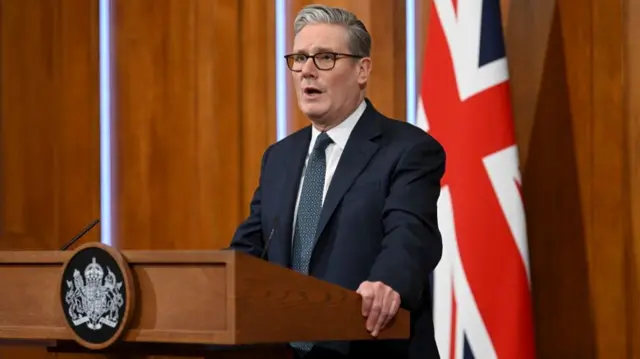
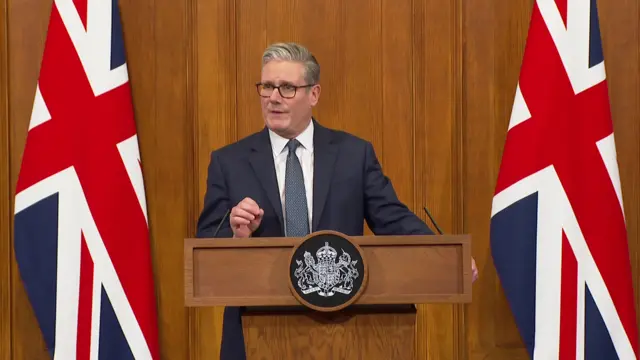
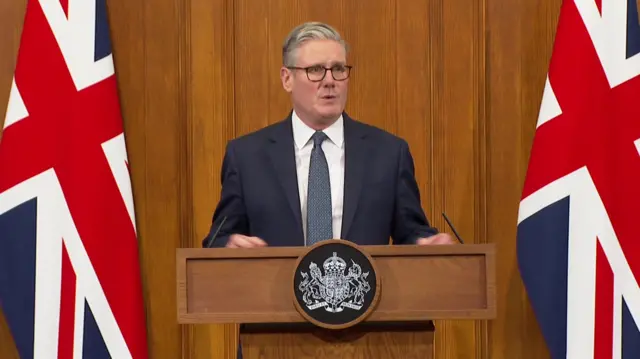
  1. Starmer defends protections around Cyprus basepublished at 14:29 GMT 5 March

    Starmer is asked if he has any sense of how long the conflict could go on for, whether he will help British people with energy prices, and how he responds to accusations that military personnel and their families were left unprotected on the Cyprus airbase that was struck at the weekend.

    The prime minister says the "absolute priority" is the "safety of our citizens".

    In relation to Cyprus, he says there are protections that have always been in place, and that the UK pre-deployed assets to Cyprus in January and February.

    He says "every measure that is needed to protect them, to protect the airbase" is being taken.

    In relation to how long the conflict will last, he says he knows people will be worried, but adds: "I can't give you a time base for this... my strong view is we need to de-escalate and ultimately this will have to be a matter of negotiation for some of the core issues."

    Starmer has now finished speaking, but we will continue to bring you more of his remarks.
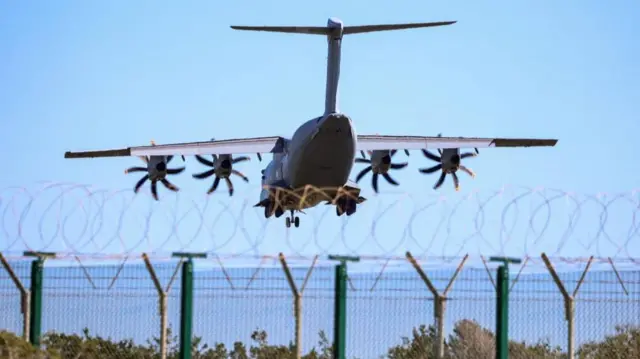
    A British Airbus A400M military aircraft approaches RAF Akrotiri on Cyprus earlier todayImage source, Reuters
    Image caption,

    A British Airbus A400M military aircraft approaches RAF Akrotiri on Cyprus earlier today

  2. Starmer not ruling out what role UK may play in conflict's futurepublished at 14:27 GMT 5 March

    Chris Mason
    Political editor

    This is the prime minister putting himself front and centre in the UK’s public response — after sharp criticism from Washington, grumbling from Cyprus and a lively domestic debate about the government’s approach to the last few days.

    He set out in some detail the planning the UK had been doing in recent months and what he wanted to characterise as his "calm, level headed leadership."

    He also sought to set out the scale of the logistical challenge in helping Britons in the Gulf.

    The prime minister, like others privately in government, isn’t ruling out where things may lead and what role the government may play — this is an unpredictable conflict, without knowable end or consequences.

  3. Starmer asked if UK could move to more offensive military activitypublished at 14:24 GMT 5 March

    Starmer is asked whether the UK's stance of defensive military activity, rather than offensive military activity, could change.

    Starmer doesn't directly say, but says the government is working with allies and the US and have been doing so "for some time".

    The US is using military bases to launch the strikes into Iran, he says, adding: "That is the understanding and arrangements that we've got in place."

  4. Conflict 'could continue for some time'published at 14:21 GMT 5 March

    Starmer says the conflict "could continue for some time".

    He reassures those in attendance that the UK will do everything it can to protect British lives and uphold British values.

    Starmer ends his address, and now moves onto questions.

  5. 'We should come together in this moment,' Starmer sayspublished at 14:20 GMT 5 March

    Starmer moves on to the economic impact of the war, specifically the impact on oil and gas facilities and shipping through the Strait of Hormuz.

    He says the UK government will work with industries affected, and allies, to respond to any impact.

    He says the UK has the right plan to decrease its dependence on volatile markets and to create "the energy security and independence that we need".

    He says it is "sad" that some will use the current geopolitical situation "to divide us". Which, he says, is why the government is reaching out to communities in the UK, especially Jewish and Muslim ones, to make sure they have "appropriate support".

    The prime minister says "we should come together in this moment", and that the "scared" British citizens that are stuck in the region "come from all backgrounds".

    "The armed forces who protect them come from all backgrounds too," he adds.

  6. PM is working to manage expectations for Britons abroadpublished at 14:16 GMT 5 March

    Henry Zeffman
    Chief political correspondent

    Keir StarmerImage source, PA Media

    That was a clear effort from Sir Keir Starmer to manage expectations for the British citizens stuck in the region who want to come back to the UK.

    He announced that the first repatriation flight from Oman - which was meant to take off yesterday but scuppered by technical issues - is now in the air, and said that around 4,000 Britons had already made it home.

    But that is just a tiny fraction of the 140,000 British nationals who have told the government they are in the Middle East. “This is a huge undertaking,” he said. “It’s not going to happen overnight.”

    The government’s private hope - but it is just a hope, not an expectation - is that the conflict will calm in time for the government not to have to find a way to evacuate all of those people.

  7. UK is sending additional Typhoon jets to Qatar, and helicopters to Cypruspublished at 14:16 GMT 5 March

    Starmer says the UK is sending four additional Typhoon fighter jets to join Britain's squadron in Qatar.

    Wildcat helicopters with anti-drone capabilities are arriving in Cyprus tomorrow, he says, and the HMS Dragon is being deployed to the Mediterranean.

    The PM adds that the UK has allowed the US to use British bases "to conduct defensive operations".

    He says: "We will maintain this shield over British people in the region and our allies."

    The UK government, he says, is working to "strengthen" it everyday and "get people out" of the Gulf region.

    So far, says Starmer, over 140,000 people in the region have registered their presence with the UK government.

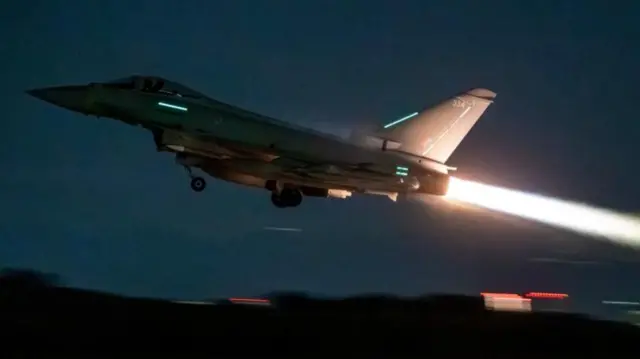
    An RAF Typhoon aircraft, seen taking off from the UK for operations across the Middle East earlier this monthImage source, UK MoD
    Image caption,

    An RAF Typhoon aircraft, seen taking off from the UK for operations across the Middle East earlier this month

  8. UK defensive assets were moved to region earlier this year - Starmerpublished at 14:14 GMT 5 March

    Starmer says his priority is to protect British people, which is why "long before" the US-Israeli strikes began, he had begun adding defence assets to the region "to defend our interests".

    Throughout January and February, the UK was moving defensive assets to Cyprus and Qatar, including fighter jets, air defence missiles and advanced radar systems, he says, to ensure the UK was "in a heightened state of readiness" in advance of any conflict.

    He says when the strikes began on Saturday, the UK "immediately" put those jets in the sky and they were able to shoot down multiple drones, at least one of which was heading towards a base housing British military personnel.

    The UK is "constantly resupplying our jets and our missile stores" and responding to allies in the region for further help, Starmer says.

  9. Starmer defends decision not to join US-Israeli joint strikespublished at 14:11 GMT 5 March

    Henry Zeffman
    Chief political correspondent

    Sir Keir Starmer has been clear that the main purpose of this press conference is to reassure the public who are “worried sick”.

    But he went out of his way early on to defend his decision not to join the initial US-Israel strikes on Iran, declining a request to allow US planes to use British bases for offensive strikes.

    “My focus is on providing calm, level-headed leadership in the national interest,” the prime minister said, adding that this meant “having the strength to stand firm by our values and our principles no matter the pressure to do otherwise”.

    No great powers of interpretation are needed to see that that was a reference to his decision to defy President Trump.

    Starmer said that the UK’s longstanding position was that the best solution to the issue of Iran was a “negotiated settlement with Iran where they give up their nuclear ambitions,” continuing: “That’s why I took the decision that the UK would not join the initial strike. That decision was deliberate. It was in the national interest. And I stand by it.”

    It was notable that this framed the decision entirely as a matter of policy. That compares to the statement in the Commons at the start of this week, where the prime minister said not only that he did not believe there was a thought-through plan, but also strongly suggested he believed the strikes were illegal.

  10. 'Our priority is protecting our people'published at 14:11 GMT 5 March

    Starmer says his focus is to provide calm leadership "in the national interest", which he says means deploying military and diplomatic strength to protect the UK.

    He says the longstanding British position is a negotiated settlement with Iran, where they give up their nuclear ambitions - which he says is why the UK didn't join the initial strikes against Iran.

    The PM says he stands by that decision, but when Iran began attacking countries in the region the situation changed.

    "Our priority is protecting our people," he says.

  11. 'I know that people are worried sick,' Starmer sayspublished at 14:09 GMT 5 March

    Starmer begins by saying he chaired another Cobra meeting this morning.

    "I know that people are worried sick about their family and friends who are caught up in this, about the impact on our lives and our economy, and about the potential for even greater escalation," he says, adding he wants to reassure the British public about the actions the UK government is taking.

    starmer
  12. Starmer's speaking now - watch and followpublished at 14:04 GMT 5 March
    Breaking

    The PM is speaking now. Stay with us for the key lines - and watch live above.

    Starmer
  13. Starmer press conference coming in a matter of minutes - watch live abovepublished at 13:57 GMT 5 March

    Chris Mason
    Political editor

    Hello from Downing Street — a hastily arranged news conference from Sir Keir Starmer is imminent.

    You can watch live above.

    an empty podium
  14. Passenger on UK government flight says it's 'about to take off'published at 13:56 GMT 5 March
    Breaking

    Sadaf Maruf
    BBC News

    The flight chartered by the UK government to bring British citizens back from Oman is about to take off, a passenger on the plane tells the BBC's Your Voice.

    The flight was due to take off on Wednesday evening but was delayed due to a technical issue.

    Mark, who is travelling with his young family, tells the BBC it's now looking like a four and half hour flight to Cairo, then a refuel, and on to London Stansted.

    He describes the delayed take-off as a "complete shambles".

    Speaking about the planned flight yesterday, he says that after arriving at the airport three hours before departure there was "loads of issues with check-in".

    He says he was standing at check-in for around two hours, before being taken to the gate and loaded onto buses to the plane. They were stuck on the bus for almost an hour with "no communication from the craft or the crew" he tells the BBC.

    Mark says someone had a panic attack on the bus, and once the doors were finally opened to talk to someone, they were told the crew were working out of hours, meaning the flight would not legally be able to reach Cairo.

    They arrived at the airport at 20:00 local time and arrived back at their hotel around 06:00 this morning. They were offered a hotel but decided to go back to the hotel where they were staying.

    Your voice banner
  15. Analysis

    Why has Iran targeted Azerbaijan with its drones?published at 13:44 GMT 5 March

    Raffi Berg
    Middle East digital editor

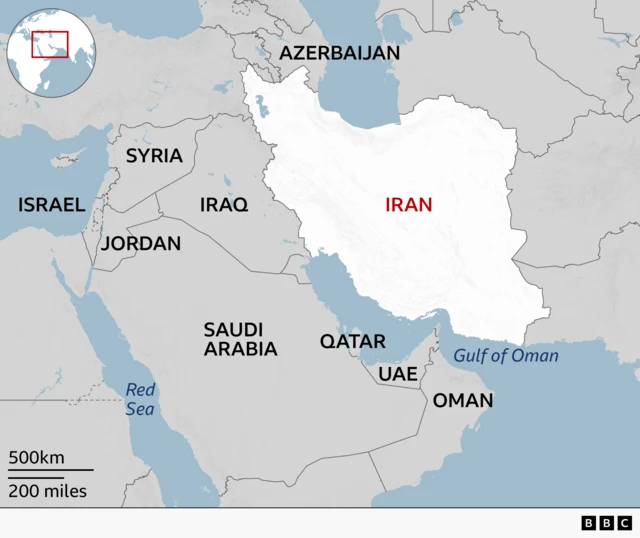
    Unlike the Gulf states and Iraq's Kurdistan Region, Azerbaijan is not known to host any US bases, raising the question of why it was attacked.

    Iran has not given a reason for launching drones at an airport in the autonomous Nakhchivan region, but one answer might lie in the fact that Azerbaijan, on Iran’s north-west border, is a close strategic partner of Israel and the US.

    Relations between Azerbaijan - a secular but Shia Muslim-majority country - and Israel have deepened since the 2000s: Azerbaijan is a major buyer of Israeli weapons, Israel imports significant amounts of Azeri oil, and the two countries are believed to co-operate closely on intelligence, particularly with regard to surveilling Iran.

    Iran has long accused Azerbaijan of allowing Mossad, Israel’s intelligence agency, to operate on its territory, including helping Mossad agents kill Iranian nuclear scientists – a charge Azerbaijan has strongly denied.

    A map of the Middle East highlighting Iran in white with its name in red. Surrounding countries—including Azerbaijan, Iraq, Syria, Jordan, Israel, Saudi Arabia, Qatar, the UAE, and Oman—are labelled in black. Bodies of water such as the Gulf of Oman and the Red Sea are labelled in blue. A scale bar shows distances of 500 km and 200 miles. An inset map in the top left shows the region’s location on a world map, and a BBC logo appears in the bottom right.
  16. Azerbaijan launches criminal case into strikes - Iran denies responsibilitypublished at 13:39 GMT 5 March

    Azerbaijan's prosecutor general has launched a criminal investigation into this morning's drone attack on the Nakhchivan region, an autonomous exclave bordering Iran and Armenia.

    In a statement, the office says the strike "significantly damaged" parts of Nakhchivan International Airport and "intentionally and unlawfully" disrupted its operations.

    It adds that an investigation has also been launched into the "origin and flight path" of the drones. However, it says the region was "attacked from the territory of the Islamic Republic of Iran".

    Azerbaijani President Ilham Aliyev describes the strike as "an act of terror" against his country and calls for Iran to be held "accountable", government news agency APA reports.

    Our colleagues at BBC Persian report that the general staff of the Iranian armed forces have denied any involvement in the accident and said that "these actions are being taken by Israel to disrupt relations between Muslim countries".

  17. BBC Verify

    Verified video shows car exploding on Lebanese main roadpublished at 13:33 GMT 5 March

    By Richard Irvine-Brown

    Videos showing the moment and aftermath of a car exploding on a main road in central Lebanon this morning have been verified.

    In CCTV footage reviewed by BBC Verify - which the BBC has chosen not to broadcast - the flaming shell of a car rolls to a stop on the Zahle-Baalbek Highway, just outside the city of Zahle.

    The vehicle then explodes on the forecourt of a premises listed online as a used car dealership. Several other videos show the aftermath as people try to extinguish the burning wreckage.

    They enable us to be certain of the location as being on the highway, about 40km (25 miles) east of Lebanon’s capital Beirut.

  18. Friends share info through VPNs in deserted Tehranpublished at 13:23 GMT 5 March

    Soroush Pakzad
    BBC News Persian

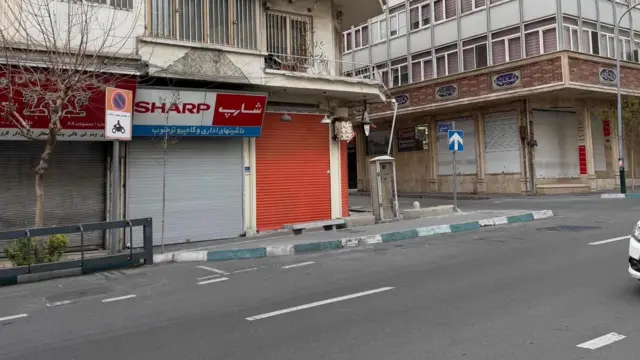
    Iranshahr street is seen in this photo. the roads are empty, shops are shuttered.Image source, SUPPLIED
    Image caption,

    Iranshahr Street is deserted

    We're hearing more now from a local in Tehran, who earlier described empty streets and security checkpoints in the Iranian capital. As a reminder, we have not named the local because of the threat of retaliation in Iran.

    He says most of the shops are closed on Iranshahr Street, a normally bustling neighbourhood.

    "That’s where I meet my friends," he says. "Even though we saw each other one or two weeks ago, it feels like we haven’t heard from each other for months."

    They are sharing what they have learnt about areas that are targeted by US-Israeli strikes, info they have gathered from a friend with VPN access.

    "It’s a strange feeling - in some ways similar to the days of the pandemic," the resident says. "Everyone is living with a sense of fear and uncertainty, not knowing what might happen next. But deep down we know that sooner or later it will end and life will return to normal."

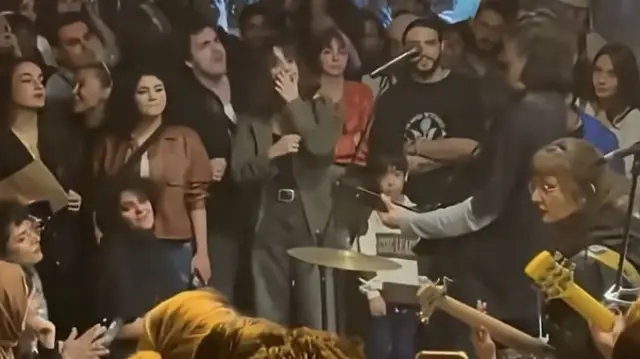
    He says it’s risky to take pictures and videos from the ground, but has shared a snapshot of Iranshahr street. It's the same place a rock band went viral for playing an outdoor show just a few months ago, he says. After the video's popularity, the government banned the musicians from playing the music.

    a rock band is surrounded by fans. they play guitars and drumsImage source, Supplied
    Image caption,

    A rock band went viral a few months ago for playing a show on this now-deserted street

  19. Streets of Tehran empty: 'It is completely dead', resident sayspublished at 13:16 GMT 5 March

    Soroush Pakzad
    BBC News Persian

    Contacting people within Iran is difficult because of the internet shutdown in the country. As a result, it is not easy to get a clear picture of the mood in the cities.

    What we do know is that the streets are quiet - but there is a strong security presence in major cities like Tehran and Isfahan, too.

    A local tells me he left his home after five days and passed through the tree-lined Naft Street in Tehran. It's a residential area where the administrative building of the Expediency Discernment Council was targeted on Monday night.

    We are not naming the local due to concerns for his safety.

    He says a drive that would have taken up to two hours due to traffic was unusually fast. Checkpoints have been established nearby by security forces, he adds.

    "Fortunately they didn’t stop me," he says. "Generally, whenever I see a checkpoint I feel stressed, even though I have never had anything with me or done anything that I should be afraid of."

    On nearby Iranshahr Street - normally lively and crowded with patrons heading to local cafes - "it is completely dead", he says.

  20. Israeli forces strike building allegedly used by Hezbollah in Lebanonpublished at 13:08 GMT 5 March

    Alice Cuddy
    Reporting from southern Lebanon

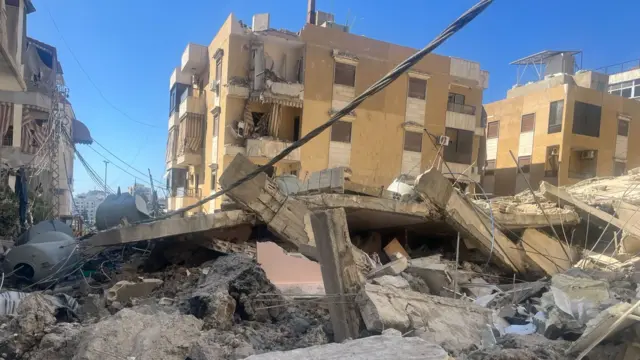
    Wide shot showing debris of buildings in Saida, Lebanon. There's three residential four-storey buildings in the background showing signs of heavy damage

    I’m in the southern city of Saida at the site of a building destroyed in an Israeli strike this week.

    The Israeli military issued an evacuation warning ahead of the strike, saying the apartment building was being used by the Iran-backed group Hezbollah.

    People living nearby tell us they believe everyone left the area following the evacuation order and that no one was killed.

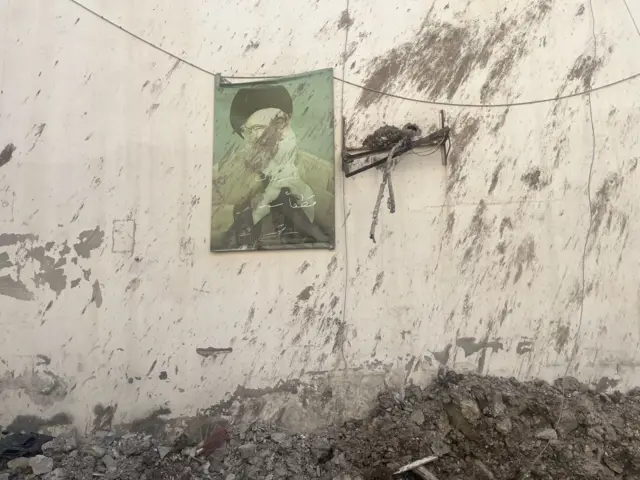
    On a wall next to the rubble is a poster of former Hezbollah leader Hassan Nasrallah who was killed by Israel in 2024.

    People living in an apartment next to the collapsed building have been cleaning debris from their balcony.

    “There was nothing here. Only people,” 43-year-old cafe owner Ahmed calls down.

    “Show the Israelis there’s nothing. Show them we’re civilians,” a woman says as she walks past the fallen building.

    A man sitting nearby tells me: "There are displaced people who came so maybe that’s why?”

    In the warning ahead of the strike, an Israeli military spokesman described the building as “Hezbollah military infrastructure” and said it was being targeted because of its “prohibited attempts to rebuild its activities in the area”.

    A scratched out poster of former Hezbollah leader Hassan Nasrallah hanging from a damaged wall