Summary

  • Our live coverage of the Iran war continues on a new live page. Follow this link for the latest updates.

  • In Jerusalem, sirens sounded and there were booms in the skies above, as families celebrated the first night of Eid - Iranian state TV has confirmed it fired four salvos of missiles in quick succession, writes our correspondent there

  • Elsewhere in the region, Saudi Arabia and Bahrain both say they have intercepted and destroyed drones

  • Iran's foreign minister earlier warned that Tehran would act with "zero restraint" if there were further attacks on its infrastructure

  • Prime Minister Benjamin Netanyahu has said Israel "acted alone" in strikes on Iran's South Pars, part of the world's largest natural gas field. He added Trump was not "dragged" into the war with Iran - here's the context

  1. Trump to take part in 'dignified transfer' of killed US military personnelpublished at 17:42 GMT 18 March

    Bernd Debusmann Jr
    Travelling with President Trump
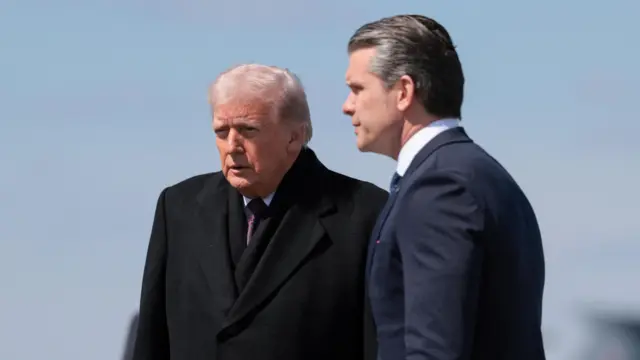
    Trump and HegsethImage source, Reuters

    I'm currently at Dover Air Force base in Delaware, where President Trump is about to participate in what is known in the US military as a "dignified transfer" of military personnel killed overseas.

    This will be the second of these that President Trump has attended since the war with Iran began, following the 7 March return of six US soldiers killed by an Iranian drone strike on a base in Kuwait.

    Today, the event will mark the return of another six service members who were killed when their KC-135 refueling aircraft crashed in Iraq while supporting Operation Epic Fury.

    Unlike the first time, today there is no expectation that the travelling press pool will be able to see the actual procedure.

    I was also at the 7 March dignified transfer. It was a solemn occasion, and the mood was very sombre.

    The process itself is well rehearsed, and familiar to many Americans who followed the wars in Iraq and Afghanistan.

    The fallen will be brought out in "transfer cases" which are used to transport the fallen to Dover and are later placed in caskets to be transported to the soldier's final resting place.

    Photographs, live images and audio were not permitted, nor are phones allowed once the process begins. We were repeatedly told that terminology is important - and that this is not a "ceremony".

  2. Several Gulf states brace for potential Iranian strikes on energy sitespublished at 17:36 GMT 18 March

    Frank Gardner
    Security correspondent, in Doha

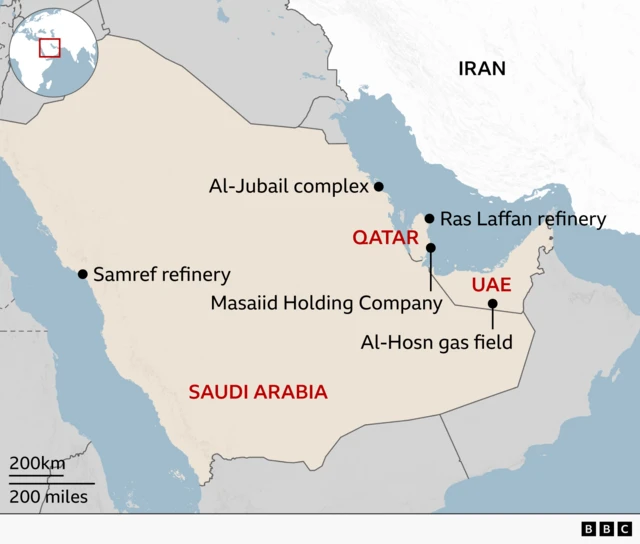
    Several of the Gulf Arab states are now bracing themselves for Iran’s retaliation after Israel struck Iranian facilities in the South Pars field, the world’s largest gas field today.

    Iran’s press agency linked to the IRGC has listed sites in Saudi Arabia, UAE and here in Qatar that it says Iran will soon be hitting in response to the Israeli attack early on Wednesday.

    The South Pars and the adjacent North Dome fields have been shared amicably for years between Iran and Qatar.

    Today Qatar’s Foreign Ministry spokesman, Majed Al Ansari, condemned Israel’s attack on this economic target as being "reckless and irresponsible".

    A map of the Gulf region highlighting five energy facilities in the Gulf that have been threatened by Iran: the Al‑Jubail complex in the northeast of Saudi Arabia and the Samref refinery on the Red Sea coast of Saudi Arabia; the Ras Laffan refinery and the Masaiaid Holding Company in Qatar; and the Al‑Husn gas field in the UAE
    Image caption,

    The five areas Iranian media said should be evacuated because they were now considered targets

  3. Two messages by Iran’s news supreme leader published by Iranian outletspublished at 17:29 GMT 18 March

    Ghoncheh Habibiazad
    Senior reporter, BBC Persian

    Mojtaba KhameneiImage source, AFP via Getty Images
    Image caption,

    Mojtaba Khamenei has not been seen since succeeding his father to become Iran's supreme leader

    Iranian outlets and the Telegram channel affiliated with Iran’s new Supreme Leader Mojtaba Khamenei have published two messages attributed to him.

    In the messages, Khamenei expresses his condolences over the death of Iran's top security official, Ali Larijani and others killed with him, and the head of the paramilitary Basij force, Gholamreza Soleimani.

    In the message for Larijani, Khamenei says that "every drop of blood has its price, which the criminal killers of the martyrs will soon have to pay".

    The statements are the third and fourth messages published by Khamenei after his succession as Iran’s Supreme leader.

    Mojtaba Khamenei, who was chosen as his father's successor on 8 March, has yet to be seen in-person - or filmed or photographed - since being named as the late Ayatollah Ali Khamenei’s successor.

  4. 'I'm losing my mind': Passengers finally able to fly out of Dohapublished at 17:02 GMT 18 March

    Barbara Plett Usher
    Reporting from Doha

    I flew out of Doha today. The airport was quite busy – the Qataris establish a secure air corridor and schedule a limited number of flights each day.

    In fact, it felt normal until a security alert went off just after I checked in.

    Everything stopped – you could hear the explosion of the interception and then we waited for the all-clear signal.

    "I just want to go home," said the man standing next to me. He was from Iraq and had actually been on a flight home the day the war started. It had to turn back.

    "I’ve been here 20 days and I’m losing my mind."

    Several hours into the flight, I took my laptop out of my backpack and it fell off my tray table with a bang.

    "You scared me," said the woman behind me, "I thought it was another explosion, and then I remembered where I was."

    She was on her way to visit family for a week of rest – "I haven’t been sleeping", she told me.

  5. Large crowds gather in Tehran for funerals of senior officialspublished at 16:51 GMT 18 March

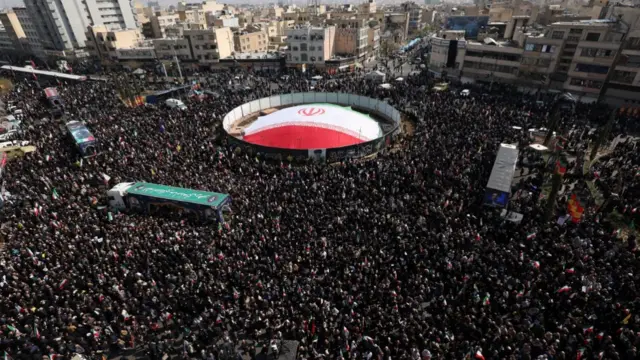
    These are the latest images coming to us from Tehran where large crowds have gathered in the Iranian capital.

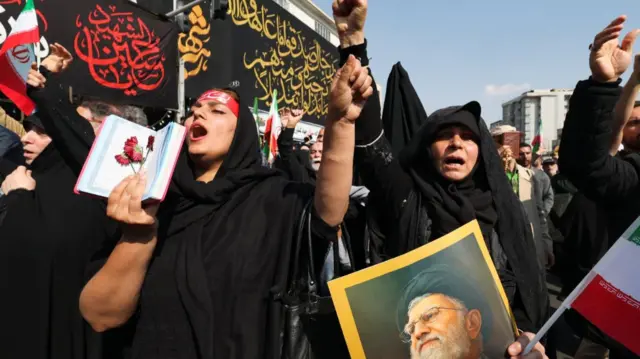
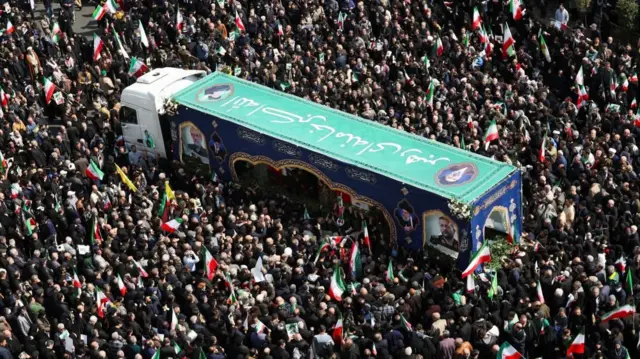
    People have congregated in large numbers for the funerals of Ali Larijani, Iran's security chief, and Gholamreza Soleimani, the head of the Basij paramilitary force, killed in strikes this week.

    Trucks carrying coffins draped in Iranian flags moved through the procession in Enghelab SquareImage source, Reuters
    Women chant slogans during the funeral of Iranian security chief Ali Larijani and victims of the IRIS Dena warship at Enghelab SquareImage source, Reuters
    A lorry passes through the crowd as part of the funeral processionImage source, Reuters
  6. Saudi defence ministry says it is dealing with 'ballistic threat' in Riyadhpublished at 16:42 GMT 18 March
    Breaking

    Saudi Arabia's Ministry of Defence has said the country's air defences are "dealing with a ballistic threat in Riyadh".

  7. Here's what to know about the South Pars gas field at a glancepublished at 16:41 GMT 18 March

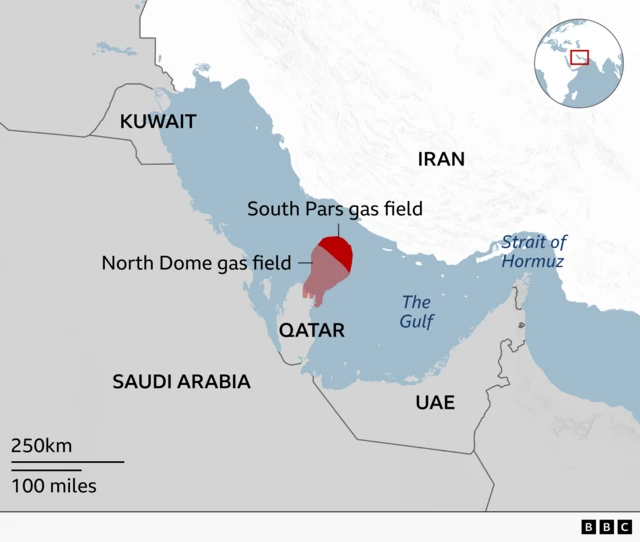
    A map of the Gulf region showing the major South Pars/North Dome gas field shared by Qatar and Iran. The field sits right on Qatar's northeast coast and extends out into the Gulf. Surrounding countries include Kuwait to the northwest, Iran to the north, Saudi Arabia to the south and west, and the UAE to the southeast. The body of water is labelled The Gulf, with the Strait of Hormuz marked at the eastern opening.

    As we've been reporting, Iran says its South Pars gas field facilities have been attacked.

    It blames Israel and the US. Neither has commented. A spokesperson for Qatar's foreign ministry blamed Israel, calling it "dangerous and irresponsible".

    South Pars is part of the world's largest natural gas field. It's located offshore, in the Gulf, between Iran and Qatar.

    In March 2024, BBC Monitoring reported that South Pars' output accounted for 70% of Iran's total gas production.

  8. UK defence minister says scope of threats in the Strait are complex and challengingpublished at 16:12 GMT 18 March

    Jonathan Beale
    Defence correspondent

    British defence sources say they are still talking to the US military and other allies about options to open up the Strait of Hormuz.

    A number of UK military specialists have been sent to US Central Command in Florida to help with planning - in addition to the small team of UK military personnel already stationed there.

    Defence Minister Al Carns said the UK was also talking to allies about what they might do together.

    He emphasised that the situation would require a multi-national response.

    Carns said the discussions were still at "very early stages". He said the scale and scope of the threats in the Strait of Hormuz was complex and challenging.

    He explained any escort mission would be far more complex than the one carried out in the Strait of Hormuz in 1987 - during the war between Iraq and Iran - which involved more than 30 warships.

    A defence source tells me the situation was fluid.

    Some Royal Navy assets had been placed on higher readiness, but he said given the current level of threat they did not see many nations willing to put warships into the Strait right now.

  9. Analysis

    Iran could be latent, long-term threat to shipping in Strait of Hormuzpublished at 15:53 GMT 18 March

    Frank Gardner
    Security correspondent in Doha

    The US Air Force’s use of 2,200kg deep ordnance penetrator bombs against Iran’s missile sites near the Strait of Hormuz will have a significant short-term effect.

    US intelligence had established that these reinforced underground sites were where Iran was storing and possibly preparing to launch powerful anti-ship cruise missiles at shipping transiting the Strait.

    But Iran has geography on its side. With a Gulf coast totalling more than 1,500km (930 miles) and numerous islands, it has by far the largest coastline in the region.

    That offers plenty of places to hide weapons that can target shipping.

    So, unless there is a change of regime or policy in Tehran, then the Islamic Republic could well continue to be a latent, long-term threat to shipping for years to come.

  10. Iraq's gas supply from Iran halted after strikes - Iraqi mediapublished at 15:25 GMT 18 March

    Iraq's gas imports from Iran have been halted following strikes on Iranian gas facilities, Iraq's electricity ministry says in a report carried in Iraqi media.

    Iraq currently imports more than a third of its gas and power needs from Iran, according to the Reuters news agency.

    Electricity ministry spokesman Ahmed Moussa tells the Iraqi News Agency: "As a result of the repercussions of developments in the region, Iranian gas flows to Iraq stopped completely."

  11. No injuries reported at Iran gas facility hit by strikes - Iranian mediapublished at 15:13 GMT 18 March

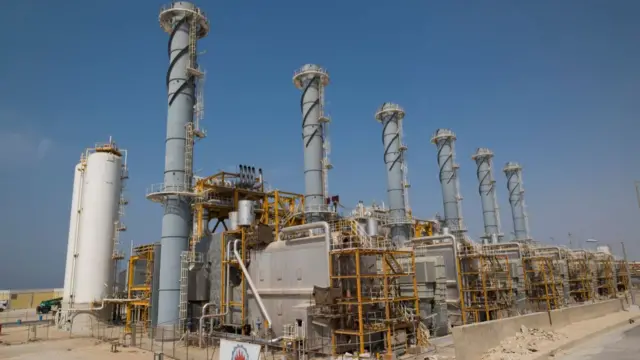
    A view of a part of phase 19 of the South Pars gas field in Iran. Large petrochemical plant can be seen with lots of tall towers, stair cases, cooling tubes and laddersImage source, Getty Images

    Iranian media is reporting that no one was killed or injured as a result of attacks on the country's petrochemical complex on the South Pars gas field.

    The oil ministry says efforts to control the fire are still under way, according to the Tasnim news agency, which is affiliated with Iran's Islamic Revolutionary Guard Corps (IRGC).

    Tasnim also reports that the attack occurred earlier on Wednesday, blaming action "by Israel and the US", saying in response "all oil and gas refineries and centres in the regime and the Gulf region in which the Americans have a stake will be targeted".

    Qatar's foreign ministry spokesman, Majed Al Ansari, said earlier that the South Pars facilities were targeted by Israel.

  12. Iranian military says it 'will retaliate strongly' to strikes on energy infrastructurepublished at 15:01 GMT 18 March

    Iran's armed forces has warned it will take "decisive action" in response to attacks on its energy infrastructure, according to a statement carried on the IRGC-affiliated news agency Tasnim.

    As we've been reporting, Iran has said its facilities at the South Pars gas field have been targeted.

    "The enemy has attacked part of Iran's fuel and energy infrastructure in the south," the Iranian military says in a statement.

    "As previously warned, if the fuel, energy, gas, and economic infrastructures of our country are attacked by the American-Zionist enemy, in addition to a powerful counterattack against the enemy, we will severely strike the origin of that aggression as well.

    "We consider targeting the fuel, energy, and gas infrastructures of the countries of origin legitimate and will retaliate strongly at the earliest opportunity," it adds.

    Qatar's foreign ministry spokesman, Majed Al Ansari, says the South Pars facilities were targeted by Israel.

  13. Iranian president says intelligence minister killed in 'cowardly assassination'published at 14:50 GMT 18 March

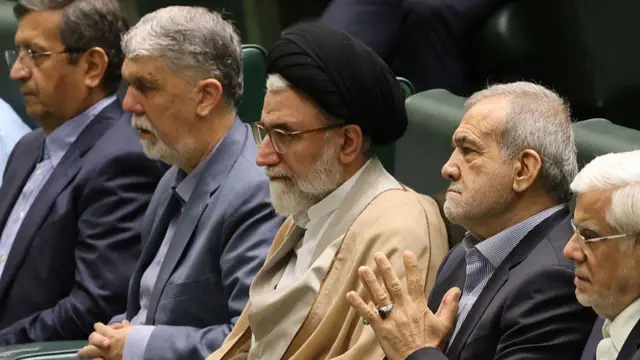
    Intelligence Minister Esmail Khatib sitting amongst members of parliamentImage source, Getty Images
    Image caption,

    Israel said earlier that it had killed Iran's Intelligence Minister Esmaeil Khatib (centre)

    As we've just reported, the Iranian President Mazoud Pezeshkian has confirmed the country's Intelligence Minister Esmail Khatib has been killed.

    In a post on X, Pezeshkian says: "The cowardly assassination of my dear colleagues Esmaeil Khatib, Ali Larijani, and Aziz Nasirzadeh, along with some members of their families and those accompanying team has left us mourning."

    The deaths of Larijani, Iran's top security official, and Nasirzadeh, the country's defence minister, have previously been confirmed.

  14. Iranian president confirms Intelligence Minister Esmail Khatib has been killedpublished at 14:37 GMT 18 March
    Breaking

    Iran's president has confirmed the Intelligence Minister Esmail Khatib has been killed.

    Israel earlier said it had killed Khatib in a strike overnight.

    We'll have more on this shortly.

  15. Strikes on Iranian energy facilities 'dangerous and irresponsible', says Qatarpublished at 14:02 GMT 18 March

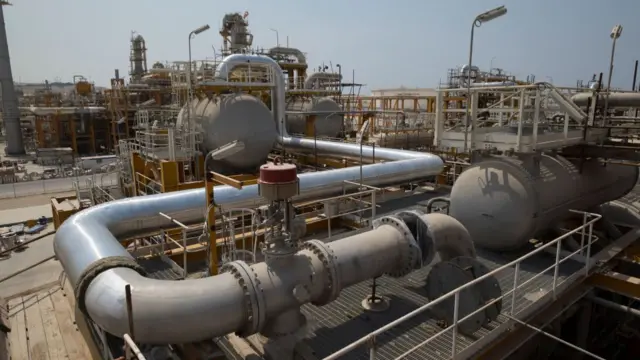
    A view of a part of the phase 19 of the South Pars gas field in Assalooyeh on Iran's Persian Gulf coast 1,400 km (870 miles) south of Tehran on August 23, 2016.Image source, Getty Images
    Image caption,

    Iranian facilities on the South Pars gas field, pictured in 2016

    Qatar says strikes against Iranian facilities - which it says were launched by Israel - linked to the world's largest natural gas field are "dangerous and irresponsible".

    Both Qatar and Iran operate facilities which extract from the same gas field, the Iranian side of which is known as South Pars.

    Iran says its petrochemical complex at the site has been hit.

    Qatar's foreign ministry spokesman, Majed Al Ansari, says strikes against energy infrastructure "constitutes a threat to global energy security".

    "We reiterate, as we have repeatedly emphasised, the necessity of avoiding the targeting of vital facilities," he says, calling on "all parties" to adhere to international law and work towards de-escalation

  16. Israel says further missiles incoming from Iranpublished at 13:53 GMT 18 March

    Israel says it has detected more missiles fired from Iran towards its territory, following a previous wave about two hours ago.

    The Israel Defense Forces (IDF) says air defence systems are in operation and those who need to shelter will receive alerts on their phone.

  17. Oil prices jump after reports Iranian gas field hitpublished at 13:30 GMT 18 March

    Rachel Clun
    Business reporter

    Oil prices leapt to more than $108 a barrel following Iranian media reports that a facility on the world’s largest natural gas field was struck.

    The Brent crude oil benchmark reached $108.60 a barrel around 13:00 GMT - up by 5% on Tuesday’s prices.

    It remains above $107.

    The benchmark UK gas price also soared, rising by nearly 6% to 139p a therm.

    Both those price spikes are below highs seen earlier in the conflict.

  18. Iran issues evacuation orders for energy facilities in Gulfpublished at 13:16 GMT 18 March

    Iran has issued evacuation orders for five energy facilities in the Gulf.

    The IRGC-affiliated news agency Tasnim posted on Telegram an "urgent warning" for citizens and residents near to:

    • The Samref refinery in Saudi Arabia
    • The al-Jubail petrochemical complex and Masaiid Holding Company in Saudi Arabia
    • The al-Hosn gas field in the United Arab Emirates
    • And the Ras Laffan refinery in Qatar

    The statement says: "These centres have become direct and legitimate targets and will be targeted in the coming hours.

    "Therefore, all citizens, residents, and employees are asked to immediately leave these areas and move to a safe distance without any delay."

  19. Iranians unsure whether to stay or flee as war ragespublished at 13:04 GMT 18 March

    Ghoncheh Habibiazad
    Senior reporter, BBC Persian

    As the US-Israeli war with Iran continues, Iranians have been telling the BBC about the tough choices they face over whether to stay or flee.

    A man in his 30s, from Tehran, says that leaving the country would mean "becoming a nobody".

    "I own a trucking company in Iran. I’m established and well known. So I can earn money," he says.

    "It doesn’t make sense to go somewhere else. So, no, I’m not planning on leaving Iran."

    A woman in her 20s, also from Tehran, tells us she is "leaning towards leaving".

    "We have some relatives in Canada and I was considering moving there but after talking with various people, I crossed it off," she says.

    She says she would have liked to have moved the US, but that this "isn't really an option now", so she's instead "considering Europe or other countries nearby".

    Their names have been withheld for their safety, as expressing dissenting views in Iran can lead to arrest or imprisonment.

  20. Watch: Huge crowds gather for funerals of top Iranian officialspublished at 12:46 GMT 18 March

    Large crowds have gathered in Iran for the funeral of Iran's top security official Ali Larijani, who was killed yesterday and and Gholamreza Soleimani, the head of the paramilitary Basij force.

    It is also being held for the 84 sailors killed when the US sank Iranian warship, the Iris Dena, with a torpedo on 4 March.

    Media caption,

    Huge crowds gather in Iran for Larijani and commander's funeral