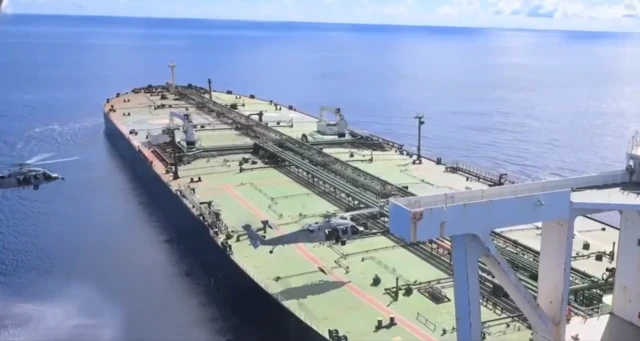
Summary

  1. BBC Verify

    What we know about the ship boarded by US forces in the Indian Oceanpublished at 17:18 BST 23 April
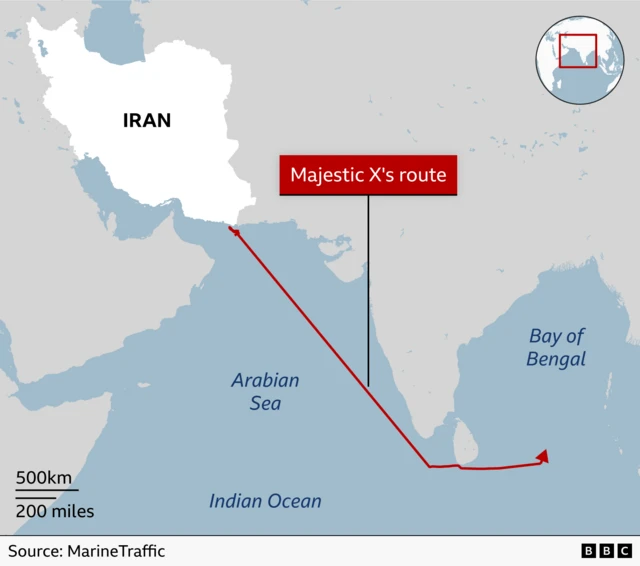
    A BBC map showing Majestic X/Phonix's route from the Gulf of Oman to east of Sri Lanka, based on ship-tracking data

    By Shayan Sardarizadeh and Alex Murray

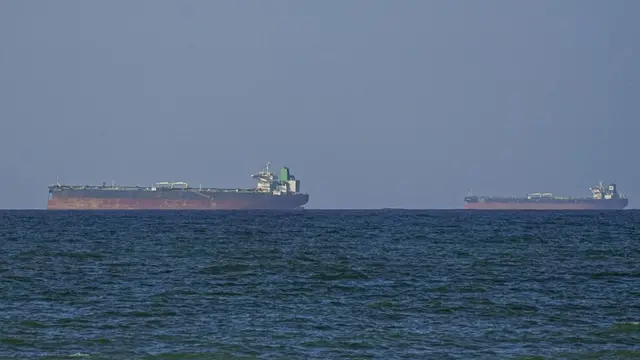
    We reported earlier the US Department of Defense posted footage of its forces intercepting a vessel called Majestic X in the Indian Ocean that it says was transporting oil from Iran.

    According to the US military, Majestic X is both “stateless” and under American sanctions, external.

    While the US identified the vessel as Majestic X, data from ship-tracking site MarineTraffic says it is also known as Phonix and sails under the flag of Guyana.

    Guyana , externalwarned in 2024, external that more than a dozen Iran-linked tankers were falsely flying its flag. We have contacted the Guyanese authorities to confirm if this is one of them.

    Using MarineTraffic data, BBC Verify has tracked the vessel’s route from near the Iran-Pakistan border early this month to the southern tip of Sri Lanka on Tuesday. The tanker appears to suddenly change course at around 04:00 GMT today before coming to a halt some hours later.

    According to monitoring group TankerTrackers the ship has helped Iran "export 20 million barrels”, external of oil since 2023.
  2. US says it has redirected 33 vessels since blockade of Iran beganpublished at 17:14 BST 23 April

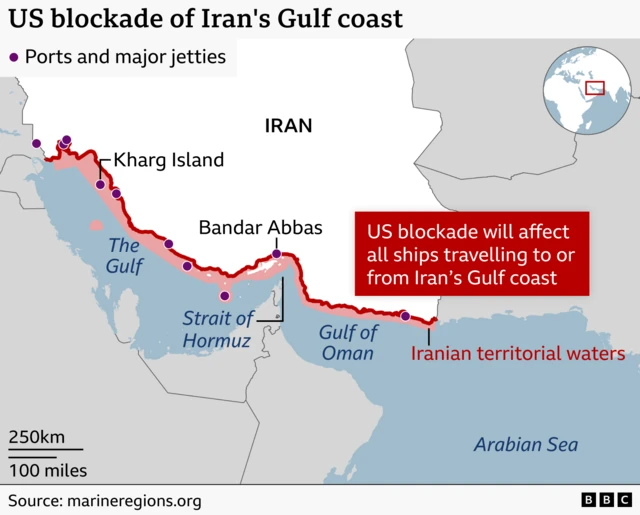
    US Central Command (Centcom) says it has redirected a total of 33 vessels since the beginning of its naval blockade of Iran.

    The update, posted on X, comes after the military said earlier on Thursday it had turned around 31 vessels up to that point.

    The US also announced today it had interdicted and boarded a sanctioned vessel that it said was transporting oil from Iran.

    Map titled “US blockade of Iran’s Gulf coast” showing Iran’s southern coastline along the Persian Gulf, Strait of Hormuz and Gulf of Oman highlighted in red to indicate a blockade. Iranian territorial waters are shaded, with a caption stating, “No ships permitted to approach or leave Iranian coast.” Ports and major jetties are marked with purple dots, including Kharg Island and Bandar Abbas. Surrounding seas are labelled, including the Arabian Sea, and a distance scale, source credit, and BBC logo are visible.
  3. Stranded oil tanker crew 'scared, exposed' amid blockade threatspublished at 16:54 BST 23 April

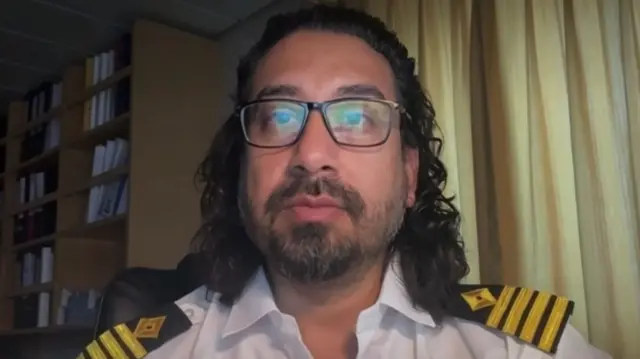
    Ramon Kapoor wears a captain's uniform, speaking to the BBC via video link. He is in front of drawn curtains and a bookshelf.

    Crew members stranded by the Strait of Hormuz blockade fear for their safety and security, an oil tanker captain tells BBC News.

    Ramon Kapoor's ship has been trapped since the start of the Iran war, unable to leave the Gulf.

    "My current situation is really unpredictable," he says. "The situation remains tense onboard ship... our repatriation has been delayed by many days or months."

    Kapoor describes being caught amid attacks earlier in the war, with "missiles passing over our head, we felt several explosions".

    He says his crew is "scared" and feels "exposed" following multiple attacks on ships in recent days.

    Iran has fired on a number of ships that have tried to transit the strait without its permission, and detained two vessels on Wednesday.

  4. 'Whatever I’m doing, it seems to be working very well': Trump when asked by BBC about 'civilisation' threatspublished at 16:37 BST 23 April
    Breaking

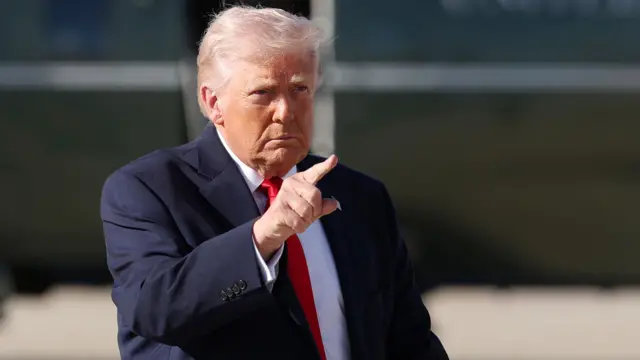
    U.S. President Donald Trump walks to Air Force One on April 11, 2026Image source, Getty Images

    US President Donald Trump has told the BBC that "whatever I’m doing, it seems to be working very well" when asked about his threats towards Iran.

    The BBC's North America editor Sarah Smith spoke to the president in a brief phone call, in which she asked if his statement earlier this month that a "a whole civilisation will die tonight" was a threat to use nuclear weapons against Iran.

    "The other side is dying to make a deal," he replied. "So whatever I’m saying or whatever I’m doing, it seems to be working very well. Thank you very much."

    On Nato, Trump said the US "didn't need them at all" in its war with Iran but that they "should've been there".

    When Smith asked why, then, he wanted them to join the war, Trump replied: "Because I wanted to see whether or not they would be involved."

    He said the US has "always been for" the UK and Nato, and criticised the UK for not making "at least a minimal effort and at least nicer words".

    He added that "many people from the UK" have let his administration know how "incredibly bad a decision" it was for the UK to not get involved in the war (the UK has only allowed the US to use its bases for "defensive" air strikes).

    Earlier in the call, Trump said he believed his relationship with UK Prime Minister Keir Starmer could "recover" if he "opened the North Sea" and if his "immigration policies became strong" - but added that "if he doesn’t, I don’t think he has a chance".

  5. What we've heard during the conflict about mines in the Strait of Hormuzpublished at 16:29 BST 23 April

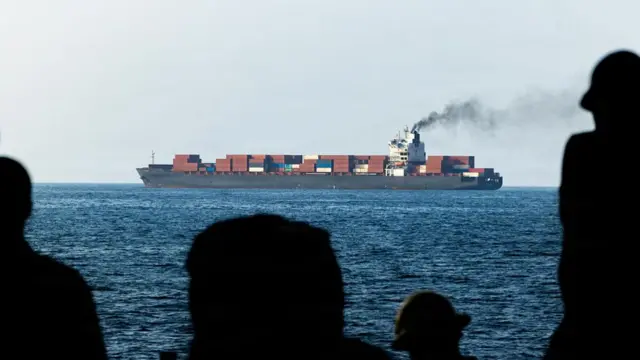
    A view of the vessels heading towards the Strait of Hormuz following the two-week temporary ceasefire reached between the United States and Iran on the condition that the strait be reopened, seen in Oman on April 08, 2026.Image source, Getty Images

    Trump's latest threat against Iranian vessels is not the first time the danger of mines in the strait has been raised throughout the war:

    • On 10 March, the US said it had hit 16 Iranian mine-laying vessels operating near the Strait of Hormuz, in what it said was the "most intense" wave of strikes up to that point
    • Two days later Iran's deputy foreign minister Majid Takht-Ravanchi denied that Iran had been laying any mines in the strait
    • Despite this, following the US-Iran ceasefire agreed on 8 April, Iran opened the waterway and warned ships to follow designated routes or risk hitting mines
    • On 12 April, Trump said the US would use the ceasefire to continue to clear mines from the Strait of Hormuz to secure safe passage
    • UK Prime Minister Keir Starmer said on 13 April that British minesweeping ships were continuing to operate in the region but said the UK would not join the US blockade
    • So far, there have been no reports of any vessels being damaged by mines in the strait since the outbreak of the current war
    • Trump says today US minesweepers are continuing to clear the strait "right now"
  6. Pentagon dismisses reports of six-month mine clearing timeline for straitpublished at 16:21 BST 23 April

    The Pentagon has hit out against media reports that US forces may need six months to clear the Strait of Hormuz of any mines that pose a threat to shipping.

    "One assessment does not mean the assessment is plausible, and a six month closure of the Strait of Hormuz is an impossibility and completely unacceptable to the Secretary,” Pentagon Chief Spokesman Sean Parnell tells the BBC.

    "The media cherry picking leaked information, much of which is false, from a classified, closed briefing is dishonest journalism."

  7. Analysis

    Trump's threat on Iranian boats: A sign of the campaign to come?published at 15:59 BST 23 April

    Bernd Debusmann Jr
    White House reporter

    We reported earlier Trump said he'd ordered the US Navy to "shoot and kill" any small boats believed to be putting mines in the Strait of Hormuz.

    While we don't know exactly what prompted the post, US media reported that Congress was told in a closed door briefing that it may take US forces as many as six months to clear the Strait of any mines that may pose a threat to shipping.

    The Pentagon has pushed back on that assessment, but the fact remains that shipping companies very much need assurances of viable, secure shipping lanes for the global economy to reset after the conflict ends - a fact that Trump is very much aware of.

    More broadly, Trump's comments - and similar comments by Press Secretary Karoline Leavitt yesterday - suggest that the US may be taking a new approach to the conflict.

    The president has now repeatedly suggested that pinprick strikes on small Iranian vessels are a preferred option to a return to the sort of full-scale combat operations that the world saw during Operation Epic Fury.

    This isn't without precedent. US forces have been conducting a similar, slow-burn campaign against alleged drug trafficking boats in the Caribbean and Eastern Pacific for months now.

    This approach would give Trump significant flexibility - allowing the blockade on Iran's ports and efforts to cut it off from the global financial markets time to bite, while also allowing Trump to avoid a potentially messy return to full-scale war.

  8. Israeli military issue fresh warning for southern Lebanonpublished at 15:45 BST 23 April

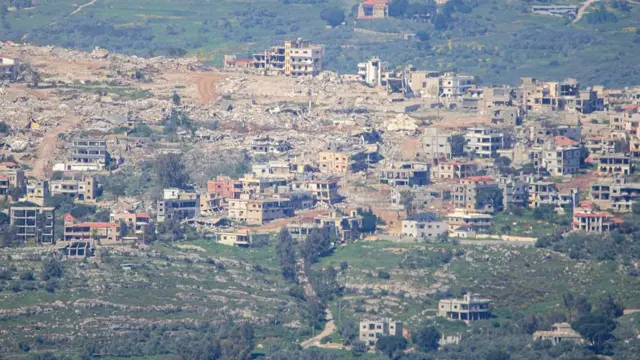
    Damaged buildings in Al-Khiyam, southern Lebanon, seen on ThursdayImage source, Getty Images
    Image caption,

    Damaged buildings in Al-Khiyam, southern Lebanon, seen on Thursday

    Ahead of ceasefire talks between Israel and Lebanon, tensions remain high on the ground in Lebanon's south.

    The Israeli Air Force says in a post on X that it "eliminated" an individual operating at a Hezbollah launch site in Sejoud, southern Lebanon, on Wednesday.

    Israel Defense Forces (IDF) spokesperson Avichay Adraee has also issued a warning in a post on X to residents of villages along the southern border of Lebanon while the Israeli military continues to operate within the area due to the "ongoing terrorist activities of the Hezbollah organisation".

    Lebanon's state-run National News Agency separately reports on Thursday of a bombing in Khiam and an explosion in Bint Jbeil, both in southern Lebanon.

    The IDF has not commented publicly on the claims made by the agency and the BBC has not been able to independently verify them.

    Israel and Lebanon last week announced a 10-day ceasefire, which took effect from 17:00 EST (21:00 GMT; midnight local time) on 16 April. Hezbollah and Israel have accused each other of violating the ceasefire agreement.

  9. Lebanon wants US to use 'leverage over Israel' in Washington talkspublished at 15:13 BST 23 April

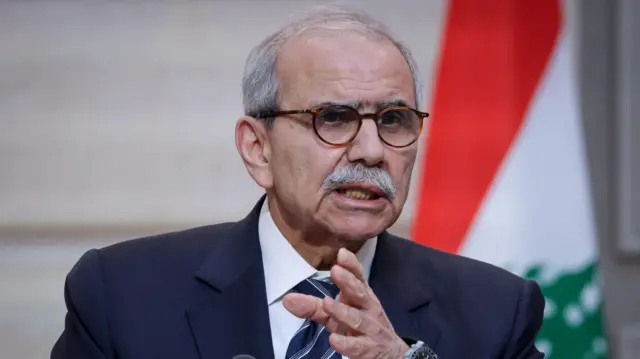
    Lebanese prime minister Nawaf SalamImage source, Reuters

    The Lebanese prime minister has told the Washington Post that his government wants the US to use "leverage over Israel" ahead of talks in Washington DC later.

    “We are entering these negotiations convened by the US convinced that the US is the party that can have leverage over Israel,” Nawaf Salam tells the outlet.

    “Their role was critical in reaching the ceasefire, and we hope they will continue exercising their leverage over Israel.”

    As Israeli forces continue to operate in southern Lebanon, Salam says his country "cannot live with a so-called buffer zone" and wants to see a full Israeli withdrawal.

    In terms of meeting Israel's demand of disarming Hezbollah, he says "it’s not something that’s going to happen overnight. But what’s more important is that we have shown seriousness".

  10. Journalists gather in Beirut to remember Amal Khalil, killed in Israeli attackpublished at 15:00 BST 23 April

    Hugo Bachega
    Middle East correspondent, reporting from Beirut

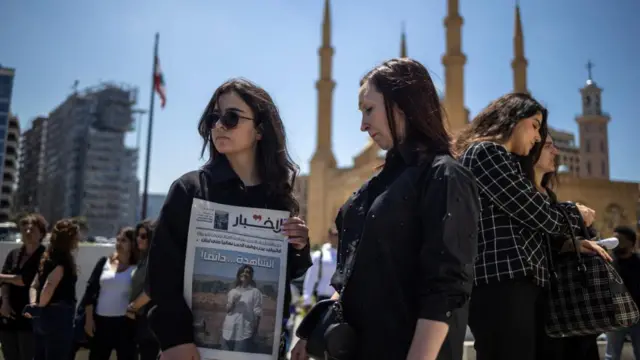
    Two women, one holding a newspaper with Amal Khalil's image on the front page, stand in a public square while wearing black.Image source, Reuters
    Image caption,

    Protesters, including members of the media, attend a vigil in Martyrs' Square in Beirut

    Lebanon’s president has accused Israel of deliberately and consistently targeting journalists in the country, urging the international community to act to stop the killings.

    This comes after journalist Amal Khalil was killed in an Israeli attack yesterday.

    Journalists gathered in Martyrs' Square in Beirut in silence this morning to remember her.

    The front page of the newspaper where she worked, Al Akhbar, featured a picture of her, microphone in hand, smiling.

    Lebanese officials say she was deliberately targeted by Israel in southern Lebanon while seeking shelter after an earlier air strike, and that the Israeli military then prevented rescuers from reaching her. Israel denies this but says it’s reviewing the case.

    The Committee to Protect Journalists says Israel has killed at least seven other reporters in Lebanon during this war, and dozens more before both here and in Gaza.

  11. Analysis

    Tehran is pushing to change the entire model of global trade in the Gulfpublished at 14:45 BST 23 April

    Frank Gardner
    Security correspondent

    The idea of Iran – or any nation – demanding a compulsory toll from vessels transiting the vital Strait of Hormuz waterway is anathema to both the neighbouring Gulf Arab states and to the global shipping industry.

    Ever since 1968, when it was ratified by the International Maritime Organisation, a carefully worked-out system has been in place by which vessels pass through the strait to pick up their cargoes from Gulf ports and terminals.

    That system is known as the Traffic Separation Scheme (TSS).

    In the narrow, normally congested channel between the coastlines of Iran to the north and Oman to the south, inbound ships pass one way and outbound ships pass in the opposite direction, separated by a buffer zone of two miles to avoid collisions. It works.

    But the Islamic Republic, which has managed to survive more than 20,000 combined US and Israeli airstrikes over a period of 39 days, is now pushing to change the whole paradigm of global trade in the Gulf.

    Instead of the pre-existing TSS, it is demanding that – when the strait is open - all shipping follows a different route, designated by the IRGC Navy, forcing it to pass close to the Iranian islands of Larak and Qeshm.

    There, says Iran, they will be checked over by naval officers and pay a fee according to the size and value of their cargo.

  12. Iranians 'don't know' who their leader is, Trump claims - while claiming 'total control' of straitpublished at 14:26 BST 23 April
    Breaking

    The US President claims Iran is "having a very hard time figuring out who their leader is" in a new post on Truth Social.

    "They just don’t know!" writes Trump, claiming there is "CRAZY!" infighting in the country between "hardliners" and "moderates".

    He adds that the US has "total control" over the Strait of Hormuz and that no ship can enter or leave without US approval, minutes after posting that he has ordered the navy to fire on any Iranian vessels laying mines.

  13. Why the US is blockading the Strait of Hormuzpublished at 14:14 BST 23 April

    Trump's latest directive comes after US forces announced earlier this month they would intercept vessels travelling to or from Iran's ports.

    US President Donald Trump hopes to put pressure on Iran by targeting two economic drivers - the huge tolls it demands ships pay to pass through the Strait of Hormuz, and its oil revenue.

    Trump previously told Fox News that "we're not going to let Iran make money on selling oil to people that they like and not people that they don't like".

    Iran calls the blockade "piracy", and its top negotiator, Mohammad Bagher Ghalibaf, says reopening the strait is "not possible" while the US maintains its naval blockade.

    The US says it has intercepted dozens of vessels since it began its blockade, and its defence department says it will continue to interdict vessels suspected of "providing material support to Iran".

  14. Trump to US Navy: 'Shoot and kill any boat' laying mines in the Strait of Hormuzpublished at 14:01 BST 23 April
    Breaking

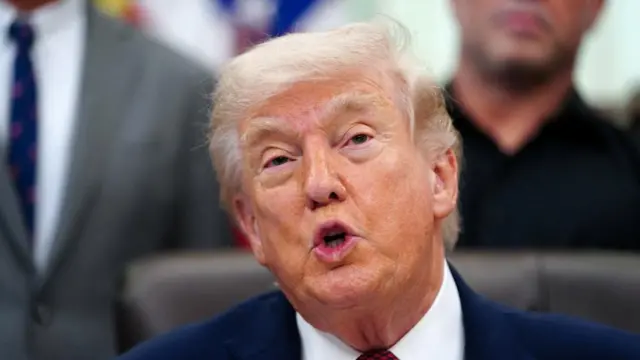
    Donald Trump speaking while sitting in his chair in the Oval Office.Image source, Reuters

    Donald Trump says he has ordered the US Navy to shoot at any boat laying mines in the Strait of Hormuz.

    "I have ordered the United States Navy to shoot and kill any boat, small boats though they may be... that is putting mines in the waters of the Strait of Hormuz," he says in a post on Truth Social.

    "There is to be no hesitation."

    He adds US mine “sweepers” are clearing the strait "right now".

  15. The latest on the US's naval blockade of Iranpublished at 13:55 BST 23 April

    In this handout photo provided by U.S. Central Command, U.S. forces patrol the Arabian Sea near M/V Touska on April 20, 2026Image source, Getty Images

    After the Pentagon announced its forces had intercepted another vessel, this time in the Indian Ocean, here's the latest on the US's naval blockade of Iran:

    • US Central Command (Centcom) says it has ordered 31 vessels to turn around or return to port since the blockade of the Strait of Hormuz began
    • It added that 10,000 service personnel, more than 100 aircraft and 17 warships are involved in the operation
    • On Sunday, the US announced that it had intercepted the Iranian flagged cargo ship the Touska, which it says failed to respond to a warning to stop - an interception Iran branded an "act of armed piracy"
    • On Tuesday the Pentagon said US forces had boarded a "sanctioned" tanker in the Indo-Pacific area of command it claims was providing material support to Iran
    • Speaking on Wednesday, White House Press Secretary Karoline Leavitt said the US president was "satisfied" with the blockade, which she said was "completely strangling" Iran's economy
    • Yesterday Centcom also denied media reports several Iranian-linked vessels had slipped through the blockade
  16. Indian Ocean operation comes days after US boarded another shippublished at 13:35 BST 23 April

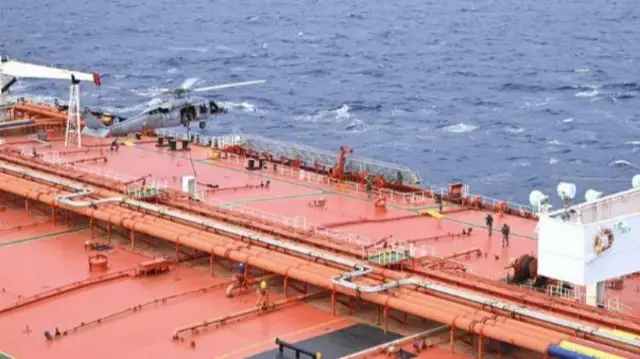
    A US military helicopter hovering above the orange deck of a tanker.Image source, US Department of War

    The US operation in the Indian Ocean comes days after its forces boarded a tanker in its Indo-Pacific area of command.

    On 21 April, the US Department of Defence published a post on social media, saying its forces intercepted and boarded the "stateless sanctioned M/T Tifani".

    In the post, the department says: "We will pursue global maritime enforcement efforts to disrupt illicit networks and interdict sanctioned vessels providing material support to Iran - anywhere they operate."

  17. US forces board sanctioned ship in Indian Ocean, defence department sayspublished at 12:41 BST 23 April
    Breaking

    US forces have interdicted a sanctioned vessel that is transporting oil from Iran, the country's defence department has posted on X.

    "US forces carried out a maritime interdiction and right-of-visit boarding of the sanctioned stateless vessel M/T Majestic X transporting oil from Iran, in the Indian Ocean," the statement says.

    The department says that the US military will continue to interdict vessels suspected of "providing material support to Iran".

    A maritime interdiction refers to the interception or inspection of a vessel by a navy on ships suspected to be hostile or in violation of the law.

    The US has intercepted dozens of vessels since it began its blockade of the Strait of Hormuz. It is not intercepting these ships near Iran, but further away in the Indian Ocean.

    A video still shows US helicopters landing on a ship.Image source, US Department of Defence
  18. BBC Verify

    Iranian ship seizure video appears to have been filmed after initial attackpublished at 12:14 BST 23 April

    Media caption,

    Iranian state broadcaster released footage it claimed showed soldiers seizing cargo ships

    By Paul Brown

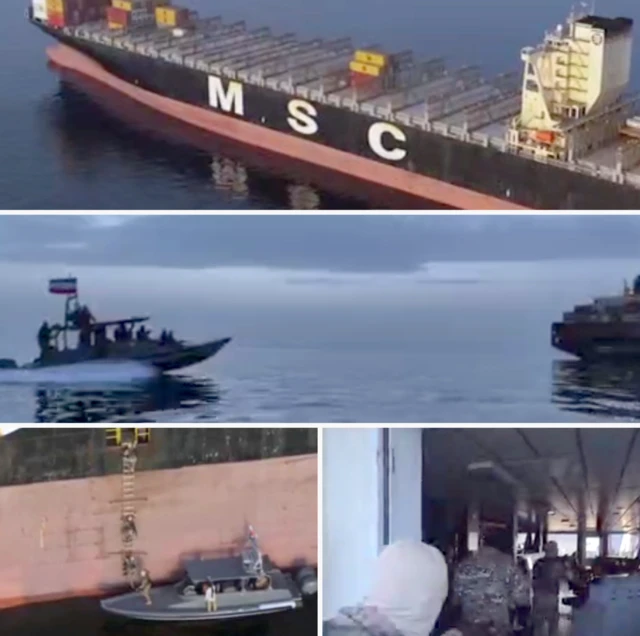
    BBC Verify has looked into a video said to show the Islamic Revolutionary Guard Corps (IRGC) approaching two cargo ships in the Strait of Hormuz yesterday, which appears to have been filmed after they were initially attacked.

    The two-minute video shows small boats carrying armed men approaching the MSC Francesca and the Epaminondas, both of which reported being fired upon yesterday morning.

    While the cargo ships are clearly identifiable, aerial shots appear to have been filmed around 15:00 BST (17:30 Iran time) due to the direction they are sailing matching with vessel-tracking data at this time. This is several hours after the initial reported attack - and there are other indications parts of the footage may have been staged for the camera.

    A composite image of grabs from the IRGC video - showing the container ship, a small IRGC speedboat, men climbing on to the ship and armed men inside it

    For example, the hatch through which the men board the MSC Francesca is already open when the Iranian boat arrives. Another clip filmed on board the MSC Francesca also captures their arrival, suggesting someone was already in place on the vessel to record it.

    A different shot shows a boat approaching the stern of the Greek-owned Epaminondas, though it is unclear whether subsequent footage featuring the inside of a ship was filmed on board it or on the MSC Francesca.

    Greek authorities have denied Epaminondas has been seized, saying its captain remains in control.

    Ship tracking data shows the Epaminondas leaving the area and heading north-west towards Qeshm Island before its transponders were switched off. The MSC Francesca’s transponders were also turned off yesterday, after broadcasting the ship remained in the area of the attack for several hours.

  19. In this conflict, the Iranian clock is longer, says former US diplomatpublished at 11:51 BST 23 April

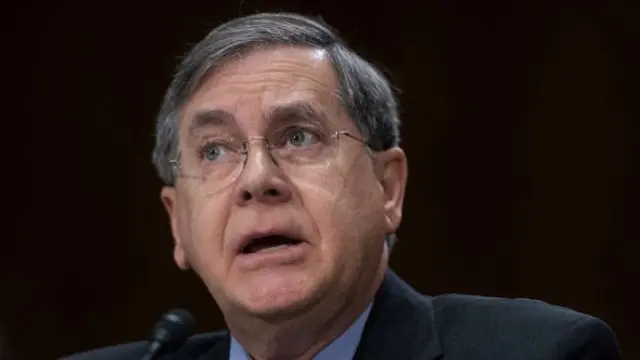
    David Satterfield speaks into a microphoneImage source, CQ Roll Call

    The outcome of the US-Iran war depends on "whose clock runs out first", says David Satterfield, a former US diplomat who advised the Biden administration.

    "My assessment is the Iranian clock is longer," he told the Today programme on BBC Radio 4 earlier.

    "Their capacity to absorb economic pain is greater than that of the US and President Trump,” he continues, while warning the US is at risk of falling into an "escalation trap".

    If the US escalates physically against Iran, Satterfield says that Iran's capacity to respond against Gulf states is "greater in terms of pain inflicted right now than the US can inflict on Iran".

  20. Iran and US both showing no signs of backing downpublished at 11:42 BST 23 April

    Lyse Doucet
    Chief international correspondent, in Tehran

    A woman in a blue outfit walks past fresh produce in TehranImage source, Getty Images
    Image caption,

    Daily life continues in Tehran, but residents say they're worried about the economic cost of the war

    Two rival blockades of the strategic Strait of Hormuz are now blocking progress in the talks.

    Neither the US nor Iran shows any sign of backing down.

    The US believes the grievous economic cost of this closure will push Tehran back to the negotiating table to accept its deal. Iran is certainly paying a steep price.

    We see it in this city. People tell us about job losses and price rises - they voice their worries about what’s to come.

    But Iran’s leaders won’t capitulate. It’s not in the DNA of this system.

    They believe they can absorb this pain, that the US will blink first. Intensive efforts are under way, including by the main mediator, Pakistan, to break this impasse.

    Yesterday, Iran’s lead negotiator, Mohammad Bagher Ghalibaf, posted on social media that the US blockade of its ports, as well as President Donald Trump’s repeated threats to bomb Iran, violated the ceasefire - he called them the main obstacles to “genuine negotiations”.

    Iran also has its commitments to keep under the terms of the fragile ceasefire, to “completely open” this maritime corridor. But it’s clear it will only ever be ready to do it, on its terms.

    The BBC's chief international correspondent Lyse Doucet is reporting from Tehran on condition that none of her material is used on the BBC's Persian Service. These restrictions apply to all international media organisations operating in Iran.