


Towards Home Rule
The rebellion failed, despite late French assistance, and led directly to the Act of Union between Britain and Ireland in 1801. Irish MPs, drawn from the Protestant Ascendancy, took seats in Westminster and the Irish parliament voted to abolish itself.
In the early 19th century, the Catholic Association was formed under the leadership of Daniel O'Connell, who turned it into a national movement to campaign for Catholic emancipation, which was achieved in 1829.
O'Connell's subsequent campaign to repeal the union failed, but the debate it inspired did see Ulster (Northern Ireland) first characterised as a 'special case', separate from the rest of Ireland.
'Ulster (Northern Ireland) was characterised as a 'special case', separate from the rest of Ireland.'
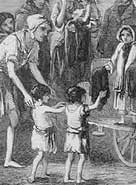
Reform ground to a halt during the cataclysm of the Great Famine of the late 1840s - a disaster brought about by potato blight and compounded by the British government's laissez faire economic policies. The combined factors of death, disease and emigration caused the Irish population to plummet by two million by 1851, to approximately six million people.
An abortive rebellion in 1848 reintroduced the use of violence as a means of achieving Irish autonomy. The Fenians (Irish Republican Brotherhood) attempted an uprising in 1867, but it was a complete failure and violent confrontation faded from the political agenda.
The Fenian rising did, however, draw the attention of British statesman William Ewart Gladstone to Irish matters. Gladstone first carried the 'Land Act' - an attempt to resolve some of the injustices of Irish land ownership - in an attempt to pacify Ireland. It failed, only increasing the Irish desire to run their own affairs from Dublin.
The creation in 1870 of what would become the Home Rule League, saw the emergence of a parliamentary lobby group for Irish self-government. Its leader, Charles Stewart Parnell, put Home Rule firmly on the parliamentary agenda, but ultimately failed to achieve his goal.
Gladstone similarly had little luck with his Home Rule Bills. His 1886 bill was lost in the Commons because of a Liberal Party revolt and the 1893 bill was defeated in the Lords.
Published: 2007-02-01