


Adam's tree
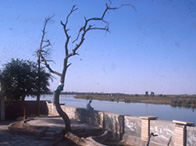
'I finished my journey through modern Iraq at Paradise.'
The military airfield that attracted the attack of 12 years ago still adjoins the ancient site, so the prospects for Ur - in the line of fire and on the route of invasion from the south - are far from good. I have been told that the US military have drawn-up a list of historic sites in Iraq, and passed their co-ordinates to attack teams, to prevent accidental damage. This is a thoughtful gesture, but could, paradoxically, lead to greater damage. The Iraqis, aware of these 'safe havens', will surely be tempted to place their forces within them in an attempt to avoid attack. If this happens then history will, literally, be in the firing line and Iraq's historic sites will become the targets of attack.
I finished my journey through modern Iraq at Paradise. Al-Qurnah, near the southern borders of Iraq at the delta of the Tigris and Euphrates, has long been regarded as a likely site for the Garden of Eden, and it certainly fits the Biblical description of paradise on earth. The town is now a quiet, decayed and desolate place but, in a small garden by the Tigris, stands what locals call Adam's Tree. Ominously, though, this Tree of the Knowledge of Good and Evil is dead, and the Tree of Life is nowhere to be seen.
'...what is certain is that, as in any conflict, history will be the loser.'
Standing at this tranquil place, where the two great rivers converge, war seemed a terrible prospect. Can the removal of Saddam and his evil regime be justified by the infliction on the people of Iraq of what could prove an equal evil - war, violence, and a prolonged period of civil unrest? Future generations will be able to answer this question, I cannot. But what is certain is that, as in any conflict, history will be the loser. In a country as culturally rich as Iraq - where every square foot is steeped in memory and archaeological sites abound - war can only ever be a catastrophe.
Dan returned to Baghdad after the conflict to investigate the reported lootings at the Iraq Museum. Read his follow-up article.
Published: 2003-02-16