|
Ian
Rankin is no stranger to West Yorkshire. His mother was born and
bred in Bradford and he often comes down from Edinburgh to visit
relatives. This visit was different as he was in Bradford to meet
his fans and sign copies of his new book.
What themes do you explore the new novel?
One
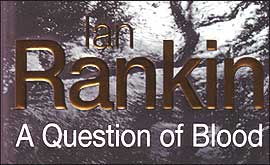
reason it's called A Question of Blood is that it looks at blood
ties, at family and friends but what it's really about is the nature
of the outsider. We are presented at the start with a shooting at
a school by a disaffected ex-Army guy who then turns the gun on
himself and the book begins as no mystery except the why. We know
who did it and what they did. It's why they did it, that's what
gets under Rebus' skin and Rebus himself is an outsider. He works
on the edge of legality in the police and likes it that way and
he's confronted by this little town outside Edinburgh where the
shooting took place and by the Goth population, teenagers who are
trying to be outsiders. It's looking at that kind of divide - people
who really do want to be seen as outsiders, and people who can't
fit in, people who are trained to kill in the army and are then
put back into civvy street. The army doesn't switch them off. It's
been a problem that we found after the first Gulf War in that a
lot of the veterans that came back went off the rails a bit. There
was a lot of spousal abuse, there were a lot of suicides, a lot
of aggression that was not locked away when they came back. We're
dealing with some pretty big questions.
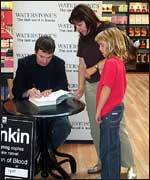 |
| Ian
Rankin meeting fans in Bradford |
Do
you find it difficult to explore new themes with so many novels
featuring the same character?
I always
wonder when I start a new book if I've got anything to say about
Scotland and the world through Rebus' eyes, or whether I've got
anything new to say about him, but he keeps on surprising me. People
give me ideas. They talk to me in bookshops and they say things
like, "Why don't you write about private schools" or "Why
don't you write about the police training college" and I think
that's a good idea, I'll do it next time. That's the good thing
about touring. I get new ideas for books.
Is
it difficult to age a character? Obviously Rebus has not stayed
the same age through the series? Is he approaching retirement?
In
crime fiction there is a tradition of the detective not aging, or
appearing not to age. With P.D. James the first appearance of Dalgeish
was 30-odd years ago, and he wasn't a young man then so he should
have retired a long time ago. Rebus does age. He is 40 in book one
and he is now 55 so he's got to retire at 60. He has got inbuilt
decrepitude so I'm not going to keep on writing the books all my
life. I knew that from the start and that was a conscious decision.
I wanted to write about Scotland changing at the end of the 20th
and the beginning of the 21st century and I thought it was important
that Rebus change with it.
You
say you were surprised when you found your first novel on the crime
shelves in bookshops?
I didn't
realise people still read or wrote crime fiction. I was doing a
PhD at Edinburgh University on the Scottish novel and I thought
of myself as a Scottish novelist so when it was published, and it
was in the crime section along with Ruth Rendell and P.D. Jame,
I thought, 'Oh, that's a bit odd, it's a dark gothic Scots novel
which just happens to have a detective in it.' I would shift it
into the Scots section alongside Iain Banks, Robert Louis Stevenson
and Muriel Spark and then go outside and watch as the staff moved
it back into the crime section. I went off and read lots of crime
novels as I hadn't really read crime fiction. I think I am the only
crime writer I know that didn't have a love of the genre as a reader
before they started writing and so I spent the last year of my PhD,
when I should have been studying the Scottish novel, sitting with
a big pile of crime novels instead.
Do
you think that these days crime novels are used to explore greater
themes?
I think
the best crime novels talk about big themes, big questions. They
pose big moral questions to their readers and they have contemporary
relevance. They are about the problems we have got in our lives
today and in some ways the literary novel has become very backward
looking. A lot of the books that win prizes seem to be historical
novels so they are looking back over their shoulders rather than
looking to the present or the future. Crime fiction does that, it
confronts you with the real world or something close to it, and
asks how did you get into the mess and what are we going to do about
it?
|