|
Before
I go any further, I must point out that before taking my seat at
this performance, I did not consider myself a great fan of operetta,
and my view was not greatly altered by The Gondoliers.
It
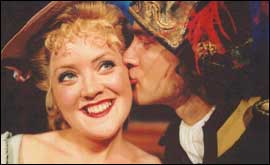
is Venice in the latter part of the 19th Century. Gilbert and Sullivans
production of The Gondoliers opens on the wedding day of Tessa and
Giuseppe, and Marco and Gianetta. Young, joyous love abounds, with
merry songs to suit. A chorus of happy guests attend the newly-weds,
the girls pretty in their simple peasants garb, their suitors
charming and cheerful in their striped shirts and gondoliers
boaters.
But
theres a catch. The impoverished Duke of Plaza-Toro has arrived
in Venice with his wife and beautiful daughter, Casilda, claiming
that the latter was married in her infancy to the heir to the throne
of Barataria. The heir happens to be none other than one of Marco
and Giuseppe the difficulty in proving which it is a minor
technicality.
Both
men are therefore compelled to sail to Barataria to act, jointly,
as King until their old nurse can arrive to identify the true heir.
Tessa and Gianetta are understandably upset at this enforced parting
on their wedding day, although the news that one of them is Queen
does provide some tonic to their woes.
Meanwhile,
Casilda, as rightful Queen, is heart-sore because of her enforced
separation from her lover, Luiz, being married as she is to the
King.
Confusion,
sorrow and comedy ensue in equal measure, with a song to express
every change in mood and each emotion is conveyed repeatedly to
the audience to ensure they do not miss it.
The
plot is contrived (I guessed the ending fifteen minutes into it),
the characters are stereotypes of stereotypes, the dialogue and
lyrics are wooden, and the jokes are about 130 years outmoded. If
all this sounds rather harsh, I must emphasize that this is only
a matter of my personal opinion and the laughter and atmospheric
buzz felt all around me testified to the audiences
appreciation of the piece.
What
cannot be disputed is the vital energy and palpable enjoyment with
which the Carl Rosa Opera Company go about depicting their scenes.
The soloists sing impressively, most notably Alycia Fashae as Gianetta
and Nick Sales as Marco, who rise above the limitations of their
respective roles to impress.
They
are matched by a lively ensemble and my only quibble here would
be that in chorus numbers, the lyrics are frequently indistinct
or drowned out by the music. However, I greatly prefer the music
to the book and lyrics, this being the main vehicle by which the
plot is carried forward and the ambiance set, and so little of the
story is lost as a result of this.
In
the minor role of Fiametta, Hannah Garner particularly stands out
as embodying the spirit of the piece, which, despite its flaws,
is pleasant enough with its intention of providing a happy ending
to the evening for characters and audience both clearly evident.
I have
no problem with a show offering simple, uncomplicated entertainment
as its principle aim and I do not think the absence of sharply drawn,
original characters and sparkling dialogue necessarily preclude
the audiences goodwill and enjoyment. I do however dislike
the pretension of writers who obviously believe their work to be
more highbrow and important than it can justifiably claim to be
that is for the audience to decide and this audience member
does not choose to agree.
However,
the Carl Rosa Opera Company does not try to echo this loftiness,
nor to make the show what it is not. The result is an amiable performance
by artists who love their work, with costumes and set appropriate
and pleasing to the eye. The result, while not the masterpiece it
has often been lauded as in the past, in the hands of this company
is nevertheless an enjoyable evening out which will disappoint neither
Gilbert and Sullivans nor Carl Rosas many fans.
IF
YOU DISAGREE WITH OUR REVIEW, OR THINK YOU COULD WRITE A STAGE REVIEW
FOR THE BBC BRADFORD AND WEST YORKSHIRE WEBSITE. THEN PLEASE DO
GET IN TOUCH
Email:
westyorkshire@bbc.co.uk
|