Summary

Send us your Winter Olympics views

  1. 'Treat it like your wedding day'published at 10:44 GMT 12 February

    Skeleton - men's run 2

    Lizzy Yarnold
    Two-time Olympic skeleton champion on BBC One

    Matt [Weston] and Marcus [Wyatt] will just be in the system of chatting to their coaches and getting the exact feedback that they are looking for.

    They aren't trying to aim for a perfect run - I know Matt and Marcus are both very detail-orientated but you can't have a perfect run in the skeleton. It's just the small improvements, allowing the balance of speed and technique.

    They should just enjoy it as well, I hope they are having a moment to look around. It's a bit like your wedding day! You have to just take a breather, it's a moment you have worked so hard for. Matt is actually getting married in a few months as well!
  2. Postpublished at 10:43 GMT 12 February

    Skeleton - men's run 2

    South Korea's Jung Seunggi has just completed his second run and is now tied for the lead with China's Lin Qinwei.

    The both have a combined time of 1:53.22.

    World number two Yin Zheng is next up, then it's Great Britain's Marcus Wyatt...

  3. Postpublished at 10:42 GMT 12 February

    Alpine skiing - women's Super-G

    We've seen the first half-dozen racers in the women's Super-G and the course is certainly proving tricky.

    Italy's Federica Brignone leads with 1:23.41 but there are some big names upcoming...

  4. 'It's been an emotional morning' - IOC president on Heraskevych banpublished at 10:40 GMT 12 February

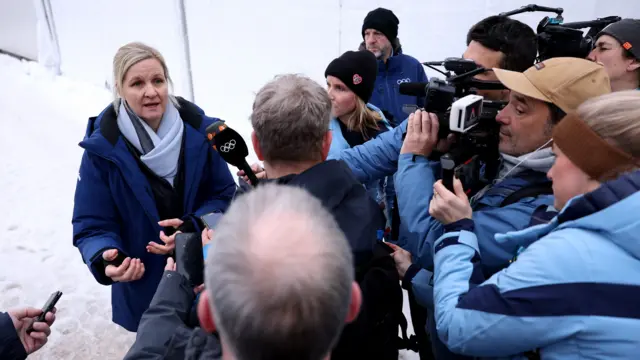
    Kirsty Coventry speaks to reportersImage source, Getty Images

    IOC president Kirsty Coventry has spoken at length about the decision to ban Ukraine's Vladyslav Heraskevych from competing at the Winter Olympics.

    Heraskevych has been for continuing to wear a helmet which features images of athletes killed during Russia's invasion of his home country.

    Coventry spoke to Heraskevych and his father Mykhailo this morning, but they were unable to come to an agreement about the helmet.

    It's quite a long statement from the IOC president, the thrust of which is that the governing body did not want Heraskevych to wear that particular helmet when racing.

    "As you've all seen over the last few days, we've allowed for Vladyslav to use his helmet in training," Coventry says.

    "No-one - no-one - especially me, is disagreeing with the messaging. The messaging is a powerful message of remembrance, it's a message of memory, and no-one is disagreeing with that.

    "The challenge that we are facing is that we wanted to come up with a solution for just the field of play. I know he's very quick, so for just two minutes to not wear the helmet on the field of play.

    "What I proposed to him this morning and to his dad - because he also said when he goes down it's blurry, you can't really see it - so I said: 'Could we find a solution where we pay homage to his message, to his helmet before he races, then as soon as he's finished racing going into the mixed zone where you can see the pictures?'

    "Because he's very right, it would be blurry going down, so could we find another solution where the memories could be honoured in a wonderful way?

    "Sadly, we've not been able to come to that solution. I really wanted to see him race today. It's been an emotional morning."

  5. Pressure on Westonpublished at 10:37 GMT 12 February

    Skeleton - men's run 1 & 2

    Jess Anderson
    BBC Sport in Cortina

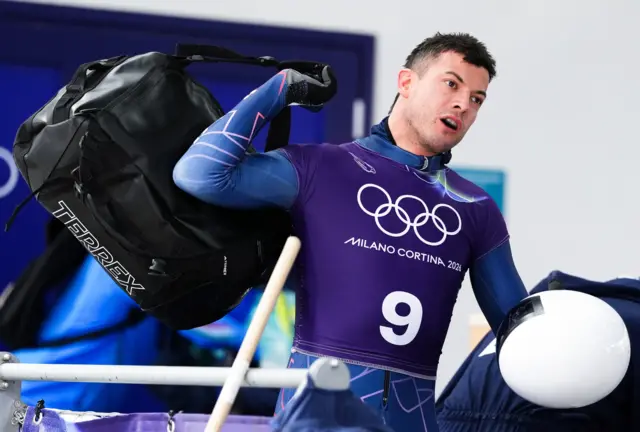
    Huge amount of pressure on Matt Weston to deliver this morning.

    He looked really frustrated after run one, punching his fist having tapped the wall near the top of the track.

    Remember this sport is decided by the tiniest of margins and he will want to create some breathing space with his second run - his current 0.06 second advantage might not be enough.

    We're halfway through the field on run number two.

  6. 'Skeleton experience doesn't matter' in Cortinapublished at 10:35 GMT 12 February

    Skeleton - men's run 2

    John Jackson
    Two-time Olympic bobsledder on BBC One

    With this track, we are finding that it doesn't really matter how much or little experience you've got; it's about how well you've adapted to it because it is so technical.

    It's also about putting it all together. Some people have done the top well but messed the bottom up or vice versa. You need to align all of the track and working it out corner by corner to make it flow. You also need to do it over four runs.

  7. Women's Super-G under waypublished at 10:34 GMT 12 February

    Alpine skiing - women's Super-G

    Switzerland's Malorie Blanc is the first of the 43 skiers down the 2,105m course at the Tofane Alpine Skiing Centre in Cortina and she sets the pace with a time of one minute 24.65 seconds.

  8. Postpublished at 10:33 GMT 12 February

    Skeleton - men's run 2

    This feels like the big chance, Callum.

    We've had 11 athletes go so far in the second run and American Austin Florian is the current leader. A lot of that is down to his superb start.

    All the leading medal contenders are still to come, though.

  9. Get involvedpublished at 10:29 GMT 12 February

    Click 'Get Involved' at the top of this page to have your say

    Every time I get my hopes up for a GB medal, something happens. So my current hopes for skeleton is fourth but a skeleton medal is possible, come on Matt and Marcus.

    Callum, Exeter

  10. Yarnold on Heraskevych banpublished at 10:25 GMT 12 February

    The big story this morning has been the IOC's decision to ban Ukraine's Vladyslav Heraskevych from competing at the Winter Olympics for continuing to wear a helmet which features images of athletes killed during Russia's invasion of his home country.

    British two-time Olympic skeleton champion Lizzie Yarnold, in the BBC studio with Hazel Irvine, has given her thoughts.

    Media caption,

    Lizzy Yarnold reacts to Ukrainian skeleton racer Vladymyr Heraskevych's IOC ban

  11. How does it work?published at 10:22 GMT 12 February

    Alpine skiing - women's Super-G

    Franjo von Allmen in actionImage source, Getty Images

    You may have noticed that in Wednesday's men's Super G that Switzerland's Franjo von Allmen was announced as gold medallist before all of his rivals had competed - and we will have a similar scenario in today's women's race.

    Here is how it works in Super G...

    The race starting order is influenced by World Cup points earned in that event over the past 12 months.

    The 10 highest-ranked athletes are drawn into bibs between 6-15.

    Skiers ranked 11th - 20th are drawn bibs numbered 1-5 and 16-20, with bibs 21-30 for those ranked 21st-30th.

    The remaining competitors will have a start number equating to their enrolment placing, from 31 upwards.

    So the strongest racers should be the first 20 to go with the medals coming from there.

  12. GB's Jeannesson misses out on moguls finalpublished at 10:21 GMT 12 February

    Men's moguls qualification

    Anna Thompson
    BBC Sport in Livigno

    Mateo JeannessonImage source, Getty Images

    Mateo Jeannesson has been competing in the men's moguls for Team GB but he has not made the top 20 to advance to the final.

    He suffered a heel injury in October and it hampered him today.

    He said: "It was rough the whole morning. I've got this injury on my heel and it was sore and I just was struggling to get over the pain and I thought at one point I might just not compete.

    "But I wanted to just go up there, try to put a run down and get the experience from it so at least I learned quite a bit."

    He has yet to make a decision on whether he will be able to compete in dual moguls on Sunday.

    "We'll have to see because the duels are pretty violent. If it was to snow I should be fine when the bumps are a bit softer it would help me a lot so we'll see, we'll see how it goes."

  13. Goggia hopes for second medalpublished at 10:17 GMT 12 February

    Alpine skiing - women's Super-G

    Sofia Goggia adjusts her headband on the medal podiumImage source, Getty Images

    In the absence of Lindsey Vonn, the second women’s individual skiing event of the Games starting at 10:30 GMT could be a battle between Italy and Germany.

    Super-G has the speed of downhill but is raced on a shorter course and with more turns.

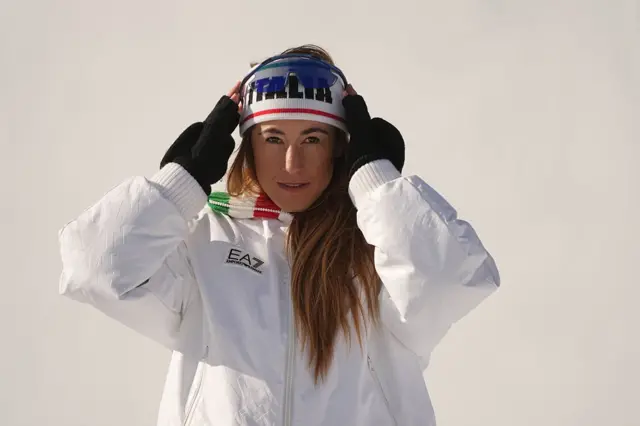
    Sofia Goggia leads home hopes having won downhill bronze on Sunday and she tops the World Cup standings but there have been four winners from the four races this season.

    German newcomer Emma Aichner already has two silvers from the downhill and the team combined event.

    Pyeongchang 2018 gold medallist Ester Ledecka will be hoping to regain her title while New Zealand could land a medal through Alice Robinson and Switzerland’s Malorie Blanc will be another aiming to figure.

  14. Vonn 'making progress' after third leg operationpublished at 10:16 GMT 12 February

    Katie Falkingham
    BBC Sport in Livigno

    Lindsey Vonn giving a thumbs up after knee surgeryImage source, Getty Images

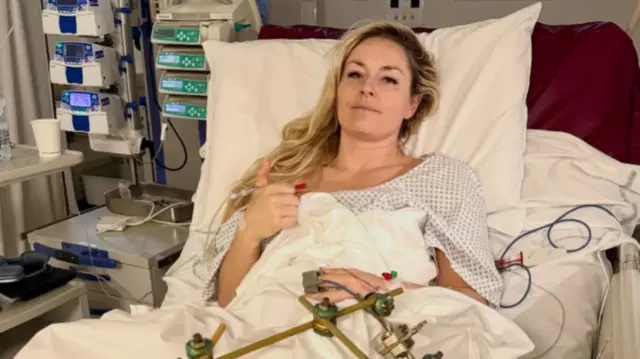
    Lindsey Vonn says she is "making progress" after having a successful third surgery on the broken leg she sustained in a crash at the Winter Olympics on Sunday.

    The American great was racing just nine days after rupturing ligaments in her left knee when she struck a gate 13 seconds into her downhill run in Cortina.

    She was airlifted off the piste and taken to hospital in Treviso, where she was diagnosed with a "complex tibia fracture" in her left leg.

    "I had my third surgery today and it was successful," she wrote in a post on Instagram yesterday., external

    "Success today has a completely different meaning than it did a few days ago. I'm making progress and while it is slow, I know I'll be OK."

  15. Postpublished at 10:11 GMT 12 February

    Skeleton - men's run 2

    Here we go then, the second runs are under way and the competitors will go in reverse order of the standings this time.

    That means Matt Weston, who began the first run, will be last up. Marcus Wyatt will go 18th of the 24 so a little bit of a wait before we see either of them.

  16. Why is Cortina's track so demanding?published at 10:08 GMT 12 February

    Skeleton - men's run 1 and 2

    Lizzy Yarnold
    Two-time Olympic skeleton champion on BBC One

    The corners are quite new to them. There isn't a lot of pressure in corners 2 and 4 where the athletes seem to be struggling. You don't have a long in the corner and you almost need to react and steer before you need to steer.

    I'd like to see a bit more confidence in those corners at the top of the track, being a bit more defined and definite with the steering process.

    At the bottom of the track, we're looking for athletes to just relax, let the sled run and pick up as much speed as possible.

    It's a new track, they are learning even through the race. They will be resting, recovering, refuelling up before the push starts for run 2.

  17. Get involved - Vladyslav Heraskevych banpublished at 10:06 GMT 12 February

    Click 'Get Involved' at the top of this page to have your say

    Not a good look for the IOC. This was less a political gesture than an act of remembrance - an easy narrative to reframe with grace. Having already barred Russia from the Olympics, the IOC has also, in effect, taken a political stance.

    Martin, London

    Why don't all the competitors refuse to run to show support? He is right. Excluding Russia is political and a new team was made to let Russian athletes compete. Let him race with the helmet. It's remembering passed athletes. IOC is wrong.

    M Neil, Airdrie

    I don't agree with the IOC's decision: What is the difference between his helmet and a black armband (which would've been allowed)? Lizzie [Yarnold] is right, communication between athletes and the IOC is needed. The IOC risks looking two-faced after reaffirming Russia's ban from competition.

    AG, Kent

  18. Team GB skeleton helmet appeal dismissed by Caspublished at 10:03 GMT 12 February

    Skeleton - men's run 1 & 2

    One of the big stories leading into the skeleton revolved around the helmets that the British team hoped to wear.

    However, they are not able to wear their new helmets because they do not comply with the sport's rules around shape.

    The British team had appealed to the Court of Arbitration for Sport (Cas) on Thursday to overturn the decision by the sport's governing body - the International Bobsleigh and Skeleton Federation (IBSF).

    But Cas says the helmet is a departure from the standard helmet shape and has clearly been designed to specifically enhance aerodynamic performance because the back of the helmet protrudes.

    The British Bobsleigh and Skeleton Association (BBSA) stressed that the helmet was designed with safety in mind and to comply with new safety regulations due to be introduced by the IBSF at the start of the 2026-27 season.

    Those rules are not in place at the Olympics but British skeleton have essentially tried to get ahead of the curve by designing and using their new helmet in Italy.

    Instead they are wearing the ones they wore during the last World Cup season.

  19. How British skeleton came back fighting after 2022published at 10:01 GMT 12 February

    Skeleton - men's run 1 & 2

    Katie Falkingham
    BBC Sport in Livigno

    Matt WestonImage source, PA Media

    Matt Weston was lost.

    His maiden Olympics, at Beijing 2022, hadn't gone the way it was supposed to. Just months earlier, he had won a first skeleton World Cup gold and was a genuine medal contender.

    The latest in a long line, too. British sliders - including two-time champion Lizzy Yarnold - had won a medal at every Winter Olympics since the sport was reinstated to the programme in 2002.

    But 20 years later, that run had come to a disastrous end. Weston's 15th-place finish was the highest of the four British athletes competing on the Yanqing track.

    Blame was laid firmly on their equipment - a risk was taken with their sleds and "it didn't pay off".

    "In this sport the fine margins are everything and you have to take risks to be the best, but sometimes that will come back to bite you and it came back to bite us at the biggest event of my career," Weston, 28, told BBC Sport.

    "I wasn't quite sure what to do with myself. As a child you think 'I want to be an Olympian' and that it's going to be the best experience of my life, but I came back and felt it wasn't how it was meant to be."

    Four years on, Weston is back at his second Olympics and things are very different - 'helmet-gate' aside.

    He is a two-time world champion, a multiple World Cup gold medallist - and will have one of the sport's greats on his side when competition gets under way on Thursday.

    Read more here.

  20. Skeleton explainedpublished at 09:59 GMT 12 February

    Skeleton - men's run 1 & 2

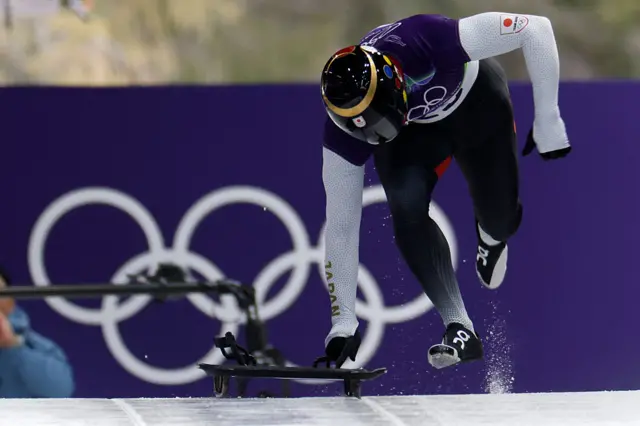
    Japanese skeleton athleteImage source, Getty Images

    Not long until run two begins and while, given Great Britain's excellent record in the event over the years, I'm sure many of you will be familiar with how the whole thing works - for the uninitiated - this is skeleton in a nutshell...

    Competitors travel headfirst along an ice track on a brakeless sled little bigger than a tea-tray. With their chins millimetres off the ice, they steer using shoulders, knees and toes while hurtling along at speeds of up to 90mph.

    The athlete with the fastest combined time over four runs is the winner.