|
WATCH &
LISTEN
|
 |
See
the 1984 news report on the Minster fire |
 |
Eye
witnesses describe what they saw |
|
MORE
|
|
|
More
on the Minster Fire from BBC News Online
More from I Love NY
|
|
LINKS
|
| York
Minster |
| The BBC is not responsible
for the content of external websites |
|
FACTS
|
|
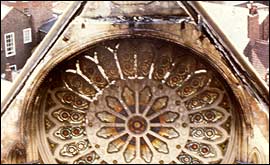
The Rose Window is early sixteenth century in date,
thought not to commemorate the marriage of King Henry
VII and Elizabeth of York in 1486, but is really a huge
symbol of the house of Tudor.
Stained glass windows are made by fixing glass into
channelled strips of lead which are held together with
solder. In the fire many of the solder joints melted,
but the lead didn't. The melting point of lead is close
to that of solder so the temperature of the window can
be estimated at around 450 degrees centigrade.
|
|
I received a call to say the Minster was on fire. By that time
the building was well alight and no-one was allowed back in. Finally
after burning for about two hours the roof fell in.
I believe it was at that point, when there was a sudden change
of temperature, that the cracking occurred to the glass.
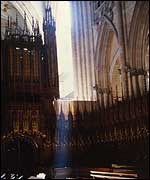
When we were finally allowed back in I walked down the nave, which
was awash with water and the immediate thing you noticed was a huge
glare of light in the south transept area.
It was so sad to see the transept area looking as it did that morning,
debris was piled nine feet high in places.
But in actual fact the first thing I noticed was the cross on the
gable above the rose window. As a committed churchman I took great
consolation that the cross had survived the fire, and I knew on
day all would be well again.
The Chief Fire Officer asked me if I wanted to go and look at the
window more closely. There is a walkway along the base of the window
so we went up the tower, 105 steps (and I got to know everyone of
those steps very well over the coming weeks) and out along the ledge
to the window.
 |
| Light
streaming in through the south transept |
When we got onto the sill, timbers were still smouldering and the
glass was still warm. I could see the cracking of the glass and
I spent about half an hour there, then the fire officer said 'Peter
you've examined the window from the inside, I'm sure you want to
have a look from the outside'. I didn't answer immediately.
So they brought one of the fire tenders into position central to
the Rose Window. They had these huge ladders in four sections and
he said 'come up with me', he put a belt around my waist and hooked
me on, then the first section went up.
Then he went back down, leaving me on my own. If you've never been
up a fireman's ladder it's quite scary because as each section goes
up the whole thing jars, rather like a train going over points.
When I was about 35 meters up, which was really quite frightening,
the ladder went up and down across the window, so I was able to
do a pretty good inspection from the outside.
When they brought me down to earth, trembling slightly, a few of
the media people collared me and asked what it was like. I was able
to say that although the Rose Window was as terribly damaged as
it could possibly be, I was quite convinced the window would shine
again. And I think they were the most cheerful words spoken that
morning.
See
the news report
It took about three weeks to put the scaffolding up. In my initial
inspection I had noticed that some of the glass had become detached
from the leadwork and those pieces could fall. So while the scaffolding
was put in place I went up the 105 steps to the ledge six times
a day to carry out remedial work. I'm quite proud to say that no
glass was lost.
 |
| The
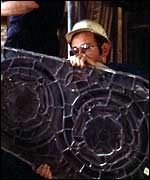
team carefully remove the Rose Window panels |
When the scaffolding was put up the time came to take the glass
out. The glass was cracked into something like 40,000 pieces. If
you imagine a piece of glass the size of the palm of your hand cracked
into 300 pieces, that gives you an idea.
To stop the cracked glass falling apart as we removed the window
panels I stuck clear plastic onto the outside. So when the team
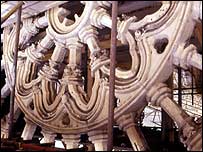
removed the 73 panels, which took about three weeks, all the glass
was secure.
Over in the workshop I was able to prepare a comprehensive report
for the Dean and Chapter of the Minster on the state of the glass
and costs of repair.
It was a huge job, and no one had ever been faced by a task like
that. So I would be in the workshop in the evening and on weekends
to examine every panel of glass.
Once the report was submitted we just had to wait. Obviously this
wasn't the only report the Dean and Chapter had to consider. There
was the new roof and all the associated stone work and joinery as
well.
After I got the go ahead to do the work, the main problem was the
repair of the multi-cracked glass. I've repaired broken glass all
my life using an ordinary edge joining adhesive. But that was no
good because the pieces were just too small. So I had to find an
adhesive to repair the glass while it was still held in the leadwork.
It's worth noting that the leadwork was quite new. I had taken
part in the restoration of the Rose Window between 1968 and 1970
when the window was put back in memory of Lord Scarborough, the
first high steward of the Minster.
 |
| The
empty window with all glass panels removed |
In my opinion that was why the window survived the fire, because
the leadwork was in good sound condition. If it had been in the
state I saw the window in 1968 it wouldn't have survived.
I wanted an adhesive that had the same refractive index as the
16th century glass. It also had to have low surface tension, in
other words it wouldn't stick readily to the glass and be difficult
to take off.
So working with our scientific advisor, the late Professor Roy
Newton, I took 20 pieces of glass with different degrees of cracking
to the Glasgow museum and art gallery. A long standing friend of
mine Dr Norman Tennent, a specialist on adhesives, was based there.
We measured the glass I'd brought and because Dr Tennent had already
done so much field work he was able to match up an adhesive with
the same refractive index, and there it was sitting on the shelf
ready to use.
Back in the workshop I fed the adhesive into the cracks using a
pipette It was drawn in by capillary action and you could see it
seeping in. Each panel stood for about a week to let the adhesive
cure. Then the panels could be taken apart and the glass carefully
cleaned. This in itself is a delicate process, sometimes under a
microscope.
At this point the glass was looking pretty good, but I wasn't prepared
to put it back in the window in that state because of what would
happen should the adhesive fail in the future. I had to have an
insurance it would not be lost.
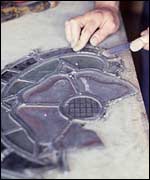 |
| The
team had to carefully dismantle each glass panel |
So to preserve the glass, each piece was sandwiched between two
layers of clear glass cut to the same size and shape. That had to
be done thousands of times (The Rose window is made up of over 8,000
individual pieces of glass).
So now all the multi-cracked pieces are in a 'Tudor sandwich' and
the team then reglazed all of the panels.
When half the window was done, it went on exhibition in the Chapter
House. I only wish more custodians of stained glass would do that
when they have windows restored. When it's in place it might be
30 or 40 metres above the ground. It's such a wonderful opportunity
for people to see the glass at close quarters. That exhibition was
visited by thousands and thousands of people.
Then when we had all 73 panels ready, conservation records were
made and the work we did recorded before the window was put back
in place in readiness for the great service on 4th November 1988,
visited by H.M the Queen.
So now that Rose Window is back again, high in the gable of the
South Transept. And I know for a fact that many people come to the
Minster, go into the South Transept and they don't even look up
because it's just part and parcel of the fabric, they've no idea
what happened to that window.
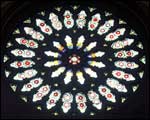 |
| The
Rose Window in 2004 |
I'm just pleased to see it there, knowing what happened behind
the scenes. I hope and pray the Rose Window will be there for the
next 500 years. That doesn't mean it won't have to be taken out
every 100 years or so because that's the cycle of reglazing.
All we tried to do during the restoration was to keep faith with
the craftsmen who created the window in the 16th century, making
sure their work lives on. It was a challenging task. Probably the
most difficult and challenging restoration task ever attempted as
far as stained glass is concerned, but I was just thrilled and very
privileged to take part in that restoration.
Peter Gibson
|