|
Saturday
14 February 2004
Today,
along with four other colleagues, we put our rucksacks into the
back of a Landrover and departed Pokhara bound for Gorkha, three
and a half hours away.
I decided
to visit Gorkha for two reasons: Firstly it has a significant place
in the modern history of Nepal, and secondly, two of my soldiers
in the Squadron in York have got family in the town. Back in November,
standing on the ranges at Strensall, I promised them that I would
do my best to call in and say hello.
 |
|
Within
a few miles we had encountered a coach headfirst in
a ditch
|
 |
|
The
journey by road was as dangerous as usual.
Within
a few miles we had encountered a coach headfirst in a ditch, a vehicle
overtaking on a blind bend towards us and the usual stray herds
of cattle wandering the streets with impunity (they are all sacred
and therefore untouchable).
It
still amazes me how cars will screech to a halt to avoid a cow,
but regularly drive perilously close to young children walking on
the side of the road.
Gorkha,
when we arrived, was under tight security, mainly because it is
the heartland of the Maoist Insurgency, with the key leaders living
in the hills within a few hours of the town.
We
were questioned over our destination by the Army and Police, and
allowed to go on our way. We were soon given a background brief
by our hosts on the general situation, which included the fact that
there was an Army-imposed curfew at night. It was the first such
experience for me.
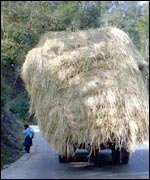 |
| Overloaded
lorry narrowly misses a very young girl walking to school along
the kathmandu to pokhara road |
In
the afternoon we climbed up to the top of the highest hill in the
area, at about 4500 feet, in order to visit a Royal Palace.
Gorkha
is famous because it is from this town, and specifically this Palace,
that the king of the Gorkha District, a couple of hundred of years
ago, expanded his influence throughout the country, which was then
only a collection of smaller kingdoms.
After
successfully uniting the country under one King, Gorkha became the
symbolic heart of the monarchy and modern day Nepal. Since the Royal
family and Government moved to Kathmandu though, Gorkha has been
rather neglected.
I found
the Royal Palace disappointing. It was much smaller than I imagined,
roughly the size of a large detached family house, with a separate,
smaller building that is still used by the King every year.
Although
the building was richly decorated with erotic wooden carvings and
built of local brick, it was also infested with pigeons. We also
had to leave our cameras and any leather shoes outside before we
entered the ramparts. Once inside we were surrounded by people of
all ages, milling around, worshiping Gods and making sacrifices.
The
floor was covered in blood and feathers. Bells were ringing, horns
were being blown and children were running around oblivious to everything
but there own games.
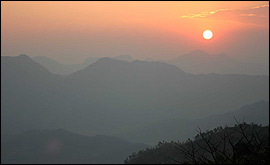 |
| Sunset
over Nepal on Valentine's day |
Add
to this scene a large number of Royal Nepalese Army soldiers, who
are stationed in the Palace for three months at a time to secure
it from the Maoists, and the whole picture was quite chaotic.
However,
it is easy to forget that the wooden beams, bricks, tiles and other
materials were all carried up by man. And I can tell you, it is
a hard walk.
However,
the views across the lower hills, out towards the Himalayas to the
north were spectacular and to have had the opportunity to visit
this ancient Nepalese historical site was quite memorable.
Later
on that day I also managed to fulfil my other key duty and met up
with the fathers of my two soldiers. I was even invited into one
house to share a drink in the afternoon.
To
be sitting in a living room, in a house in Gorkha, Nepal with the
family of one of my soldiers, currently based all the way back in
York, was a proud and humbling moment, and one I will never forget.
Previous
entry | Next
entry
|