|
Tuesday
10 February 2004
Nepal
continues to surprise me at every new turn. The country is in the
grip of a well reported Maoist Insurgency and, although much of
the effect has been felt in the countryside, Pokhara is obviously
feeling some fall out from events elsewhere.
 |
|
I
also found myself asking how a beautiful country like
Nepal could allow itself to reach such a dangerous political
crossroads
|
 |
|
Yesterday
evening I was invited to have supper at a local house. Someone told
me that the evenings spent chatting to local Nepalis, outside next
to an open fire, are the most treasured a visitor will have in Nepal.
Well,
tonight I had my first experience of this. I was in the company
of some retired ex-Servicemen, some still working for the MOD and
others reintegrated into the local society.
Standing
together outside the house, at one stage in the evening I caught
myself staring into the open fire, with my face warmed by the flames
and the crackling wood punctuating the peaceful night, my mind drifted
to my family back home in England.
But
I also found myself asking how a beautiful country like Nepal could
allow itself to reach such a dangerous political crossroads.
Well
the answer is simple, in exactly the same way that many other countries
around the world have squandered their 'crown jewels'.
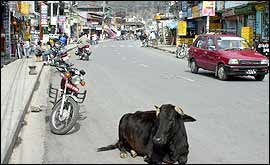 |
| Holy
Cow! Being a Hindu country, cows have right of passage. This
is the main tourist street in Pokhara. |
Although
the country is not in any sense on the verge of collapse, the tourist
numbers are down and life is changing for the average Nepali citizen,
whether in the hills or in the towns.
The
evening was soon over and I was driven home through the city.
What
is most striking about the current situation is the obvious fear
felt by the local population. From the time that we left the house,
the only other road users I saw were cows wandering with impunity
on the streets, and members of the Royal Nepalese Army casually
manning checkpoints at strategic points in the town.
We
were waved past each makeshift set of barriers, but the complete
absence of people and movement, at only 10.30pm, was quite startling.
It was as if Pokhara was under a voluntary curfew. Whether this
was because the locals feared the Army or the Maoists I do not know.
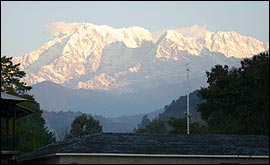
Someone
said to me recently that it is impossible to take a bad photograph
in Nepal. Well, it is also impossible to see an ordinary sight.
The greatest challenge is not to take it for granted.
Previous
entry | Next
entry
|