| One such businessman
was Sir John Magill, creation of Ulster railway
engineer and top crime novelist of the 1920s –
40s, Freeman Wills Crofts. In this week’s
programme John Bennett finds out more about Crofts
and retraces Sir John Magill’s Last Journey.
John began his journey outside the former New
Scotland Yard building on the Thames Embankment
because one of the many detectives based in this
building in the 1920s, 30s and 40s was Inspector
French. And in 1929 one of French’s many
cases involved the murder of Sir John Magill,
a well-known figure in public life in Northern
Ireland, as he was travelling on the night sleeper
from London to Stranraer.
All fiction of course because Inspector French,
who way back then was probably as famous as Hercule
Poirot or Miss Marple, was the creation of one
of the Big Five crime writers of that era –
Freeman Wills Crofts – while he was living
in Jordanstown, just outside Belfast.
Before setting out on his journey, John spoke
to Derek Martin, another former Jordanstown resident,
who has taken a keen interest in the life and
works of Crofts. |
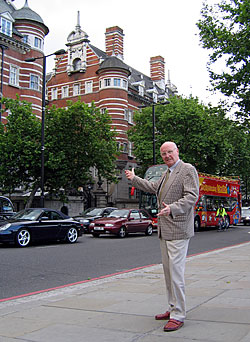 John outside the
former New Scotland Yard building on the Thames
embankment John outside the
former New Scotland Yard building on the Thames
embankment |
John’s railway journey proper began, as did Sir
John Magill’s Last Journey and Inspector French’s
subsequent journeyes as he carried out his enquiries,
at London’s Euston Station, very different to
the Euston Station of today. The huge Doric Arch at
the entrance and the massive Great Hall which French
passed through were swept away in the 1960s, when the
station was replaced by the present more utilitarian
structure. And the great steam locomotives which hauled
the trains north to Scotland have been replaced by electric
traction. Sleepers still operate to various destinations
in Scotland but, sadly, there is no longer a through
service to Stranraer.
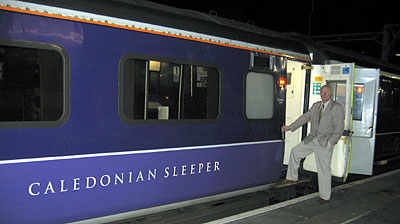
John boarding the Caledonian
Sleeper for his journey north
So John took the Glasgow “Caledonian Sleeper”
and after sampling the facilities in the lounge car
he headed to his berth before getting his early morning
call, and a first class breakfast, in time to leave
the train at Carlisle at 5am!
He could have stayed on the train to Glasgow, and got
another couple of hours sleep, and then taken a train
to Ayr and then on to Stranraer, but as he wanted to
travel the route used by Sir John Magill and Inspector
French as closely as possible he had to change at Carlisle
and take a “Sprinter” railcar to continue
his journey over the Nith Valley Railway to Dumfries.
Sir John’s and Inspector French’s trains
would have continued directly to Stranraer, via Castle
Douglas, over a section of line known as “the
Port Road”, but it succumbed to the Beeching cuts
of the mid-1960s, leaving passengers today to take a
diversion via Kilmarnock and Ayr.
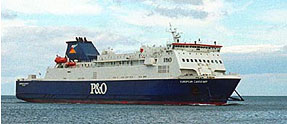 At
Stranraer John had to change his route again because
ferries no longer leave from there to Larne –
indeed it’s now over a decade since the last ships
sailed from Stranraer to Larne with Stena Line preferring
to operate their high speed ferry to and from Belfast.
So John had to resort to taxi for the short journey
to Cairnryan where John boarded a conventional ferry
for the crossing to Larne. At
Stranraer John had to change his route again because
ferries no longer leave from there to Larne –
indeed it’s now over a decade since the last ships
sailed from Stranraer to Larne with Stena Line preferring
to operate their high speed ferry to and from Belfast.
So John had to resort to taxi for the short journey
to Cairnryan where John boarded a conventional ferry
for the crossing to Larne.
And, as at Euston, the railway scene at Larne Harbour
today is very different to that which greeted Inspector
French as he disembarked from his steamer, way back
in 1929. The railway station was on the quayside –
indeed it was designed by Freeman Wills Crofts’
uncle, Berkeley Dean Wise who was responsible for many
delightful station buildings in Co. Antrim – and
it was unusual in that it straddled a level crossing,
so that a moveable section of platform had to be inserted
when a train was in the station. There French would
have had a choice of two routes out of Larne. There
was the narrow gauge line to Ballymena which boasted
the fastest and most luxurious trains anywhere on the
narrow gauge in the British Isles, but passenger services
on that line ended in the 1930s, and of course there
was the broad gauge line to Belfast.
French’s journey on the boat train express to
Belfast’s York Road Station took little over half
an hour, running non-stop. But it’s now over a
decade since the boat train ran and today Larne Harbour
enjoys only a limited service of stopping trains which
take nearly an hour to reach Belfast.
John’s journey took him along the shore of Larne
Lough, through Whitehead which was developed by the
railway company as a seaside resort and where the Railway
Preservation Society of Ireland now have their headquarters,
along the shore of Belfast Lough to Carrickfergus with
its impressive Norman castle and fine Victorian railway
station, recently restored by Translink, through Jordanstown
where Freeman Wills Crofts once lived and where he created
Inspector French, past the magnificent Bleach Green
viaduct which carries the main line to Portrush and
Londonderry over Valentine’s Glen on the loop
line on which Crofts worked in the planning stage, and
on into Belfast.
Nowadays the trains bypass the site of York Road station,
where French would have disembarked from his short train
journey, and continue over the new Dargan bridge into
Central Station, and journey’s end.
Radio series produced
by Ian Sinclair © BBC Northern Ireland
Relevant web-links:
The Caledonian Sleeper and services to and from Stranraer
are operated by First Scotrail:
www.firstgroup.com/scotrail
Some links with further information about Freeman wills
Crofts:
www.classiccrimefiction.com/croftsbiog.htm
http://home.aol.com/mg4273/crofts.htm
|



 print version





















 POST A COMMENT ON THIS ARTICLE