Summary

  1. Maduro pleads not guilty in New York courtpublished at 17:23 GMT 5 January
    Breaking

    Maduro has pleaded not guilty to all the charges he is faced with.

    Four counts were listed on the indictment, including narco-terrorism conspiracy and possession of machine guns and destructive devices.
  2. Maduro enters court in prison uniform with feet shackledpublished at 17:18 GMT 5 January

    Cameras are not allowed inside the court room, but some reporters including from the BBC's US partner CBS News are allowed to send out information from inside the court.

    Maduro has just walked into New York Southern District court wearing a prison uniform with his feet shackled, CBS News reports.

    His wife, Cilia Flores, is also wearing a prison outfit.

    Maduro and Flores's hands are not shackled, allowing Maduro to shake hands with his attorney.

  3. Lawyer who acted for Julian Assange listed as Maduro's legal representativepublished at 17:09 GMT 5 January

    Maduro has retained attorney Barry Joel Pollack, federal court records show.

    Pollack is best known for representing Wikileaks founder Julian Assange.

    The BBC has reached out to Pollack for comment.

  4. Maduro expected in court imminentlypublished at 16:59 GMT 5 January

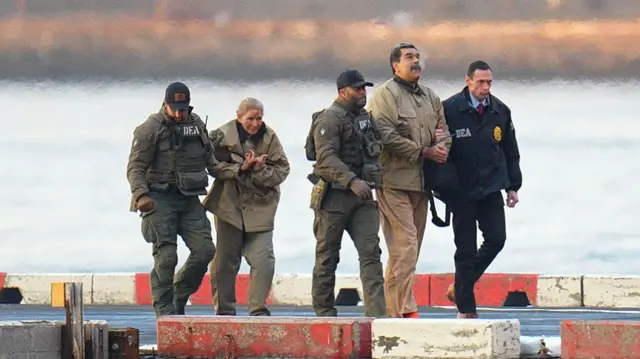
    Maduro and his wife, Cilia Flores, seen in handcuffs after landing at a Manhattan helipad. They're being escorted into a car by federal agentsImage source, Getty Images

    Maduro is due to appear before a judge in a New York court shortly. Here’s what to expect:

    • Maduro and his wife Cilia Flores are due in court at 12:00 local time (17:00 GMT), where their charges will be read out
    • The 25-page indictment includes allegations of various drugs and weapons charges, including "narco-terrorism conspiracy" - you can read more on that here
    • Alvin Hellerstein, a 92-year-old district judge, is overseeing the case
    • Maduro and his wife are then expected to be taken back into custody, as it’s unlikely any bail request will be granted

  5. Was US operation to arrest Maduro legal?published at 16:43 GMT 5 January

    Nick Ericsson
    BBC World Service

    Critics of Trump’s operation in Venezuela say it breaches international law, which generally prohibits the use of force except in exceptional circumstances, such as authorisation by the UN Security Council or self-defence.

    Hours after the US attacked Venezuela and seized Maduro, Trump administration officials presented the action as a matter of self-defence against "narco-terrorism".

    Maduro has denied being the leader of a drug cartel and accused the US of using the so-called "war on drugs" as a pretext to try and overthrow him and seize Venezuela's vast oil reserves.

    Another legal dispute is that congressional approval was not sought before the attacks on Venezuela. US Secretary of State Marco Rubio argued that briefing Congress ahead of time would have endangered the mission. Trump said "Congress has a tendency to leak".

    Rubio said the raid was carried out on behalf of and at the request of the US Department of Justice. This could be an attempt to allay concerns about the lack of congressional approval.

    The Trump administration could also rely on the War Powers Act, which allows the president to initiate short-term military action for up to 60 days - with an additional 30 days for withdrawal - without prior congressional approval, as long as notice is given within 48 hours.

    However, US lawmakers can still vote on a bipartisan basis to restrict or end any subsequent military action. A vote is expected in the coming days.

  6. In pictures: Crowd waits for Maduro to appearpublished at 16:28 GMT 5 January

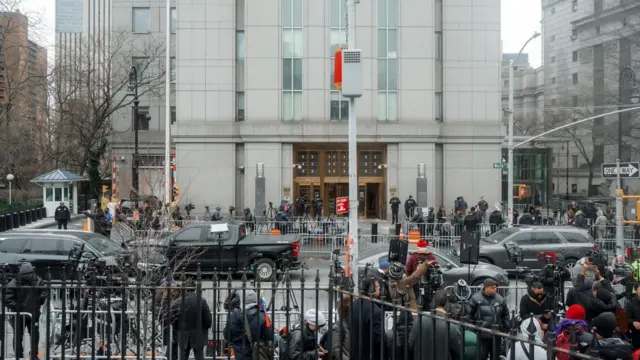
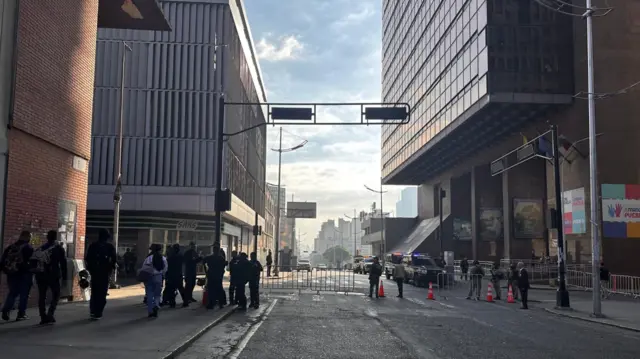
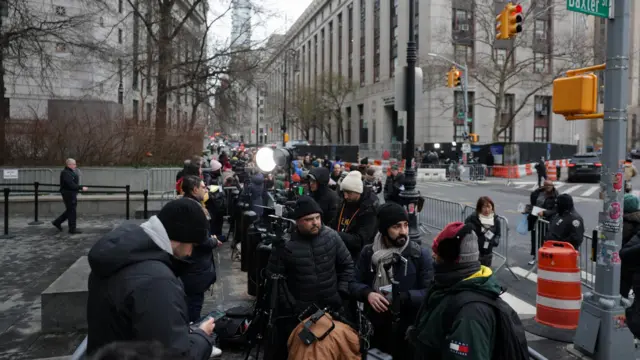
    As we've just reported, journalists and protesters are gathering outside the Daniel Patrick Moynihan United States Courthouse, where Maduro is due to appear.

    Here are the pictures that have just come in.

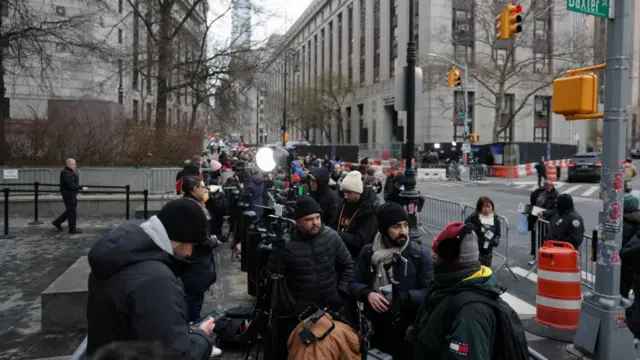
    Reporters outside the courthouse, where we can more visibly see the camera crews, lights, microphonesImage source, Reuters
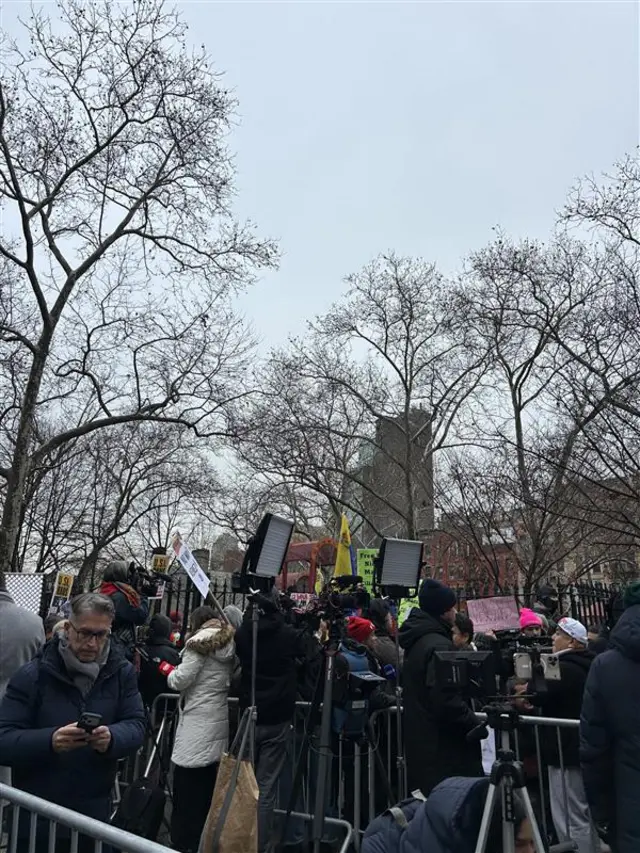
    Protestors hold signs outside the court. One says 'Free President' with the Venezuelan flag. Another says 'No [...] Venezuelan oil', another says 'From Venezuela to the Philipenes, stop the war [unknown]'Image source, EPA/Shutterstock
    Image caption,

    Pro-Maduro protestors shout slogans and hold signs outside the courthouse

    A shot of the courthouse from the other side of the road, where there are lots of different camera crews gathered behind barricadesImage source, EPA/Shutterstock
    Image caption,

    Journalists wait outside the courthouse

  7. Protesters gather outside court ahead of Maduro hearingpublished at 16:15 GMT 5 January

    Madeline Halpert
    Reporting from outside New York court

    A couple of dozen protesters have gathered outside the court as we get closer to the hearing for Maduro and his wife.

    They're chanting in Spanish, with the number of pro-Maduro protesters appearing to outnumber the anti-Maduro demonstrators.

    The space has become crowded as hordes of press have gathered around the people chanting.

    Many of those gathered are holding Venezuelan flags and signs.

    A photo of individuals gathered outside court. Some can be seen holding signs and flagsImage source, Madeline Halpert/BBC
  8. Colombian president says he would be prepared to 'take up arms' to defend the countrypublished at 16:13 GMT 5 January

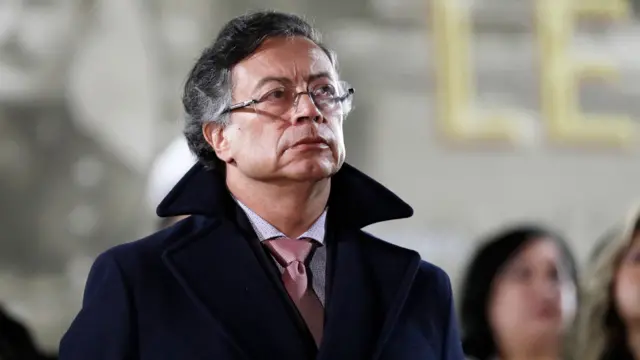
    Headshot of Gustavo PetroImage source, EPA

    Colombian President Gustavo Petro says he would be prepared to "take up arms" to defend Colombia.

    His comments follow threats from Donald Trump, who threatened military action against the Colombian government, according to Reuters and several media outlets.

    Trump alleged the Colombian leader was involved in drug trafficking into the US.

    In a post on social media this morning, Petro says he would not respond directly to Trump until he was sure the comments had been translated correctly. He also denied being "illegitimate" or a drug trafficker.

    In his post, Petro says he had sworn "not to touch" a weapon again - but for the homeland, he would take up arms.

  9. Americas do not belong to any doctrine or power, Mexican president sayspublished at 16:01 GMT 5 January

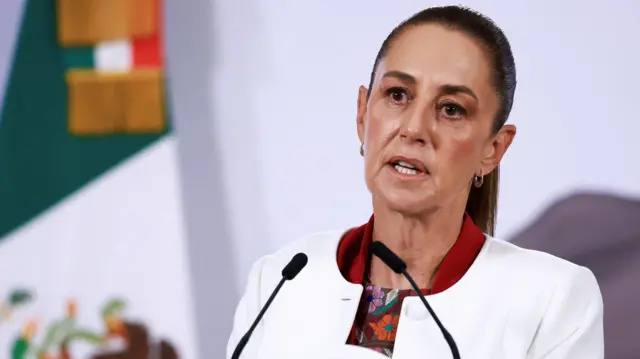
    Claudia Sheinbaum. She is a woman with dark-brown hair tied tightly back. She is wearing a white jacket with a red collar and floral patterned top underneath. She is standing at a lectern with two microphonesImage source, Reuters

    Mexican President Claudia Sheinbaum has told a news conference she does not think a US intervention is likely in her country, as she repeats her opposition to the seizure of Maduro.

    She says that the Americas do not belong to any doctrine or power but to their people, adding Mexico is open to co-operation against drug trafficking but will not accept subordination or intervention.

    On Sunday, Donald Trump told Fox News that "something's going to have to be done with Mexico", but Sheinbaum says she doesn't think it's something the US is "taking seriously".

    She also says she has said "no very firmly" to the idea of the US Army entering Mexico.

  10. Shares in US energy companies risepublished at 15:48 GMT 5 January

    Natalie Sherman
    New York business reporter

    Shares in US energy companies are up as investors bet that the US seizure of Maduro will open opportunities to tap the country's oil reserves.

    Shares in Chevron opened more than 4% higher, after surging more than 7% in pre-market trading.

    Other firms, including ConocoPhillips, Spain’s Repsol, Haliburton also gained.

    Elsewhere, precious metal prices and shares in defence stocks also rose as the intervention increased investors' concerns about geopolitical risks.

    Chevron is the only US energy firm currently operating in Venezuela, which has rich holdings of oil but has seen production wither in recent decades in the face of US sanctions and other challenges.

    Trump has suggested that US firms will enter the country to rebuild the industry after the removal of Maduro, but industry analysts have warned that revival will be a long-term project.

  11. UN Secretary General 'concerned international law not respected'published at 15:31 GMT 5 January

    At the emergency session of the UN's Security Council, under-secretary general Rosemary DiCarlo has read out a statement on behalf of Secretary General António Guterres.

    Guterres says that he is "deeply concerned that rules of international law have not been respected" when it comes to the US's actions in Venezuela.

    The statement says: "I am deeply concerned about the possible intensification of instability in the country, the potential impact on the region, and the precedent it may set for how relations between and among states are conducted."

  12. US allies in ‘very difficult position’ at UN meeting - former UK national security adviserpublished at 15:24 GMT 5 January

    As we've just reported, an emergency session of the UN Security Council has begun to discuss the situation in Venezuela.

    A little earlier we heard from former UK national security adviser Sir Mark Lyall Grant, who says the UK and other European nations are "in a very difficult position".

    Sir Mark, who also formerly served as the UK ambassador and permanent representative to the UN, tells BBC Radio 4's World at One programme that the US's actions are "almost certainly not" legal under international law.

    France and the UK will be “very keen” not to talk about the legality of the operation at the UN, he says, adding he expects them instead to focus on what comes next for Venezuela.

  13. UN Security Council meeting on Venezuela beginspublished at 15:06 GMT 5 January

    A United Nations Security Council meeting on the current situation in Venezuela has just begun.

    The agenda for the emergency meeting is listed as discussing "threats to international peace and security".

    Our reporters will be watching live and we'll bring you updates on any key developments.

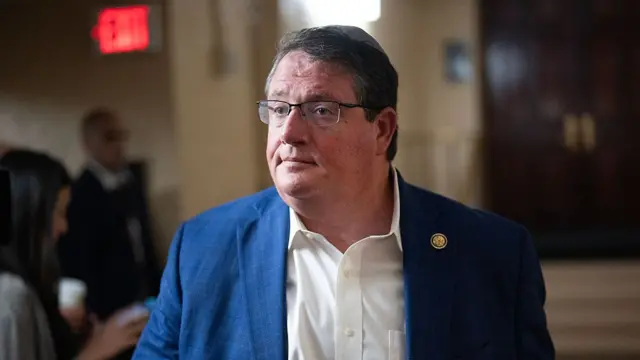
  14. Trump was right to not inform Congress, Republican sayspublished at 15:01 GMT 5 January

    A file photo of Republican congressman Randy FineImage source, Inc via Getty Images

    Republican congressman Randy Fine says that the president “doesn’t need to check with us every time he arrests a drug dealer”, in response to questions about the seizing of Maduro.

    “If he did, we wouldn’t arrest a whole lot of drug dealers,” Fine tells CNN.

    The congressman says he believes Trump made the right decision not to inform Congress ahead of the strikes and Maduro's seizure because he believes “someone would have run their mouth”.

    Chuck Schumer, the US Senate's top Democrat, previously said "launching military action without congressional authorisation" to seize Maduro was "reckless" and ran counter to what he had been told by the Trump administration about its intentions.

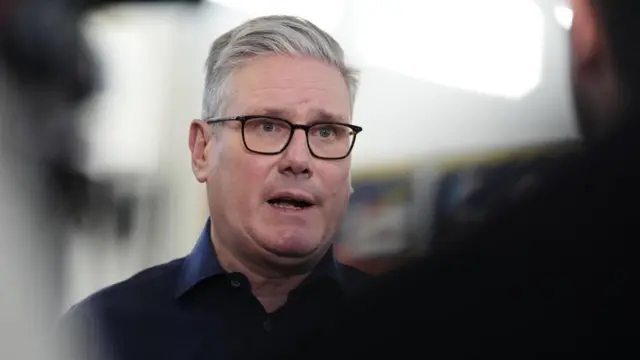
  15. Starmer says he wants to see 'peaceful transition to democracy' in Venezuelapublished at 14:33 GMT 5 January

    Sir Keir Starmer speaking to reporters, looking seriousImage source, Reuters

    UK Prime Minister Keir Starmer spoke to reporters a little earlier, saying he wants to see a "peaceful transition to democracy" in Venezuela.

    “What’s happened here in Venezuela is obviously really important. We have long championed a peaceful transition to democracy, because the president was illegitimate," he says.

    International law needs to be the "anchor" for the country's future, he says, adding "it's for the US to set out its justifications for the actions that it's taken".

    "It remains a complicated situation. The most important thing is stability and that peaceful transition to democracy," he says.

  16. Usual routine resumes in Caracas, but tension remainspublished at 14:18 GMT 5 January

    Nicole Kolster
    Reporting from Caracas

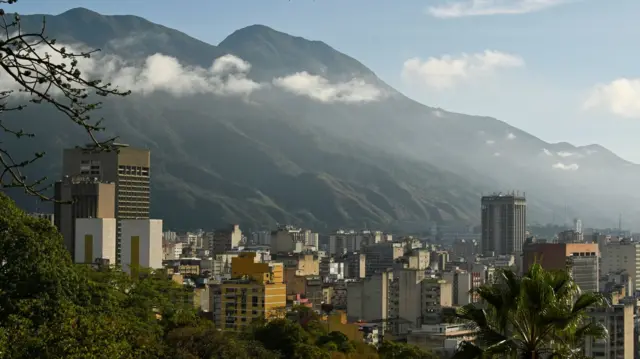
    The skyline of Caracas after the U.S. launched a strike on Venezuela, capturing its President Nicolas Maduro and his wife Cilia FloresImage source, Reuters

    Monday morning. The usual routine begins. The streets and avenues of Caracas gradually regain their normal traffic after it was disrupted and greatly reduced over the weekend following the events that ended with the seizure of Nicolás Maduro.

    It’s a working day, and businesses have also started to open. The metro and gas stations are operating and there is no significant security presence on the streets.

    However, around the parliament, where a special session is taking place today for Delcy Rodríguez to be sworn in as interim president of Venezuela, some streets are closed.

    A street closed off by a fence outside the parliament building

    Here, there is a deployment of officials, but not of the magnitude seen, for example, during Maduro’s swearing-in on 10 January, 2025.

    A 49-year-old woman near the palace tells me that "food prices are extremely high, it’s terrifying".

    While she speaks to us, a group of national guard officers prepare for security duty.

  17. Crowds gather outside New York court ahead of Maduro appearancepublished at 14:02 GMT 5 January

    Madeline Halpert
    Reporting outside court in New York

    Members of the media work outside the Daniel Patrick Moynihan United States CourthousImage source, Reuters

    I'm outside New York federal court, where Maduro and his wife are expected to appear in a courtroom in just a few hours.

    Like it was on days when other high-profile defendants have come before the court in the past, there is a line around the block of reporters and members of the public queuing to get access to the room where Maduro and his wife, Cilia Flores, will appear for the first time since their seizure this weekend.

    Maduro and his wife will stand before 92-year-old Judge Alvin Hellerstein and be formally charged on drugs and weapon counts.

    They are expected to enter their pleas during the arraignment, which are typically brief hearings.

  18. Recap: Maduro transferred to court and Venezuela's interim president to be sworn inpublished at 13:55 GMT 5 January

    Maia Davies
    Live reporter

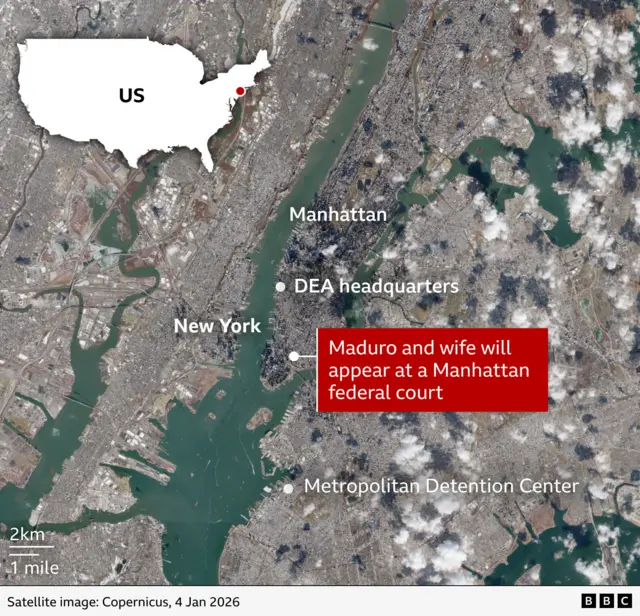
    It's now 08:55 in New York (13:55 GMT), where Maduro is due in court in a few hours after being seized by the US over the weekend.

    In the last few hours

    A graphic map of New York showing where Maduro will appear in court

    Coming up

    • Maduro is due to appear before a judge at 12:00 local time (17:00 GMT), charged with various weapons and drug offences
    • His vice president Delcy Rodríguez is set to be sworn in as Venezuela’s interim president today
    • We’re also expecting a UN Security Council meeting later where the situation will be discussed
  19. US oil companies' share prices set to jumppublished at 13:36 GMT 5 January

    Nick Edser
    Business reporter

    While the price of oil has not seen a major reaction to the US actions in Venezuela over the weekend, share prices in US oil companies are set to jump when official trading begins later.

    This is on the back of expectations that US firms will get greater access to Venezuela's oil reserves in the future, following President Trump’s comments over the weekend.

    In pre-market trading, shares in Chevron – the only major US oil company still operating in the country – are up more than 7%, while oil field services firms such as Halliburton have seen their shares jump by a similar amount. The US market opens at 09:30 EST (14:30 GMT)>

    However, analysts have warned that reviving the Venezuelan oil industry will take a long time and cost billions of dollars.

  20. Swiss government freezes Maduro's assetspublished at 13:30 GMT 5 January

    Jonathan Josephs
    Business reporter

    The Swiss government has frozen assets held by Venezuela’s Nicolás Maduro and “other persons associated with him with immediate effect”.

    It says this is being done to prevent any such assets being taken out of the country and that if future legal proceedings show they were acquired illegally Switzerland will try and return them to the Venezuelan people.

    Switzerland has had sanctions in place on Venezuela since 2018 which includes asset freezes and travel bans on 54 individuals.

    It’s unclear exactly what assets Maduro holds in Switzerland, but a 2021 report in a Swiss newspaper based on leaked documents said that Swiss prosecutors had identified bank accounts containing approximately $10 billion that may have come from embezzled public funds in Venezuela.

    Today’s asset freeze comes into force today with immediate effect and will remain valid for four years until further notice.