Summary

  1. Power outages affecting many residentspublished at 20:19 GMT 28 October 2025
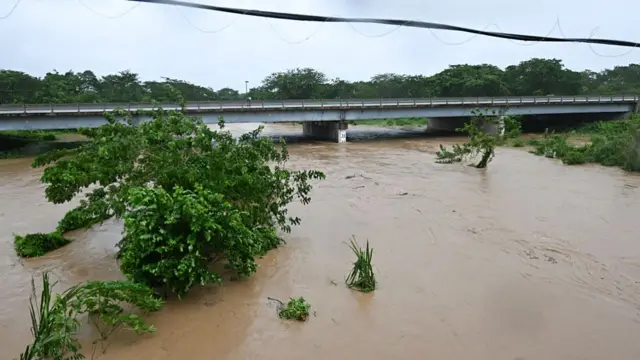
    image of muddy brown river overflowingImage source, AFP via Getty Images
    Image caption,

    The Rio Cobre flowing out of its banks near St. Catherine, Jamaica

    Shortly before Melissa made landfall, Jamaica's electricity provider JPS said that over a third of its customers were without power, mostly in the west, and outage reports were still increasing.

    In the last hour, JPS posted an update - it doesn't offer specific numbers but says, "We know many of you are without power. We see you. We hear you".

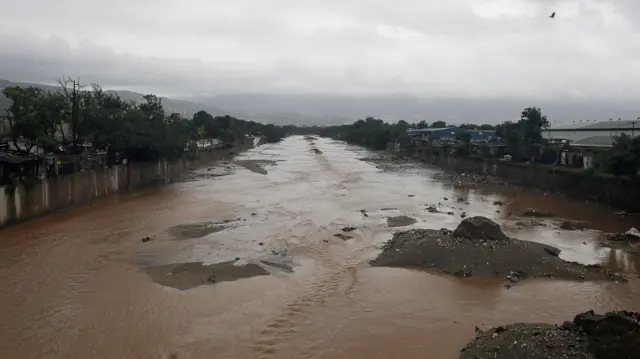
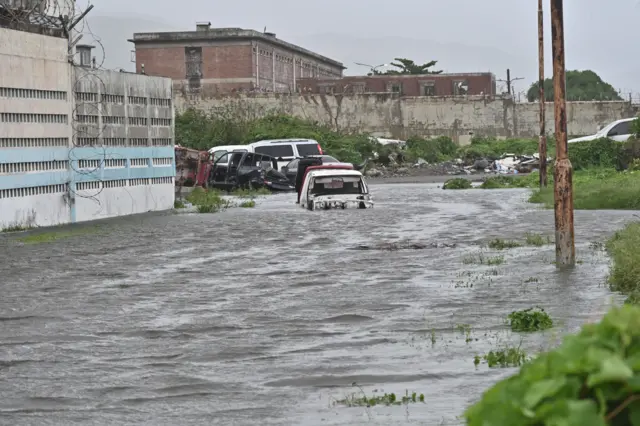
    Meanwhile, roads continue to flood and waterways are overflowing.
    road flooded with water going halfway up a carImage source, EPA/Shutterstock
    Image caption,

    A flooded road in Kingston
  2. Photos show damage as hurricane lashes Jamaicapublished at 20:09 GMT 28 October 2025

    Photos taken from the last few hours show the damage the hurricane is inflicting as it makes landfall.

    We'll bring you more photos as they emerge.

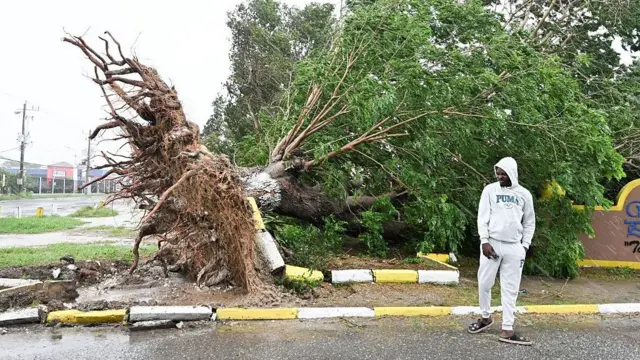
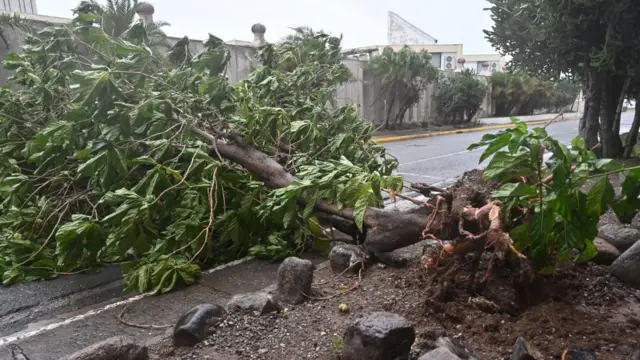
    A man looks at a fallen tree in St. Catherine, JamaicaImage source, Getty Images
    Image caption,

    A man looks at a fallen tree in St Catherine, Jamaica

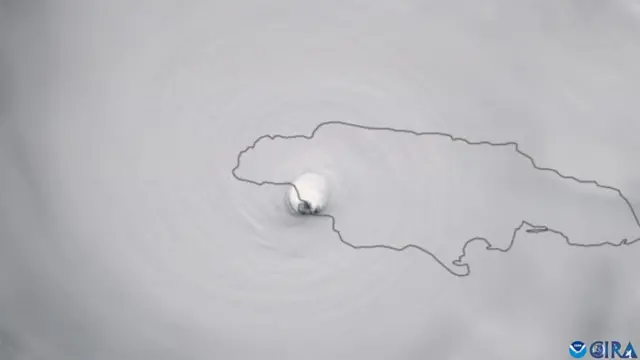
    All of Jamaica is now covered by clouds, blocking the satellite viewImage source, Getty Images
    Image caption,

    All of Jamaica is now covered by clouds, blocking the satellite view

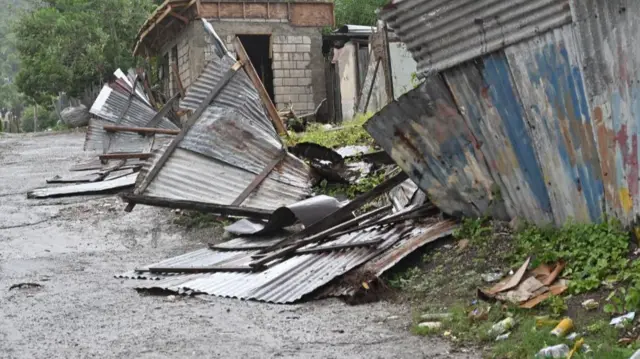
    A damaged home and fence seen in KingstonImage source, EPA
    Image caption,

    A damaged home and fence seen in Kingston

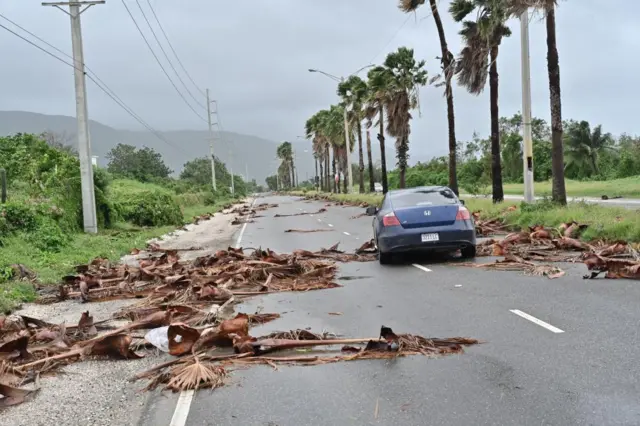
    Palm fronds blown down by wind seen strewn around the roadwayImage source, EPA
    Image caption,

    Palm fronds blown down by wind seen strewn around the roadway

  3. 'Cover yourself with a mattress': Jamaicans warned to shelter in placepublished at 19:55 GMT 28 October 2025

    Official warnings about the storm haven't changed more than two hours after it made landfall.

    The latest alert from the US National Hurricane Center shows the hurricane is still bringing "catastrophic winds, flash flooding and storm surges" to Jamaica and warns people to continue sheltering in place.

    The centre of the storm has moved to the north coast near the tourist resort town of Montego Bay, and the sustained wind speed has dropped to 160 mph (260km/h), down from 185 mph when it made landfall.

    To protect yourself, the NHC says you should avoid falling trees and "put as many walls as possible between you and the outside."

    "You can cover yourself with a mattress and wear a helmet for added protection," it adds.

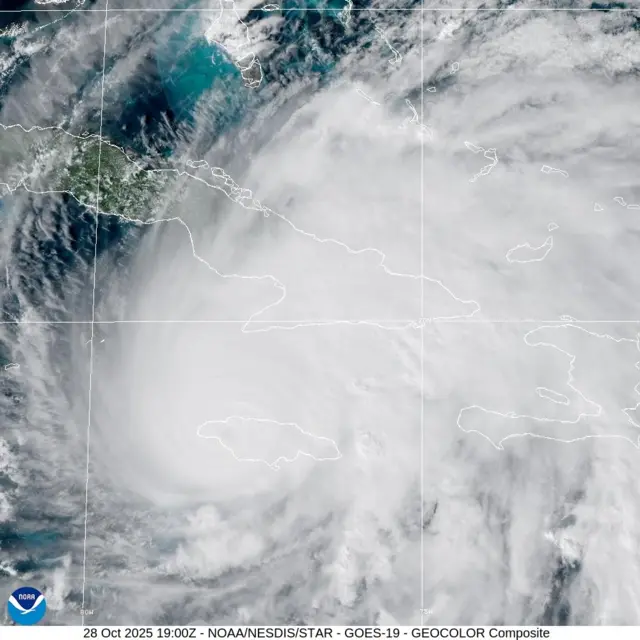
    A satellite map showing Jamaica and Hurricane MelissaImage source, National Hurricane Center
  4. Hotels put guests in makeshift ballroom shelters to wait out stormpublished at 19:47 GMT 28 October 2025

    Mary Litchfield
    UGC & Investigations

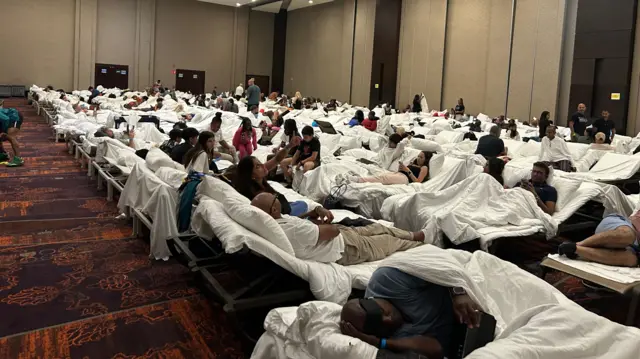
    Dozens of people sit on cots with white sheets in a hotel ballroomImage source, George Chac
    Image caption,

    People shelter on cots in an event room at the Moon Palace Resort

    With his flight home yesterday cancelled because of the storm, an American traveller and his family are now huddled in a Jamaican hotel shelter.

    George Chac from Phoenix, Arizona arrived to Ocho Rios, a town on the north coast of Jamaica, last week. Now, he's sheltering in a communal room at the Moon Palace Resort with dozens of others.

    "The prepping and waiting has been a roller coaster of emotions. A lot of anxiety," he said. "We just wish it would get on with it and be over instead of looming over us like it is."

    Staff has been staying at the hotel attending to guests instead of with their own families, he said.

    A little girl in pyjamas watches TV on her tablet while in a hotel shelterImage source, George Chac
    Image caption,

    Chac's daughter

  5. US warns travelling citizens to get out of hurricane's pathpublished at 19:40 GMT 28 October 2025

    The US Department of State has sent out a warning to American travellers as Hurricane Melissa hits: get out if you can or take cover.

    "If you’re in an area projected to be in the storm's path, depart ASAP if still possible. Americans who decide to remain should make preparations to shelter in place," said a notice put out on the department's social media.

    They encouraged citizens in the storm's path to register with their Smart Traveler Enrollment platform so US embassies can contact them and their emergency contacts.

  6. 'We are all terrified' says holidaymaker from UKpublished at 19:33 GMT 28 October 2025

    Alex Emery
    BBC News

    View from hotel room of Hurricane MelissaImage source, Emma/UGC

    Emma, who is on a family holiday in Jamaica from Essex, England, says they currently aren’t allowed to leave the safe area of the hotel, as windows have been smashed by high winds.

    "We are currently in Montego Bay. The wind is roaring through the hotel, windows are rattling and doors have been screwed shut."

    "We moved to a safe room as the children were petrified. The windows have been blown through and the staff are working furiously to make us safe."

    “We have all just moved to another room in the building as the glass in the lobby is unsafe. We are all terrified.”

  7. Latest map of hurricane pathpublished at 19:25 GMT 28 October 2025

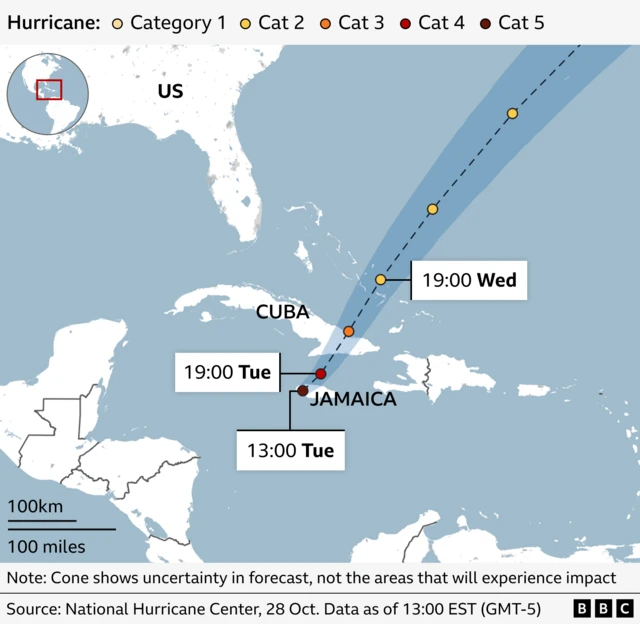
    A forecast map showing Hurricane Melissa’s projected path across the Caribbean. The hurricane is on the coast of Jamaica and is shown as a Category 5 storm (dark red dot) at 13:00 local time Tuesday 28 Oct. It is expected to move northeast toward Cuba overnight as Category 4 (red dot), then continue toward the Bahamas as Category 2(yellow dot). The map includes a cone of uncertainty extending toward the Atlantic Ocean. All times in local time for Jamaica (GMT-5).

    Here’s the latest map showing the projected path of Hurricane Melissa as it continues to track across Jamaica and the Caribbean, heading northeast toward Cuba and the Bahamas.

    The category five storm is currently moving across the southside of Jamaica and is expected to weaken to category four as it reaches Cuba.

    The National Hurricane Center believes it will then be downgraded to a category two as it moves out into the North Atlantic later on Wednesday.

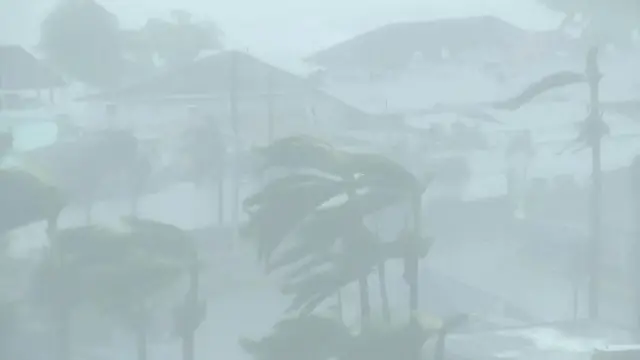
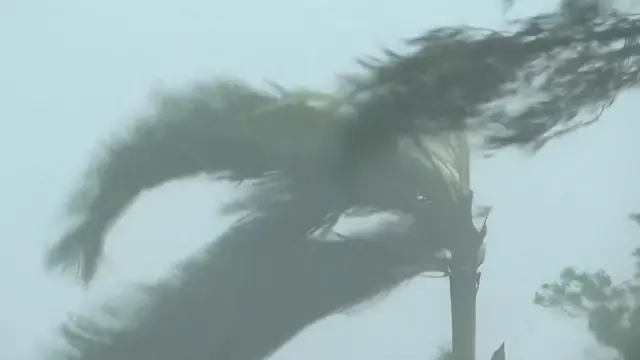
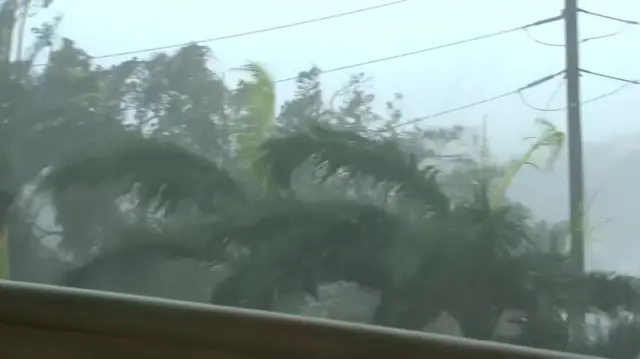
  8. Montego Bay lashed by Hurricane Melissapublished at 19:19 GMT 28 October 2025

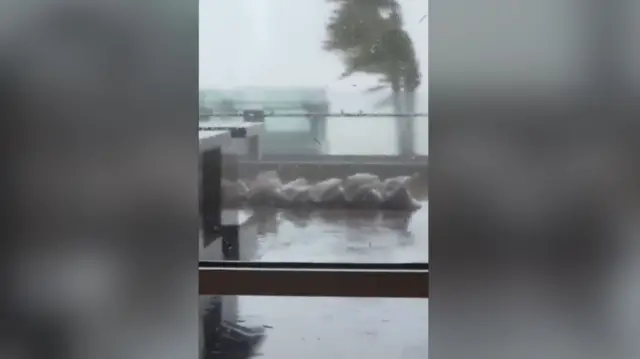
    As the hurricane slams into Jamaica with with estimated maximum wind speeds close to 300 kilometres an hour, these live pictures from Montego Bay in Jamaica show its initial impact.

    Montego Bay, JamaicaImage source, Reuters
    Tree being buffeted by strong windImage source, Reuters
    Pylons and trees, Montego BayImage source, Reuters
  9. What's the latest?published at 18:56 GMT 28 October 2025

    A fallen tree on a road caused by Hurricane Melissa in Kingston, JamaicaImage source, Reuters
    Image caption,

    A fallen tree on a road caused by Hurricane Melissa in Kingston

    Hurricane Melissa has made landfall in Jamaica as a category five storm, bringing catastrophic winds and risks of flash flooding across the Caribbean island.

    It is now the most powerful storm recorded this year and among the strongest in the Atlantic since records began. Here's what else you need to know:

  10. Why is Hurricane Melissa's pressure so low - and what does that mean?published at 18:35 GMT 28 October 2025

    Helen Willetts
    BBC Weather

    As a hurricane forms, the air rotates around its centre and warm moist air rises, leaving a gap in the middle, with surrounding air rushing in to fill this space. This process continually repeats while the storm is over the ocean.

    If the wind doesn't change too much, this means the storm will continue to grow in magnitude and strength.

    And as the storm grows, more air leaves the centre of the hurricane than can be replaced - which causes the pressure inside to drop. This ultimately makes the storm even stronger by increasing the wind strength.

    In fact, how strong a hurricane becomes is measured by its central pressure and maximum wind strength.

    According to the US National Hurricane Centre, Melissa had maximum sustained winds of about 185 miles per hour and an estimated minimum central pressure of 892 millibars at landfall, making it one of the most powerful storms to ever make landfall in the Atlantic Ocean.

  11. Residents and tourists take shelter as Melissa bears down on Jamaicapublished at 18:17 GMT 28 October 2025

    Alex Emery
    BBC News

    Louis-Ray Harris
    Image caption,

    Louis-Ray Harris

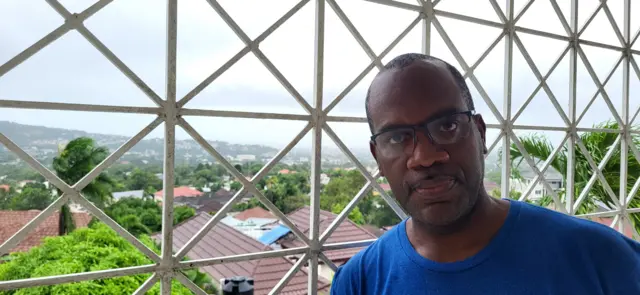
    A university lecturer in Kingston, Jamaica, says the wind is now picking up near his home, where he is staying with his wife and three children.

    "It has been raining and windy in some areas, with the occasional lull," Louis-Ray Harris, a senior lecturer in the Department of Physics at the University of the West Indies, tells me.

    "We just lost power and the wind has picked up significantly."

    Dave Griffiths, who works in HR and lives in Gloucester, is visiting Jamaica with his wife and children.

    The group are in lockdown at their hotel in Lucea, on the island's north-west side, and they expect to stay there for the rest of the day.

    Griffiths says he's "wide awake listening to the storm strengthening outside the windows of my hotel room", adding that he's lucky to feel "safe and secure" there.

    Looking ahead, he says his biggest concern is the devastation that's predicted to happen across Jamaica in the coming hours.

    "I feel so sad for the people that live here - we’ve had a disrupted holiday only," Griffiths says. "Their lives are likely to literally be turned upside down.”

  12. Catastrophic winds and flash flooding expected across Jamaica - National Hurricane Centerpublished at 18:10 GMT 28 October 2025
    Breaking

    We can now bring you the latest update from the US National Hurricane Center, which says the maximum sustained winds have now eased to 165mph (270 km/h).

    This comes after the hurricane made landfall with wind speeds of 185 mph (295 km/h).

    It further warns that "catastrophic winds, flash flooding and storm surges" are expected across Jamaica.

    "Catastrophic flash flooding and numerous landslides are likely," the NHC says, as well as "total structural failure" for buildings on the island near its path.

    This announcement repeats earlier warnings - that residents should stay inside and seek emergency shelter - and urges those living in the warning zone of the Bahamas and Cuba to complete any property protection measures as soon as possible.

  13. Analysis

    How does Melissa compare with other storms?published at 17:59 GMT 28 October 2025

    Rachel Hagan
    World Service reporter

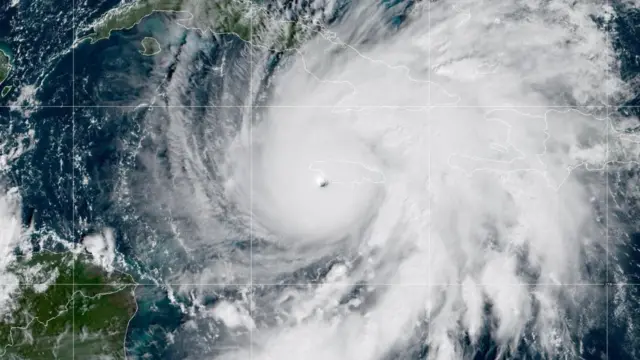
    A handout satellite image made available by the National Oceanic and Atmospheric Administration (NOAA) shows Category 5 Hurricane Melissa approaching Jamaica, 28 October 2025.Image source, Reuters
    Image caption,

    A handout satellite image made available by the National Oceanic and Atmospheric Administration shows Hurricane Melissa

    Hurricane Melissa, now a category five system after making landfall a short while ago, is the strongest on Earth so far this year.

    It ranks as one of the strongest storms in the Atlantic this century.

    For Jamaicans, the comparisons with past storms are chilling.

    Gilbert in 1988, the last direct hit, was a category four. It destroyed thousands of homes and killed 49 people. Dean in 2007 and Beryl in 2024 came close, but neither matched Melissa's raw power.

    Globally, Melissa ranks among the most powerful cyclones ever observed - just behind Mexico's Hurricane Patricia in 2015 and the record-holding Typhoon Tip of 1979.

    Earlier today, the storm had an air pressure in its centre of 901 millibars (mb), just ahead of Hurricane Katrina, which reached 902mb.

    Katrina, which hit New Orleans in 2005, killed 1,392 people and caused damage estimated at $125bn (£94bn).

    Melissa has set itself apart for how quickly it grew. The storm intensified from a tropical system to a category five hurricane in just a day, fuelled by exceptionally warm waters in the Caribbean (as my colleague explained a bit earlier), around two to three degrees above normal.

  14. How a so-far calm Atlantic hurricane season is making Melissa more powerfulpublished at 17:49 GMT 28 October 2025

    Helen Willetts
    BBC Weather

    One of the main reasons Melissa has become a category five hurricane - an extremely dangerous storm, which forecasters warn could cause catastrophic flooding - is because it has been sitting over its fuel source, the warm ocean, for almost a week.

    The Caribbean Sea is currently warmer than average by a couple of degrees, which has fuelled this hurricane even more.

    We haven't seen many big storms in the Atlantic so far this season, meaning the warm air and energy in this ocean region has not been depleted or used up in previous storms - leaving more fuel for Melissa.

    And of course with climate change, we can expect warmer conditions - which lead to more extreme weather events.

    • As a reminder, as my colleague pointed out earlier, while the direct link between Hurricane Melissa and a warmer environment may be studied after the event, it is likely that it has been made wetter and windier by human-induced climate change
  15. Pictures show storm picking up as Melissa makes landfall with catastrophic windspublished at 17:35 GMT 28 October 2025

    Hurricane Melissa has just made landfall in Jamaica as a category five hurricane, meaning the storm's eye has crossed over Jamaica's coastline and is now above the island.

    Here's a look at where things stand now on the island as the storm picks up.

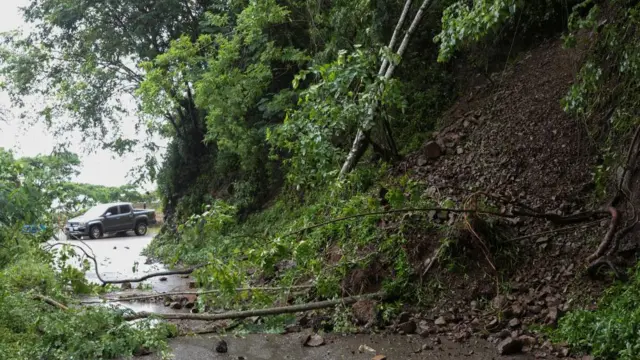
    tree branches fallen down in roadImage source, Reuters
    Image caption,

    Downed tree branches blocking a road in Gordon Town, Jamaica

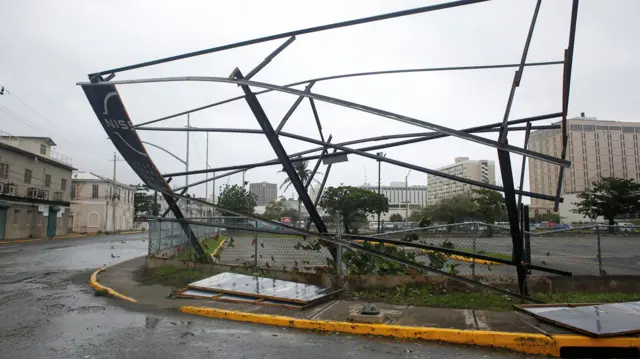
    partially collapsed big metal frameImage source, Reuters
    Image caption,

    A partially collapsed hoarding frame is seen in downtown Kingston before Hurricane Melissa made landfall

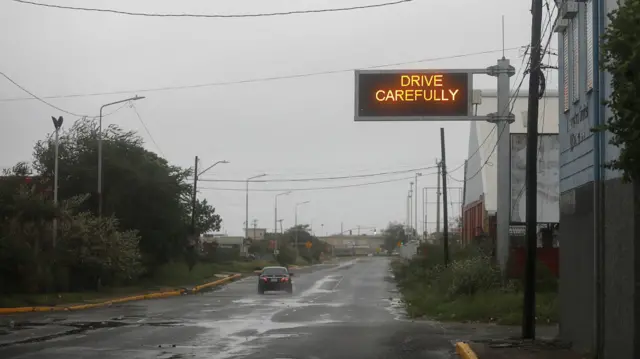
    single car on wet road with stormy sky in backgroundImage source, Reuters
    muddy water flowing through a concrete basin between neighborhoodsImage source, Reuters
    Image caption,

    Muddy water flows through a basin in Kingston

  16. Jamaicans hunker down as Hurricane Melissa makes landfallpublished at 17:19 GMT 28 October 2025

    Rozina Sini
    BBC News

    Shelley Jackson

    Shelley Jackson lives in Montego Bay - she tells us there's "significantly more wind and rain" today - and that the petrol station opposite where she lives has "lost some of its roof" due to "gusts of constant wind".

    “I’m here with my neighbour and we are hunkering down," she says, adding the pair have provisions including canned food, propane and gas tanks for a stove.

    Shelley says when she first heard about the storm, "it didn’t bother me because we've had storms before" - but she adds that by the time she realised the severity of the situation "it was a bit late".

  17. Storm 'extremely dangerous and life-threatening' - National Hurricane Centerpublished at 17:16 GMT 28 October 2025

    The statement from the National Hurricane Center, external repeats a lot of what we've heard already throughout the day.

    It says the storm is "extremely dangerous and life-threatening".

    Citizens are urged not to leave their shelter as the eye passes through the country. This is because "winds will quickly, and rapidly increase" again on the other side of the eye, the NHC says.

  18. With wind speeds of 185 mph, hurricane is still category fivepublished at 17:10 GMT 28 October 2025
    Breaking

    Hurricane Melissa has made landfall with an estimated maximum sustained wind speed of 185 mph (295 km/h), the US National Hurricane Center says.

    This means it's still a category five hurricane.

  19. Melissa makes landfall in Jamaicapublished at 17:05 GMT 28 October 2025
    Breaking

    Hurricane Melissa makes landfall in south-western Jamaica, near New Hope, the National Hurricane Center says.

    We'll bring you more on this as soon as we have it.

  20. Hurricane Melissa is stronger than 'anything we've experienced', resident sayspublished at 17:04 GMT 28 October 2025

    Rozina Sini
    BBC News

    Rebecca Allen is in Southfield, Jamaica, on the south of the island.

    “It is incredibly rough here. Lots of things are flying around, the wind speeds are incredible," she says, adding they have done as much as they can to prepare for the storm.

    "My community was devastated by Hurricane Beryl last year," she tells me. In July 2024, when that category four storm swept the island, it brought more than 12 hours of heavy rain.

    Allen says this time around, her family is better prepared, but notes that this storm - a category five - is more than "anything we've experienced".

    "We've tried our best, that's all I can say."