Summary

  1. Melissa now a category three hurricanepublished at 00:24 GMT 29 October 2025
    Breaking

    Melissa is now a category three hurricane, according to a new update from the US National Hurricane Center.

    Maximum sustained windspeeds are currently 125mph (205km/h), a large drop from the 185mph when it made landfall a few hours ago.

    It warns that more "catastrophic" flooding is likely in Jamaica, with some areas expecting 30 inches (76cm) of rain.

    The latest bulletin calls for Jamaicans to remain inside shelters until the storm is fully passed.

    It also calls on residents of Cuba, where up to 25 inches of rain is predicted, to "seek safe shelter immediately".

    In the Bahamas, where Melissa is due to arrive in a few hours, "preparations to protect life and property should be rushed to completion".
  2. Jamaica's St Elizabeth Parish under water - ministerpublished at 00:02 GMT 29 October 2025

    St Elizabeth Parish, in Jamaica's southwestern coast, is now under water, after the country's infrastructure was "severely compromised" by Hurricane Melissa, a local government minister says.

    Desmond McKenzie says the Black River Hospital in St Elizabeth Parish is now without power and 75 patients are being relocated.

    The region of Clarendon has suffered extensive damage, he adds, and a fire station in Santa Cruz is flooded.

    "We're still not out of the woods," he warns, adding that assessment teams will make their way out to provide communities with necessary relief supplies when the opportunity presents itself.

    "We are on standby. Everything is ready, we are just waiting for the system to pass and for some level of calm to come back to the system," McKenzie says.

    Close to 15,000 Jamaicans have gone to various shelters across the country, he says.

  3. Watch the moment Melissa made landfall - as seen on CCTV across Jamaicapublished at 23:38 GMT 28 October 2025

  4. 'One of the worst experiences Jamaica has ever encountered'published at 23:23 GMT 28 October 2025

    More now from Desmond McKenzie.

    He says Jamaica's government "remains proactive in our planning" and remains poised to respond "when the opportunity presents itself".

    "This is one of the worst experiences that we have ever encountered," he says, referencing Hurricane Charlie in 1951 and Hurricane Gilbert in 1988.

    He adds that the government and its Office of Disaster Preparedness have learned lessons from those storms, as well as from Hurricane Beryl last year. They reviewed their performance in those disasters and instituted lessons from them, he says.

    "Despite the challenges, I think we have done well," he says, adding: "The next round is going to be more difficult than preparing for Melissa."

  5. No official information on deaths in Jamaica, minister sayspublished at 23:11 GMT 28 October 2025

    We've been hearing from Jamaica's local government minister Desmond McKenzie, who says he hasn't "gotten anything official to say that there are deaths".

    "Let us hope that there are none so far," he says at a news conference.

    He adds that it is "not possible to do any assessment at all on damage" - even on a preliminary level - because "nobody right now can go to do any assessment".

    He reiterates that officials continue to wait for "a window of opportunity" to get relief supplies to the thousands of Jamaicans "who do not know what their fate is".

    "That is our first priority - to get relief supplies to those who are in need and the assessment will come after."

    Airports also remain closed, which is also stalling the influx of relief supplies.

  6. Watch: BBC reporter in Jamaica 'feels anxiety in chest' as Melissa hitspublished at 23:00 GMT 28 October 2025

    We can bring you latest video sent to us by Nick Davis, a BBC reporter in Kingston:

  7. 'The fear is real': Recovery group braces for hurricane's damagepublished at 22:35 GMT 28 October 2025

    We're hearing more about what it's like for people on the ground in Jamaica as the storm continues, and how difficult they expect recovery efforts to be.

    Tamisha Lee is in Mandeville, where she is seeing heavy rain, powerful winds, objects flying through the air, and darkness as the electricity has gone out. Lee is the president of the Jamaica Network of Rural Women Producers (JNRWP), a partner of humanitarian organisation CARE International, which will be helping with the recovery effort.

    "I am feeling anxious and tense, but I am focused. The fear is real, but our preparation is helping us manage that fear," she says.

    The post-storm recovery will be a marathon, not a sprint, Lee says. With a lot of infrastructure damage expected, making roads impassable, Lee says JNRWP will have a difficult time delivering aid to its members. And without electricity, communication will be a struggle too, she adds.

    "Based on the forecast and what we have been experiencing since Sunday evening, I am anticipating the damage will be enormous."

  8. Charity in Miami prepares emergency suppliespublished at 22:18 GMT 28 October 2025

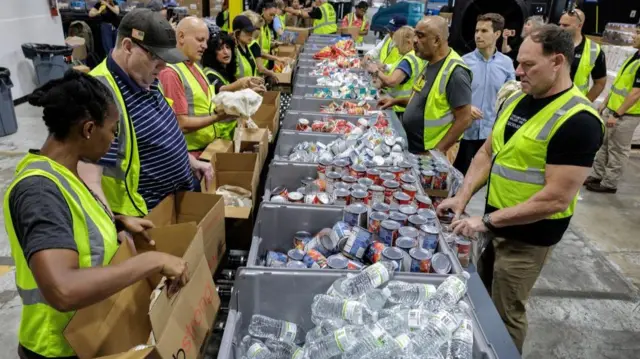
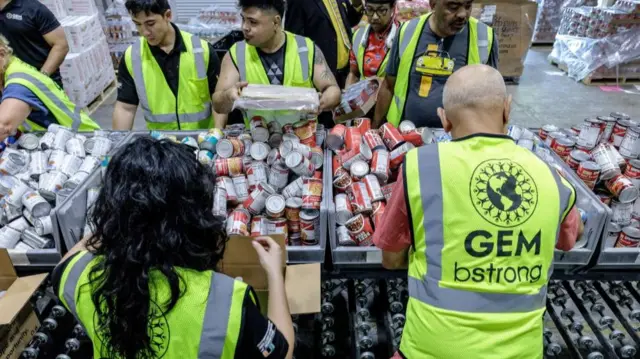
    Volunteers for the Global Empowerment Mission charity have been filling boxes of essential goods to send to affected areas.

    The boxes, which they are preparing at the group's headquarters in Miami, Florida, contain drinking water, preserved meat, canned soups and stews:

    Workers in neon vests stand near bins of water and canned foodImage source, EPA
    Workers in neon vests stand near bins of water and canned foodImage source, EPA
  9. Holidaymaker describes 'disaster zone'published at 21:56 GMT 28 October 2025

    Earlier we spoke to Kyle Holmes, from Bolton, who is visiting Jamaica with his wife and young daughters, aged 7, 10, and 12, for a family wedding.

    He said the windows and balconies of the hotel he was staying in - the Grand Palladium Resort, in the town of Lucea - had started to rattle and "everything was smashing against the building".

    The hotel now looks like "a disaster zone" said Holmes, who added his family are now safe after the "worst experience ever".

    He says he has barricaded the windows to the hotel room by placing all the furniture against them.

    "We were supposed to be flying back tomorrow afternoon at 15:30," he told BBC Manchester radio.

    "But the president of the airport has said it won't be open until Thursday.

    Our reporter Dan Wareing has the full story here.

  10. Have hurricanes been getting worse?published at 21:44 GMT 28 October 2025

    Mark Poynting
    Climate reporter

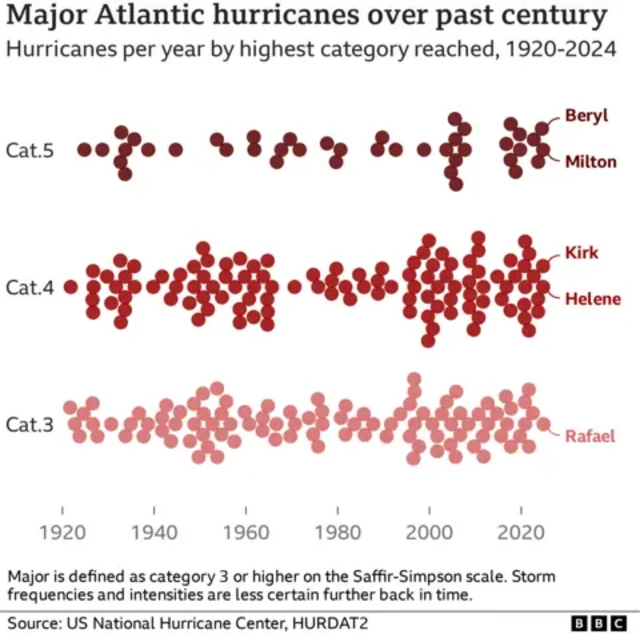
    Globally, the frequency of tropical cyclones has not increased over the past century, and in fact the number may have fallen, external - although long-term data is limited in some regions.

    But it is "likely" that a higher proportion of tropical cyclones across the globe are reaching category three or above, meaning they reach the highest wind speeds, according to the UN's climate body, the IPCC, external.

    BBC Graphic showing the increasing number of category three, four and five hurricanes in the North Atlantic

    The IPCC quotes "medium confidence" that there has been an increase in the average and peak rainfall rates associated with tropical cyclones.

    The frequency and magnitude of "rapid, external intensification events" in the Atlantic has also likely increased, external. This is where maximum wind speeds increase very quickly, which can be especially dangerous.

    There also seems to have been a slowdown in the speed at which tropical cyclones move, external across the Earth's surface. This typically brings more rainfall for a given location. For example, in 2017 Hurricane Harvey "stalled" over Houston, releasing 100cm of rain in three days, external.

    In some places, the average location where tropical cyclones reach their peak intensity has shifted poleward - for example the western North Pacific, external. This can expose new communities to these hazards.

    And there is some evidence, external the increased intensity of US hurricanes means they are causing more damage.

  11. Dangerous environment will continue after the storm passespublished at 21:34 GMT 28 October 2025

    Heavy rainfall and damaging winds will continue affecting the majority of the island through the night, with an additional six to 12 inches of rain possible, Mike Brennan, the director of the US National Hurricane Center tells BBC News.

    But even after the storm passes over the island, the "flooding risk, and just the post storm environment in Jamaica, is going to be extremely dangerous with widespread trees and power lines down, significant structural damage", Brennan says.

    It's going to remain a very dangerous environment - particularly in the western part of the country and in the mountains - "for days, if not weeks, to come", Brennan says.

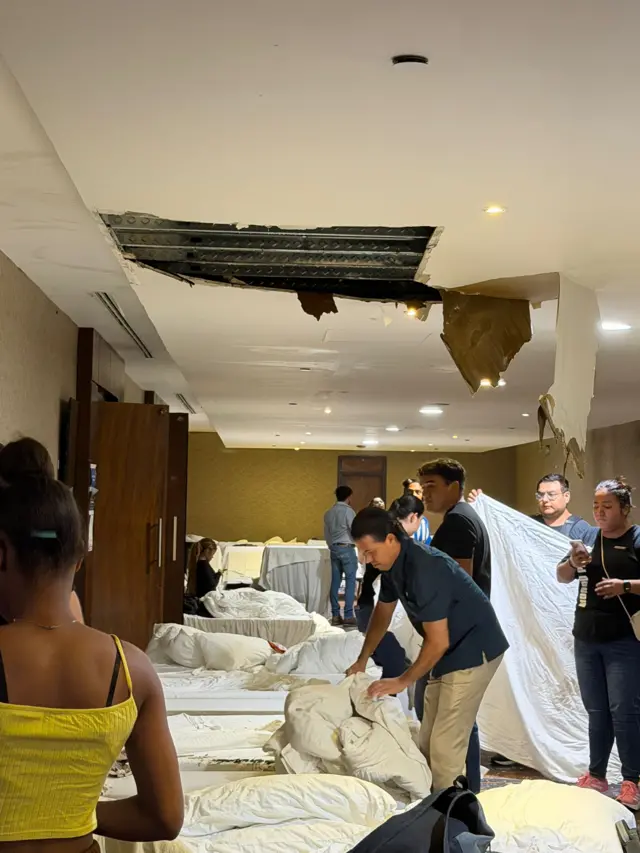
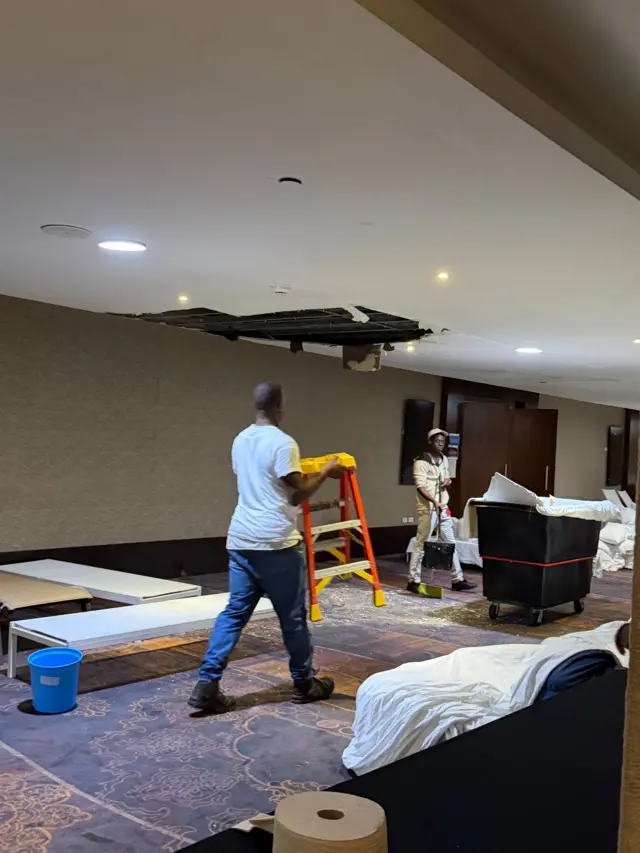
  12. Torrential rain causes hotel ceiling to fall inpublished at 21:29 GMT 28 October 2025

    We've just been sent these photos from Moon Palace in Ochos Rios, a coastal town in north Jamaica.

    Damage wrought by the hurricane has caused some of the ceiling to collapse in an area where guests are sheltering.

    In other parts of the island water has risen up to the roofs of buildings.

    A group of people stand around handling bed linen in the room of a hotel. A hole gapes in the roof, and plasterboard hangs down.Image source, Richard
    Image caption,

    People remove bed linen from a room where the ceiling has collapsed due to Hurricane Melissa.

    Two hotel workers dressed in white collect bits of ceilings in a laundry binImage source, Richard
    Image caption,

    The beds have been removed and a laundry trolley is being used to transport bits of ceiling.

  13. Shelter in place advisory extended overnight as Melissa eyes Cuba and Bahamas nextpublished at 21:17 GMT 28 October 2025

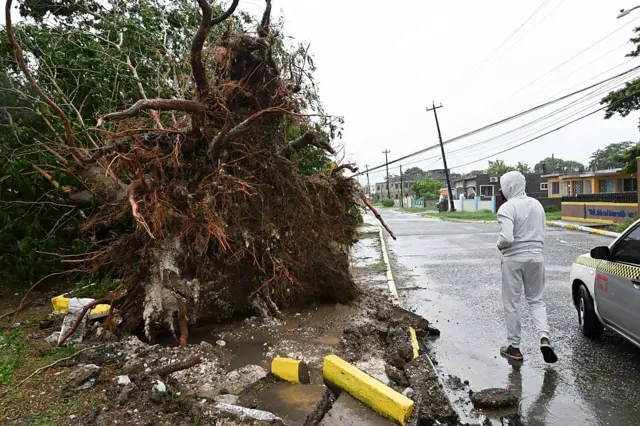
    A man looks at a fallen tree in St. Catherine, Jamaica, shortly before Hurricane Melissa made landfall on October 28, 2025Image source, Getty Images

    We can now bring you the latest update from the US National Hurricane Center (NHC), which has been tracking Hurricane Melissa.

    The hurricane's maximum wind speed is now expected to be around 145 mph (230km/h) and it will move from the west towards Jamaica's northeast.

    "Damaging winds will continue across portions of Jamaica through this evening, especially in mountainous areas," the NHC says. "Remain in a safe shelter in Jamaica through tonight."

    "Melissa is expected to reach southeastern Cuba as an extremely dangerous major hurricane, and it could still be a major hurricane when it moves across the southeastern Bahamas," the NHC adds.

    US hurricane hunting planes will be out later tonight to gather more information about Melissa's path.

  14. Videos show early impacts of Hurricane Melissapublished at 21:03 GMT 28 October 2025

    Dramatic videos out of Jamaica show the early impacts of Hurricane Melissa, one of the strongest storms ever recorded.

    Videos show strong wind forces in Kingston, in the south, and swaying tree and flying debris in Montego Bay in the north of the island nation.

    Melissa has been downgraded to category 4, but it still presents a dangerous situation.

    Media caption,

    Strong winds and flying debris as Hurricane Melissa makes landfall

  15. Roofs torn off hospitals, former senator sayspublished at 20:59 GMT 28 October 2025

    Some hospitals on the south coast of Jamaica have had their roofs torn off, former Jamaican senator Imani Duncan-Price tells BBC News.

    "We have some solid structures, but some structures, because we are a developing country, are not as sturdy."

    A hospital in Saint Elizabeth, Duncan-Price says, had to move some patients up to higher floors because of previous damage the structure had sustained in Hurricane Beryl last year.

    The winds have been so strong in some parts of the country that "no structure" could withstand them, she says.

    In Mandeville, for example, water has risen up to the roofs of houses, Duncan-Price says.

    "People are trying to rescue people in the middle of the storm just to save lives."

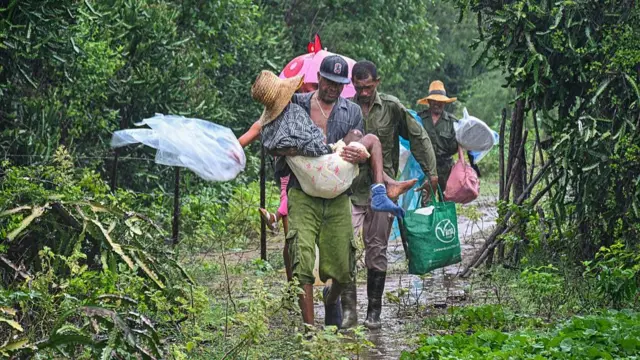
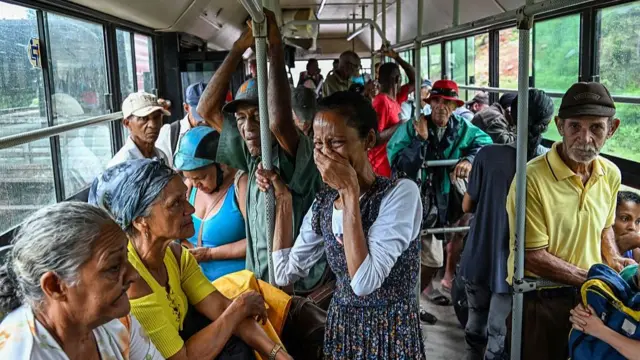
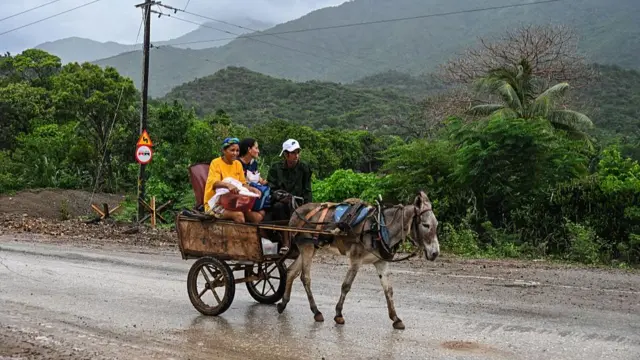
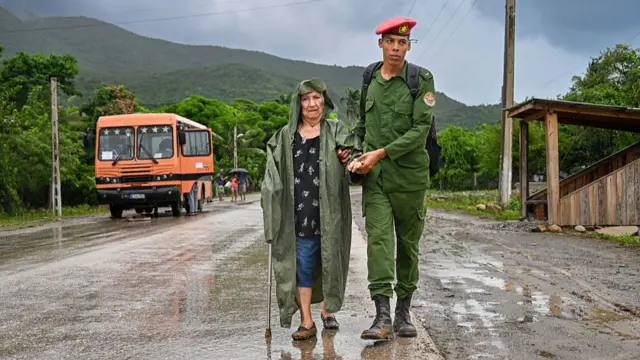
  16. Evacuations underway in Cubapublished at 20:52 GMT 28 October 2025

    As Melissa continues to batter Jamaica, across the Caribbean to the north, residents of the southern Cuban city of Santiago de Cuba are evacuating to higher ground.

    Some are staying behind, trying to secure roofs and fences, while stockpiling drinking water.

    Cubans carry their supplies through a dense forest under rain. One man carries an older person.Image source, Getty Images
    Evacuees on a bus. A woman hold her hand to her mouth and appears to be crying.Image source, Getty Images
    Cubans on a donkey-drawn carriageImage source, Getty Images
    A soldier escorts an older woman down the roadImage source, Getty Images
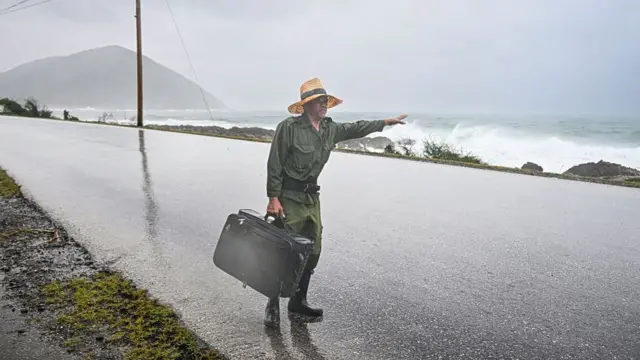
    A man holds his hand out and tries to a hitch a ride while holding a suitcaseImage source, Getty Images
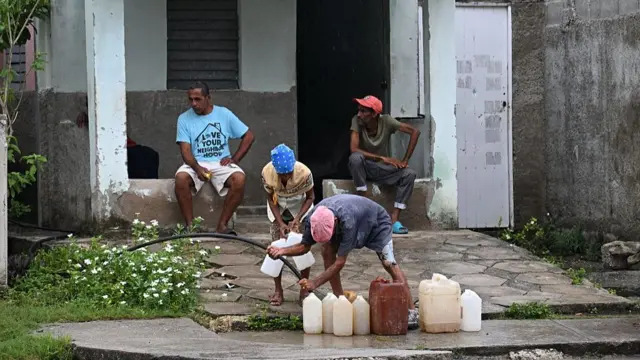
    Men fill containers with drinking waterImage source, Getty Images
  17. 'We've seen a lot of roofs blown off', Kingston resident sayspublished at 20:44 GMT 28 October 2025

    Brandon Drenon

    Winston Warren has been riding out the hurricane from inside his home in east Kingston with his wife and father.

    I asked him to describe what it's like when a category 5 hurricane comes barreling past your doorstep.

    Warren, who says he lives less than 1km from the ocean, describes the sound as "a constant roar of water".

    "There are times you just wonder - are the waves going to come crashing into your house," he says.

    "We've seen a lot of roofs blown off," he continues.

    Warren says he believes he has escaped the worst of the impact, having taken the necessary precautions, like trimming the branches on the mango trees in his yard days ago.

  18. Beware of crocodiles, Jamaican officials warnpublished at 20:34 GMT 28 October 2025

    Hurricane Melissa and the resulting flooding may displace crocodiles from their natural dwellings, Jamaican health officials say.

    "Rising water levels in rivers, gullies, and swamps could cause crocodiles to move into residential areas," the South East Regional Health Authority said in a statement online. The warning covers residents in several parishes including the capital Kingston, St. Andrew, St. Thomas and St. Catherine.

    "Residents living near these areas are therefore advised to remain vigilant and avoid flood-waters."

    Crocodile sightings should be reported to the National Environment and Planning Agency.

    The American Crocodile (Crocodylus acutus) is the only species found on the island, primarily in the south, according to NEPA. Crocodiles are an important symbol for Jamaica, featuring on the country's coat of arms. A 1971 law protects crocodiles from hunting, capture and harassment, according to a NEPA fact sheet.

  19. How is climate change affecting hurricanes like Melissa?published at 20:29 GMT 28 October 2025

    Mark Poynting
    Climate reporter

    Melissa is one of the strongest hurricanes of the century. And while it will take time to pin down the role of climate change, there are reasons to believe it is making things worse.

    1. The warm waters currently in the Caribbean Sea give the storm extra “fuel”, helping it to intensify rapidly and reach higher wind speeds.

    2. A warm atmosphere can hold more moisture, which can lead to heavier rainfall.

    3. Higher sea levels – driven by melting glaciers and warming oceans – make it more likely that storm surges will lead to coastal flooding.

    Another notable feature of Melissa is how slowly it is moving, known as “stalling”.

    Some research suggests hurricanes are generally moving more slowly than they used to, although links to climate change are complicated.

    It means that a hurricane can bring rain to a single location for days on end, worsening flooding.

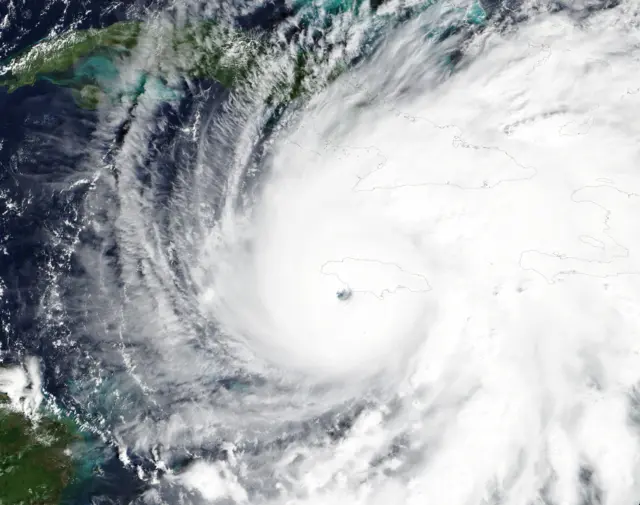
    A handout satellite image made available by NASA's Worldview application, part of the NASA Earth Science Data and Information System (ESDIS), shows Hurricane Melissa approaching Jamaica, 28 October 2025.Image source, EPA
    Image caption,

    Hurricane Melissa makes landfall in Jamaica on 28 October 2025

  20. Melissa downgraded to category 4published at 20:23 GMT 28 October 2025
    Breaking

    The hurricane's force has been downgraded from a category five to a category four, but it is still lashing the island.

    Catastrophic winds up to 150mph (240km/h), flash flooding, and a dangerous storm surge are ongoing, the National Hurricane Center says.