Summary

  1. First student receives MenB vaccine at Kent campuspublished at 15:08 GMT 18 March
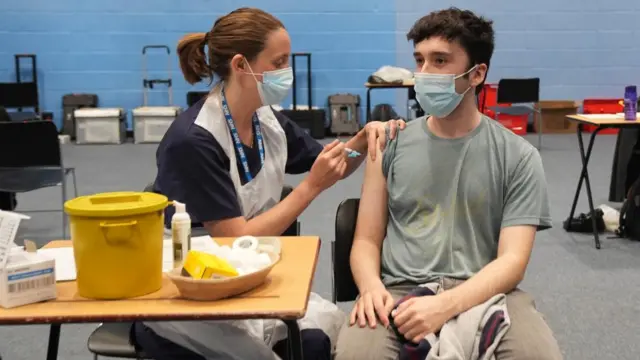
    22-year-old postgraduate law student Oliver Contreras receives an injection in the sports hall at University of Kent campus in Canterbury, where the rollout of a meningitis B vaccine to about 5,000 students has begunImage source, PA

    Oliver Contreras, 22, is the first student to have been given a Meningitis B vaccine at the University of Kent's Canterbury campus.

    He tells the PA news agency he is "pretty happy" to have received the vaccine, adding that his dad had wanted him to get one before heading home this weekend.

    However, the postgraduate student says he was not happy about the communication surrounding the outbreak, adding that he thinks the university let people know "a bit too late".

    "All these social events went ahead on Sunday, and I was at one of them, and I kind of wish I'd got more information before all that," he says.

    The University of Kent has said in a statement that the jab rollout was "part of our ongoing commitment to offer a swift response and reassurance to support Kent students at this difficult time".

    Alongside this, it added that the university will "continue to offer precautionary antibiotics to staff and students that may be affected".

  2. Sense of relief as students arrive for jabspublished at 14:52 GMT 18 March

    Simon Jones
    Reporting from the University of Kent

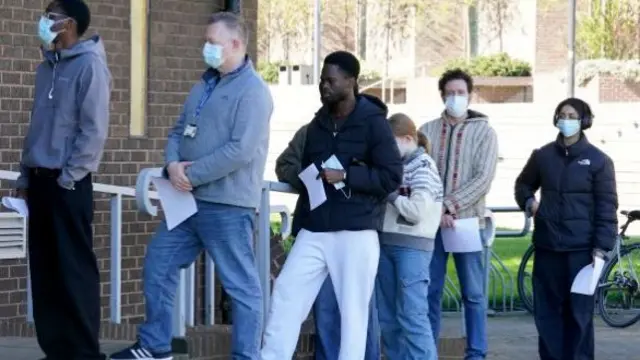
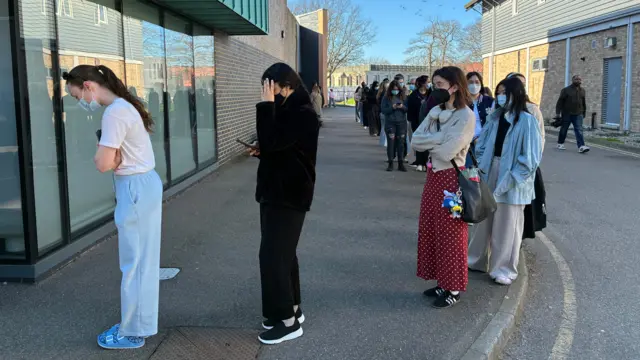
    Queue of people on road outside building

    Scores of students have begun arriving at the university sports hall for jabs, and there is a sense of relief among those here that the programme has begun.

    People must show a letter and their student ID to prove they live in the university halls of residence, and therefore qualify to receive the jab.

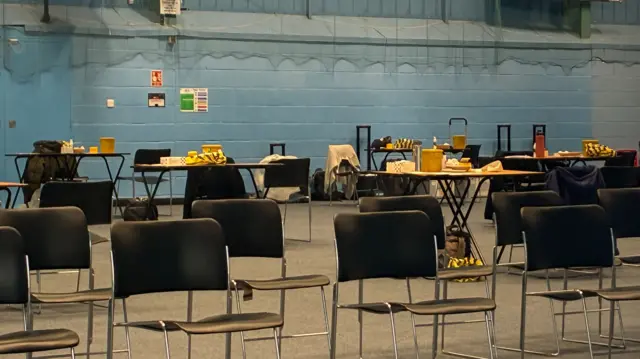
    Chairs laid out in sports hall with tables in the background
  3. Vaccine rollout for University of Kent students beginspublished at 14:34 GMT 18 March
    Breaking

    The rollout of a Meningitis B vaccine to 5,000 students at the University of Kent's campus in Canterbury has begun.

    Vaccinations are taking place at the Sports Centre on campus.

    Vaccines will be offered to all students living on campus from today, the university says, adding that eligible students living in accommodation on campus have been informed and have started to arrive.

  4. It's 'especially worrying' to find out you're not vaccinated for MenB - studentpublished at 14:17 GMT 18 March

    A vaccination programme is expected to start in Kent today.

    These students and staff members have been telling the BBC why they are going to take up the vaccine.

  5. 'Everybody looked scared' as Kent campus 'deserted' after meningitis outbreak, says studentpublished at 14:02 GMT 18 March

    Gabriela Pomeroy
    Live reporter

    Gabriella PitchImage source, Gabriella Pitch
    Image caption,

    Gabriella Pitch says most of her friends have taken the antibiotics as they have a connection to one of the students who is in hospital

    Gabriella Pitch is a fourth-year student studying film and management at the University of Kent.

    “When I first heard about the outbreak on the news I freaked out," she says.

    "Then I went into the kitchen of our student house and told my friends and they all freaked out.”

    Gabriella says she knows of one of the Kent University students who is in hospital with meningitis, adding that "most of my friends have taken the antibiotics".

    There was a sense of "trauma" among the students, she says, and it reminded them of the Covid days.

    “People were not going out on campus, it looked deserted. People were wearing face masks and everybody was looking scared", she says.

    Gabriella's exam was supposed to be at the university campus on Tuesday, but it was cancelled and moved online. She left campus and went home to London where she got her antibiotics.

  6. 5,000 University of Kent students to be offered vaccinationspublished at 13:41 GMT 18 March

    Students queuing for antibiotics at the University of Kent in CanterburyImage source, PA Media
    Image caption,

    Students queuing for antibiotics at the University of Kent in Canterbury

    The UK Health Security Agency says students at the University of Kent will be able to access antibiotics as a precautionary measure., external

    If they have travelled home to another part of the country, they will be able to get antibiotics from their local GP.

    A targeted vaccination programme is available to students who are residents of the Canterbury Campus halls of residence at the University of Kent.

    The agency says up to 5,000 students will be contacted and offered the vaccine.

    Health Secretary Wes Streeting told the BBC that it was "okay" that students will have gone home already, but he said that if they were at Club Chemistry on the 5, 6, or 7 March, they need to seek antibiotics - which they can do in their hometown.

  7. What is Meningitis B?published at 13:20 GMT 18 March

    James Gallagher
    Health and science correspondent

    There are different types of bacterial meningitis caused by different strains of bacteria.

    Meningitis B, or MenB, is now the most common in the UK - accounting for over 80% of invasive infections - since vaccination made other forms much rarer.

    Group B bacteria are not a single strain, but encompass many different forms of meningococcal B bacteria.

    There is a vaccine given to babies that protects against the most common, but not all, group B bacteria.

    Since it was introduced in 2015, MenB infections have been reduced by around 75% in those immunised.

    However, anyone over the age of 11 has not been protected unless their parents paid for the vaccine privately.

    The risk from MenB is highest in very young children and older teenagers and young adults - often linked to going to university.

    However, a vaccination campaign for teenagers was not considered to be cost-effective. This is because the vaccine is expensive and does not stop you spreading the infection, but rather stops you getting seriously ill.

    Vaccines can be used to help control an outbreak, but health officials will need to know if available vaccines match the specific type of group B that is spreading.

  8. 'All my friends are talking about it - it's scary'published at 12:49 GMT 18 March

    Phil Harrison
    BBC Radio Kent

    A girl stands in a street holding a water bottle

    There’s a steady stream of students, often accompanied by their parents, at the Vicarage Lane Clinic in Ashford town centre, where free antibiotics are available.

    The clinic began offering them this morning and has a large stock - students at local schools were advised to take them. It is open on a no appointment basis until 4pm today.

    One of those attending the clinic today is Agatha Burton, who has come with her dad.

    “I’ve come here as a precaution as I was out in Canterbury on the dates my school told us needed checking," she explains.

    She says that a friend of hers is in hospital with meningitis. "But he is doing fine. He was moved from Medway to London though.”

    “All of my friends are talking about it because there’s people from Ashford who have meningitis, it’s scary," she adds.

    “The antibiotics were easy to take, it’s just a pill to swallow.”

    Mohammed Sheik stands in street smiling at the camera

    Another young person queuing at the clinic for antibiotics is Mohammed Sheik, a media student at Ashford College.

    People are "worried" about meningitis, he tells me.

    "I know of some friends who have become ill. I’m glad the antibiotics are available but I won’t be socialising as much just in case.”

  9. Analysis

    How worried should we be?published at 12:30 GMT 18 March

    Nick Triggle
    Health correspondent

    The meningitis outbreak has been described as an unprecedented and explosive event.

    But at the same time we are being told it’s not like Covid and there’s low risk of it spreading nationwide - so how do we reconcile those two things?

    It’s true this outbreak is highly unusual. You don’t normally get such a concentration of cases all at one time.

    When cases occur in clusters, it's often limited to only three or four cases. So to have 20, seemingly linked, is hardly ever seen.

    Meningitis does not spread super easily. Sitting next to someone on a bus is not considered a risk, for example. It normally requires very close contact involving the exchange of saliva - such as kissing or sharing drinks or vapes.

    What is more, many of us already have the bacteria that causes it in the back of our throats and in our noses – and it doesn’t cause a problem.

    Only in rare cases does it lead to invasive meningitis, involving brain inflammation and blood poisoning - there are only around 300 to 400 of those cases every year.

    It’s why experts in the field continue to say the risk, even to people in Kent, is very small.

    But the unanswered question, of course, is why this has happened.

    It could just be completely random or a freak event with a particular set of unique circumstances. Or, and this is very much worst-case scenario, it could have mutated.

    While the health authorities cannot rule that out – they are carrying out tests to check – their working assumption is it hasn’t.

  10. Starmer expresses 'deepest condolences' to families of those killedpublished at 12:15 GMT 18 March

    Sir Keir StarmerImage source, House of Commons

    In the House of Commons, Prime Minister Sir Keir Starmer started this week's Prime Minister's Questions by expressing his "deepest condolences" to the families and friends of the two young people who have died following the meningitis outbreak in Kent.

    He says "this will be a deeply difficult time" for the loved ones of those are now seriously ill, and adds that health experts are working to identify close contacts of those affected.

    The prime minister calls on anyone who attended Canterbury nightclub Club Chemistry on 5, 6 and 7 March "to come forward please and receive antibiotics."

  11. 'I haven't been out since Sunday', says University of Kent studentpublished at 11:58 GMT 18 March

    Simon Jones
    Reporting from the University of Kent

    A student stands on the campus of University of Kent

    There is a strange atmosphere again today on the university campus - it’s a bit like a ghost town.

    There are very few students here, apart from people coming to pick up antibiotics, wearing masks. It feels like the Covid era.

    The university says it’s doing all it can to support its students.

    One who does remain on site is Kwatng. He tells me: "It’s really quiet. I haven’t been out since Sunday. I’ve been locked in my room. This is my first time going out."

    Many students have left the site and headed home. This should be exam season, a stressful time already. But people here are feeling stressed here for very different reasons.

    A deserted campusImage source, PA Media
  12. Analysis

    Why is this outbreak 'unprecedented'?published at 11:46 GMT 18 March

    James Gallagher
    Health and science correspondent

    This meningitis outbreak is unusual because of the large number of cases occurring in such a short period of time.

    The big unknown is why it's happened.

    Answers are not obvious. Meningitis B is the most common type in the UK, students go to clubs up and down the country - nothing is overtly unusual.

    We know people regularly catch Meningitis B bacteria and they usually live harmlessly in the nose. But in rare cases the bacteria can invade the body and cause meningitis.

    So has there been an exceptional amount of spread of the bacteria or has it become more likely to cause invasive disease?

    There is speculation about vaping - could sharing a vape in groups accelerate spread or could vaping itself making it easier for meningitis bacteria to invade the body.

    But it still asks the question what could cause such an explosive outbreak as vaping is not new or rare.

    Is there something different about the meningitis bacteria this time? Is there some unusual environmental or behavioural factor - we know smoking increases the risk of invasive disease - that is different this time.

    There are so many questions. We're still waiting for answers.

  13. Health agency says there's 'sufficient vaccine stocks' as pharmacies warn of surge in demandpublished at 11:32 GMT 18 March

    A UK Health Security Agency (UKHSA) spokeswoman says that "there are sufficient MenB vaccine stocks".

    The UKHSA "will work with local resilience partners to ensure effective distribution", a spokeswoman tells news agency PA.

    It comes as high street pharmacies warn of a surge in demand for the vaccine.

    Speaking to the Today programme on Wednesday morning, Olivier Picard - chair of the National Pharmacy Association - says that "most of our distributors and wholesalers have no stock".

    He says the association is "hearing that there may be some stock in the system" but "it is taking its time to come into our fridges".

  14. Vaccinations at University of Kent expected this afternoon, but still awaiting details of rolloutpublished at 11:16 GMT 18 March

    Simon Jones
    Reporting from the University of Kent

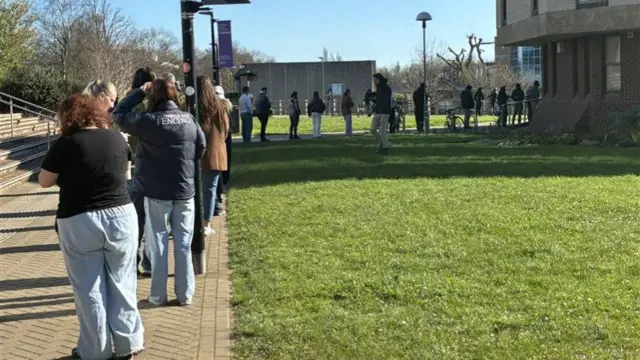
    We’re still awaiting firm details of where and when the vaccination programme for 5,000 students who live on the University of Kent will begin.

    Jabs are expected to start being given some time this afternoon.

    It is a big logistical operation getting hold of the vaccines and finding the staff to administer them, but it is being treated as an urgent matter.

    That’s why this outbreak is being classed as one requiring a national response, so resources can be brought in from elsewhere.

    Students queue up at the University of KentImage source, Simon Jones / BBC
  15. Meningitis patient who returned to France from England in stable condition - health ministrypublished at 11:07 GMT 18 March

    French authorities say a person who was admitted to hospital with meningitis, after returning from England, is now in a stable condition.

    On Saturday, French authorities alerted UKHSA to a second confirmed case in France linked to the University of Kent.

    In a statement today, the French health ministry says "no other cases linked with the situation across the Channel" have been reported.

    "All possible measures have been taken to limit the spread of the infection. People who were in risky contact with the patient have been informed and an antibiotic treatment has been offered to them," the ministry says.

    "The situation is being monitored by French authorities, with their British counterparts," it adds.

  16. What we know about the meningitis outbreak so farpublished at 10:45 GMT 18 March

    • With five additional cases announced by the UKHSA this morning, a total of nine meningitis cases have now been confirmed, and 11 are under investigation
    • Two young people have died - an 18-year-old sixth form student called Juliette, and a University of Kent student whose identity has not been released
    • Six cases are known to be Meningitis B - a bacterial form of the disease
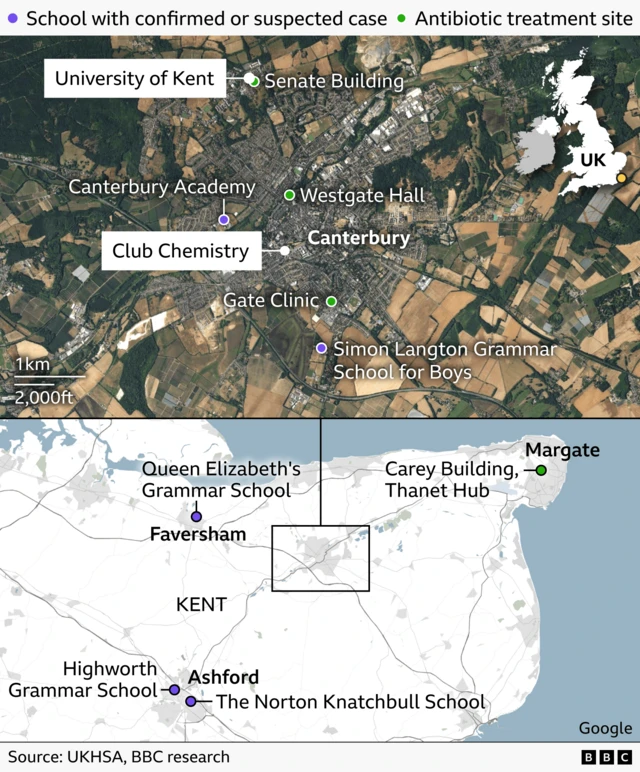
    • Five schools in the Kent area have so far confirmed or suspected cases among their students
    • All cases are currently being treated as linked to Kent. Anyone who visited Canterbury nightclub Club Chemistry on 5, 6 or 7 March is being urged to pick up preventative antibiotics from clinics in the Kent area, or from their GP - more information on those services can be found on the NHS website, external
    • Close contacts of cases are being traced, and advised to take antibiotics too - the health secretary said earlier that 2,500 people have been given medication
    • Meanwhile a targeted vaccination programme is expected to roll out later today, which will aim to give MenB jabs to around 5,000 students at the University of Kent
    A two‑part map showing five schools with confirmed and suspected meningitis cases and four antibiotic treatment sites in Kent, UK. The top map focuses on Canterbury, marking schools, clinics, treatment locations, Club Chemistry and the University of Kent. The bottom map shows the wider Kent area, including Faversham, Ashford, Margate and additional schools. Coloured dots indicate confirmed and suspected cases (purple), and treatment sites (green).
  17. 'The mood just shifted completely': University of Kent student tells BBC about anxiety on campuspublished at 10:35 GMT 18 March

    "Everyone's just feeling a lot of anxiety at the moment," says Izzy Kenny, who is in her fourth year at the University of Kent.

    She tells BBC Radio 5 Live Breakfast that she was with friends when she first heard about the meningitis outbreak and "the mood just shifted completely."

    Kenny says she received an email from the university "explaining the situation, the symptoms to look out for, also explaining that unfortunately one of the students has passed away".

    Since then, she says she's had "a few small updates through things like Instagram" laying out when people should get antibiotics but "that's been about it, to be honest."

    Having been told she was a close contact of a meningitis case, Kenny says she picked up antibiotics on Monday.

    "It was a long line, a lot of people going even if they haven't been in contact with somebody, just to get it for the sake of it, which I do think is a good thing," she says.

    Izzy KennyImage source, Izzy Kenny
  18. Postpublished at 10:19 GMT 18 March

    This Flourish post cannot be displayed in your browser. Please enable Javascript or try a different browser.

  19. How long does it take for MenB jabs to provide protection?published at 10:09 GMT 18 March

    Dr Simon Clarke, associate professor in cellular microbiology at the University of Reading, says MenB vaccination doesn't provide a "huge immediate effect".

    Speaking to BBC Radio 5 Live, Clarke says: "Protection from [the jab] will take a couple of months to come on full strength. It requires a couple of doses and then the protection comes about two weeks after the second dose, the full protection."

    "It won't have a huge immediate effect, even if people start having it today," he adds.

    As a reminder, a targeted vaccination programme for 5,000 students on the University of Kent campus in Canterbury is expected to begin later on Wednesday.

  20. High street pharmacies warn of high demand for jabpublished at 09:52 GMT 18 March

    High street retailer Boots says it has implemented a queuing system for customers who are trying to enter the vaccination service page of its website, warning that demand for its MenB jab is currently high.

    Similarly Superdrug has also created a waiting list for the vaccine, with a note on its website informing customers of a "national shortage".

    It says it is "working with suppliers to secure more doses."