Summary

  1. All doctors told to look out for meningitis symptoms in urgent public health alertpublished at 19:26 GMT 18 March
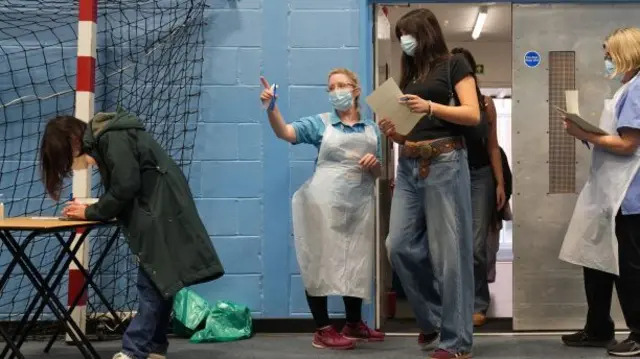
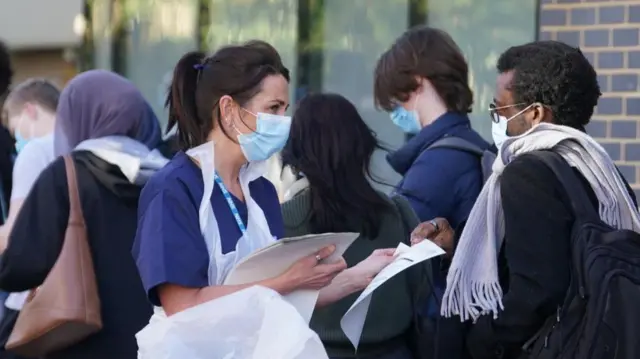
    Students at the vaccine centreImage source, PA Media

    The government has declared an urgent public health alert following what has been described as an unprecedented and explosive outbreak of meningitis in Kent.

    This alert is to the health system rather than the public, and aims to inform staff working in hospitals and GP practices what to be on the look out for and how to respond.

    There have been 20 confirmed and suspected cases since the weekend in one small area of Kent. This includes the original cluster of cases of students who were at the Club Chemistry nightclub on 5, 6 and 7 March.

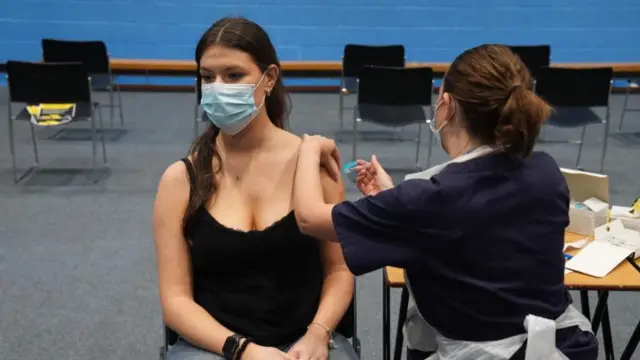
    Meanwhile, a vaccination programme for 5,000 students began at the University of Kent's campus in Canterbury today.

    It will take around four weeks for full immunity to build, our health reporter explains.

    So far, 6,500 people have been given antibiotics as a precaution.

    The outbreak is deeply unusual and defies easy explanation, writes our health and science correspondent James Gallagher.

    We're closing our live coverage now, but you can read more and keep up to date with any developments here:


  2. 'Explosive start' to meningitis outbreak as situation to be monitored, says UKHSA chief executivepublished at 18:59 GMT 18 March

    As we've been reporting, the UK Health Security Agency has issued an urgent public health alert regarding the meningitis outbreak in Kent.

    The UKHSA chief executive, Professor Susan Hopkins, tells the BBC's Health Editor Hugh Pym she has not in her career "seen such an explosive start to a meningitis outbreak".

    She explains that the rarity of the situation is why the UKHSA has taken unprecedented action and issued advice to the health system via a public health alert. However, she adds that it is not yet known how the disease has been spreading.

    The strain that has been detected has been circulating for five years, she says.

    "What it does is it gets into a new population who have no immunity to it, who haven't been living with it in the back of their throat and then that makes it cause severe disease in some individuals."

    She says the outbreak, and the bacteria more specifically, will continue to be studied and hopefully there will be more answers in the coming days and weeks.

    She adds that historically the "vast majority" of meningitis outbreaks have been successfully controlled by interventions.

    However, she says that this is an "unusual situation" which will need to be monitored to ensure "things don't change and aren't different to what we've seen before".

  3. 'Large number' of students come forward for 'highly effective' vaccine - Kent chief medical officerpublished at 18:35 GMT 18 March

    Headshot of Kate LangfordImage source, PA Media

    The chief medical officer for Kent and Medway Integrated Care Board, Kate Langford, has said a "large number" of students have come forward to receive a Meningitis B vaccine in the last few hours.

    She says they have "responded brilliantly" to the invitation.

    "This vaccine is highly effective against Meningitis B," she explains.

    "Our anticipation is it's effective against the sub-type that we're finding.

    "I would stress that the laboratory people are doing more and more work on that all the time, but yes, this vaccine is going to be highly effective."

    Langford stresses that people who exhibit symptoms or feel unwell should still seek medical advice.

  4. 'We were quite panicked' says student after Kent University outbreakpublished at 18:27 GMT 18 March

    Gabriela Pomeroy
    Live reporter

    Mor, a student at Kent UniversityImage source, Mor

    I've spoken to Mor, a classics student at Kent University, who describes the "panic" she and her friends felt when any of them displayed any symptoms.

    When the news first broke, she says she was in the library and then "suddenly everyone got up and left".

    One of her housemates started developing some of the symptoms, including a fever and a stiff neck, so Mor says "we were quite panicked in the house and called an ambulance which took her to hospital".

    Mor says they later learned her housemate did not have meningitis, but she was a carrier for the disease.

    Another of her housemates "kept taking his temperature over and over again", Mor says.

    She has left the campus and gone home to London because of the outbreak.

  5. All protocols followed in response to outbreak at University of Kent, says vice chancellorpublished at 18:11 GMT 18 March

    Professor Georgina Randsley de Moura looks to the left of the cameraImage source, UK Pool

    The acting vice chancellor at the University of Kent has said she is "confident" all protocols were followed in response to the meningitis outbreak.

    "We've been working with public health authorities working through their protocols to make sure we get people as safe as possible as quickly as possible", Professor Georgina Randsley de Moura tells the media.

    She says the university has been guided by experts who themselves are guided by the evidence.

    "What everybody has recognised over the last few days is that the spread has perhaps not been as normal as it may have been, and of course that will need to be reviewed in due course. I know that health officials are considering that too."

    Randsley de Moura says the priority is providing vaccines for those who have been deemed most at risk.

  6. Analysis

    This meningitis outbreak is deeply unusual and defies easy explanationpublished at 17:44 GMT 18 March

    James Gallagher
    Health and science correspondent

    This is not the normal pattern. Meningitis in the UK is now rare and typically occurs as isolated one-off cases.

    Occasionally there are small clusters, such as two infants at nursery in the north of England in 2023. Bigger outbreaks have happened before.

    In the 1980s there were 65 cases of MenB - including two deaths - in Gloucestershire, but those cases were reported over four and a half years, not less than a week.

    The burning question is: what's different this time?

    The answer is important, but not obvious – so far it appears to be an exceptional outbreak in seemingly unexceptional circumstances.

    Prof Andrew Preston, from the University of Bath, says there are two broad explanations for the numbers getting severely ill and dying in Kent.

    He tells me there has either been an "astonishing rate of transmission" meaning so many more people are catching the bacteria, or the infection is proving to be "more invasive" this time.

    The underlying cause could reside in the bacteria itself, human behaviour, the environment or a combination of them all.

  7. Experts answer your questions on the meningitis outbreak - watch livepublished at 17:33 GMT 18 March

    On the BBC News channel, a panel of experts are answering your questions on the meningitis outbreak in Kent.

    On hand to answer them are Paul Hunter, professor of medicine at the University of East Anglia, Dr Liz Whittaker, professor of practice at Imperial College London, and BBC health correspondent Nick Triggle.

    That programme is under way - you can watch live at the top of the page.

    Your voice
  8. What does a public health alert mean?published at 17:31 GMT 18 March

    Nick Triggle
    Health correspondent

    A public health alert sounds alarming - and it is serious.

    But this is an alert to the health system rather than the public, something similar was done for Mpox.

    It is about informing staff working in hospitals and in GP practices what to be on the look out for and how to respond.

    That includes what treatments to offer patients with suspected meningitis, what protective equipment staff should wear, how they should follow up with close contacts and which antibiotics to offer.

    It does not mean this outbreak is going to spread nationwide. Health Secretary Wes Streeting said earlier today the risk of that is low.

    Meningitis does not spread super easily. The message from experts is that this is not another Covid, but questions do remain about how such a big local outbreak has happened.

    It could be a random or freak event. A mutated strain is not being ruled out - tests are ongoing to check that out - but the working assumption is that it hasn't.

  9. At least 10 suspected cases attended Canterbury nightclub - health agencypublished at 17:11 GMT 18 March

    At least 10 people with confirmed or suspected cases of meningitis attended Club Chemistry in Canterbury on 5, 6, or 7 March, the UK Health Security Agency (UKHSA) says.

    In its guidance published as part of its public health alert, the agency says this is out of the 20 confirmed or suspected cases it is currently looking at.

    "The illness has been severe with rapid deterioration, and 2 deaths have occurred," it says.

  10. UK Health Security Agency issues urgent public health alert for Englandpublished at 16:52 GMT 18 March
    Breaking

    Hugh Pym
    Health editor

    The UK Health Security Agency has issued an urgent public health alert following the meningitis outbreak in Kent.

    A message has been sent to the health system across England advising on signs to look out for among patients and treatment options.

    This sort of alert is unusual but has been put out in recent years for Mpox and other public health issues.

    Professor Susan Hopkins, the UKHSA chief executive, tells the BBC they are still trying to work out why the bacteria spread so fast at sites in Canterbury.

    Vaccines held by the government would be used for NHS patients, she says, including students in Kent but they would not rule out supplying some to the pharmacies.

  11. Why students are being offered MenB vaccine nowpublished at 16:43 GMT 18 March

    Philippa Roxby
    Health reporter, BBC News

    The MenB vaccine has started being offered to some students at the University of Kent this afternoon. It's expected that 5,000 students will be contacted and told they can have the jab.

    So why is this vaccine part of the plan now, and not before?

    Vaccines are not usually the first line of defence in an outbreak of this kind but given how serious the situation is, UK health officials say vaccinating lots of students is a sensible extra precaution.

    The protection from vaccines doesn't kick in immediately - it takes a few weeks, and booster doses may be needed. But in the long term, students will be protected for a few years against most strains of Meningitis B.

    The MenB vaccine is available to babies in the UK, since 2015, but it's not offered to anyone who missed out including current teenagers. That's down to a decision made by the UK's vaccine experts that it wasn't cost effective for the NHS - which the government has now asked them to revisit.

    Antibiotics have been the first choice to help control this outbreak. They work more quickly than vaccines, and are seen as the best way to kill bacteria in the throat and help stop the spread of the disease. But one dose only works for a few days.

    Antibiotics have been given to people who are close contacts of anyone who is ill with meningitis.

  12. 'Less scared' and 'quite impressed' say students receiving vaccinespublished at 16:32 GMT 18 March

    A nurse hands out information sheets to those standing in lineImage source, PA Media
    Image caption,

    Students have been receiving vaccine doses at the University of Kent campus in Canterbury

    University of Kent international business student Rebecca Chapman is among those who have received a meningitis vaccine this afternoon.

    Speaking to the PA news agency, she says she feels the situation has been dealt with "quite well".

    "I think we've got information as quickly as they could give it to us," she says.

    "I'm less scared, and I did get the antibiotic as well, so I feel a lot more protected from the risk."

    Management student, Lucy, who did not give her last name, tells PA she has been "impressed" with the rollout.

    "I only just got the email whilst I was on a walk, so I thought, better get here quick before the queues start.

    "I'm quite impressed with how quick it's coming around."

  13. Six hundred vaccines available for Kent students todaypublished at 16:24 GMT 18 March

    Simon Jones
    Reporting from the University of Kent

    Six hundred vaccines are available for students on the University of Kent campus today - with more tomorrow.

    People will have to return in four weeks for a second dose.

    So far, 6,500 people have been given antibiotics as a precaution.

  14. 'She was really, really ill, slumped over', says mum of daughter with meningitispublished at 16:14 GMT 18 March

    Sara Smith
    Reporter, BBC South East

    A headshot of Candice Skinner

    Candice Skinner's daughter is being treated for meningitis at the William Harvey Hospital in Kent.

    Tyra, 20, is a student at Canterbury Christ Church and her mum has told BBC South East Today she is currently on the mend.

    The family have been in Ashford today to receive antibiotics as a precaution.

    Candice says when Tyra, who had visited Club Chemistry, woke up on Thursday feeling unwell they thought she was developing flu symptoms.

    "After that she started developing a red eye over the weekend", says Candice.

    "On Monday, she was really, really ill, slumped over, no energy so we took her to hospital and they’ve tested her now.

    "It’s been stressful but she seems to be on the mend now."

    Here are the key symptoms of meningitis which can appear in any order.

  15. Campus remains open after meningitis case - Canterbury Christ Church Universitypublished at 16:07 GMT 18 March

    We can bring you a bit more now from that statement issued by Canterbury Christ Church University in Kent, which has confirmed that one of its students has meningitis.

    The UK Health Security Agency has advised "that the risk of transmission for a close contact within the same household (flatmate) is low, and risk of transmission for anyone else remains very low," it says.

    The university says that it continues to "monitor the case closely and work with UKHSA".

    The university campus "remains open, and core teaching, learning, and research activities will continue."

  16. Second Kent university confirms meningitis casepublished at 15:54 GMT 18 March
    Breaking

    Canterbury Christ Church University in Kent has confirmed that one of its students has meningococcal disease.

    In an update shared on its website, the university says that "the UK Health Security Agency (UKHSA) has now confirmed one case of meningococcal disease for a CCCU student".

    "This case is linked to the initial cluster in Club Chemistry on 5, 6 and 7 March," it adds.

  17. MenB vaccine rollout in full swing on Kent campuspublished at 15:46 GMT 18 March

    The targeted vaccine rollout for students at the University of Kent - announced by the health secretary on Tuesday - is now under way.

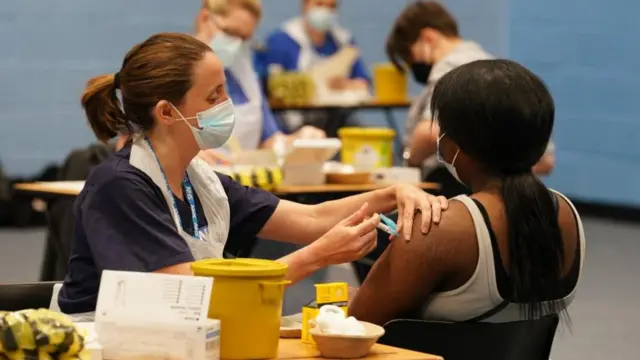
    Students in halls of residence on the Canterbury campus of the university are eligible for the MenB jab. These are some of the latest images coming in to us.

    A girl receives a vaccination inside a sports centreImage source, PA Media
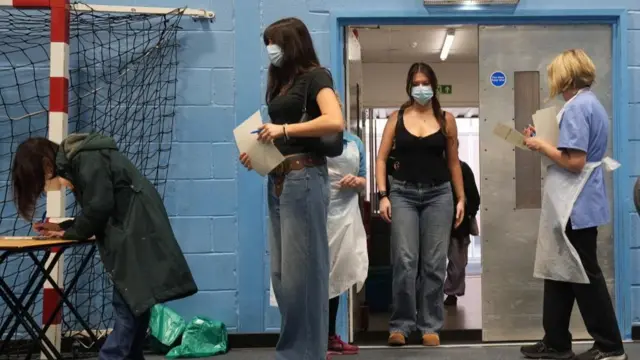
    Students wait in line inside a sports centreImage source, PA Media
    A girl receives a jab in a sports centreImage source, PA Media
  18. University says plans under way to get vaccines to students who went homepublished at 15:30 GMT 18 March

    We've had some more detail from the University of Kent about the targeted rollout of the Meningitis B vaccine on campus.

    The vaccine is being offered to "all students who reside in Canterbury campus halls of residence", says a letter sent to students by the university.

    For students who can't receive the vaccine today, it will "continue to be available to eligible students all week".

    "Arrangements are currently being developed" to ensure eligible students who have returned home already can receive the vaccine too, it says.

    The Meningitis B vaccine comes in two doses and "arrangements will be made for students to receive their second course of treatment on the campus", the letter adds.

    Vaccination is an "additional precautionary measure" on top of the antibiotics that have been handed out this week, it says.

  19. Analysis

    Vaccination may have started, but antibiotics are still importantpublished at 15:21 GMT 18 March

    Nick Triggle
    Health correspondent

    The vaccine rollout has begun - but it's worth bearing in mind what the aim of this is.

    The vaccine is about providing students with longer-term protection if the type of Meningitis B that has caused this outbreak continues to circulate in the coming weeks and months.

    When you have a cluster of invasive cases you can sometimes see a tail - where people pass it on and future cases develop.

    Many people carry the bacteria that causes meningitis in their throats and noses and for most it does not cause illness.

    It will take around four weeks for full immunity to build - and a second dose will be needed.

    What is more, Meningitis B is actually essentially a collection of different strains. The vaccine does not work against them all, although it does provide good protection against serious illness for the ones it does match.

    At the moment, the health authorities do not know exactly which version of Meningitis B is causing the outbreak - so this is to some extent a bit of a punt.

    That is why they are still advising people to come forward for antibiotics. They are the short-term solution which will help stop the infection in its tracks.

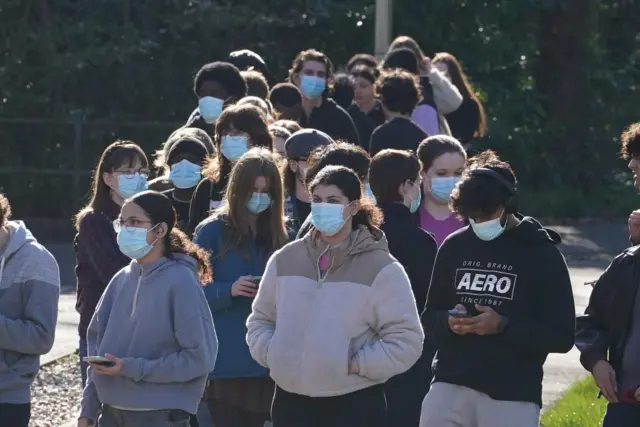
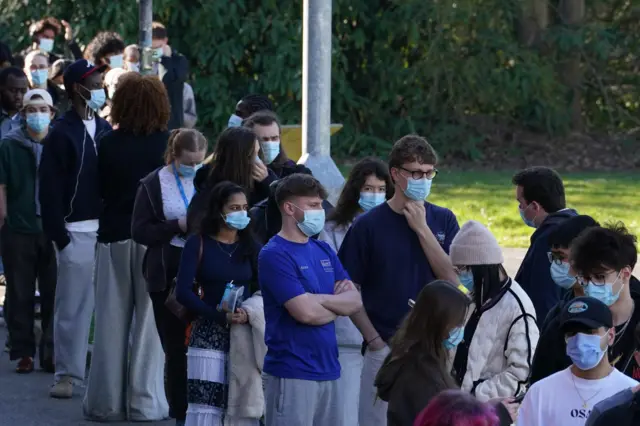
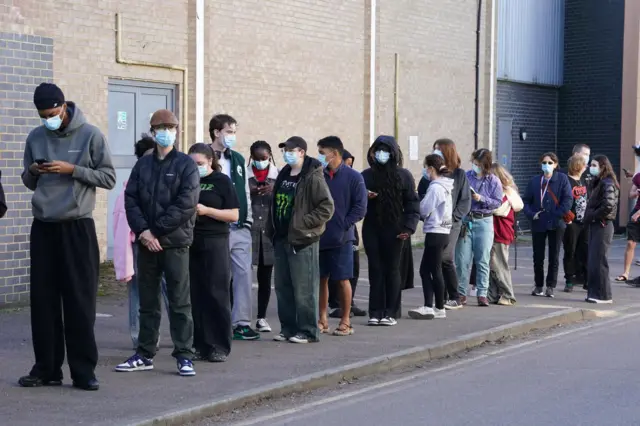
  20. Long queues for jab outside university sports hallpublished at 15:15 GMT 18 March

    People wear face masks in queue outsideImage source, Gareth Fuller/PA Wire
    People wear face masks in queue outsideImage source, Gareth Fuller/PA Wire
    Long queue outside building. Students lining up are wearing face masksImage source, Gareth Fuller/PA Wire