Summary

  1. CQC reports from 2019 to 2022 showed 'not much had changed in three years'published at 10:51 BST 18 May

    An inspection report published in 2022, following Brewin's departure, rated the key elements of the trust as "requires improvement".

    Brewin agreed that as far as the CQC was concerned, "it appears not much has changed" over the course of his tenure.

    However, he said the commentary underneath those key elements suggested there had been "some quite significant improvements in a number of areas".

    Brewin said by then, there had been a number of "waves" of the coronavirus pandemic and that at the time of that inspection, a new variant of coronavirus was leading to staff absences.
  2. Inquiry hears the CQC report 'to some extent buoyed' the trustpublished at 10:42 BST 18 May

    The inquiry heard in February 2020, the CQC carried out another inspection of the trust - focusing on acute wards for adults and psychiatric intensive care.

    Inquiry team barrister Carr told the hearing the CQC found the trust was given a rating of "requires improvement" in this category - compared to an "inadequate" rating in 2019.

    Brewin told the inquiry the report "to some extent buoyed" the trust as there were "some positive statements".

    The inquiry heard the staffing levels were stated as "adequate" in the report and that they were "kind and compassionate".

    "There was a sense that... we had started to lay the foundation for some changes but there was certainly no sense of complacency," he said.

  3. Staff did not feel able to raise concerns - reportpublished at 10:35 BST 18 May

    In the 2019 CQC report, it was highlighted that not all staff felt able to raise concerns, with fear of retribution if they did.

    Brewin said that pointed to concerns across a range of issues.

    "Staff didn't feel able to, you know, speak the truth and raise issues when there were issues to be raised, and that's a poor position to be in," he said.

    The report also found management of risk was poor.

    Brewin agreed that was a "significant concern".

  4. Inspection found trust required improvement in 2019published at 10:27 BST 18 May

    The inquiry heard that very early into Brewin's tenure as CEO of the trust, there was an inspection by the the healthcare watchdog, the Care Quality Commission (CQC).

    The hearing was told that it was the expectation from senior leadership team at the trust there would be a "deterioration" in its rating.

    When questioned by inquiry team barrister Craig Carr why that was the case, Brewin said it was "difficult to put a finger" on anything in particular.

    The inquiry heard in 2019 following an inspection by the CQC, the trust was given a rating of "requires improvement".

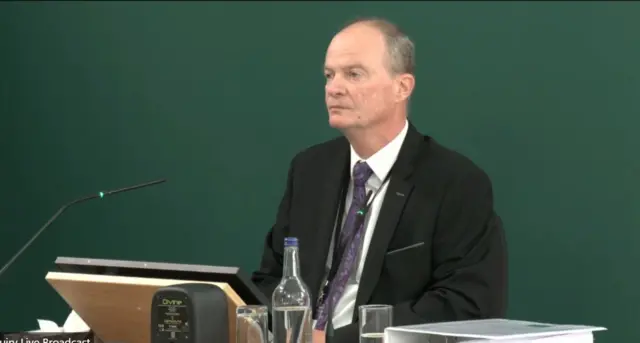
    In response to being asked by Carr whether there was a feeling things needed to change at the trust, Brewin (pictured below) responded that he agreed.

    Brewin at the inquiryImage source, The Nottingham Inquiry
  5. Culture and values 'not given sufficient priority'published at 10:17 BST 18 May

    In his witness statement to the Nottingham Inquiry, Brewin said culture, values and behaviours at the trust were not given "sufficient priority".

    He said while there were quality initiatives and projects, it "wasn't pulled together and focused".

  6. Ex-trust boss had clinical background, inquiry toldpublished at 10:16 BST 18 May

    Dr John Brewin had worked as a consultant psychiatrist at the trust between 1995 and 2011.

    "I think it stood me in good stead having a clinical background," he told the inquiry.

    Brewin said his background in various clinical and management roles kept him "grounded in the day-to-day challenges of working in services" as well as understanding the issues he needed to be aware of later, in the CEO position.

    He said when he joined, there was a perception the trust had not been a "significant participant in the external health economy" in the county.

    He said it was important to "develop professional relationships with these organisations so that we could further develop and improve what's called the patient pathways" those with with mental illness may go through.

  7. Nottingham Inquiry evidence beginspublished at 10:09 BST 18 May

    Dr John Brewin, a former CEO of Nottinghamshire Healthcare NHS Foundation Trust, has been sworn in and his evidence has begun.

  8. What does the Nottinghamshire Healthcare NHS Foundation Trust do?published at 10:08 BST 18 May

    Nottinghamshire Healthcare NHS Foundation Trust is a provider of healthcare services, employing more than 11,300 members of staff.

    The trust says it delivers "a wide range of services including mental health, intellectual disability, community, forensic and offender health services".

    It operates in a range of environments including low, medium and high-secure settings - such as mental health hospitals and prisons.

    The trust provided care for Valdo Calocane prior to the attacks in June 2023, and an independent report into its dealings with the killer identified a catalogue of failings.

    The report said "the system got it wrong" with Calocane.

  9. Who is giving evidence today?published at 10:04 BST 18 May

    Today, we will be hearing from two former chief executive officers (CEOs) of Nottinghamshire Healthcare NHS Foundation Trust.

    The trust was responsible for Valdo Calocane's care from 2020 to 2022. The killer had been diagnosed with paranoid schizophrenia in 2020.

    Calocane was discharged back to his GP in September 2022 - nine months before he carried out the fatal attacks - due to a lack of engagement. The trust has come under scrutiny for that decision.

    Ifti Majid

    John Brewin is today's first witness. He was the CEO of the trust from January 2019 to August 2022, covering almost the whole period Calocane was under the trust's care.

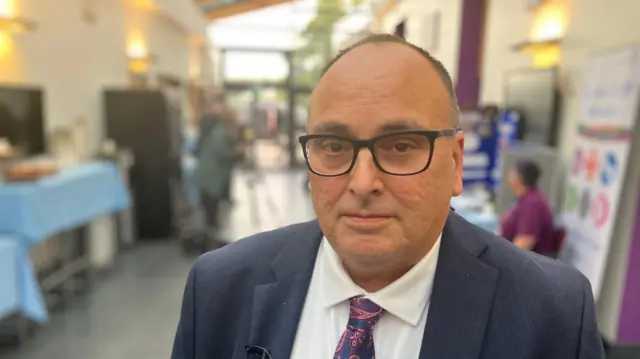
    Ifti Majid (pictured above), the outgoing CEO, joined the trust in December 2022, after Calocane was discharged. He was in post at the time of the attacks.

    Majid announced his retirement in November last year. He had intended to retire on his 60th birthday in October but the trust said at the time, he would be staying in post for the public inquiry with a view to leaving in June.

  10. What happened during the Nottingham attacks?published at 10:01 BST 18 May

    On 13 June 2023, Valdo Calocane killed Barnaby Webber, Grace O'Malley-Kumar and Ian Coates.

    He also tried to kill three others - Wayne Birkett, Sharon Miller and Marcin Gawronski.

    Calocane first stabbed to death 19-year-old students Barnaby and Grace, in Ilkeston Road, as they walked home from a night out in the early hours.

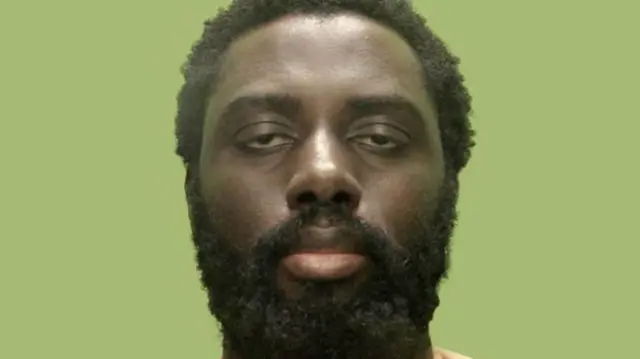
    Valdo Calocane mugshotImage source, Nottinghamshire Police

    He then walked across the city to Magdala Road, where he stabbed 65-year-old Ian and took his van.

    Calocane drove Ian's van into the city centre, where he struck Wayne, Sharon and Marcin, leaving them with life-changing injuries.

    He was sentenced to an indefinite hospital order in January 2024, after pleading guilty to three counts of manslaughter on the grounds of diminished responsibility, and to three counts of attempted murder.

  11. Welcome to our live coveragepublished at 09:59 BST 18 May

    Welcome to our live coverage of day 45 of hearings as part of the Nottingham Inquiry.

    The public inquiry is examining the killings of Barnaby Webber, Grace O'Malley-Kumar and Ian Coates by Valdo Calocane in Nottingham in June 2023.