Summary

  1. Calocane told family 'I love you' out of the bluepublished at 14:04 BST 13 May

    Elias also noted a message from Valdo Calocane to his immediate family members, saying "I love you" in January 2020.

    "I think we were all quite concerned that it might, I don't know, it might have felt almost like some sort of goodbye message," he said.

    In March 2020, Calocane's mother Celeste called him on FaceTime without warning and he became angry. Elias noted his brother told their mother "never to do that again".

    Elias said he had never reacted that way over a phone call before.
  2. Elias compiled a document of interactions with his brotherpublished at 14:02 BST 13 May

    Elias put together a document outlining interactions with his brother from 2017 onwards.

    He told the inquiry the purpose of this was to "hopefully help Dr Seedat [Calocane's inpatient consultant] and the inpatient team come up with some sort of diagnosis".

    "I guess around the time, around May, when his first sort of psychosis started, we were concerned.

    "We didn't really know what was going on at all," he said.

    He noted in 2017, Calocane became concerned he had been hacked and cancelled all his bank cards. Elias said he was not sure if this was relevant, but thought it might relate to Calocane's concerns about being monitored.

  3. Triple killer's brother Elias Calocane sworn inpublished at 13:55 BST 13 May

    Elias Calocane

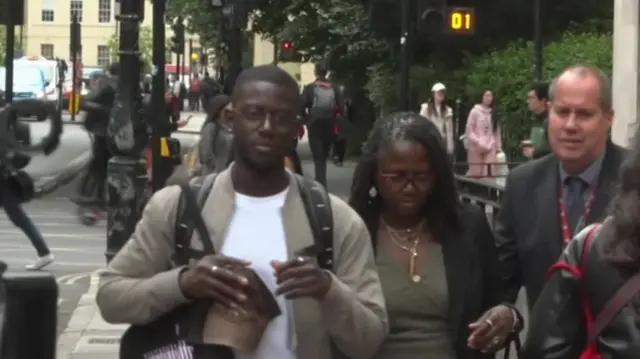
    Valdo Calocane's younger brother, Elias - pictured arriving at Mary Ward House in London earlier - has been sworn in and is beginning his evidence.

  4. Nottingham Inquiry evidence resumespublished at 13:48 BST 13 May

    The hearing now continues after a lunch break.

    References to witness statements about Valdo Calocane's care are now being read to the inquiry. These statements will be uploaded to the Nottingham Inquiry website.

    Elias Calocane, Valdo's brother, will be giving evidence next.

  5. Recap: What evidence have we heard so far today?published at 13:32 BST 13 May

    Dr ThangaveluImage source, The Nottingham Inquiry
  6. What is non-concordance?published at 13:17 BST 13 May

    We have heard a lot about concordance or non-concordance with medication throughout the inquiry evidence today.

    Non-concordance, in this case, refers to non-compliance with medication - not taking medication as prescribed.

    The inquiry has heard that Valdo Calocane had a history of non-concordance with his medication throughout his mental health care.

  7. What will the Nottingham Inquiry hear this afternoon?published at 13:00 BST 13 May

    A series of documents are expected to be read into the record of the inquiry after lunch.

    Then, we will hear from the younger brother of Valdo Calocane, Elias.

  8. Hearing pauses for lunch breakpublished at 12:59 BST 13 May

    The hearing has stopped for a lunch break. Evidence is expected to start again at 13:45.

  9. University 'should have been informed of Calocane's discharge'published at 12:58 BST 13 May

    The University of Nottingham, where Calocane was a student at the time, was not informed of a visit he made to the campus during his fourth admission in January 2022.

    Calocane's fourth admission followed an assault of his flatmate Christopher.

    Asked why the university was not informed when Calocane was discharged in February 2022, Thangavelu said he did not believe Calocane had given consent for them to do so.

    However, he agreed consent could have been "overridden" if there was a risk to others.

    It was only after a mental health support worker at the university rang Calocane that she learned he had been discharged.

    Thangavelu said: "In hindsight, we should have got that out."

  10. Police and NHS relationship 'fell by the wayside'published at 12:46 BST 13 May

    John Beggs KC, representing Nottinghamshire Police, asked Thangavelu if there was a "reluctance" for medical professionals to contact the police for information.

    Thangavelu said: "We used to have a good relationship with the police.

    "I think it fell by the wayside at some point, I don't know why but I wouldn't say there was a cultural reluctance, we always wanted to work together."

    Nottingham attacks policeImage source, PA Media
  11. Doctor asked if he 'gave a misleading picture' over medication impactpublished at 12:43 BST 13 May

    Straw points out that as Calocane was clearly showing evidence of non-compliance with medicine, this should have been viewed by Thangavelu as being behind his mental health relapse.

    Straw said: "Are you giving a misleading picture here to excuse the wrong decision?”

    Thangavalu said: "No, I don't know what other concrete evidence people had at that time. We were all speculating that the reason for relapse was non-concordance.

    "It may well be, so does somebody who is extremely psychologically stressed, not sleeping at night, working in a warehouse, having university guidelines to meet, just come out of hospital.

    "There could be many reasons and we can't just go down one alleyway, we should be keeping an open mind."

  12. Doctor tells inquiry he wanted Calocane to 'get well' and 'remain stable'published at 12:39 BST 13 May

    Earlier in his evidence, Thangavelu said he believed at the point of discharge that Calocane would engage with services in the "short to medium term".

    Straw KC asked: "Were you not concerned what would happen beyond the short to medium term?"

    Thangavelu asked: "I think that would be very difficult to foresee, as a prognosis for any patient with schizophrenia, because there are so many dynamic factors, social factors, psychological factors, environmental factors.

    "I don't think anyone can see beyond the short to medium term. But that's the very nature of the illness."

    Thangavelu said he wanted Calocane to "get well, remain stable, and get on with his life" as he did for all his patients.

  13. Doctor denies taking killer 'at his word'published at 12:29 BST 13 May

    Adam Straw KC, who is representing Calocane's mum, Celeste, and brother, Elias, is questioning Thangavelu.

    Straw asked: "You would agree wouldn't you, that it was particularly important for someone like [Calocane], not just to rely on his word?"

    "Yes I agree," Thangavelu said.

    The consultant also agreed it was important to take a longitudinal view, looking at patterns in his history.

    Straw said: "You failed to do that didn't you? You took him at his word and failed to identify relapse indicators?"

    Thangavelu replied: "I wouldn't agree with that actually. We looked at the previous patterns and this submission was quite different to the previous."

  14. 'Clearly he wanted to get on with his life'published at 12:28 BST 13 May

    Asked why he did not move Calocane to a Section 3 order, under the Mental Health Act, by Cartwright, Thangavelu said: "Just keeping him on a Section 3 inpatient unit much longer is not going to make him necessarily engaged. In fact it would institutionalise him.

    "It largely depends on what matters most to the patient, and for him clearly he wanted to get back to his studies, get on with his life, and what we need to do is support him to achieve those aims."

    Sophie Cartwright KC, who is representing the survivors, said this was not a safe discharge as his accommodation was not vetted.

    Thangavelu said: "Checking the accommodation is a very fair point.

    "Appropriate medical treatment is not just medications. The main aspect of treatment is to get them rehabilitated in the community."

  15. Doctor did not want to 'write off' Calocane as non-concordantpublished at 12:03 BST 13 May

    Patrick has now questioned Thangavelu on his decision to discharge Calocane without a depot.

    She asked: "Did you not think at any time that he'd failed on three previous chances at concordance? He was never going to be well without compulsion was he?"

    Thangavelu replied: "I wouldn't want to write somebody off just like that.

    "I'd want to weigh things up and I was looking for reason to go for a forced depot.

    "I wouldn't have hesitated if it was very blatantly obviously clear in my head. But I was struggling on that occasion."

    Patrick said: "Can I suggest in weighing up, you gave too much of the benefit of the doubt to VC [Calocane] and didn't pay attention to what was in front of you?"

    Thangavelu said he considered Calocane's presentation during that fourth admission and said, again, he was largely asymptomatic.

  16. Doctor did not request notes from previous admissionpublished at 12:01 BST 13 May

    Thangavelu is now being cross-examined about his evidence, with questions about how he looked over Valdo Calocane's notes.

    He admitted to Angela Patrick, who is representing the bereaved families, he had not requested notes from Calocane's third admission at hospitals in Darlington and Nottinghamshire.

    Asked if he would have read all the notes, Thangavelu said he would only read the notes "he needed to".

    Patrick said: "This is a very unwell man, he lacks insight, an appreciation that part of his history when unwell was an intention to hurt others... that's relevant information for you to have had, isn't it doctor?"

    Thanagvelu said he had only become aware of the full picture of the notes since the start of the inquiry.

  17. Calocane treated under a 'least restrictive approach' culturepublished at 11:54 BST 13 May

    Yesterday, the inquiry heard there was a culture at the time of Calocane's treatment of a "least restrictive" approach to patients, said Carr, who asked if Thangavelu echoed this view.

    Thangavelu said: "Having been in this field for 25 years, I have certainly seen many instances where I felt the least restrictive option was available and could have been used, when a more coercive route was taken."

    He added since Calocane, his practice had moved more towards coercion.

    He told the inquiry the Nottingham attacks were the only instance of homicide following discharge in his professional career, but added there had been suicides.

    Carr then asked if psychiatry was "institutionally racist" with an "implicit bias".

    Thangavelu said: "I think we all stick to our core principles and ethics and values."

  18. Doctor 'could not justify forced injection'published at 11:51 BST 13 May

    Calocane, the inquiry heard, was admitted under Section 2 of the Mental Health Act during the fourth admission. To be coercively administered depot medication, he would have to have been on a Section 3 admission, so a Community Treatment Order (CTO) could be imposed.

    The inquiry heard a Section 2 admission could be converted to a Section 3 if a patient met the criteria.

    Asked if he would have imposed a CTO if Calocane had been converted to a Section 3 admission, Thangavelu said: "Not necessarily. It would have given us more time to think and then decide."

    He added: "Based on all the factors I considered at that point, I did not think a forced injection could be justified."

    Carr asked: "Have you ever discharged someone on a CTO with a condition of depot?"

    "Very many times, yes," Thangavelu replied.

  19. University was a motivator for Calocane, Thangavelu saidpublished at 11:37 BST 13 May

    Thangavelu told the inquiry he thought Calocane - a former University of Nottingham student - "wanted to get well" and "get through the exams".

    He said this was the reason he believed that Calocane would be compliant after his discharge.

    He said: "It was one of the main drivers for him to get out of hospital, he was keen to get back to his studies."

  20. Depot order would not guarantee taking of medication, doctor arguespublished at 11:37 BST 13 May

    Calocane did not want to move to depot medication, the inquiry heard.

    Calocane's reported fear of needles was also raised by Carr, who said the killer had been given his Covid-19 jabs.

    Asked if depot should have been made a condition of Calocane's discharge, Thangavelu said: "I was trying to convince him somehow and make him agree and he was quite resistant.

    "I wasn't attaching it to the condition of discharge, perhaps that wouldn't serve the purpose because he could just get discharged and stop.

    "That happens a lot of the time actually, people will have the first dose and won't turn up for the next depot."