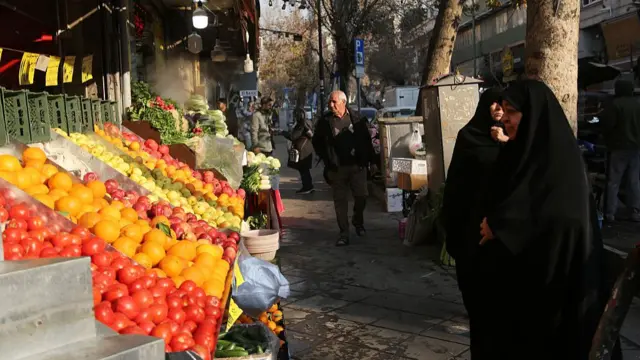
Summary

Media caption,
Why are there huge protests going on in Iran?
  1. Pahlavi not seeking to restore monarchy, says supporterpublished at 16:02 GMT 9 January
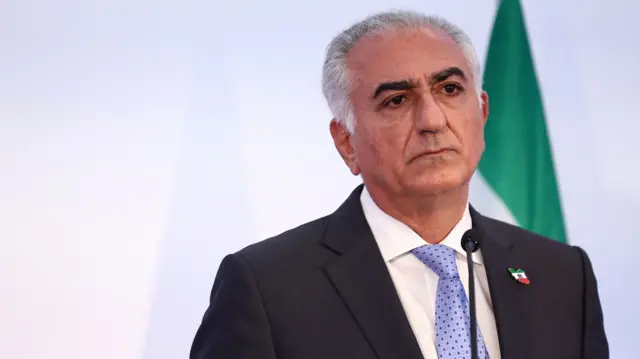
    Reza Pahlavi, the exiled son of the last Shah of Iran, attends a press conference about the situation in Iran and the need to support Iranians, in Paris, France, June 23, 2025Image source, Reuters

    A supporter of Reza Pahlavi and a spokesman for an organisation that has worked on his return to Iran has told the BBC that people in Iran have been clearly "rallying" around the son of the deposed shah.

    Cameron Khansarinia, vice president of the US-based National Union for Democracy in Iran, tells BBC World Service's Newshour that protesters are "re-raising the lion and sun flag. They are chanting his name, they are putting up his picture... it takes a lot more courage to go into the street facing live gunfire and chant the name of Pahlavi."

    He adds that Pahlavi is not looking to restore the monarchy, but enable free elections to allow the people of Iran to "decide whether they want to return to constitutional monarchy or they want a republic".


  2. Reza Pahlavi asks Trump to be 'prepared to intervene'published at 15:50 GMT 9 January

    Reza Pahlavi, the exiled son of Iran's late former shah, has called on US President Donald Trump to "be prepared to intervene to help the people of Iran".

    "Mr. President, this is an urgent and immediate call for your attention, support, and action," Pahlavi wrote in a post on X. "The people will be on the streets again in an hour. I am asking you to help."

    As we have been reporting, Pahlavi, who resides in the Washington DC area, has encouraged Iranians to protest. Although it's impossible to accurately measure his support among protesters, there have been increasing chants amongst demonstrators calling for his return.

    "I have called the people to the streets to fight for their freedom and to overwhelm the security forces with sheer numbers," Pahlavi says in his post calling for Trump's attention.

    Trump on Thursday vowed to hit Iran "very hard" if protesters are killed.

  3. Why are protests erupting now?published at 15:37 GMT 9 January

    Ghoncheh Habibiazad
    Senior reporter, BBC Persian

    These protests began less than two weeks ago with shopkeepers - famously known in Iran as the backbone of support for the Islamic Republic - in Tehran angry about the collapsing currency, before spreading to students and street demonstrations in several cities in the country.

    Based on the videos, these are the biggest protests we have seen since 2022, and the anger is not just related to economic issues. Protesters have been chanting slogans against the whole clerical leadership and the supreme leader himself.

    Iran has experienced lots of issues; a combination of economic crisis, political repression and social unrest, as well as international tension because of its nuclear and ballistic missile programme.

    Iran’s leadership has been cracking down on protests for years. The security forces are prepared to act, and the authorities can move quickly to close banks, schools and public institutions, while tightly controlling the state media narrative.

    Officials increasingly point the finger at foreign enemies, especially the US and Israel, as they try to contain the unrest.

    With the internet outage, the main narrative coming out of Iran right now is from state media and officials.

  4. Iran's top security body vows 'no leniency' amid escalating protestspublished at 15:26 GMT 9 January

    Soroush Negahdari
    BBC Monitoring

    Iran's top security body has warned that the Iranian Judiciary and security forces will show "no leniency towards saboteurs", following a sharp escalation on 8 January in nationwide protests initially sparked by the collapse of the country's currency.

    In a statement issued after demonstrations grew in size and geographic reach, the Supreme National Security Council (SNSC) said security and law-enforcement forces had been deployed to "neutralise the destabilisation plans of the Zionist regime [Israel] and its godfather, the United States".

    The statement, which echoed a narrative earlier promoted by Iranian state TV, was reported by the Telegram channel of Iran's state broadcaster on 9 January - as news websites remain inaccessible due to an internet blackout since the night before.

    While acknowledging that the unrest initially began as protests against economic instability, the statement accused foreign enemies of steering the demonstrations towards violence and insecurity.

    It also strongly condemned attacks on religious symbols and symbols of the Islamic Republic, like the burning of flags and statues of the late IRGC Quds Force Commander Qasem Soleimani.

  5. Pictures from last night's protests emergepublished at 15:13 GMT 9 January

    Despite the internet outage, some people in Iran are staying connected through the satellite service Starlink.

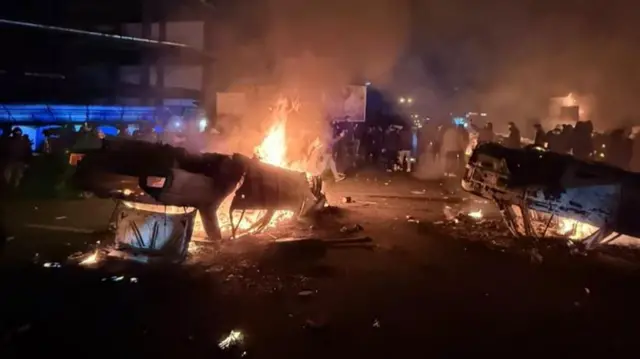
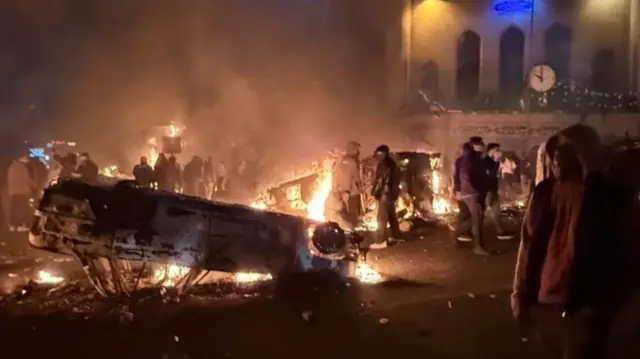
    In the last few hours the BBC received images from someone who was at a protest last night. Cars that were overturned and set alight could be seen at Tehran's Kaaj roundabout.

    As a reminder, the BBC and most other international news organisations are barred from reporting inside Iran, so social media is relied upon to verify what is happening on the ground.

    Image of cars set alight and turned upside down in TehranImage source, Handout
    Image of cars set alight and turned upside down in TehranImage source, Handout
  6. The exiled former crown prince at the centre of Iranian protest chants - who is Reza Pahlavi?published at 15:03 GMT 9 January

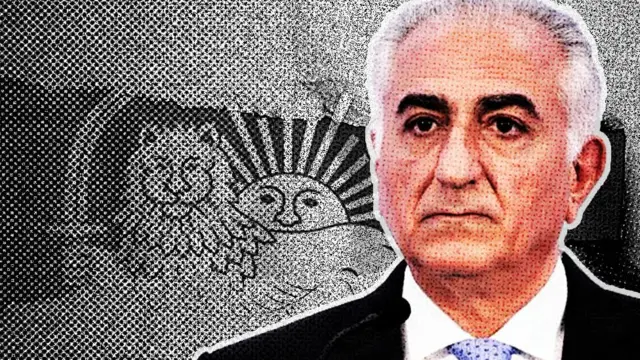
    Iranian opposition leader and son of the last Shah of Iran, Reza Pahlavi's portrait superimposed on a lion and sun emblem featuring on the historical flag of IranImage source, AFP
    Image caption,

    Reza Pahlavi is the son of Mohammad Reza Shah Pahlavi, Iran's last shah before the 1979 Islamic Revolution

    Many protesters in Iran have been calling for the return of Reza Pahlavi, the exiled son of Iran's last shah - so who is he, and how much support does he have?

    When the 1979 revolution swept away his father's monarchy, Pahlavi and his family were left stateless, but, now 65, he is once again seeking a role in shaping his country's future.

    From his home in Washington DC, he himself has called on the people of Iran to take to the streets and previously stated he was prepared to help lead a transitional government if the Islamic Republic collapsed.

    He has since outlined a 100-day plan for an interim administration, telling reporters: "This is not about restoring the past... it's about securing a democratic future for all Iranians."

    Over the years in exile, Pahlavi has made multiple attempts to build opposition coalitions. However most have struggled with internal disagreements and limited outreach inside Iran.

    Now, his supporters see him as the only opposition figure with name recognition and a long-standing commitment to peaceful change, while critics say he remains too dependent on foreign backing.

    While Iran's government portrays him as a threat and protesters chant in support of him, it is impossible to measure his true support without an open political space and credible polls.

    You can read a full profile on Pahlavi here.

  7. What to know as Iran plunged into internet blackout following weeks of protestspublished at 14:50 GMT 9 January

    Jack Grey
    Live reporter

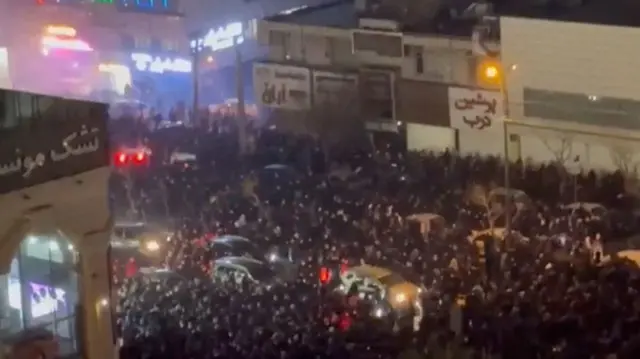
    People gather on the streets amid anti-government unrest in Tehran, Iran, in this still image obtained from social media video released on January 8, 2026Image source, Reuters
    Image caption,

    Protestors took to the streets of Tehran on Thursday, ahead of the widespread internet blackout in the country

    Anti-government protests in Iran have continued for the 13th consecutive day as a nationwide internet blackout continues to block communications for people around the country.

    Here's what to know today:

    Our team of reporters and experts are monitoring for updates - we'll bring you the latest here throughout the day.

  8. BBC Verify

    Iran's protests spread to 16 more townspublished at 14:39 GMT 9 January

    By Christine Jeavans

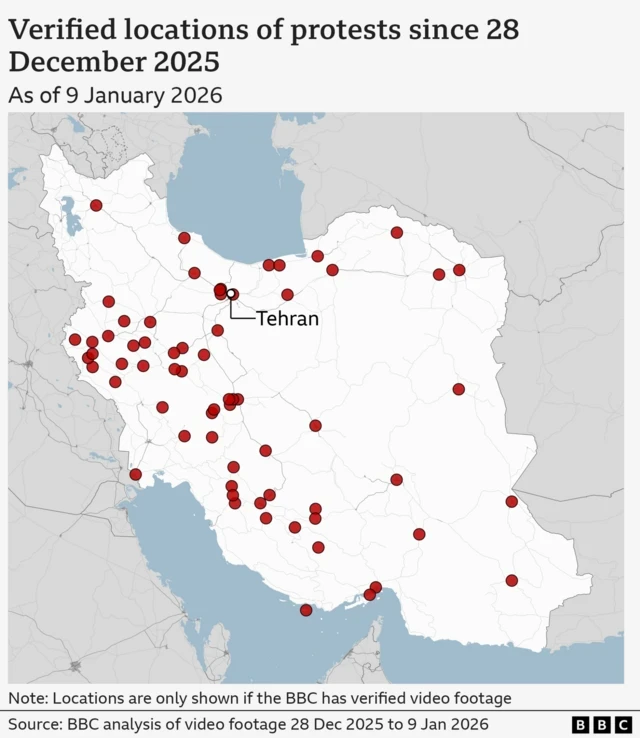
    Here’s an updated map of verified locations in Iran that have seen one or more protests since 28 December 2025.

    We’ve added 16 more towns and cities to the map since Tuesday, with the latest being Zahedan in the east, near the border with Pakistan.

    This map shows locations where the BBC has verified video footage - there may be other protests that we have not yet been able to verify.

    Map of verified locations in Iran that have seen one or more protests since 28 December 2025
  9. Analysis

    Many people in Iran feel they have little to losepublished at 14:26 GMT 9 January

    Jiyar Gol
    BBC Persian

    These are certainly the most sustainable and wide-ranging unrest we have seen in many years and that makes it significant.

    What we have seen in Tehran, and the footage we obtained from eyewitnesses before the regime cut off the internet, tell us that in many neighbourhoods people have poured into the streets chanting slogans against Iran's supreme leader, targeting him directly and holding him responsible for the current conditions in the country.

    Protests erupted last night shortly after exiled Reza Pahlavi, whose father was overthrown in the 1979 Islamic Revolution, called on Iranians to join the ongoing protests.

    Two days earlier, seven Kurdish political parties in exile and six Kurdish women’s rights groups had called on people in Iran’s Kurdish regions, across four provinces, to stage a general strike. On Thursday, more than 50 cities and towns, large and small, across the Kurdish regions shut down their shops, and many people took to the streets later in the evening.

    In the past, most mass protests were outside of the capital, Tehran, and this time around it is also in Tehran.

    If people in Tehran come out in masses, it will encourage the rest of the country to do the same and this could be a turning point.

    Iranian human rights groups say more than 40 people were killed during protests. BBC Persian has spoken to the family of 21 of them and confirmed their identities.

    US-led sanctions have crippled Iran's economy. The value of the Iranian currency - the rial - has sharply fallen against the US dollar and this has created an unsustainable situation for many people who are struggling to make ends meet.

    Also, many people are unhappy about social restrictions and there's deep anger at political unaccountability, including corruption.

    There's a combination of many different reasons why people are going to the streets and it feels like many of them have little to lose.

  10. Internet blackouts aren’t unusual in Iran - but these circumstances arepublished at 14:13 GMT 9 January

    Reha Kansara
    News reporter

    The Iranian government has cut millions of Iranians off from communicating with their families - both within and outside the country - and from organising on the ground.

    Internet blackouts aren’t unusual in Iran. But these circumstances are.

    The last spate of protests to have taken place on this scale was after the death of Mahsa Amini in 2022.

    At the time, Iran stepped up surveillance following nationwide women-led, anti-establishment protests - reportedly employing digital tactics such as phone hacking to spy on civilians as well as cutting off the internet.

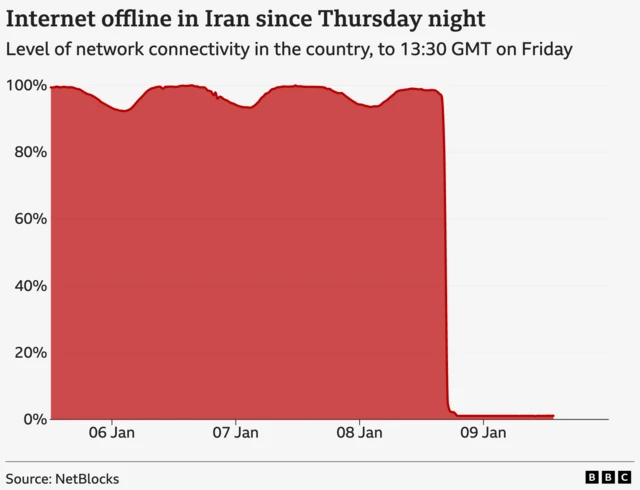
    An area chart showing internet connectivity in Iran from midday GMT on 5 January. Connectivity remains close to 100% from 06–08 January with small fluctuations, then drops sharply to about 1% during the evening of 8 January and remains almost fully offline to the end of the data set at 13:30 GMT on 9 January. Source: NetBlocks.

    Amir Rashidi, director of internet security and digital rights at the NGO Miaan Group who has been tracking internet shutdowns and cybersecurity issues in Iran for more than 20 years, tells the BBC he has never seen conditions like this.

    “No communication tools are working, and the Islamic Republic is even disrupting Starlink using electronic warfare tools," Rashidi tells me. "Phones are down, domestic services are severely disrupted, and payment systems are heavily affected.”

  11. Iran still mostly offline 18 hours after blackout, says internet firmpublished at 13:52 GMT 9 January

    Iran has been mostly without internet for the past 18 hours, according to Cloudflare, a major internet infrastructure firm.

    It says its data shows that some internet traffic started resuming at around 09:00 GMT on Friday, but that volumes remain "extremely low".

  12. Watch: Protests erupt after Friday prayers in Iran’s Zahedanpublished at 13:37 GMT 9 January

    Ghoncheh Habibiazad and Yi Ma
    BBC Persian and BBC Verify

    Videos verified by BBC Persian and BBC Verify show a group of protesters gathering earlier today in the city of Zahedan, in Iran’s south-eastern Sistan-Baluchestan province.

    Protests have previously been seen after Friday prayers in Zahedan but demonstrations have been ramping up in recent weeks. In one of the videos from today, people can be heard chanting “death to the dictator”, referencing Iran’s Supreme Leader, Ayatollah Ali Khamenei.

    The Halvash news website, which focuses on human rights issues in Sistan-Baluchestan, said security forces fired tear gas and so-called “pellet bullets” during the action. Internet access is still restricted in Iran, which means fewer videos are emerging today from the country.

    Zahedan has repeatedly been the scene of unrest in recent years.

    On 30 September 2022, a day that later became known as “Bloody Friday”, at least 60 people were killed and dozens injured during widespread protests following the death of Mahsa Amini, according to human rights groups. They said security forces opened fire on demonstrators from inside a police station in the city.

  13. Some protesters see Pahlavi as the 'only way out of this'published at 13:25 GMT 9 January

    Caroline Hawley and Ghoncheh Habibiazad
    BBC News Persian

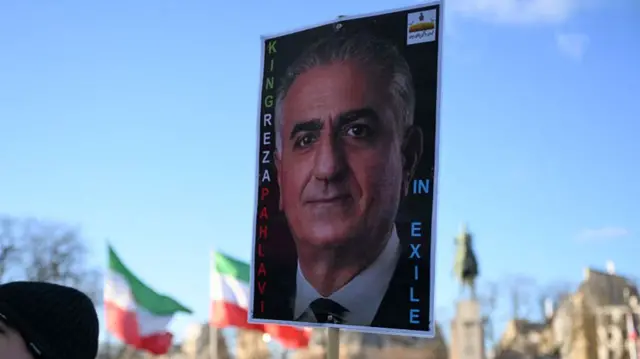
    A protester holds a placard of Iranian opposition leader and son of the last Shah of Iran, Reza Pahlavi, during a demonstration against the Iranian regime's crackdown on protests in central Paris, on January 4, 2026Image source, Getty Images
    Image caption,

    Demonstrations have also taken place in other countries, as pictured above in Paris last week, after almost two weeks of demonstrations across Iran

    New to these latest protests is the chant: "Pahlavi will return," a reference to Reza Pahlavi, the son of the late Shah of Iran who was overthrown in 1979. It was he who called for people to turn out on the streets on Thursday night.

    The protests of the last few days have seen increasing chants for the return of the monarchy.

    "Personally I think he's the only way out of this," 26-year old Sara from Tehran told the BBC.

    Other Iranians say that they see expressions of support for the monarchy as a sign of desperation to be rid of the current regime, and a lack of alternatives.

    "I'm not the biggest fan of Reza Pahlavi. But to be honest my personal opinion is not important now," 27-year old Maryam from Tehran told the BBC. "Being and staying united is more important. It's a different vibe from the Woman Life Freedom protests [of 2022]."

    She says they were characterised by grief for Mahsa Amini.

    "But people seem more angry and determined now."

  14. Downing Street calls on Iran to 'exercise restraint'published at 13:08 GMT 9 January

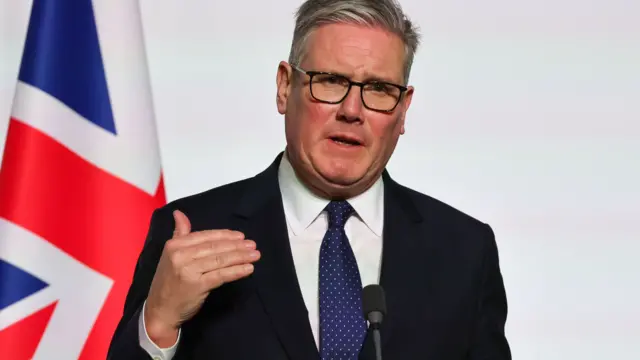
    rime Minister Sir Keir Starmer during a press conference at Elysee Palace in Paris,Image source, PA

    Downing Street has called on the Iranian authorities to “exercise restraint” and says the UK government supports “those who exercise their right to peaceful protest”.

    “The Iranian authorities must exercise restraint and respect fundamental freedoms, including freedoms of expression, assembly and access to information," says the prime minister’s official spokesperson.

    Asked if Starmer agrees with US President Donald Trump’s threat to "hit" Iranian leaders "very hard" if they kill protesters, the spokesman says the UK government’s “focus is supporting those who are exercising their right to peaceful protest”.

  15. 'People are becoming bolder now' - Iranians reflect on widespread discontentpublished at 12:55 GMT 9 January

    Caroline Hawley and Ghoncheh Habibiazad
    BBC News Persian

    A view from a market as people shop amid soaring prices, a rapidly devaluing currency, and mounting economic pressure ahead of the governmentâs planned rollout of a monthly food coupon system during the worst economic crisis since 1979, in Tehran, Iran on January 7, 2026Image source, Getty Images
    Image caption,

    The state of the economy is one of the main factors triggering protests this time around

    Vast crowds of Iranians have taken to the streets of the capital Tehran and in several other cities to call for an end to the Islamic Republic - and in many places for the restoration of the monarchy.

    Young and old, rich and poor, Iranians across the country and from all walks of life are now demonstrating their fury at the clerical establishment which has ruled them for close to half a century.

    One young woman in Tehran told the BBC she was protesting because her dreams had been "stolen" and she wanted the regime to know that "we still have a voice to shout, a fist to punch them in the face".

    Another spoke of the despair and hopelessness that is driving the protests.

    "We're living in limbo," she said. "I feel like I'm hanging in the air with neither wings to migrate nor hope to pursue my goals here. Life here has become unbearable."

    Day after day since late December, protests in Iran have been spreading and building momentum, fuelled by deep-seated economic and political frustration.

    "People are becoming bolder now," 29-year old Sina told the BBC on Thursday by text message from the city of Karaj, west of the capital Tehran. "I went to buy some groceries and people were speaking out loud against the regime in the daylight! I was thinking that the protests will stop but it hasn't lost its momentum."

    It is hard to know the full picture of what is taking place because independent media are not allowed to operate freely in Iran, many people are fearful to speak publicly, and now the internet has been severely restricted. The BBC spoke to people before the near blackout.

    But there is no disguising the extent of discontent, and the size of some of the protests filmed and posted on social media.

  16. Iran routinely imposes internet restrictions during periods of unrestpublished at 12:46 GMT 9 January

    Ghoncheh Habibiazad
    Senior reporter, BBC Persian

    The internet monitoring organisation NetBlocks reported at 04:30 GMT this morning that “Iran has now been offline for 12 hours, with national connectivity flatlining at around 1% of ordinary levels”.

    Iranians online have said they have not been able to contact family members using even landlines since last night.

    Iranian authorities have repeatedly imposed internet restrictions during periods of unrest, citing security concerns and alleged cyber-attacks. The most recent internet outage was during the 12-day war with Israel in the summer, when officials cited the same reasons.

    During one of the blackouts in 2019, following a fuel price hike, hundreds of protesters were killed, according to human rights organisations, with details emerging only after internet access was restored.

    Videos from last night’s protests are still circulating online. BBC Persian and BBC Verify are looking into the footage.

    We have verified videos from protests in several parts of the country last night, including the holy city of Mashhad, the capital Tehran, the southern island of Kish and north-western Ardabil province.

  17. Video shows fire at building linked to state TV in Isfahanpublished at 12:35 GMT 9 January

    Joshua Cheetham and Ghoncheh Habibiazad
    BBC Verify and BBC Persian

    BBC Verify and BBC Persian are analysing footage of protests from several parts of Iran, including in Tehran, the holy city of Mashhad, the southern island of Kish and north-western Ardabil province.

    One site we’ve been investigating includes a fire in the offices of state broadcaster IRIB in the city of Isfahan. A video shared on social media shows several buildings on fire along a stretch of road.

    We matched features in this video with satellite imagery on Google Earth, and have located it to the office of the Young Journalists Club – a subsidiary of IRIB.

    It’s unclear what caused the fire and if anyone has been injured.

    Media caption,

    Verified video shows fire in Iranian state broadcaster offices

  18. Flydubai cancels Friday's flights to Iranpublished at 12:25 GMT 9 January

    In the last few moments we had an update from flydubai, an Emirati airline that operates frequent flights to Iran.

    A spokesperson for the company says all of its flights to Iran today have been cancelled due to the ongoing unrest in the country.

    The company says it will continue to monitor the situation closely and stay in touch with passengers affected.

  19. How have Iran's protests got to this point?published at 12:15 GMT 9 January

    Unrest began on 28 December, when anger initially broke out in Tehran following a significant devaluation of the country's currency against the dollar, before spreading rapidly across the nation.

    Over the past 13 days, protests have been recorded in over 100 cities and towns across all 31 provinces, according to the US-based Human Rights Activist News Agency (HRANA).

    Yesterday alone, BBC Persian reported that more than 50 towns and cities in Iran's Kurdish-majority regions had joined a strike in solidarity with the nationwide demonstrations.

    BBC Persian has been able to confirm that at least 22 people have been killed during the protests - HRANA has reported that at least 34 protesters and four security personnel have died and that 2,200 have been arrested.

    It comes as Iran's economy remains troubled, with little prospect for growth this year or next.

  20. What’s Iranian state TV's narrative?published at 12:06 GMT 9 January

    Ghoncheh Habibiazad
    Senior reporter, BBC Persian

    Iran’s national broadcaster has accused protesters of “being led by the US and Israel” and of “destroying public property and holy sites”.

    In its morning bulletin, state television aired a vox pop in which some accused protesters of “burning the Quran”, Islam’s holy book.

    The broadcaster also described a call for protests by Reza Pahlavi as “anti-Iranian”. Pahlavi, the exiled son of Iran’s late Shah, called for protests overnight.

    Iran's national broadcaster is also reporting that unrest in Esfarayen, in the northern Khorasan province, resulted in the death of a prosecutor and security personnel, citing the head of the provincial judiciary.

    Another six died in Hamedan, according to the state broadcaster, as people it describes as "rioters" allegedly caused extensive damage to property.

    After an internet blackout, most Iranian news websites are inaccessible from outside the country.

    Telegram channels run by some of these outlets, which were previously updated regularly, are also offline, while the official IRNA news agency has published only pre-scheduled posts today.