Summary

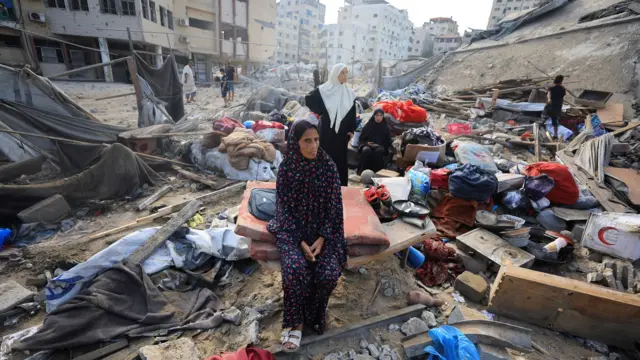
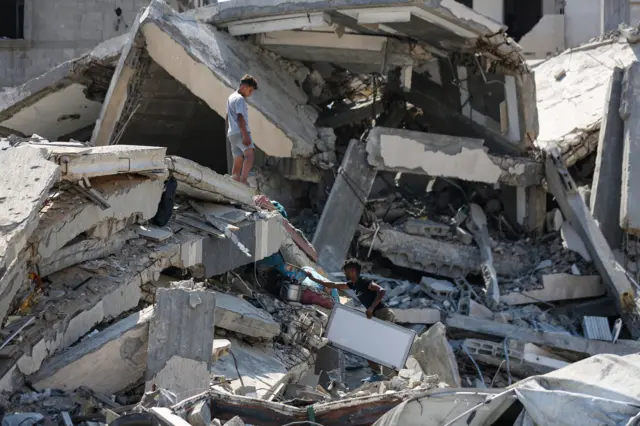
  1. In pictures: Life in Gaza as Israeli strikes continuepublished at 11:55 BST 31 July

    As Donald Trump says an agreement has been reached for the "complete disarmament" of Hamas in Gaza, Israeli strikes continue.

    Several Palestinians were wounded in an air strike in Gaza earlier today, according to Reuters News Agency.

    These photos, taken over the last week, show what life is like for those living in a warzone.
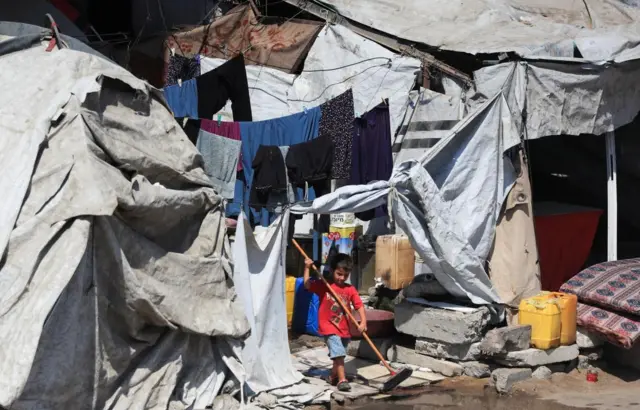
    A child walks carrying a broom as displaced Palestinians shelter at a tent camp, in Gaza City, July 31.Image source, Reuters
    Image caption,

    Makeshift tents are home to children and their families in large parts of Gaza
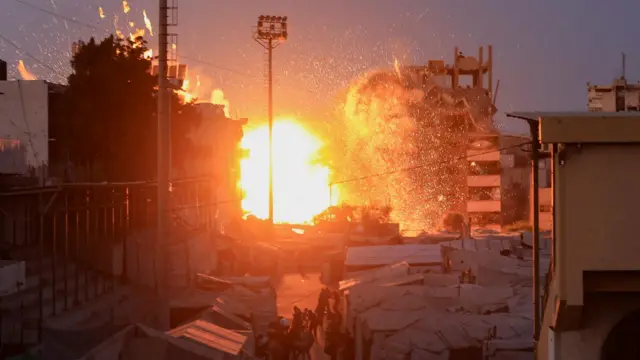
    Smoke and flames rise after an Israeli airstrike hit a mosque in Gaza City, July 28, 2026.Image source, Reuters
    Image caption,

    Smoke and flames rise after an Israeli air strike hit a mosque in Gaza City on Tuesday
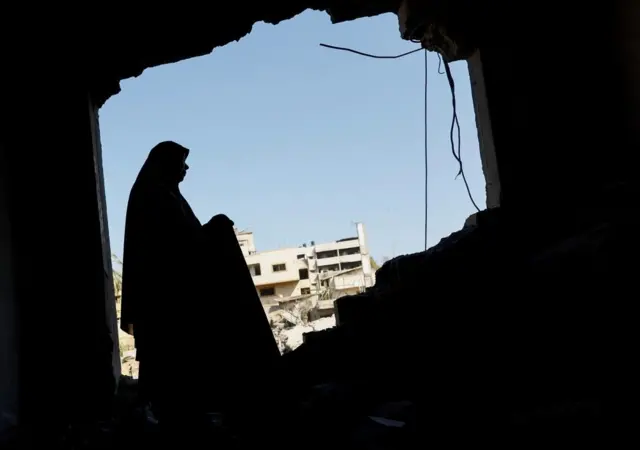
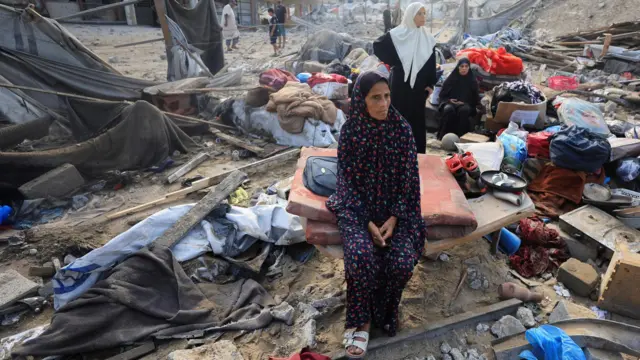
    A Palestinian woman inspects her damaged home after an Israeli strike on a nearby mosque that had been pre-warned by the Israeli military for evacuation, in Gaza City, July 29, 2026.Image source, Reuters
    Image caption,

    A woman surveys the damage to her home following an Israeli strike earlier this week
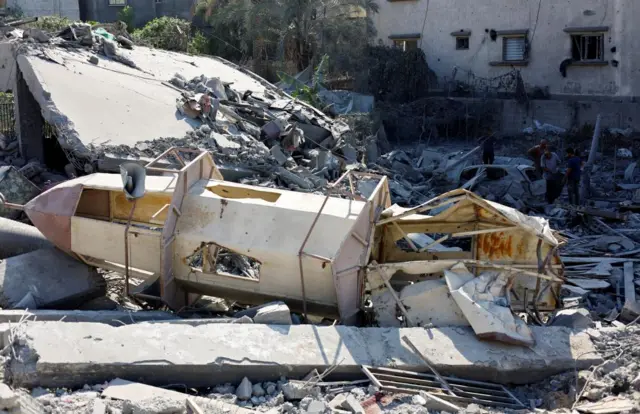
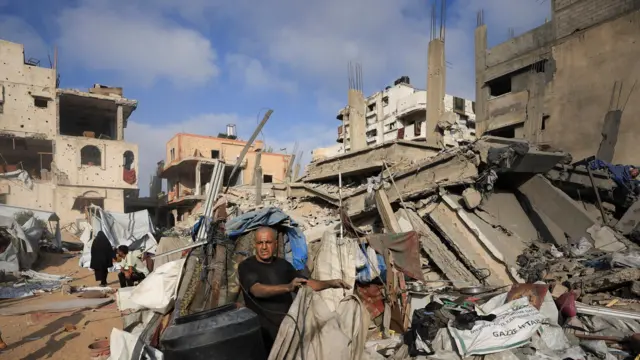
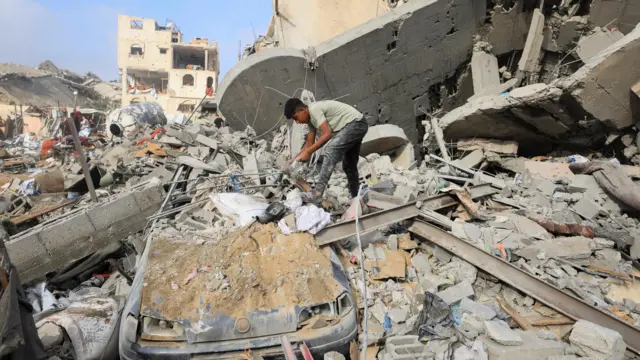
    Palestinians inspect a site of an Israeli strike on a mosque that was pre-warned by the Israeli military to evacuate on Tuesday, in Gaza City, July 29Image source, Reuters
    Image caption,

    A mosque in Gaza City lies in ruins after being hit in a pre-warned attack by the Israeli military on Tuesday
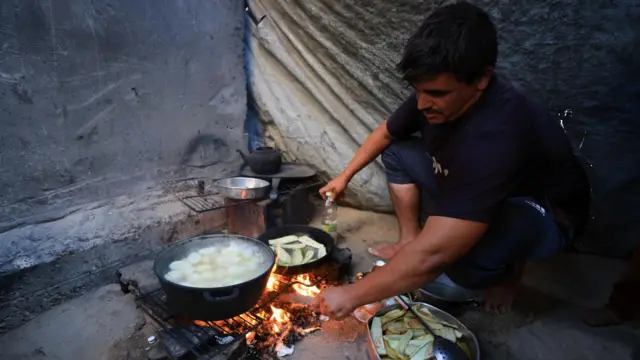
    A man prepares food at a tent camp in Gaza City, July 26, 2026.Image source, Reuters
    Image caption,

    A man prepares food inside a tent at a camp in Gaza City on Sunday
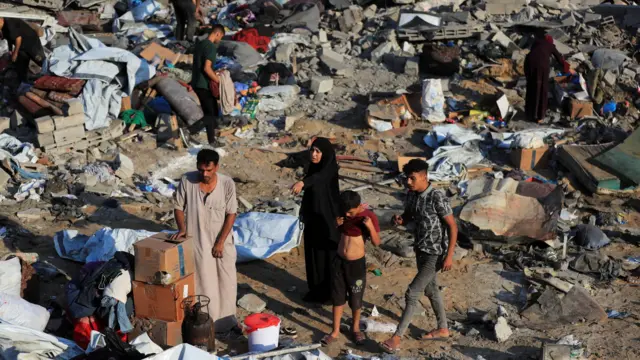
  2. 'We hope this development will change the reality' Gazan tells BBCpublished at 11:23 BST 31 July

    Mohamed Ali Abed, 41, is currently displaced in the central Gaza Strip with his wife and two children.

    On Hamas's agreement to disarm, he tells the BBC: "If the issue of weapons is a pivotal one, upon which ambitions, hopes, reconstruction, the end of the siege, and the withdrawal of the army depend, then so be it."

    He says arms are "something legitimate" for them, because "we are an occupied people, and there needs to be resistance".

    Yet he says resistance can also be "an ideology, not individuals or tools".

    "We hope that this development will change the reality of Gaza, the families and life in Gaza, and that the second phase of the October 2025 ceasefire agreement will truly begin," he says.

  3. How Hamas disarmament would work, according to Trump's planpublished at 11:14 BST 31 July

    Palestinians inspect the site of Wednesday's Israeli strike on a house whose residents were pre-warned by the Israeli military to evacuate, in Gaza City, July 30, 2026Image source, Reuters
    Image caption,

    The site of an Israeli strike in Gaza City on Thursday, 30 July

    The four-page roadmap of Donald Trump's plan, seen by the BBC, sets out the phased disarmament of Hamas and gradual Israeli withdrawal, with US officials saying each step of the process will be "verified".

    According to page three of the agreement, which Israel is yet to comment on, this is how that would work:

    • It will begin with an inventory being made of all heavy weapons, military production sites, weapons depots and tunnels within Gaza
    • An "international stabilisation force" will be deployed to Gaza, alongside a newly-formed Palestinian National Committee for the Administration of Gaza - that will manage the process
    • The disarmament will be "gradual and sequential", and will occur based on a schedule to be prepared "within 14 days"
    • Disarmament will be linked to a "phased Israeli withdrawal", with a "verification committee" ensuring each phase is completed
    • The agreement states that no weapons will be handed to Israel or any non-Palestinian entity

    After this process is complete, according to the roadmap, this new Palestinian authority "alone shall retain, store, or exercise control over weapons in Gaza".

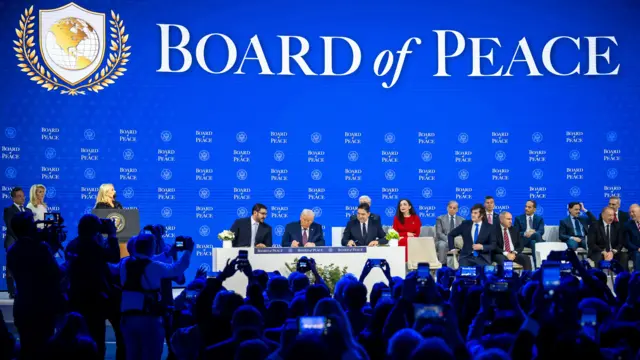
  4. Board of Peace committee ready to 'take over administration' of Gazapublished at 11:04 BST 31 July

    A Palestinian woman sits amidst debris as people inspect the site of Wednesday's Israeli strike on a house whose residents were pre-warned by the Israeli military to evacuate, in Gaza City, July 30, 2026.Image source, Reuters

    The body set up by Trump's Board of Peace to manage the day-to-day governance of Gaza says it is fully ready to "assume its responsibilities".

    As a reminder, Trump set up the Board of Peace last September when he announced his plan to end the war in Gaza. He later said the board's remit would be extended beyond Gaza to tackle other conflicts worldwide.

    The National Committee for the Administration of Gaza (NCAG), which the Board of Peace also says will oversee the disarmament of Hamas, says it is prepared to "take over the administration" of Gaza.

    In a post on X, the NCAG says it will "restore essential public services, strengthen the rule of law, facilitate the delivery of humanitarian aid, and lead recovery and reconstruction efforts".

    "The task ahead is immense, and rebuilding Gaza requires sustained international commitment [and] substantial financial resources," it adds.

    "The people of Gaza have waited long enough. The NCAG is ready to assume its responsibilities."

    For context: The NCAG is a 15-member Palestinian technocratic committee, set up by Trump's Board of Peace, and is charged with managing the day-to-day governance of post-war Gaza.

  5. Fresh Israeli air strike hits Gaza - reportspublished at 10:39 BST 31 July

    There are reports of a fresh Israeli air strike on Gaza, just hours after US President Donald Trump announced a deal has been reached to disarm Hamas that would see Israeli troops withdraw.

    Reuters News Agency reports that several Palestinians have been wounded in the strike, citing Gaza medics.

    While Al Jazeera has reported a strike near a mosque in the Karama area, north of Gaza City.

    The Israel Defense Forces (IDF) has told the BBC they are looking into the incident - we will provide an update as soon as we hear more.

    According to Gaza's Hamas-run health ministry, at least 1,168 Palestinians have been killed in Israeli attacks since a ceasefire between Israel and Hamas took effect last October. Four Israeli soldiers have been killed in Palestinian attacks in Gaza over the same period.

  6. Analysis

    What will Hamas do with their weapons? And what about ongoing Israeli military action?published at 10:23 BST 31 July

    Jeremy Bowen
    International editor

    Hamas have a new leader, Khalil al-Hayya, he's a savvy politician and they're trying to relaunch themselves ultimately as more of a political organisation using the strategy of religious instruction, social and welfare services.

    Hamas also don't have a great many options at the moment because Israel has very much kept up military pressure.

    More than 1,000 Palestinians have been killed since the ceasefire in October, including many children, and Israel has taken more territory.

    Also, of course, Trump at the moment has got his own set of elections in America. The midterms are coming up later in the year in November, and he wants to have some wins.

    Trump was making extravagant claims for the ceasefire when the deal was done last year, saying this is the best thing to have happened in the Middle East for 3,000 years.

    Palestinian man inspects the site of Wednesday's Israeli strike on a house whose residents were pre-warned by the Israeli military to evacuate, in Gaza City, July 30, 2026.Image source, Reuters

    But what Hamas definitely will not do is just pile up their weapons and say, "Come on, IDF, they're for you."

    The idea of this plan is that they are put under the control of Palestinians, a new Palestinian technocratic committee who will be in charge of these weapons, and will take over the governance ultimately of Gaza.

    And if you can think back to the process of the IRA weapons being put beyond use in Northern Ireland after the Good Friday agreements, that was a very long and difficult process, and this is massively more complex.

    It's also in the context of the continuing deep crisis in Israeli-Palestinian relations with Israel, effectively annexing the other end of the occupied territories, the West Bank.

    A process is going on there, trying to change things in the West Bank, much more Israeli control, effective annexation, and trying to do it in ways that cannot be undone by a future government.

    So, the broader context, as well as events in Gaza, make this really tough.

  7. Trump's plan and what it could mean for withdrawal of Israeli forcespublished at 09:52 BST 31 July

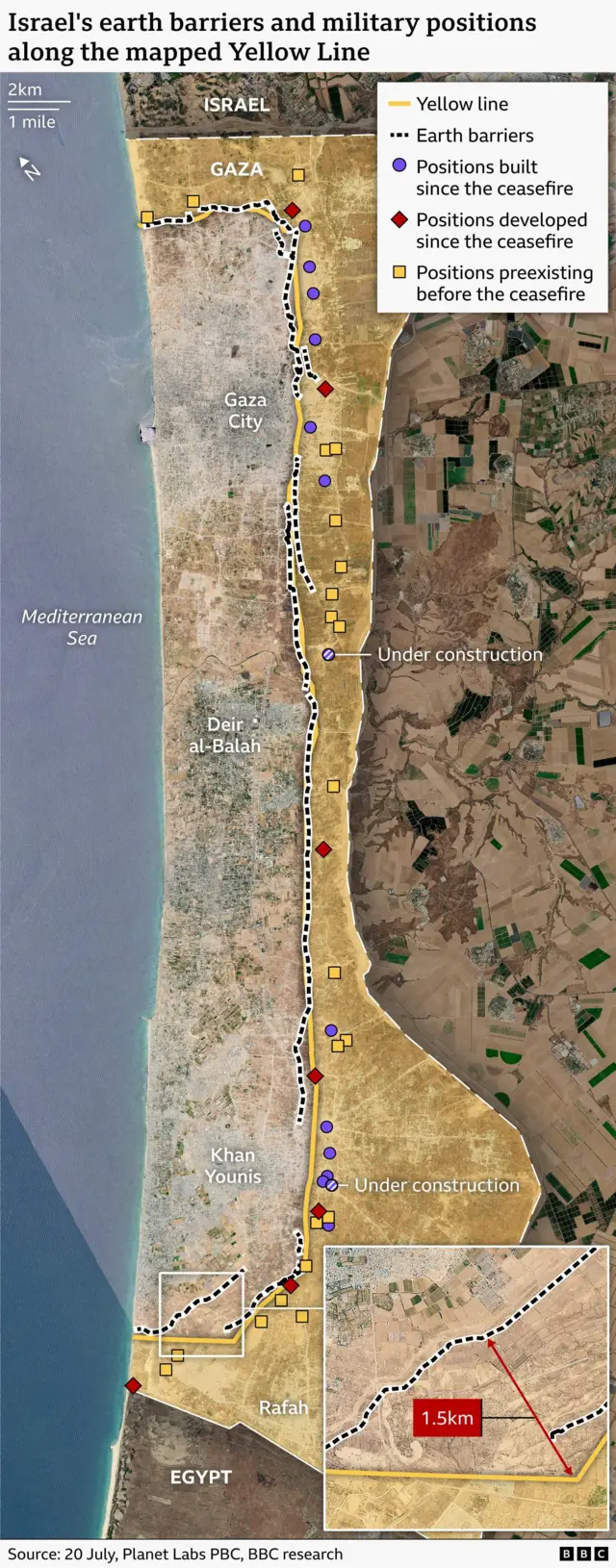
    There is still uncertainty over if the withdrawal of Israeli forces listed in the Board of Peace agreement would include territory behind the so-called Yellow Line.

    This is the designated demarcation point within Gaza at which Israel agreed to withdraw its forces to following the US-brokered ceasefire between Israel and Hamas, signed in October 2025.

    The deal was meant to leave Israel in temporary control of the area behind the Yellow Line - equating to 53% of Gaza's territory.

    So far, we have not heard anything from Israel on Trump's latest announcement.

    Israel's earth barriers and military positions shown along the mapped Yellow Line including positions that existed before the ceasefire, positions developed since the ceasefire and positions built since the ceasefire
  8. Any progress on Gaza peace negotiations 'extremely welcome', says UK ministerpublished at 09:14 BST 31 July

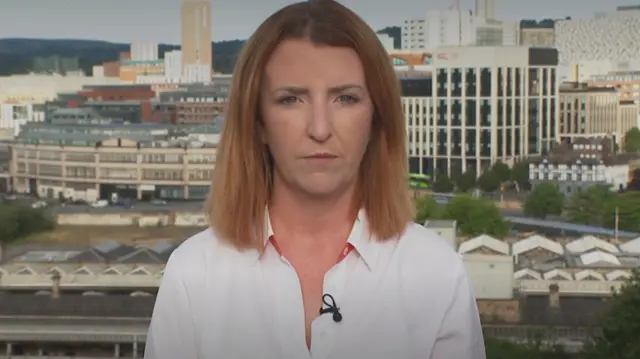
    Louise Haigh speaking to BBC breakfast wearing a white shirt with a city backdrop

    Cabinet minister Louise Haigh says any progress in the peace negotiations and disarmament of Hamas is "extremely welcome".

    "Obviously we will need to await the Israeli government's response," the first secretary of state tells BBC Breakfast.

    She says the UK government will await Israel's withdrawal from Gaza, and also for it to take action against "settler violence in the West Bank".

    "The suffering in Gaza and the wider region has been too extreme for far too long and the human cost of the war has been absolutely obscene and intolerable," she adds.

    Asked if the UK government has been involved in these discussions, Haigh doesn't answer but says it will "set out details in due course of our wider government response".

  9. Analysis

    Why Trump's plan may not work in practicepublished at 08:41 BST 31 July

    Jeremy Bowen
    International editor

    A Palestinian boy inspects the site of Wednesday's Israeli strike on a house whose residents were pre-warned by the Israeli military to evacuate, in Gaza City, July 30, 2026.Image source, Reuters

    There are many reasons why this will not work.

    But there are many reasons why everybody should hope that it does find a way of working.

    More than two million people, Palestinians in Gaza, live in the most hellish conditions: intense disease, awful misery, and equally, Israelis have legitimate reasons for being concerned about Hamas because of what happened on 7 October.

    However, there are lots of conditionals in this.

    It depends on Israel also agreeing to withdraw from territory in Gaza, when actually what they've been doing is deepening their control of it.

    While there hasn't been an official response to this from the Israeli government, when there were earlier reports in the course of yesterday that there were breakthroughs being made in negotiations in Cairo, the Netanyahu office basically issued a statement from the prime ministerial office pouring cold water on the whole process.

    In Israel, they're having elections in October and the whole political spectrum is very much on the right - in other words, against concessions towards Palestinians.

    So there are loads of reasons why this might not work.

  10. Some Israeli politicians sceptical of Trump's plan, but Netanyahu yet to commentpublished at 08:13 BST 31 July

    Yolande Knell
    Middle East correspondent, in Jerusalem

    There’s been no official Israeli response to President Trump’s announcement. However, we are already seeing sceptical and dismissive reactions from members of the government.

    “Israel says it will not take any action until Hamas is disarmed with its weapons, tunnels and infrastructure and we all understand the complexity of this,” Moshe Sa’ada, from the Israeli PM’s Likud party told public broadcaster Kan News.

    "Hamas is already saying that it’s the other way around: that it expects Israel to withdraw and only afterwards it will disarm."

    Sa’ada says he still believed that ultimately there would be "no other option" in Gaza "apart from military rule and end-to-end occupation."

    The far-right National Security Minister, Itamar Ben Gvir, lambasted the emerging deal before Trump’s social media post.

    "You only talk with Nazis through the crosshairs – and no other way," he wrote on X.

    "The only solution in Gaza to which Israel is willing to be a partner is encouraging emigration and destroying Hamas."

  11. What's included in Trump's Gaza peace plan?published at 07:39 BST 31 July

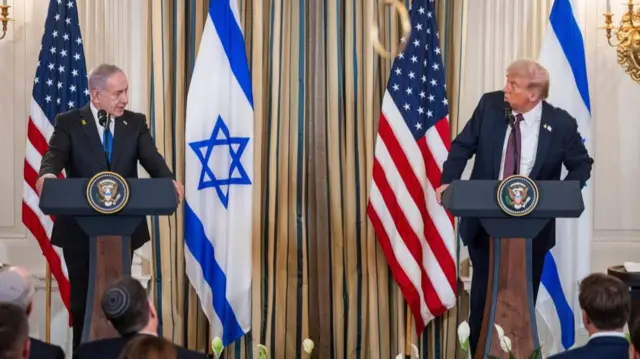
    US President Donald Trump (R) and Israeli Prime Minister Benjamin Netanyahu (L) speak at a press conference in the State Dining Room of the White House in Washington, DC, USA, 29 September 2025Image source, EPA/Shutterstock
    Image caption,

    US President Donald Trump and Israeli Prime Minister Benjamin Netanyahu agreed the peace deal in September 2025

    US President Donald Trump unveiled his 20-point Gaza peace plan at the White House on 29 September 2025 alongside Israeli Prime Minister Benjamin Netanyahu, who said Israel accepted the terms.

    On 3 October, Hamas said it agreed to return all 48 remaining hostages being held in Gaza in exchange for Palestinian prisoners in Israeli jails and Gaza detainees, and to the idea of handing over the governance of Gaza to Palestinian technocrats.

    But the group did not mention other elements, most notably the requirement that it disarm.

    Trump's plan, as provided by the White House at the time, said Gaza would be a "deradicalised terror-free zone that does not pose a threat to its neighbours".

    The plan also proposed a "Trump economic development plan to rebuild and energise Gaza", which it said would be created by "convening a panel of experts who have helped birth some of the thriving modern miracle cities in the Middle East".

    You can read Trump's plan in full here.

  12. What we do and don't know about disarmament planpublished at 07:11 BST 31 July

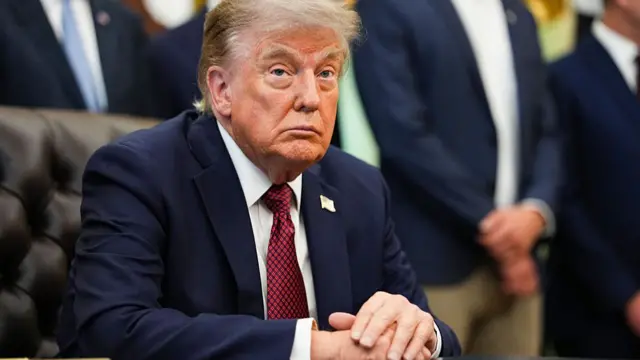
    President Donald Trump makes an announcement on American nuclear innovation in the Oval Office at the White House on July 24, 2026 in Washington, DC.Image source, Getty Images

    Overnight, US President Donald Trump announced an agreement had been reached for the "complete disarmament" of Hamas and other armed groups in Gaza and the withdrawal of Israeli troops.

    Here's what we know:

    • Trump said the agreement had been reached by his Board of Peace and described it as a "critical step towards Gaza finally being governed by a new Palestinian government"
    • The four-page roadmap of the plan, seen by the BBC, sets out phased disarmament of Hamas and gradual Israeli withdrawal, with US officials saying each step of the process will be "verified"
    • A senior Hamas official has told the BBC that the group has agreed to the plan - but an official statement from the group is yet to be released
    • Trump will be "very disappointed" if Israel does not withdraw from Gaza, according to a US official

    And what we don't know:

    • Israel's stance on the agreement, or if they were involved in negotiations - we have not heard anything from Israeli officials since Trump's announcement
    • How an Israeli withdrawal would work, or whether it would include the buffer zone known as the Yellow Line
    • Who would ultimately take custody of the weapons Hamas would be giving up under the agreement
    • How the "verification" mechanism put forward by the US would operate in practice

    We'll bring you the latest on the agreement and answers to these questions as we get them.

  13. Analysis

    If Hamas disarmament plan holds, it could mark first credible step to ending Gaza warpublished at 06:34 BST 31 July

    Rushdi Abualouf
    Gaza correspondent, in Cairo

    A Palestinian woman sits amidst debris as people inspect the site of an Israeli strike on a house in Gaza City, 30 July 2026.Image source, Reuters

    After months of marathon talks, Hamas has, for the first time, accepted a framework of the Board of Peace's plan to completely disarm in Gaza.

    The plan provides for the inventorying and storage of its remaining heavy weapons under Palestinian supervision, potentially removing the most significant obstacle to advancing the Trump-backed peace initiative for Gaza.

    The move comes soon after Hamas concluded leadership elections that brought Gaza-based leader Khalil al-Hayya to the head of the movement.

    Palestinian officials involved in the talks believe the new leadership was prepared to take what they describe as the most consequential political decision in Hamas's history, driven by the devastating humanitarian conditions facing more than two million Palestinians in Gaza.

    It remains too early to judge whether the agreement will be fully implemented or whether all parties will honour their commitments.

    But if it holds, it could mark the first credible step towards ending a war that has lasted for nearly three years and opening the way for a broader political process.

    Read the full analysis here.

  14. Analysis

    Hamas disarmament was a key sticking point as ceasefire stalledpublished at 06:04 BST 31 July

    Yolande Knell
    Middle East correspondent, in Jerusalem

    In recent months, the US-brokered Gaza ceasefire deal has stalled – with the disarmament of Hamas a key sticking point.

    But after recent intense talks between Hamas and regional mediators, President Trump wrote on social media that “a monumental step toward lasting peace and security” had been taken.

    Under a new proposal sent to Washington – and seen by the BBC – Hamas promises an inventory of weapons, military production sites and tunnels.

    Its arms are to be stored and kept under control of the new Palestinian administration; they cannot be transferred to Israel. The process is linked to “a phased Israeli withdrawal," according to the proposal.

    A separate plan is laid out on how Gaza’s new technocratic government should deal with Hamas public servants.

    There’s been no official response from Israel – which remains highly sceptical about Hamas’s willingness to disarm.

  15. If you're just joining us, here is what you need to knowpublished at 05:46 BST 31 July

    Here's what you need to know to catch up on this breaking story:

    • US President Donald Trump says the Board of Peace reached an agreement for the "complete disarmament" of Hamas and other armed groups in Gaza
    • Hamas has agreed to the plan, a senior Hamas official has told the BBC
    • Israeli soldiers will also withdraw from the Gaza Strip "as disarmament is completed", according to Trump
    • We are still waiting for an official response from Israel, which has not commented
    • There will be multiple phases to the disarmament process with progress to be independently monitored, US and Board of Peace officials said in a call with reporters
    • The deal was brokered with the help of meditators from Qatar, Egypt and Turkey
    • While some negotiators are hailing the agreement as a breakthrough, caution and scepticism remains on all sides
    US President Donald Trump (C) holds a signing ceremony for the 'Board of Peace' charter during the 56th annual meeting of the World Economic Forum (WEF), in Davos, Switzerland, 22 January 2026Image source, EPA
    Image caption,

    US President Donald Trump (C) holds a signing ceremony for the 'Board of Peace' in January 2026

  16. Cairo to hold meeting with mediators, state-linked news outlet sayspublished at 05:41 BST 31 July

    Cairo will host a meeting between the Gaza peace plan mediators "soon", state-linked Al-Qahera News reported early Friday. The mediators include Egypt, the US, Qatar and Turkey.

    The news outlet spoke to an "informed Egyptian source" who did not specify when the meeting would take place "to confirm the commitment of all parties concerned to implementing the terms of the agreement."

  17. How would disarmament be confirmed?published at 05:27 BST 31 July

    Speaking to reporters earlier today, a US and Board of Peace officials said an "implementation verification committee" will monitor progress on disarmament.

    The third-party committee will independently examine how conditions are progressing – noting difficulties of Hamas and Israel monitoring each other.

    The official acknowledges that it could take longer to ensure that Hamas has disarmed, saying that its army, tunnels and production facilities are more like those of a state than a militant group.

  18. How would Hamas disarmament work?published at 05:10 BST 31 July

    US and Board of Peace officials have given reporters a rough outline of how the disarmament process could work.

    In a phone call they said first, Hamas's police in Gaza will surrender their weapons to the transitional authorities.

    Then, there will be a "process of decommissioning" heavy weapons, which would including shutting down tunnels and depots as well as standing down the fighters who are operating these facilities.

    This would be a "very technical process" where one of the key questions would be how to store the collected weapons safely.

    Finally, all personal weapons in Gaza would have to be "dealt with" under Palestinian law.

    Officials said militias and clans would also have to decommission their weapons as part of this process.

  19. Israel has continued to launch strikes on Gaza since ceasefire agreement was signedpublished at 05:02 BST 31 July

    In the six months since Israel and Hamas were meant to begin phase two of the ceasefire deal, little progress has been made. At least 1,168 Palestinians have been killed in Israeli attacks since a ceasefire between Israel and Hamas took effect last October, according to the Hamas-run health ministry, whose figures are considered reliable by the UN.

    Four Israeli soldiers have been killed in Palestinian attacks in Gaza over the same period.

    Hamas led an attack on Israel on 7 October 2023, in which 1,200 people were killed and 251 were taken hostage.

    Israel responded by launching a massive military campaign in Gaza, during which more than 73,290 people have been killed, including 21,280 children, according to the territory's Hamas-run health ministry.

    In 2024, the International Criminal Court (ICC), issued arrest warrants over alleged war crimes for Israel's prime minister, Benjamin Netanyahu and former defence minister, Yoav Gallant, and as well as the military commander of Hamas, Mohammed Deif. Israel has said Deif was killed in an air strike.

    Prime Minister Netanyahu condemned the ICC's decision as "antisemitic", while Hamas said the warrants for Netanyahu and Gallant had set an "important historical precedent".

    A UN commission of inquiry said in September 2025 that Israel had committed genocide against Palestinians in Gaza. Israel's foreign ministry said it categorically rejected the report, denouncing it as "distorted and false".

    Residents inspect damage after last night's airstrikes by Israel on residential buildings on July 30, 2026Image source, Getty Images
    Image caption,

    Residential buildings in Gaza crumbled after being pounded by strikes earlier on Thursday.

  20. Agreement comes after 'months of very difficult negotiations', Board of Peace official sayspublished at 04:40 BST 31 July

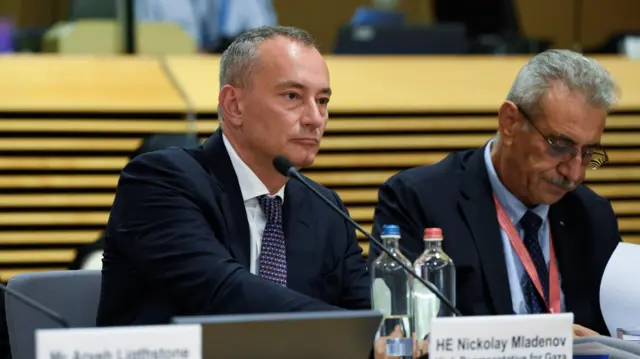
    We have heard from one of the most senior people involved in the region's diplomacy – the group's director-general and high representative for Gaza Nickolay Mladenov.

    In a post on X, he writes: "Today, agreement has been reached on the decommissioning of weapons and civilian transition in Gaza. It took months of very difficult negotiations to get here.

    "There were several points when I did not believe we would make it..." he continues. "What the agreement says matters. What happens next matters even more. Implementation and verification have to be real. Withdrawal must move in lockstep with decommissioning.

    Mladenov, a former Bulgarian foreign minister, has held multiple regional high-level roles in the United Nations – including as the UN's special coordinator for the Middle East Peace process.

    "Ahead of us is a Gaza rebuilt, governed by Palestinians and at peace with Israel an a political horizon to a meaningful resolution the Israeli Palestinian conflict. That is the work now."

    UN Special Coordinator for the Middle East Peace Process, Nickolay Mladenov in JulyImage source, Reuters
    Image caption,

    Nickolay Mladenov, one of the most senior diplomats, commended mediator countries Turkey, Egypt and Qatar.