Proceedings pause for lunchpublished at 13:29 GMT 23 March
The hearing has paused for a lunch break. Evidence is expected to resume at 13:55.
Temporary Deputy Chief Constable Rob Griffin, of Nottinghamshire Police, has given evidence to the public inquiry into the Nottingham attacks of 13 June 2023, which saw Barnaby Webber, Grace O'Malley-Kumar and Ian Coates stabbed to death by Valdo Calocane
Ian's body remained at the scene where he was killed for 15 hours, which Griffin said "seemed like a long time"
At the time, Griffin was assistant chief constable, and assumed the role of gold commander - the senior officer with overall strategic command
He has apologised for a "lack of empathy" after he gave a press statement that said he "wouldn't have looked to have changed anything", and denied a press release that stated "91 minutes from calls to cuffs" was published to make the force look good
In another draft press release, it was suggested Calocane could not be found and arrested due to his "nomadic lifestyle", something Griffin admitted was "not true"
It has also emerged that police staff were viewing material related to the case "inappropriately" one week after the killings - with the victims' families not told of any misconduct for months
The hearing has paused for a lunch break. Evidence is expected to resume at 13:55.
Julian Blake told the hearing that in a statement, former head of professional standards Hayley Williams had raised a concern about "homicide materials being stored on an insecure system" - called the "Big Job Drive".
Griffin told the inquiry he was aware of a conversation with Williams about that at the time.
"I don't remember it being a particular concern for me at that point," he told the inquiry.
He said he believed there were videos and images uploaded to that particular drive.
On 20 September 2023, the inquiry heard Rob Griffin became aware that a special constable had viewed distressing images related to the attacks with no policing purpose.
The inquiry heard there was no audit carried out of who accessed images and footage relating to the attacks.
Griffin said he became aware of the matter involving the special constable from an email sent by Det Supt Hayley Williams, the head of the professional standards department at the time, and replied to say "these are matters that should be shared with the families by us, rather than through any other means".
Julian Blake, counsel to the inquiry, said: "Do you consider it odd that there hasn't been a proactive investigation into who accessed images and footage?"
In response, Griffin said: "I thought there ought to have been, yes."
The inquiry was shown minutes from an Operation Hendrix - the investigation name assigned to the attacks - meeting at Nottinghamshire Police on 20 June 2023, a week after the Nottingham attacks.
The minutes showed Hayley Williams, former head of professional standards at Nottinghamshire Police, had asked for a message to be reinforced that officers and staff should not look at incidents/CCTV on systems "if they are not directly connected to the job".
Notes showed Rob Griffin had said "far too many people had made unnecessary checks and stressed the need for teams to be reminded".
Griffin told the inquiry: "I do remember Hayley sharing there was evidence our officers, or our workforce, had looked inappropriately at systems and as a response to that I ordered some messaging through the chief superintendents."
Griffin told the inquiry that there were "peaks and troughs" in Valdo Calocane's behaviour between 2020 and 2023, but not "an upward trajectory" or "escalation of violence".
"It is really difficult to comprehend three years' worth of incidents like these which do not show a consistent and upward escalation in violence," Griffin said.
Julian Blake said: "They do show incidents against students and a fixation on students?"
Griffin replied: "Yes."
The inquiry is shown a statement, made by Griffin and shared to the press in which he said: "I have personally reviewed this matter and we should have done more to arrest him.
"In my opinion it is highly unlikely that he would have received a custodial sentence for the alleged offence."
Asked if the above statement was an appropriate thing to say, he said: "No, it wasn't."
Griffin added: "It was my opinion at the time - and I know this is a highly controversial point so I take great care when I say this - but it remains my opinion that it is highly unlikely that he would have received a custodial sentence for the assault on the police officer, had he been arrested on the warrant."
Temporary Deputy Chief Constable Rob Griffin is continuing to be questioned on information shared with the families and press.
In one statement to the media, in relation to Calocane's assault of his university flatmate Christopher in January 2022, the force said further police action was "not supported".
Blake said: "You recognise 'not supported' sounds like victim blaming - I think those are the very words you used?"
Griffin said that in a conversation with the press team, he said they needed to "be careful to ensure that it would not be interpreted as victim blaming", although he could not remember that conversation.
He added: "I think we have perhaps settled on, 'there is no better or more accurate way to describe it'.
"But if I might just finish the point a moment ago, there were failures in these investigations. There is no question about that."
Griffin added it was still true to say the victim in the case did not support further police action.
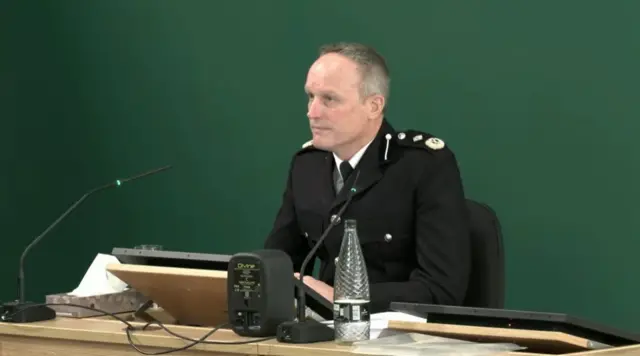 Image source, The Nottingham Inquiry
Griffin told the inquiry that senior investigating officer (SIO) Det Supt Leigh Sanders "failed to explain [Calocane's] warrant in a way that I would have wanted him to", to the victims' families.
He added families were not given information that "goes anywhere close to explain why he [Calocane] wasn't arrested".
The inquiry heard Emma Webber, mother of Barnaby Webber, had asked police for information about their interactions with Valdo Calocane.
Blake said: "What is entirely absent from this answer is why he had not been arrested."
"I completely agree with that, yes," Griffin replied.
"The fact that we hadn't arrested him over that period is itself a complete failure."
In a draft press release about why the warrant for Valdo Calocane's arrest was not executed, the inquiry heard press officer Matthew Jarram suggested the force could explain Calocane could not be found because of his "nomadic lifestyle".
Asked if that was something the senior investigating officer Leigh Sanders would have told him, Griffin said he "can't see where else Matt Jarram can have taken it from".
Sanders used the word "nomad" to describe Calocane in his evidence earlier in the inquiry.
Julian Blake, counsel for the inquiry, said: "Why insert that sentence there about the nomadic lifestyle? That wasn't true, was it?"
Griffin replied: "That's not true, no."
He added: "I think the person that drafted this thought it was true."
Griffin has been questioned on a press release to the media, which outlined the police's history with Calocane.
However, the inquiry has been told the release omitted various details, and Griffin agreed the statement focused on Calocane's history with mental health, rather than police involvement.
"It had never been the intention to lay out the whole history of our interactions with Calocane," he said.
"Rather, I ended to provide what I would describe as a broad overview, because this is communicating with the public and it was to give them an indication of the context of the nature of those interactions."
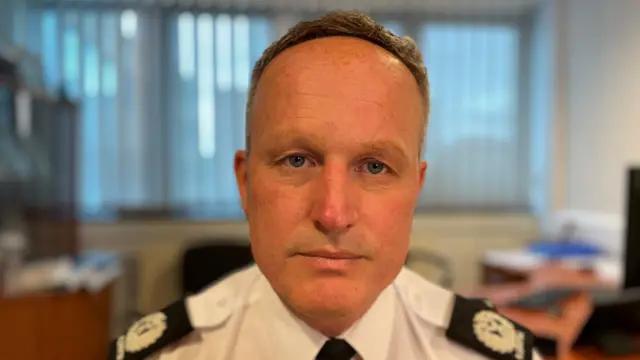
Rob Griffin (pictured above) told the inquiry that during discussions on 16 June 2023, three days after the killings, senior investigating officer (SIO) - the now retired Det Supt Leigh Sanders - was "obviously and understandably thoughtful" about when Valdo Calocane's warrant and the Leicestershire assault should be shared with the families.
"I completely agree with him that this was the wrong time really, because as an SIO we would think really carefully about delivering difficult messages like this, so we can provide the right support to the family and it's delivered in the appropriate way," he said.
Griffin said he acknowledged this, but was concerned it was something that the families were going to learn about through the media.
"I think his decision-making was right, he agreed with me that they need to be told about the warrant and he agreed with me that they need to be told about the Leicestershire incident," he added.
"Neither of those bits of information in an ideal world would have been shared at that time in that way, and we agreed together that the warrant needs to be disclosed now, the Leicestershire incident does not need to be disclosed now but all of the incidents including those two need to be disclosed at the right time, in the right way, by the right person."
Griffin added: "The notion that the families would read or hear first about that [warrant] in the newspaper, or through some other media outlet, for me, was absolutely unacceptable.
"And I'd been clear all week that week, and continued to be my mantra was 'families first, families first, families first'."
He added the media "were hassling us all week, not surprisingly".
Griffin said he stood by his decision that stakeholders and the media "are going to have to wait because the families need to know first".
He added, however, that there was not sufficient information passed on about the warrant at the time.
We have heard throughout the inquiry about an arrest warrant for Valdo Calocane, which was outstanding at the time of the attacks.
The warrant was issued in September 2022 after Calocane - who was detained under the Mental Health Act at the time - failed to appear in court in relation to his assault on a police officer.
That warrant was never executed - even after Calocane attacked two warehouse workers in Leicestershire just weeks before his killings, on 5 May 2023.
In his statement to the inquiry, Griffin said he was "particularly concerned" about the matter of the warrant being revealed to the media before the families knowing.
He said in the aftermath of the attacks, he believed it would have been "inappropriate" to be trying to give the families "the complex explanation" for why the warrant had not been executed.
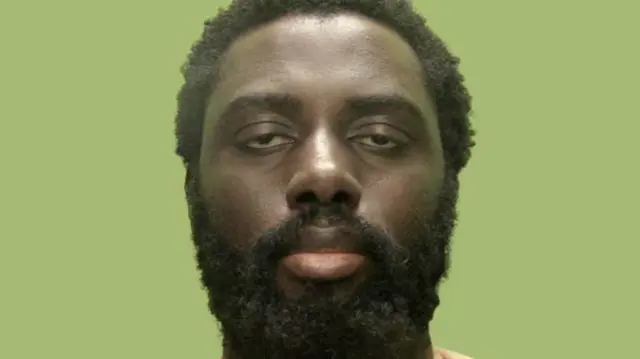 Image source, Nottinghamshire Police
Griffin has been questioned on Valdo Calocane's encounters with Nottinghamshire Police over a three-year period.
That period included a number of incidents. One one occasion, in May 2020, Calocane broke into a woman's flat and she fled out of the window, causing her to break her spine.
Calocane assaulted one of his flatmates Sebastian in July 2021, the inquiry has been told.
He also assaulted a police officer, PC Barnaby Pritchard, in September 2021.
A warrant for the killer's arrest over the assault on Pritchard was issued in September 2022, but it was never executed and remained outstanding at the time of the attacks.
Griffin said: "All of those encounters in my opinion are characterised and bear the hallmarks of mental health incidents."
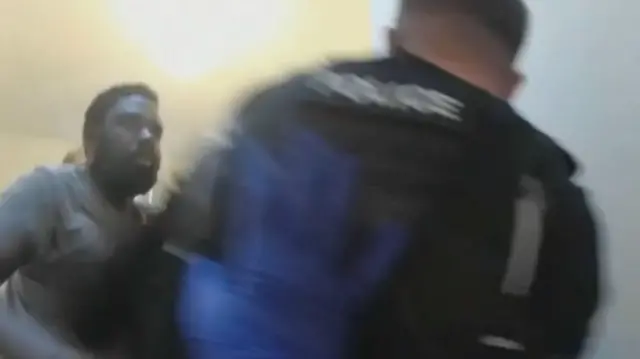 Image source, Nottinghamshire Police
He said from a legal standpoint, he believed the only incident of "serious violence" was that involving the woman who jumped out the window.
Of the assault on PC Pritchard, he said: "In my opinion - looking through the lens of a senior police officer who has 30 years' policing experience working in the areas that I do - I think it is inaccurate to describe that incident as serious violence."
Griffin accepted that it would have been better to liaise with the families of the bereaved and survivors before issuing press releases later on, following Calocane's arrest and subsequent sentencing.
Julian Blake said: "Reflecting more broadly - and we'll come to more examples - was there a failure to realise how those kind of statements might have affected the bereaved and the survivors?"
Griffin responded: "Yes, I think there was.
"And I've thought about that a lot and continue to, and I can see - and I saw on the day of sentence - the hurt I've caused, which was quite the opposite of my intention.
"And I know I've said it in my witness statement, but I've never had the opportunity to say to the families that I'm so, so sorry."
A press release published by Nottinghamshire Police following the attacks has been scrutinised by Julian Blake.
That release said it was "91 minutes from calls to cuffs" on 13 June.
Asked if that was something he thought the force should be proud of, Griffin said: "I don't think it's something that we should be proud of, no".
The press release said "officers managed to track down the van and arrested Calocane".
Blake said: "It sounds from that final press release that the 91-minute press release is being used there to suggest that this arrest was as a result of great police action, rather than as a result of having mowed down pedestrians in the city centre. Would you agree?"
Griffin said it "could be interpreted" that way, however, that was not his intention.
"It was never designed to indicate that he was arrested due to - to use your words sir - great police work," he added.
"But I do believe it gives an important context to the events of the evening."
Questioned on the search that took place for Valdo Calocane on the day of the attacks, Griffin said following a review of the police response, "the co-ordination of that search activity should have been better".
"There is no question about that," he added.
We heard earlier in the inquiry that Calocane was moving away from the city centre after stabbing to death Barnaby and Grace and walking two miles away towards Magdala Road, before he killed Ian.
He had also stopped shortly before killing Ian, at a hostel, which he unsuccessfully tried to enter a number of times.
A number of cameras across the city captured Calocane's movements on that morning - but police searches were directed towards the city centre.
As Griffin outlined difficulties in the search, Lee Coates - one Ian's three sons - shook his head as he walked out of the hearing room.
The inquiry has been shown an earlier statement Rob Griffin made to the media after the attacks.
In that statement, he said: "I'm really confident that everything that we did was thorough and professional.
"I wouldn't have looked to have changed anything, and tragically, we couldn't have stopped any of what happened."
He told the inquiry he now apologised for those words, and the impact they would have had on the bereaved families and survivors.
"And I want to say again that I'm so, so sorry about that," Griffin said.
"It was the tone and choice of words and the lack of empathy that is what I really reflect on and I apologise for."
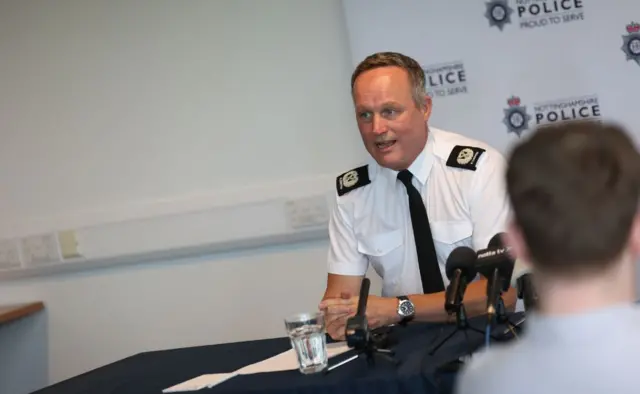 Image source, Nottinghamshire Police
Griffin has now been quizzed on why it took so long for the families of Barnaby Webber, known as Barney, and Grace O'Malley-Kumar to be told about what had happened to them.
"I completely agree with that, actually, I think the parents of Barney and Grace should have been told just as soon as humanly possible. And I completely understand the impact of them not having been," he said.
"However, there is always a balance to be struck and one of the areas of police work that I've worked in for many years is disaster victim identification."
Griffin said it was important to avoid mistaken identity.
He then went on to say: "I agree that Barney and Grace's parents should have been told sooner, but not if there was even the remotest risk of misinforming them.
"I would preferred for them to have been told sooner, but I don't necessarily think that it follows that they could or even should have been told sooner."