Summary

  1. Iran launches missiles at Israel - IDFpublished at 13:16 GMT 7 March

    The Israeli military says it has identified missiles launched from Iran towards Israel.

    "Defence systems are operating to intercept the threat," the Israel Defense Forces says, adding alerts have been sent to some mobile phones instructing residents to stay in protected spaces.

  2. Message from Iran's president is 'clear', says spokespersonpublished at 13:13 GMT 7 March

    The deputy of communications for the Iranian president's office has commented on Masoud Pezeshkian's televised message this morning.

    "President Pezeshkian's message is clear: if the countries in the region do not co-operate with the US in its attacks on us, we will not attack them," he says.

    "The Islamic Republic of Iran never bows to force, and our powerful armed forces, in accordance with the issued guidelines, will give a decisive response to any aggression from American bases."

    Pezeshkian apologised to neighbouring states earlier, and said Tehran would not attack them "unless attacked first". However, neighbouring states continue to report today that they are intercepting missiles and drones.

  3. Trump's language in Truth Social post is unusually strongpublished at 13:03 GMT 7 March

    Bernd Debusmann Jr
    Travelling with the president

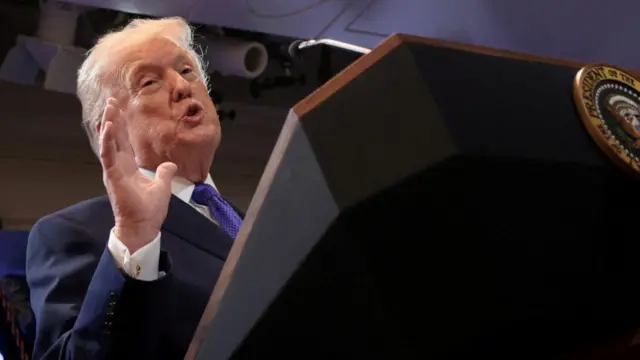
    president trump at a lecternImage source, Reuters

    The Iranian president's apology and vow to stop attacking neighbouring countries has prompted Donald Trump to declare what amounts to what he sees as a partial victory in this conflict.

    Exactly one week on from the start of the campaign, Trump believes that the Iranian concession "was made only because of the relentless US and Israeli attack" - a sign he believes that the US has the upper hand so far.

    Even by his standards, Trump's language in his earlier Truth Social post is unusually strong, promising "very hard" strikes and saying that the US is considering "complete destruction and certain death".

    The statement, however, offers little insight into the administration's "day after" planning or who they believe might run Iran if the Islamic Republic were to fall.

    Over the last week, some US commentators had suggested that Trump could seek a quick "off-ramp" that would allow him to declare victory while avoiding a prolonged conflict that could grow unpopular with members of his Maga base that are weary of another messy regime changing exercise in the Middle East.

    But his post suggests that, at least for the moment, Trump is taking a maximalist approach and is in no mood to negotiate until he believes the US has accomplished its military objectives and Iran is no longer able, or willing, to fight back.

  4. Analysis

    Pezeshkian apologised, but is he really speaking for Iran's leadership?published at 12:57 GMT 7 March

    John Simpson
    World Affairs Editor

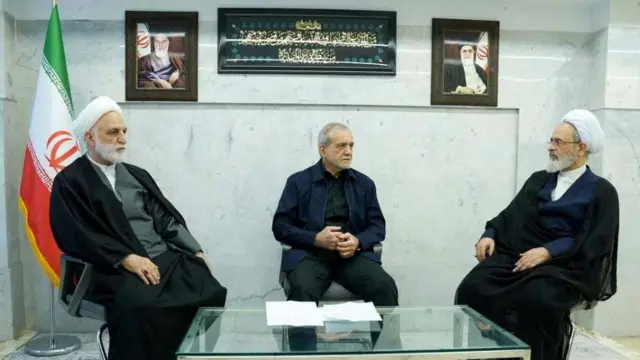
    ranian President Masoud Pezeshkian, Gholam-Hossein Mohseni-Eje'i, the head of the judiciary and Alireza Arafi, deputy chairman of the Assembly of Experts, attend the meeting of the interim leadership council of Iran in an unknown locationImage source, IRIB/Reuters
    Image caption,

    Pezeshkian (centre) with members of Iran's interim leadership council

    An apology from Iran’s president, Masoud Pezeshkian, for the strikes on the Gulf states, plus a promise not to hit them if attacks on Iran aren’t launched from their territory, looks like an olive-branch.

    But is Pezeshkian really speaking for Iran’s leadership?

    Although he’s the elected president, he doesn’t have the same authority as hardliners like Mojtaba Khamenei, the son of the now-deceased Supreme Leader Ayatollah Ali Khamenei, or the surviving commanders of the Islamic Revolutionary Guards Corps.

    Pezeshkian, a former heart surgeon, was elected in 2024 as a relative moderate, and he has always been an outsider in Iran’s hierarchy.

    Could he maybe be putting down a marker to show the Americans they can do business with him when this war is over?

    As for the hardliners, it’s hard to think they want to show conciliation at this stage.

    They’ve planned for an American and Israeli attack for years, and are schooled in the spirit of Shia Islam, which emphasises self-sacrifice for the faith.

    The men with real power in the leadership are surely on the side of continuing resistance. They know that if they can only survive the Israeli and American onslaught, that will be a form of victory.

  5. 'We will defend ourselves' from aggression, says Iran's ambassador to UKpublished at 12:51 GMT 7 March

    Media caption,

    Iranian ambassador to UK: 'We will defend ourselves'

    The Iranian ambassador to the UK, Seyed Ali Mousavi, has told the BBC that if the "aggression from the American and Israeli side continues, we will continue to defend ourselves".

    While Iran’s president has apologised this morning and promised to stop attacks on neighbouring states, the ambassador says his country's policy is to “defend themselves”.

    In an interview with Sunday with Laura Kuenssberg, Mousavi is asked if Iran would stop its attacks on military bases in other parts of the Middle East.

    He says there is "willingness from the Iranian side not to strike, not to attack our neighbours".

    But he adds: "it depends on the activities of the Americans and the Israeli regime. If the aggression… continues there is no doubt we will defend ourselves. And if they want to use these military bases, although we don’t want to do that, there is no doubt we will defend ourselves accordingly".

    He says that bases, properties or facilities which target Iran would be considered "legitimate targets".

  6. IDF issues evacuation orders in parts of southern Lebanonpublished at 12:41 GMT 7 March

    A little earlier, the Israel Defense Forces (IDF) warned of further strikes on southern Lebanon.

    In a post published on X, IDF spokesperson Avichay Adraee shares a map of the targeted area and warns residents in affected areas to evacuate.

    The IDF says buildings used by Hezbollah are in the vicinity.

    The Israeli military has also reported that it "continues to degrade" Hezbollah capabilities in the region, following earlier strikes on Beirut's southern suburbs.

  7. Hezbollah says it targeted Israeli military basepublished at 12:34 GMT 7 March

    Hezbollah says it targeted Israel's Dado military base, north-east of the city of Safed, with a missile strike at 13:00 local time (11:00 GMT).

    In a post on Telegram, it said the strike was in response to Israeli strikes on "dozens of Lebanese cities and towns, including the southern suburbs of Beirut".

  8. More B-1 bombers arrive at RAF Fairfordpublished at 12:25 GMT 7 March

    Nick Johnson
    Reporting from RAF Fairford

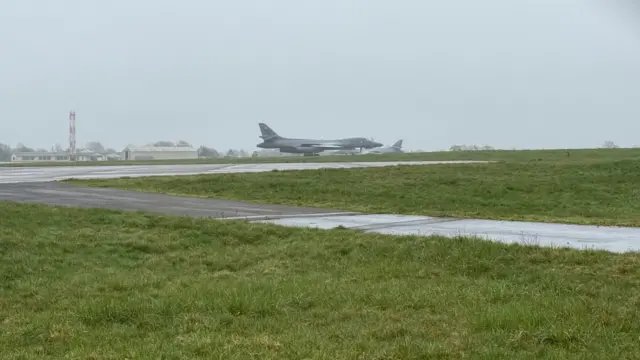
    A B1 bomber seen on an airfield

    Three US B-1 bombers - affectionately known as “Bones” - approached from the west, roaring through the mist and cloud before touching down at RAF Fairford earlier this morning.

    Online chatter suggests they had arrived after a bombing campaign over Iran.

    They joined one other B-1, which is believed to have arrived from its air base in Texas last night.

    These aircraft are supersonic strategic bombers - and can carry a huge payload.

    At just under two miles (3km), RAF Fairford - which is used by the US Air Force - has one of the longest runways in the UK, which is why it’s the preferred choice for these large bombers.

    The visibility at Fairford is extremely poor, but the aircraft make imposing shapes through the mist, sitting on the tarmac with their engines off.

    They will be re-loaded with ammunition and the crews rested before taking off.

  9. Iranian man in UK says he is 'attached to phone' for updates from parentspublished at 12:20 GMT 7 March

    Kris Bramwell
    BBC News

    A British-Iranian man in his 40s tells the BBC that his parents are based in Tehran. We are identifying him as Omid due to security concerns if his real name is shared.

    Omid says his parents are in their 70s and based in the capital's north-west.

    He tells me: "My parents have managed to call me once every two days. I am literally attached to my phone for any calls."

    Omid adds: "I remember calling them the night before the war and telling them that I had a feeling war was about to begin.

    "My father said they had decided to remain in Tehran rather than leave, as they felt safer where they are, since their home is not close to potential military sites or other locations of interest.

    "Two days after the war began, I received a call from my mother. She put it as ambiguously as possible - calls are strictly controlled by Iranian intelligence service - saying that for the first time, she felt that some positive change might be on its way for Iran.

    "She told me that I should not worry, and that they planned to stay in Tehran for 72 hours and then reassess whether to move to the north or not.

    The last update he has received from his parents is that they have decided not to leave home, Omid explains.

    "All I hope for is that a new Iran will rise from the ashes, a land where people can live normal lives and enjoy the simplest rights that many of us take for granted."

    Do you have family in Iran? If it's safe to do so, you can get in touch anonymously via this link.

    Your Voice branding
  10. Analysis

    How Iran's 'decentralised mosaic defence' strategy could explain Gulf strikespublished at 12:12 GMT 7 March

    Joe Inwood
    World news correspondent

    At the start of the war, aware of the risk that the US and Israel could wipe out their top commanders, Iran is said to have adopted what’s known as a "decentralised mosaic defence".

    It’s a strategy where responsibility is devolved to a much lower level around the country. Military commanders are given a set of targets and objectives which they must achieve. They are then told not to expect further instructions from above, but to operate independently.

    This is a useful strategy when you expect chains of commands to be disrupted, as they have been in Iran, where much of the country's top brass have been killed in US-Israeli strikes.

    It is potentially less useful when the overall strategic objective changes - which could be what we are seeing today.

    Iran's President Masoud Pezeshkian said that the country’s wealthy Gulf neighbours would no longer be targeted by strikes.

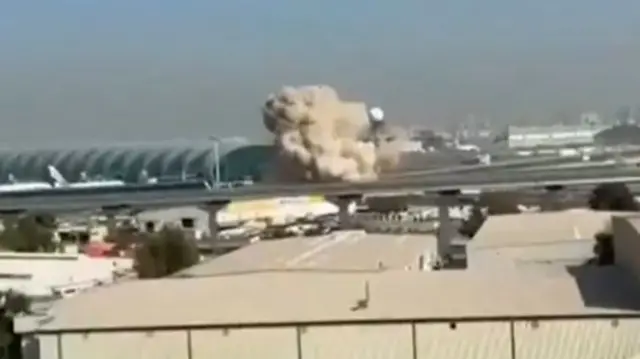
    But at roughly the same time, footage emerged of what appeared to be a drone strike on Dubai International Airport.

    We cannot be certain exactly what has happened at this point, or if the president's promises were sincere, but it may be that what we are witnessing is the danger of the mosaic strategy and the difficulties it will pose to attempts at deescalation.

  11. Apparent drone strike at Dubai airport - here's what else to knowpublished at 12:00 GMT 7 March

    Freya Scott-Turner
    Live reporter

    Smoke rises over the Iranian capital of TehranImage source, Reuters
    Image caption,

    Smoke rises over the Iranian capital of Tehran

    Israel and Iran continued to trade strikes overnight, as the war in the Middle East passes the one-week mark.

    This is what you need to know this hour:

    Apologising to neighbouring countries attacked during the conflict, Iran's president pledged in a video message to "not attack neighbouring countries, unless attacked first" - but around the same time the video was aired, Qatar's defence minister said its armed forces had "intercepted" a missile attack.

    Iranians told the BBC of "a second terrible night in a row", under more bombardment by Israel, and fire was seen in the direction of Tehran's Mehrabad Airport in Tehran.

    And, the Israeli military continues to give updates on its widespread bombing campaign - waves of which targeted sites across Iran and Lebanon.

    In Israel, air raid sirens sounded in Jerusalem and Tel Aviv, as the IDF announced its defence systems were working to intercept missiles launched from Iran.

    Services are "partially resumed" at Dubai International Airport, after the emirate's busiest airport earlier suspended all services - as did the Emirates airline.

    And the human cost of this week-long war continues to come into focus. The Iranian ambassador to the UN says that at least 1,332 civilians have been killed in strikes in the country. Lebanon's health ministry says that Israeli strikes have killed at least 217 people, and first responders in Israel say that 10 people have been killed there.

  12. Fifteen ballistic missiles intercepted today, says UAEpublished at 11:49 GMT 7 March

    The United Arab Emirates says it has intercepted 15 ballistic missiles and 119 drones today.

    In an update from its ministry of defence, it says that air defence systems detected a total of 16 ballistic missiles, of which 15 were intercepted and one fell into the sea.

    Air defence systems also detected 121 UAVs - or drones - and intercepted 119 of them, "while two fell within the territory of the UAE", it says.

    Ballistic missiles are rocket-powered long-range weapons, that can cost millions to manufacture. UAVs - unmanned aerial vehicles - or drones, are slower, low-flying propeller-driven aircraft. They can be produced at a much lower cost.

    It reports three deaths from drone attacks on the country over the course of the week-long war so far, as well as 112 minor injuries.

  13. Analysis

    Unclear if Pezeshkian's apology to neighbours will make a differencepublished at 11:38 GMT 7 March

    Lyse Doucet
    Chief international correspondent

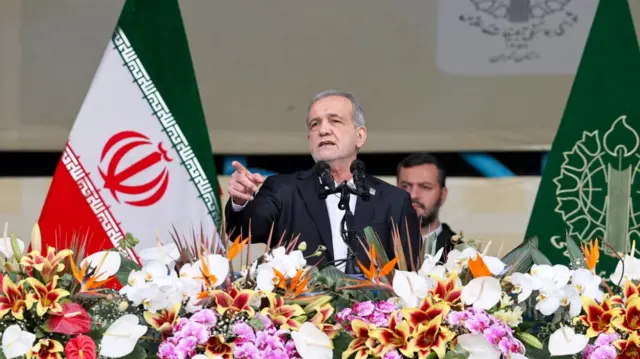
    Pezeshkian stands in front of Iranian flags and behind a table full of flowers.Image source, Wana/Reuters
    Image caption,

    Masoud Pezeshkian speaks at an event last month

    It’s not clear what impact Iran's President Pezeshkian’s apology to neighbouring states will have on the ground.

    He suggested that Iran's strikes had been carried out as "fire at will" by the armed forces. Iran's command structure is reported to have been decentralised in this war.

    But the president, and military officials, are still making it clear that if attacks originate from US military bases in the region they will be a target.

    The president's announcement of a decision he said was made by the interim Leadership Council appears to be a response to the enormous anger among Arab leaders who, in recent years, had developed a new relationship with their former arch-enemy; many had urged the US not to go to war against Iran.

    A senior official in the region told me their rupture with Tehran would last for decades. The president, a relative moderate in Iran’s system, is known for trying to strike more conciliatory tones.

    After the major wave of nation-wide protests in January was crushed by lethal force, he apologised for the government’s failure to resolve economic issues - but didn’t address the calls from the streets for political change.

  14. Trump says Iran 'will be hit very hard', military considering new targetspublished at 11:30 GMT 7 March

    US President Donald Trump has shared an update on his Truth Social platform.

    In apparent reference to comments made by the Iranian president earlier, Trump says that Iran "has apologized and surrendered to its Middle East neighbors, and promised that it will not shoot at them anymore."

    He says that "this promise was only made because of the relentless U.S. and Israeli attack." Iran has not entirely reined in its strikes on its neighbours, with an apparant drone strike seen near Dubai International Airport. Qatar also says it has intercepted a missile.

    Later in the post, Trump says that "today Iran will be hit very hard!"

    "Under serious consideration for complete destruction and certain death," are "areas and groups of people that were not considered for targeting up until this moment in time."

  15. BBC Verify

    Footage shows apparent drone impact at Dubai airportpublished at 11:17 GMT 7 March

    Still taken from footage shared on social media this morning. It shows what appears to be a drone impact within the perimeter of Dubai International Airport.Image source, X

    Yi Ma and Paul Brown, BBC Verify

    Footage shared on social media this morning shows what appears to be a drone impact within the perimeter of Dubai International Airport.

    The footage, filmed from an industrial area just south of the airport, shows an explosion close to a terminal building. The person filming can be heard saying "another drone" and there is a audible whirring sound prior to impact which is consistent with sounds made by drone engines.

    An object can be briefly seen descending sharply before the explosion, but it is not possible to identify what it is.

    The impact appears to have occurred to the north of a train line and a Hertz building, which would place it close to Concourse A. At least four aircraft can be seen parked on the apron next to the building.

    It is unclear if the impact was the result of an interception or a targeted strike.

    Earlier this morning Emirates Airlines announced the suspension to operations, but that post has now been deleted and replaced by one saying services have resumed.

  16. Some flights now taking off and landing at Dubai airportpublished at 11:06 GMT 7 March
    Breaking

    Nick Beake
    Europe correspondent reporting from Dubai

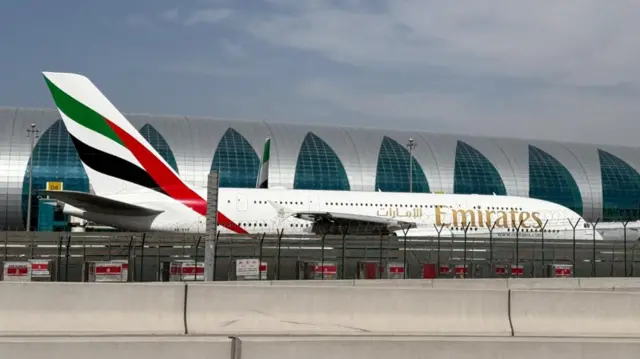
    An Emirates airplane at Dubai International AirportImage source, Reuters

    Some flights are taking off and landing at Dubai International Airport, following an explosion filmed there earlier today.

    The authorities in the UAE earlier suspended operations, without giving an explanation for the decision.

    Footage showing a projectile and explosion at the airport has been verified by the BBC.

    The official X account of the Government of Dubai Media office posted that there had been no incident at the airport on Saturday.

    It says: “Dubai authorities have confirmed that a minor incident resulting from the fall of debris after an interception has been successfully contained. No injuries have been reported. Authorities have also denied reports circulating on social media regarding any incidents at Dubai International Airport.”

    Some flights have been departing, but with delays.

    Emirates flight EK001 to London Heathrow, which was due to leave Terminal 3 at 07:00 local time, is now showing as departed following a delay of several hours.

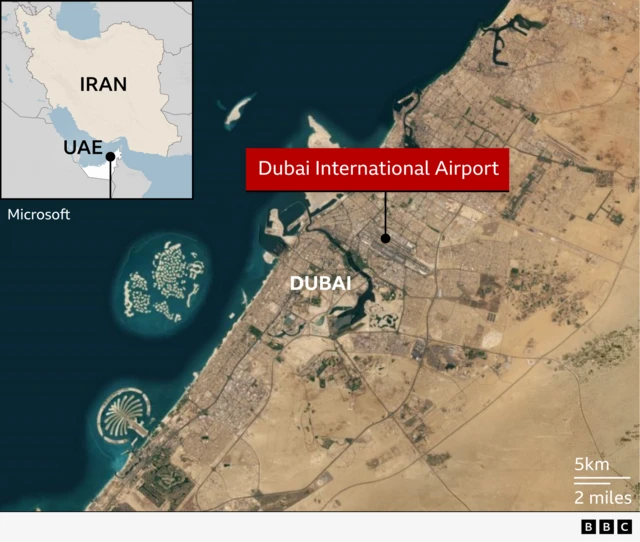
    A satellite map of Dubai showing the location of Dubai International Airport marked with a red label. The map includes major landmarks such as Palm Jumeirah and The World islands along the coast. An inset map in the top-left corner shows the UAE’s position relative to Iran. A scale bar indicates distances of 5 km and 2 miles. There are BBC blocks in the bottom-right corner.
  17. Flight map shows planes avoiding area around Iranpublished at 11:00 GMT 7 March

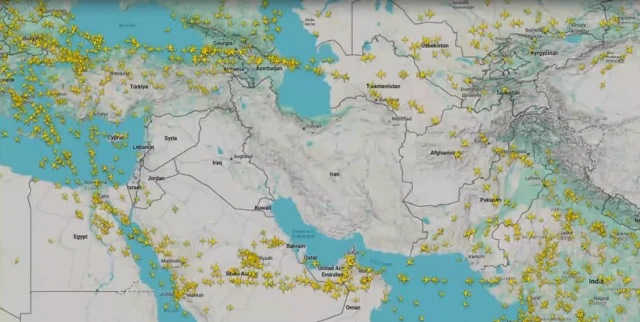
    Planes are steering clear of the area around Iran due to safety concerns and closed airspace.

    Here’s a map from Flightradar, showing the situation at around 10:30 GMT.

    Flight tracker map shows planes avoiding airspace over IranImage source, Flightradar

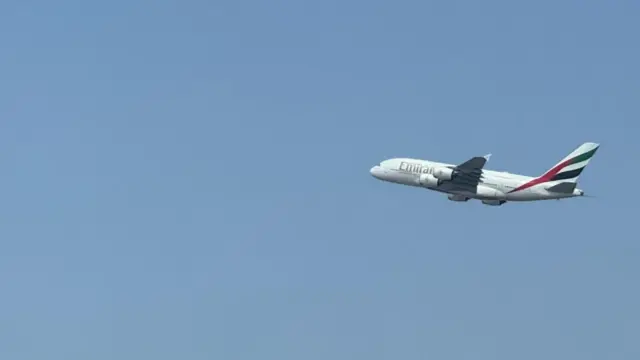
    Meanwhile, we've also seen a photo of an Emirates flight taking off from Dubai International Airport after an area near the airport was struck. We don't yet know if full operations have resumed in Dubai.

    An Emirates flight takes off from Dubai International AirportImage source, Reuters
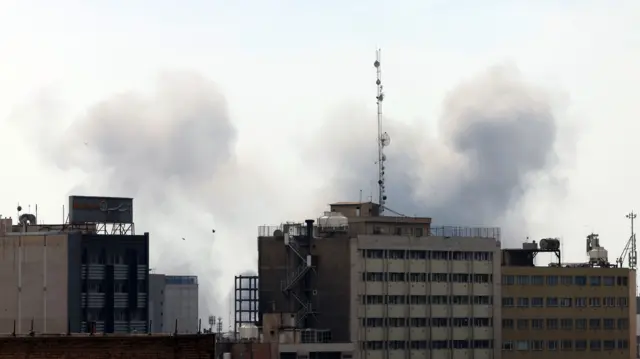
  18. Image shows smoke rising over Tehran as Iranian media report explosionspublished at 10:51 GMT 7 March

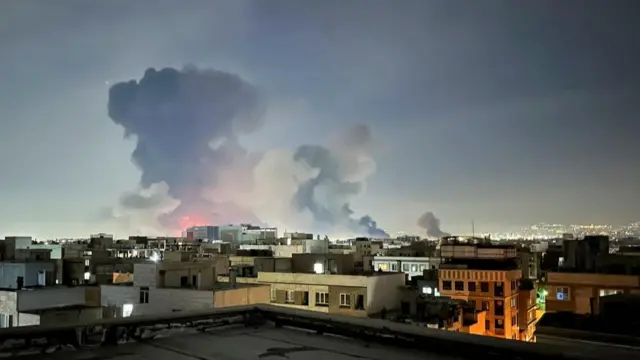
    Iranian media are reporting explosions in Tehran. We've also just seen the below image, which shows smoke rising over the city a short while ago.

    At around 08:50 GMT, Israel's military said it was conducting new strikes on infrastructure in Tehran and Isfahan.

    Smoke rises after an airstrike in TehranImage source, EPA
  19. US oil firms evacuating staff from Iraqpublished at 10:45 GMT 7 March

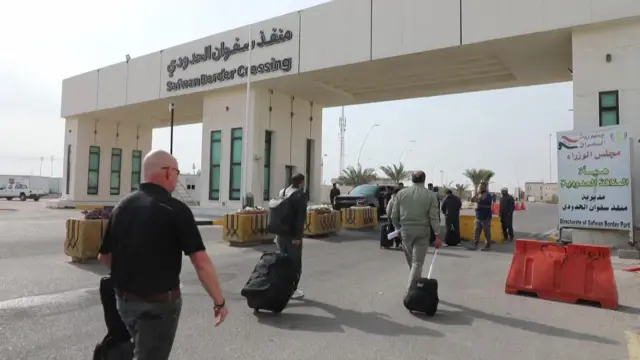
    People wheel suitcases across a border pointImage source, Reuters
    Image caption,

    Halliburton staff crossing the Safwan border into Kuwait

    Foreign oil companies in the Middle East have started evacuating their staff out of oilfields in Iraq.

    Footage gathered by Reuters news agency shows staff crossing through the Safwan border into Kuwait.

    A security guard at US oil firm Halliburton, Mohamed Ta'meh, told the agency that “due to the security situation in Iraq, foreign staff working at the oil stations (in Iraq) have left for the state of Kuwait, and from there they will see where they will go.”

    Oil fields have been a target during the week-long conflict, with another US oil firm, HKN Energy, halting production at a site in Iraqi Kurdistan on Friday following reports from the regional government of an attack by "outlaw groups in Iraq".

  20. Watch: Moment drone strike hits near Dubai Airportpublished at 10:39 GMT 7 March

    Earlier, we reported that a drone struck a location near Dubai International Airport.

    Here's a video showing how the event unfolded.

    Media caption,

    Watch: Moment of drone strike close to Dubai Airport