Summary

  1. Lib Dems and Greens call for parliamentary vote on UK involvement in warpublished at 19:43 GMT 20 March

    The Lib Dems say the UK is being "drawn further and further down Trump’s slippery slope" after the government allowed the US to use its bases to strike Iranian sites targeting the Strait of Hormuz.

    "This decision by the Prime Minister reminds us all of the disaster of Iraq and shows how we’re being drawn further and further down Trump’s slippery slope," the party's foreign affairs spokesperson Calum Miller says.

    "Starmer must now let Parliament vote on the terms of the agreement with the US for their use of UK bases."

    Greens leader Zack Polanski says the UK expanding permission for the US to use its bases signifies "another worrying escalation".

    He accuses calls for MPs to be "given a vote on our involvement".

    Earlier, Tory leader Kemi Badenoch called the government's decision the "mother of all U-turns".
  2. How the UK's stance on the US using its bases has shiftedpublished at 19:15 GMT 20 March

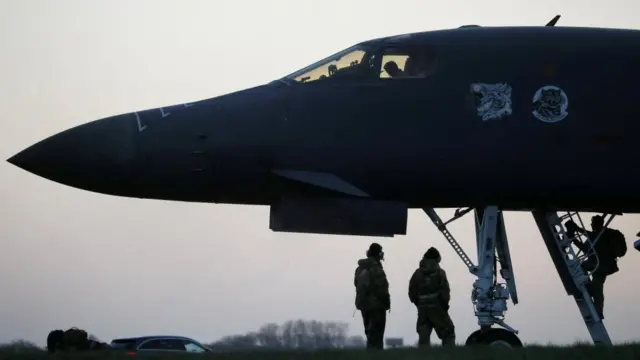
    A crew member boards a USAF B-1B bomber at RAF Fairford airbase.Image source, Reuters
    Image caption,

    A crew member boards a USAF B-1B bomber at RAF Fairford airbase in the UK

    At the outset

    In the lead-up to the conflict the British government withheld permission from the US to use UK military bases to support US strikes on Iran.

    On 28 February, the day the US and Israel launched joint strikes against the regime, Prime Minister Keir Starmer instead said British planes were "in the sky" in the Middle East as part of a defensive operation "to protect our people, our interests and our allies".

    'Defensive' action only

    The following day, Starmer announced the UK had given permission for the US to use its RAF Fairford in Gloucestershire and Diego Garcia in the Indian Ocean for "defensive" strikes.

    Starmer said those strikes would target Iranian sites that were firing against UK personnel and allies in the region - but said the UK would still not join "offensive action", and withheld permission of the US to use its bases for that purpose.

    Trump said he was "not happy" with Starmer. "This is not Winston Churchill that we're dealing with," he said on 3 March.

    Today's decision

    Shortly after the US president called Nato "cowards" for not doing more to help open the Strait of Hormuz, the UK government said it had approved the use of its bases for the US to launch strikes on Iranian sites targeting the strait.

    "The principles behind the UK’s approach to the conflict remain the same: the UK remains committed to defending our people, our interests and our allies, acting in accordance with international law and not getting drawn into the wider conflict," it said.

  3. Analysis

    What has changed with the UK's latest announcement on the US using its basespublished at 18:49 GMT 20 March

    Damian Grammaticas
    Political correspondent

    Let’s be clear this is a broadening of the terms under which the US military is allowed to use UK bases in actions against Iran.

    From the first weekend of the war the UK agreed to let the US use British bases for "specific and limited defensive action against missile facilities in Iran which were involved in launching strikes at regional allies".

    Now the US can use those bases, in Gloucestershire and the Indian Ocean, to target Iranian missile and other sites being used to attack shipping in the Strait of Hormuz.

    But let’s also be clear, this does not mean UK forces themselves are going to be involved in striking targets in Iran.

    So it’s not a major reversal of UK policy. The UK is not going to be taking part in offensive military operations, which has been a red line all along.

    Some will certainly warn that the UK is risking being drawn into deeper involvement in the war.

    The Iranian government was already warning today that it viewed the UK allowing the use of British bases by the US as "participation in aggression".

    The UK government believes it is sticking to its careful, and legally defined parameters of responding to Iranian attacks against allies and associated interests.

  4. The Strait of Hormuz - what is it and why is it so important?published at 18:38 GMT 20 March

    What is it?

    The Strait of Hormuz is a key trade artery - under normal circumstances around 20% of the world's oil passes through it.

    That oil comes not only from Iran, but the Gulf states such as Iraq, Kuwait, Qatar, Saudi Arabia and the UAE.

    Where is it?

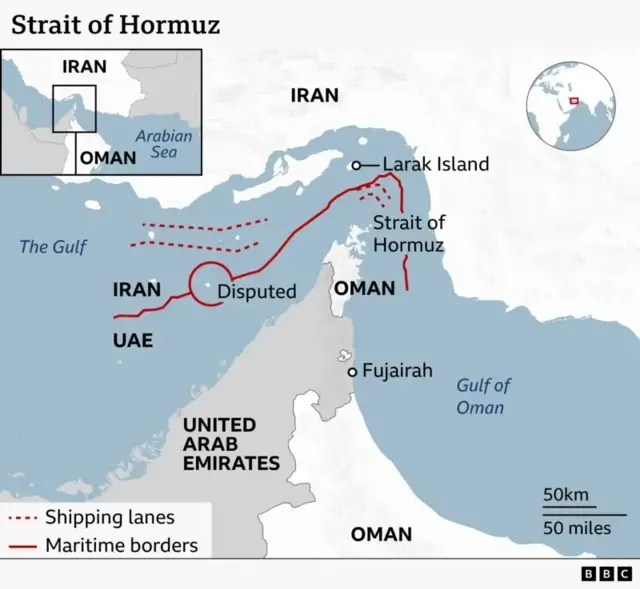
    The narrow stretch of water is located between Iran, the United Arab Emirates (UAE) and Oman.

    The waterway - which is about 21 miles (33 km) at its tightest point - connects the Gulf to the Gulf of Oman and Arabian Sea, making it a vital global shipping route.

    A map showing the Strait of Hormuz and its proximity to Iran, Oman and the United Arab Emirates

    What impact is it having on the war?

    Since the beginning of the US-Israel war with Iran, numerous ships have come under attack in the area.

    Iran's new supreme leader said last week that Iran should keep using the "lever of blocking" the Strait.

    The sharp reduction in the number of ships passing through has led to volatility in the energy markets, with the price of oil and gas rising.

    Currently, around 20,000 seafarers are stranded in the Gulf west of the strait, the UN's International Maritime Organisation (IMO) has reported, following Iranian threats to attack ships.

  5. Need a simple catch up? Watch The Iran War Today live abovepublished at 18:31 GMT 20 March

    Join us for The Iran War Today, where our experts will be taking you through the last week in the war, analysing the fast-moving conflict, and getting you up to speed on the latest developments.

    Press watch live above to see the 30-minute programme, where we'll be hearing from:

    • Chief North America correspondent Gary O'Donoghue in Washington on the US angle
    • Middle East analyst Sebastian Usher in Jerusalem and Azadeh Moshiri in Dubai on the latest in the region
    • BBC Persian and more Iranian voices from the Iran-Turkey border
    • The military take from Mikey Kay and security correspondent Frank Gardner
    • Deputy economics editor Dharshini David on the global economic impact
    • Chief international correspondent Lyse Doucet on the big picture
  6. Analysis

    The UK's announcement is a partial win for Trumppublished at 18:28 GMT 20 March

    Bernd Debusmann Jr
    White House reporter

    For the Trump administration, the UK's announcement that it has approved the use of its bases to launch strikes to help protect the Strait of Hormuz will be seen as a victory - although potentially only a partial one.

    For weeks - even before strikes began - Trump has repeatedly criticised the British government and Starmer, jabbing at him that he is "no Winston Churchill" and that a country the US once considered "the Rolls Royce of allies" has been disappointing.

    For many within Trump's orbit, the announcement will likely be seen as the British acquiesing to Trump's demands as a result of a strategy of publicly calling into question the strength of the alliance between the US and the UK's current government.

    The announcement, however, is not exactly what Trump has been asking for. Since Operation Epic Fury began, Trump has been calling on US alllies including the UK to do more to escort vessels transitioning through the strait.

    This falls short of that, and Downing Street has made clear that its broader approach and views towards the war remains unchanged.

    It remains to be seen whether Trump views it as enough to sway his opinion on Starmer, but it should be noted that moves perceived as helpful or concilliatory by foreign leaders have often prompted Trump to ease his criticism.

  7. Allowing US to use UK bases to hit sites striking strait is 'mother of all U-turns' - Badenochpublished at 18:23 GMT 20 March

    As we've just reported, the UK government has agreed to allow the US to use its bases for strikes on Iranian sites targeting the Strait of Hormuz.

    Reacting on social media, Conservative leader Kemi Badenoch calls it the "mother of all U-turns".

    We can also bring you an update from Badenoch's remarks to broadcasters a littler earlier - she called Donald Trump's criticism of Nato countries "completely untrue".

    She was responding to Trump posting on social media that Nato are "cowards".

    Asked if the Trump's comments were out of line, Badenoch replied "yes".

    "This silliness with an endless war of words is not good for the Western alliance", she said.

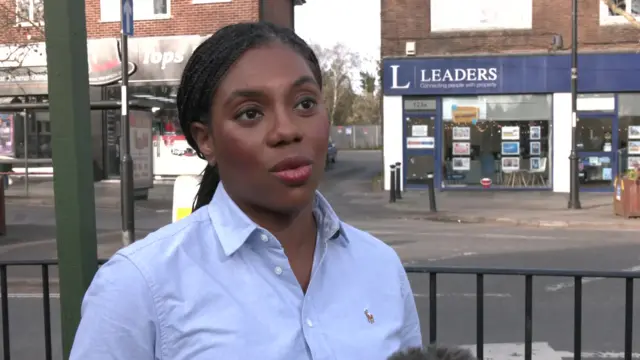
    Kemi Badenoch wearing a blue shirt and standing on a high street
  8. UK agrees to let US use bases for strikes on Iranian sites targeting Strait of Hormuzpublished at 17:57 GMT 20 March
    Breaking

    Nick Eardley and Jack Fenwick
    Political correspondents

    The UK has approved the use of its bases for the US to launch strikes on Iranian sites targeting the Strait of Hormuz.

    Downing Street had previously allowed American forces to use British bases for operations to prevent Iran firing missiles that put British interests or lives at risk.

    But ministers agreed during a meeting today that the US use of British bases could now be expanded to include protecting ships in the Strait of Hormuz.

    The UK will still not be directly involved in the strikes and Downing Street says "the principles behind the UK’s approach to the conflict remain the same".

    A Downing Street spokesperson says ministers agreed today that bases could now be used for "US defensive operations" to target "capabilities being used to attack ships in the Strait of Hormuz".

    They add that "ministers underlined the need for urgent de-escalation and a swift resolution to the war".

  9. Saudi Arabia destroys six drones over territory, defence ministry sayspublished at 17:37 GMT 20 March

    Saudi Arabia's defence ministry says it has destroyed six drones over its territory on Friday afternoon.

    In a series of posts on X over the last few hours, the ministry says it intercepted the drones over the country's eastern region.

  10. Nato relocates personnel from Iraq to Italypublished at 17:31 GMT 20 March

    Nato teams of advisers have left Iraq and relocated to Europe, the bloc has confirmed.

    Nato Mission Iraq was based out of a military base in Baghdad's Green Zone - near the US embassy, which has been attacked several times since the start of the war.

    The non-combat mission, which assists Iraq in building more sustainable and effective security institutions and forces, will continue its work from a Nato command centre in Naples, Italy, it says in a statement.

    General Alexus Grynkewich, Supreme Allied Commander Europe, says: “I would like to thank the Republic of Iraq and all the Allies who assisted in the safe relocation of NATO personnel from Iraq."

    He adds: "I would also like to thank the dedicated men and women of NATO Mission Iraq, who continued their mission throughout this period. They are true professionals.”

  11. BBC Verify

    Building said to be used by Iran’s Basij struck overnightpublished at 17:10 GMT 20 March

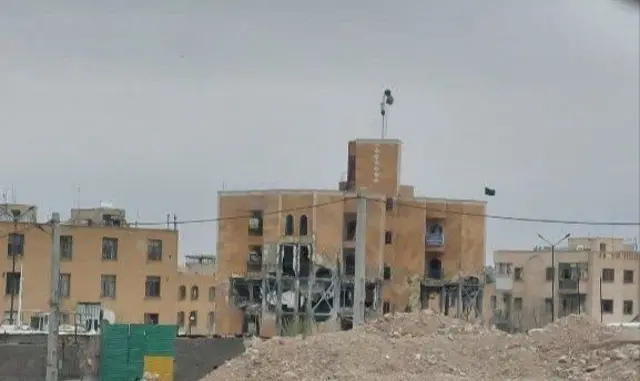
    The building in Semnan that was apparently struck overnight - it's about four-storeys tall with a central tower and appears to be constructed from a sand-coloured brickImage source, Telegram

    By Sarah Jalali and Tom Gould

    We have verified footage showing the aftermath of an air strike on a building in the city of Semnan in northern Iran that was reportedly used by the Basij militia.

    The Basij is a volunteer militia whose estimated one million members are often called out onto the streets to use force to suppress dissent. It is controlled by the powerful Iranian Revolutionary Guard Corps.

    The video shows extensive damage throughout one storey of the brick building. Nearby buildings are undamaged, suggesting this was a targeted strike.

    We geolocated the video by matching the building with publicly available street view images and satellite maps of the area.

  12. Energy prices remain well above what they were before the warpublished at 16:54 GMT 20 March

    Lucy Hooker
    Business reporter

    As we reach the end of the third week of the conflict, energy prices remain well above where they were beforehand.

    Brent Crude oil was trading at around $70 a barrel before the conflict - now it's at $109, having briefly hit $119 earlier in the week.

    UK gas, meanwhile, was trading at 80p per therm before the crisis. It's now at 151p per therm, having hit a peak earlier in the week of 184p.

    This Flourish post cannot be displayed in your browser. Please enable Javascript or try a different browser.

    Motorists will have noticed this feeding through to prices at the pump.

    The RAC says since the conflict began average petrol prices in the UK are now almost 12p (9%) higher - at 144.51p a litre - with diesel up by twice that amount (24p, 17%) - to 166.24p.

    The cost of filling a typical family car with unleaded is £6.40 more now than at the start of March, while the figure for diesel is a hefty £13 more.

    “The oil price has been consistently above the $100 a barrel mark this week, so unfortunately further rises look all but inevitable going into next week,” says the RAC’s Simon Williams.

  13. US to send thousands more military personnel to Middle East - reportspublished at 16:40 GMT 20 March

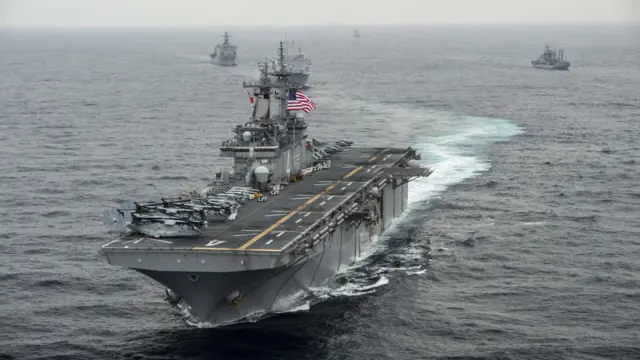
    In this handout photo provided by the U.S. Navy, the amphibious assault ship USS Boxer (LHD 4) transits the East Sea on March 8, 2016Image source, Getty Images
    Image caption,

    The USS Boxer is reportedly being deployed to the Middle East

    The US is deploying thousands of additional Marines and sailors to the Middle East, according to multiple reports citing unnamed officials.

    US officials say around 2,500 Marines from the California-based USS Boxer and the 11th Marine expeditionary unit will be heading to the Middle East, US media report.

    One official tells the Reuters news agency the deployment from the west coast comes three weeks ahead of schedule.

  14. A timeline of Trump's criticisms of Nato over the Strait of Hormuzpublished at 16:21 GMT 20 March

    A photo of Trump speaking in front of US military personnelImage source, Reuters

    28 February: The US and Israel launch widespread strikes on Iran. Iran responds with retaliatory strikes on sites in nearby Gulf states, many of which house US bases.

    14 March: Trump urges the UK and other nations to send warships to the Strait of Hormuz, which has been effectively closed by Iranian threats on shipping, causing the price of oil to soar.

    15 March: In an interview with the Financial Times, Trump says it would be "very bad for the future of Nato" if allies do not help secure the vital shipping lane.

    16 March: Starmer says the UK is working on a "viable plan" to reopen the strait. Trump later says "some countries" have "greatly disappointed" him, and singles out the UK - once "the Rolls-Royce of allies".

    17 March: Trump accuses Nato members of making a "foolish mistake" over the strait. He insists "we don't need any help" from Nato. He also says the reluctance to send mine-sweeping vessels to the Gulf was "not a big deal", but was "unfair" to the US.

    In a separate, lengthy post on Truth Social, Trump says "most" Nato allies "don't want to get involved with our Military Operation" and says: "WE DO NOT NEED THE HELP OF ANYONE!"

    "Because of the fact that we have had such Military Success, we no longer 'need,' or desire, the NATO Countries’ assistance — WE NEVER DID!" he says.

    20 March: Trump calls Nato allies "COWARDS", saying it would be "easy" for them to help open the strait, adding "we will REMEMBER!"

  15. Analysis

    Trump says there is 'nobody' in Iran the US can talk topublished at 15:58 GMT 20 March

    Bernd Debusmann Jr
    White House reporter

    Trump's comments on Iran at the White House earlier were brief, and offered very little insight into his thinking on the way forward as Operation Epic Fury continues.

    One thing that stood out to me was Trump's remark that "we want to talk to Iran" but that there is "nobody to talk to".

    The US president has repeatedly said that multiple rungs of Iran's leadership has been decimated, and has suggested that Mojtaba Khamanei may not be physically able to lead the country after being injured earlier in the war.

    It is unclear then who he believes is in charge of Iran on a day-to-day basis, or who he believes could come next.

    Trump has said he believes the US should play a part in choosing Iran's next leader, and that his preferred option would be someone already in the country, an Iranian version of Venezuela's Delcy Rodriguez.

    But so far, nobody in the administration has publicly identified who that might be.

    Khamenei was named as Iran's new supreme leader earlier this month, but has not been seen since, although several statements attributed to him have been published by Iranian media - you can see the latest in our last post.

  16. Khamenei claims attacks on Turkey and Oman weren't carried out by Iranpublished at 15:38 GMT 20 March

    Ghoncheh Habibiazad
    Senior reporter, BBC Persian

    More now from Mojtaba Khamenei's written statement.

    Turning to Iran’s neighbouring counties, he says Iran considers its eastern neighbours “very close” - naming Pakistan as a country which was a “special favourite” of his father.

    Khamenei asks for better relations between Pakistan and Afghanistan, saying he is ready to “take the necessary measures” on his part.

    Referencing strikes on these neighbouring countries during the war, he claims that “the attacks that were carried out on Turkey and Oman, both of which have good relations with us, against some parts of these countries were not in any way carried out by the armed forces of the Islamic Republic and other forces of the Resistance Front”.

    On this topic, he has accused Israel of playing a “trick” to create division between Iran and its neighbours.

    This represents a stark difference compared to Nowruz messages given his father, Ayatollah Ali Khamenei, who would traditionally deliver the message in front of camera.

    Mojtaba Khamenei, who was chosen as the successor to his father earlier this month, has yet to be seen in-person - nor filmed or photographed - since being chosen. So far several written messages by him have been published by Iranian media.

  17. State TV reads out Nowruz message from Iran supreme leaderpublished at 15:32 GMT 20 March
    Breaking

    Ghoncheh Habibiazad
    Senior reporter, BBC Persian

    State TV has read out a written message from Iran's third Supreme Leader Mojtaba Khamenei for the Persian new year festival of Nowruz.

    His message covers nine pages, and was also published by Iranian media outlets.

    In the message, he says that Iran has been through three wars already this year - one with Israel back in June, another the current war, and the third the war of Iran’s deadly anti-establishment protests that started in late December last year.

    He hails those who have participated in pro-establishment rallies, and asked people to carry out Nowruz considering that his father, Ayatollah Ali Khamenei, who has recently been killed in the war.

    The supreme leader has referred to his father's death on 28 February as a “tragedy of martyrdom” of the “beloved leader”.

    Khamenei also sets out the slogan for this year, which is: “Resistance Economy in the Shadow of National Unity and National Security”.

  18. Cooper warned Iran FM against attacks on UK bases, Foreign Office sayspublished at 15:20 GMT 20 March

    British Foreign Secretary Yvette Cooper speaks to the press before a United Nations Security Council meeting on Sudan at UN headquarters in New York on February 19, 2026Image source, Getty Images

    UK Foreign Secretary Yvette Cooper warned her Iranian counterpart Abbas Araghchi against attacking UK bases in a phone call on Thursday, the Foreign Office says.

    It comes after the Iranian foreign ministry released details of the call, including Araghchi warning that allowing the US to use British bases was "participation in aggression".

    The UK Foreign Office says during the call Cooper condemned "Iran's reckless attacks", including the strikes against "critical energy infrastructure".

    She also called for the "immediate restoration of freedom of navigation" in the Strait of Hormuz and "made clear" that the UK's defensive operations were in "response to Iranian aggression" against Gulf nations.

  19. 'We want to talk to them but we have nobody to talk to' - Trumppublished at 15:10 GMT 20 March

    Trump lists off Iran's navy, air force, anti-aircraft, radar, and leaders and says "they are all gone".

    "Now nobody wants to be a leader over there anymore," the president says. "We are wanting to talk to them but we have nobody to talk to."

    "We like it that way," he adds.

    Trump also says Iran wanted to take over the Middle East and repeats that "if they had a nuclear weapon they would have used it".

    The US had to stop that, he says, and it "should have been done long ago".

  20. Trump says US 'doing extremely well in Iran'published at 15:03 GMT 20 March

    Trump speaking at the Commander in Chief trophy presentation at the White House

    Trump begins by saying that the US is "doing extremely well in Iran".

    He says Iran has "no navy anymore" and 58 ships have been "knocked down" in two days, and the US has the "greatest navy anywhere in the world".

    "We're doing really well," he says, adding the US will not let Iran get nuclear weapons because "if they had them, they'd use them".