Summary

  1. Republicans have been split on tariffspublished at 16:11 GMT 20 February

    Bernd Debusmann Jr
    Reporting from the White House

    Republicans have not been uniform in their support of Trump's tariffs policies, with many facing pressure from their own constituents who have been feeling their impact.

    This is particularly true of farm-state Republicans, whose local economies depend heavily on agricultural exports, and whom are among the hardest hit by retaliatory tariffs.

    These retaliatory tariffs can lower commodity prices, reduce farm income and increase financial state in rural states.

    On several occasions, we've even seen some Republicans – symbolically –side with Democrats to attempt to reverse tariffs.

    Agriculture is far from the only sector that has led to disagreements within the party. Among those who have voiced opposition is Kentucky Senator Mitch McConnell, who has argued that the tariffs have harmed bourbon distillers and car manufacturers based in his state.

    “Consumers are paying higher prices across the board as the true costs of trade barriers fall inevitably on them,” he said in a statement last year.

    "Protectionists in Washington insist that the past several months have vindicated the policy of indiscriminate trade war against both close allies and strategic adversaries. But Kentuckians are especially well equipped to sort the bluster from the truth.”

  2. Many US businesses now face uncertain futurepublished at 16:09 GMT 20 February

    Mitchell Labiak
    Business reporter

    When Trump's April tariffs were first announced, many US businesses faced a handful of choices.

    They could have moved some or all of their manufacturing to the US to avoid the import taxes, which is what Trump was hoping would happen, they could have passed on the cost to US consumers by raising prices, or they could have taken the cost hit themselves. They also could have done some combination of the three.

    Whatever they have chosen to do, those same businesses will now need to decide whether to unmake those choices or stick with them.

    There's freedom in being able to do that, but there is also uncertainty. And there's also ongoing uncertainty around whether they will be able to claw back any import taxes they have already paid.

    As a general rule, businesses don't like uncertainty, which helps to explain the stock market reaction in the US.

  3. Trump needed congressional authority to impose tariffs, ruling sayspublished at 16:05 GMT 20 February

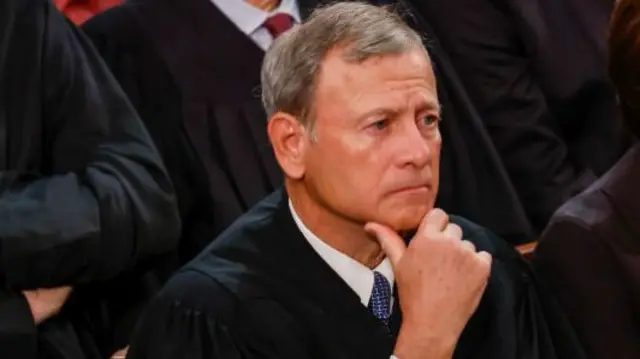
    close-up of Justice John Roberts with his hand on his chinImage source, Getty Images

    Chief Justice John Roberts delivered the main opinion in today's decision.

    In the ruling, Roberts said if the Trump administration was allowed to prevail with its tariffs agenda it "would replace the longstanding executive-legislative collaboration over trade policy with unchecked Presidential policymaking".

    "Accordingly, the President must 'point to clear congressional authorization' to justify his extraordinary assertion of the power to impose tariffs. He cannot."

  4. Anti-tariffs group calls for 'full, fast' refundspublished at 15:57 GMT 20 February

    Bernd Debusmann Jr
    Reporting from the White House

    One of the most vocal anti-tariff organisations in the US, We Pay the Tariffs, has launched a national sign-on letter calling for "full, fast, and automatic" refunds.

    "Today's Supreme Court decision is a tremendous victory for America's small businesses who have been bearing the crushing weight of these tariffs," says the group's director, Dan Anthony.

    The court's decision, Anthony adds, is "meaningless without actual relief for the businesses that paid these tariffs".

    "The administration's only responsible course of action now is to establish a fast, efficient and automatic refund process that returns tariff money to the businesses that paid it," he says.

    We Pay the Tariffs - which includes more than 800 businesses under its umbrella - filed an amicus brief with the Supreme Court in the tariffs cases.

  5. Analysis

    Ruling undoubtedly a blow for Trumppublished at 15:50 GMT 20 February

    Theo Leggett
    International business correspondent

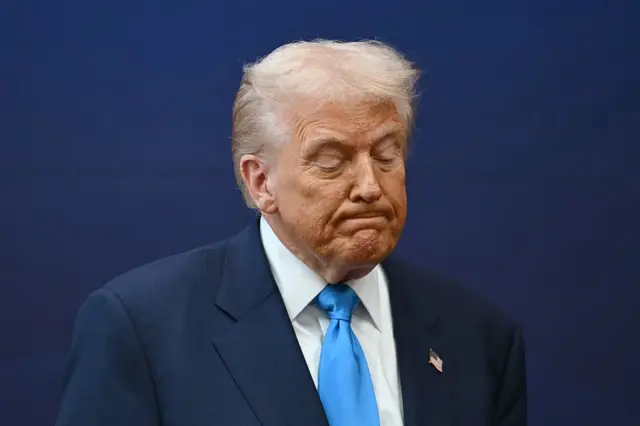
    Trump, wearing a blue suit over a white shirt and blue tie, in thinking face.Image source, AFP via Getty Images

    The Supreme Court – with, let’s not forget, a conservative majority – has struck down the legal justification for a large portion of the so-called reciprocal tariffs, as well as measures brought in against Canada, Mexico and China, ostensibly in response to the influx into the US of illegal drugs such as fentanyl.

    These import taxes were introduced under the International Emergency Economic Powers Act. But the court ruled that the Act did not authorise measures which were “unbounded in scope, amount and duration”.

    However, this is not the only legal avenue the administration has used to impose extra tariffs since Trump took office. There are other laws which he could use to re-impose them if he wishes.

    Given the president’s clear enthusiasm for tariffs as a negotiating tool, we are unlikely to see a big change in policy from the White House.

    That said, those other methods may require congressional approval or investigations by the US Department of Commerce – so would probably take longer. It’s not yet clear what will happen in terms of refunds for tariffs that have already been paid by US importers.

    So while the ruling gives certainty in one sense – the president cannot use this particular method to impose the tariffs he wants – it creates uncertainty in other ways.

  6. UK government expects 'privileged trading position with the US to continue'published at 15:43 GMT 20 February
    Breaking

    The UK government says it's working with the US to understand how the overturning of Trump's tariffs will affect the UK.

    "We expect our privileged trading position with the US to continue," it says in a statement.

    It also says that while Supreme Court ruling is a matter for the US to determine, the government will continue to support businesses in the UK as further details are announced.

    Stick with us for the latest updates, and you can also follow our coverage with the Watch live button at the top of this page.

  7. Who is on the Supreme Court?published at 15:40 GMT 20 February

    Put simply, the Supreme Court is the keeper of US laws.

    The justices decide whether laws and government actions follow the US constitution. They also interpret laws passed by congress to decide if they are being correctly carried out.

    Americans do not vote for who can serve on the court. Justices are appointed by the president and then approved by the Senate.

    They serve for life or until they voluntarily retire, and they can only be removed by impeachment. Congress has only attempted an impeachment once, more than 200 years ago, and it failed.

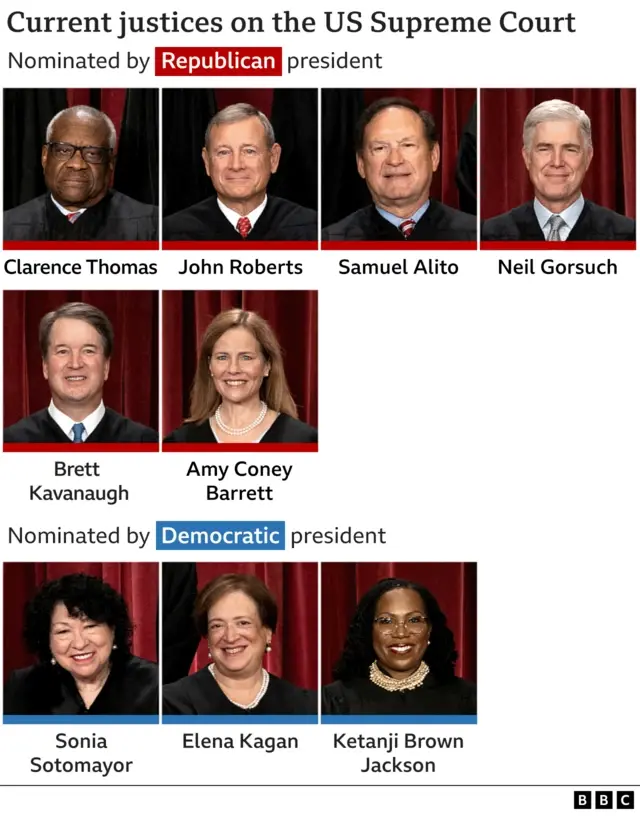
    Today, the three liberal justices, Ketanji Brown Jackson, Elena Kagan and Sonia Sotomayor, and three conservative justices, Amy Coney Barrett, Neil Gorsuch and John Roberts, voted to strike down Trump's tariffs.

    Justices Brett Kavanaugh, Samuel Alito and Clarence Thomas dissented.

    Nine headshots of the sitting US Supreme Court justices, with their names underneath
  8. Analysis

    Ruling invalidates only some of Trump's tariffspublished at 15:36 GMT 20 February

    Dharshini David
    Deputy economics editor

    From tearing down the White House's East Wing to capturing foreign leaders, this is not a president who is used to being told "no".

    Today, the Supreme Court's ruling that President Trump cannot legally use emergency powers to invoke reciprocal and country-specific tariffs derails his existing trade strategy.

    But are we heading back to pre-Trump business as usual? Think again.

    First, this invalidates only some of the additional tariffs President Trump has ordered since taking office last year.

    After intense negotiations following Liberation Day, the average tariff rate countries faced on selling into America settled at around 15%. The Supreme Court decision has – in theory more halved that typical rate. But it remains above 6% - around three times the typical rate at the start of 2025 - due to tariffs imposed under different guises.

    Second, importers may not actually see much change from current tariff levels – they have been agile in switching their supply chains away from the most highly tariffed countries.

    But that and a desire to keep the money flowing in - has perhaps empowered the Trump fightback. "We'll figure something out" said the President pre-judgement.

    It remains to be seen what will happen next.

  9. Why did Trump enact so many tariffs?published at 15:32 GMT 20 February

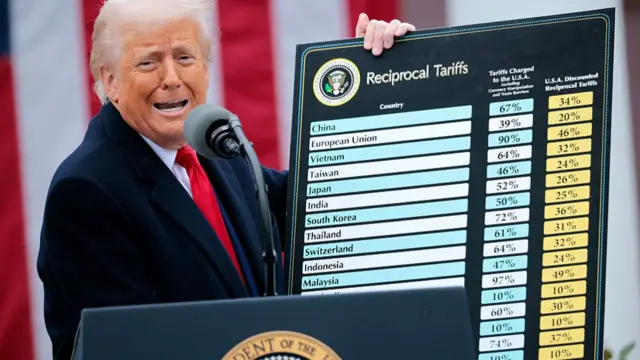
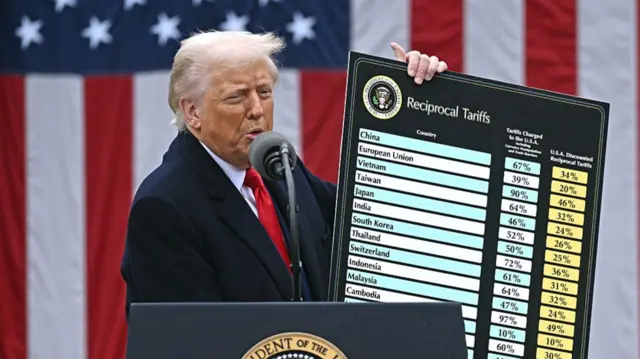
    Trump stands in front of a podium holding up a board that reads "Reciprocal Tariffs" with a list of countries and ratesImage source, Getty Images
    Image caption,

    Trump announced tariffs on nearly every country in the world in April, on what he called "Liberation Day"

    Back in April, US President Donald Trump introduced tariffs on goods from nearly every country in the world.

    Trump says tariffs will increase the amount of tax raised by the government, encourage consumers to buy more American-made goods and boost investment in the US. But critics warn of higher prices and damage to the global economy.

    He wants to reduce the US trade deficit - the gap between the value of goods it buys from other countries and those it sells to them.

    The president argues that the US has been exploited by "cheaters" and "pillaged" by foreigners.

    Trump has also used the taxes to make other demands.

    For example, when announcing tariffs against China, Mexico and Canada, he said the countries must do more to stop migrants and the illegal drug fentanyl reaching the US.

    Many tariffs have been amended or delayed after being announced.

  10. Analysis

    Court's decision represents rare check on Trump's powerpublished at 15:26 GMT 20 February

    Anthony Zurcher
    North America correspondent

    View of the columns at the US Supreme Court. A US flag on a pole is in the foreground on the left.Image source, Getty Images

    Donald Trump had been warning for months that a Supreme Court decision curtailing his ability to impose tariffs would be an “economic and national security disaster” with “catastrophic” consequences. A six-justice majority of the Supreme Court, in ruling against the president today, didn’t care much about his concerns.

    Congress, not the president, has the power to impose tariffs, the justices held. And nothing in the law that the president cited in his legal defence, the Emergency Economic Powers Act of 1977, delegated such sweeping powers to Trump.

    The court’s decision represents a rare check on this president’s broad use of executive authority. A majority of the justices over the past year have shown a willingness to allow Trump to press ahead with his agenda, particularly on immigration and reshaping the federal government, even as legal challenges work their way through the court system.

    This case, considered on an expedited basis, slams the door on one such expansive use of presidential authority.

    With several other major cases involving controversial uses executive power – such as efforts to end birthright citizenship and to dismiss a Federal Reserve governor based on alleged improprieties – this may not be Trump’s only setback in the coming months.

  11. White House waits for Trump's reactionpublished at 15:24 GMT 20 February

    Bernd Debusmann Jr
    Reporting from the White House

    I'm currently at the White House, where President Trump is at a working breakfast alongside state governors.

    The media caught only a brief glimpse of him earlier, before he abruptly told reporters "you can leave now" so that he could speak to the governors candidly.

    We have yet to hear his reaction or that of White House officials to the tariffs news - which marks a significant blow to his agenda.

    The president often remarks that he views tariffs as extremely important to the US economy, as well as a key foreign policy tool that he claims to have used, for example, to bring warring countries to the negotiating table.

    I've just asked the White House for their comment.

    I also expect that we will soon hear from President Trump on Truth Social. It is unclear if the media will be allowed back into his ongoing event.

  12. The decision impacts some, but not all of Trump’s tariffspublished at 15:22 GMT 20 February

    A file photo of Trump holding up a large board showing the level of tariffs he planned to impose on each countryImage source, AFP via Getty Images

    The tariffs affected by Friday's ruling:

    The country-wide tariffs Trump imposed on most of the world.

    The ruling centres on Trump’s use of a 1977 law, the International Emergency Economic Powers Act (IEEPA), that gives the president the power to "regulate" trade in response to an emergency.

    Trump first invoked it in February 2025 to tax goods from China, Mexico and Canada, saying drug trafficking from those countries constituted an emergency.

    He deployed it again in April, ordering levies from 10% to 50% on goods from almost every country in the world. He said the US trade deficit – where the US imports more than it exports – posed an "extraordinary and unusual threat".

    The unaffected tariffs

    The industry-specific steel, aluminium, lumber and automotive tariffs, which were implemented under Section 232 of the Trade Expansion Act of 1962, citing national-security concerns.

  13. Wall Street reacts positively after Supreme Court strikes down Trump's tariffspublished at 15:20 GMT 20 February
    Breaking

    Wall Street has responded quickly and positively to the court's ruling.

    Here is how the main indexes are performing currently:

    • The S&P 500 index is up 0.45%
    • Dow Jones is up 0.07%
    • Nasdaq is 0.42%

    It is still very early in the day for trading in New York. We'll be watching how markets react throughout the day.

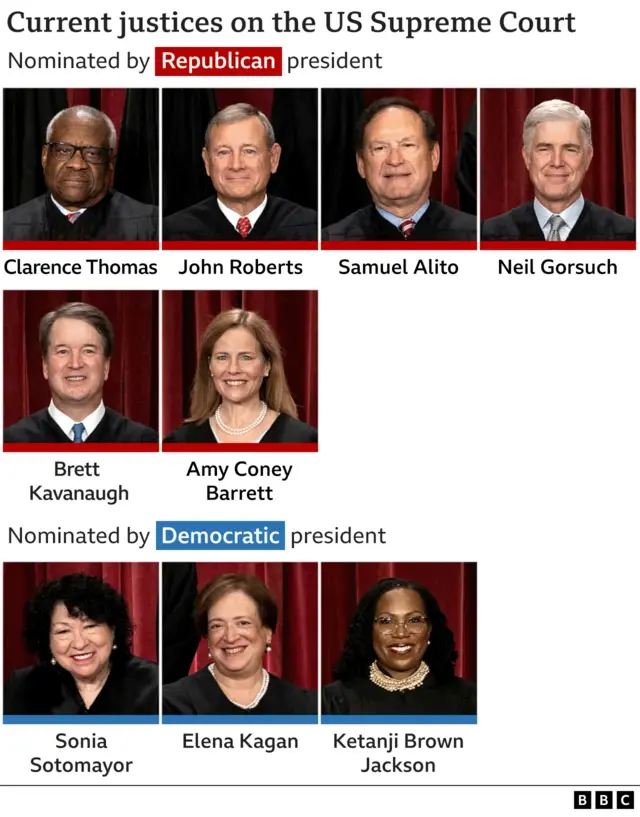
  14. How the justices votedpublished at 15:18 GMT 20 February

    The Supreme Court ruled against Trump's tariffs in a 6-3 majority.

    The three liberal justices, Ketanji Brown Jackson, Elena Kagan and Sonia Sotomayor, joined by three conservative justices, Amy Coney Barrett, Neil Gorsuch and John Roberts, voted to strike down the tariffs.

    Justices Brett Kavanaugh, Samuel Alito and Clarence Thomas dissented.

    A graphic showing the Supreme Court justices
  15. Emergency law doesn't authorise Trump to impose tariffs, ruling sayspublished at 15:15 GMT 20 February
    Breaking

    In its ruling, the US Supreme Court says Trump exceeded his authority in imposing sweeping tariffs through a law reserved for a national emergency.

    The high court rules the International Emergency Economic Powers Act "does not authorize the President to impose tariffs".

  16. Trump said he's been 'waiting forever' for this decisionpublished at 15:15 GMT 20 February

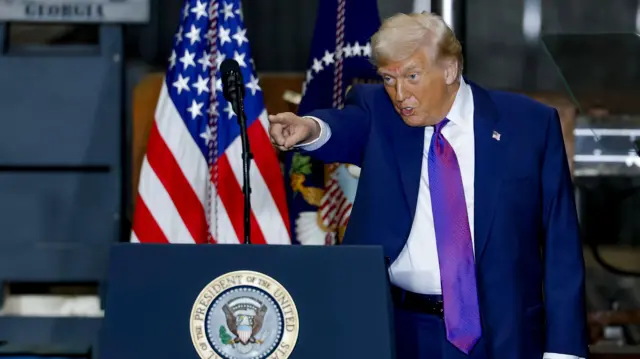
    Donald Trump stands next to a podium and points to his right. An American flag is behind himImage source, EPA/Shutterstock

    The US president repeatedly mentioned tariffs while speaking at an event in the US state of Georgia on Thursday afternoon.

    Trump said without tariffs, "everybody would be bankrupt".

    Trump maintained it was his "right" to set tariffs because he is president, and the "language was clear".

    The president also complained about having to "wait for this decision" from the Supreme Court.

    "I've been waiting forever. Forever," he said.

    The Supreme Court justices heard arguments on the legality of Trump's tariffs in November.

    We're yet to hear the president's reaction to this ruling - we'll bring you it as soon as we get it.

  17. US Supreme Court strikes down Trump's tariffspublished at 15:05 GMT 20 February
    Breaking

    The top court in the US has ruled against US President Donald Trump's global tariffs, which went into effect last year.

    We're reading through the ruling now, and we will bring you updates shortly. Stay with us.