(Image: Getty)
_____________________________________________________________________________________________________
Download a free 6 Minute English worksheet and transcript!
Try our free interactive quiz!
______________________________________________________________________________________________________


Introduction
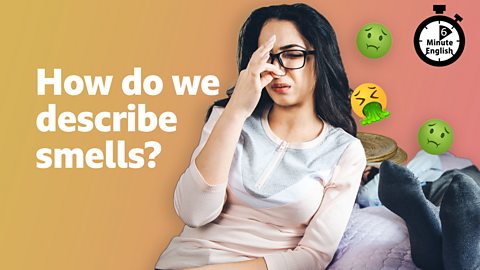
What is the worst smell in the world? And what is the best smell? Are there any smells that you like, but that your friends or family hate? Smells are all around us all the time, but the English language is often quite general in the way it describes smells, as opposed to other senses like sounds or tastes. But why is this? Neil and Georgie discuss this and teach you some new vocabulary.
This week's question
What is the word for the smell of old books?
a) vellichor
b) petrichor
c) nidor
Listen to the programme to hear the answer.
Vocabulary
stinky (also: reeking, honking, humming, miffy, funky)
(informal) having a bad smell
fragrant
having a sweet or pleasant smell
subjective
based on your own personal opinions and feelings
visual
related to seeing
auditory
related to hearing
shut (something) down
stop something

TRANSCRIPT
Note: This is not a word-for-word transcript.
Neil
Hello, this is 6 Minute English from BBC Learning English. I'm Neil.
Georgie
And I'm Georgie. In English, there are many ways to describe smells. Poet Michael Rosen wanted to find words describing bad smells, and asked listeners of his BBC Radio 4 programme Word of Mouth for some suggestions.
Michael Rosen
Fusty, reeking, toiking, honking, humming, funky…
Neil
Smells are everywhere, whether they're bad smells like rotten eggs and sweaty feet, or pleasant ones like lavender and freshly baked bread. What smells do you especially like or dislike, Georgie?
Georgie
Well, I really enjoy the smell of leather, but something I really love is the smell of rain, which has a name. Do you know it, Neil?
Neil
Erm, I don't think I do actually.
Georgie
It's called petrichor. It's that smell of the ground just after it's rained.
Neil
Mmm.
Georgie
Neil, what about you? Which smells do you like?
Neil
Well, I don't think you can beat the smell of a freshly opened packet of ground coffee.
Georgie
Ooh, that's a good one. In this episode, we'll be learning the language of smells using some useful new words and phrases. And remember, you can find all the vocabulary plus a quiz and worksheet on our website, bbclearningenglish.com.


Neil
But first, I have a question for you, Georgie. One smell many people love is the smell of old books and the sentimental feeling it gives them for second-hand bookshops. In fact, there's even a word for it, but what is it? Is it:
a) vellichor,
b) petrichor, or
c) nidor?
Georgie
Well, we already know that petrichor is the smell of the ground after rain. I'm going to go with a) vellichor.
Neil
Well, we'll find out at the end of the programme. Listening to Michael Rosen's list – funky, reeking, humming and the rest – you might think English is good at describing smells, but in fact, all those words really mean is bad smelling.
Georgie
In English, we often describe smells by comparing them to other objects. For example, something nice might smell like a rose, while something bad might smell like rotten eggs, but there are few words to describe the actual smell itself.
Neil
Oxford University psychologist Asifa Majid has researched the subject of smell extensively. Here, she tells Michael Rosen a little of what she's found out on BBC Radio 4 programme Word of Mouth.
Asifa Majid
So, if we think about things like stinky or fragrant, they're definitely telling us that something is good or bad. But unlike colour terms, it doesn't really seem to be about the object it's describing. It seems to be a subjective thing. I could say, "Oh this perfume you think is really fragrant, I think is stinky," and both can be true.
Georgie
Describing smell is not like describing other senses. I might think a perfume is stinky, an adjective meaning bad smelling, while Neil might find the same perfume fragrant, meaning pleasant smelling. Both can be true. The point is that neither stinky nor fragrant say anything specific about the perfume's actual smell.
Neil
With our sense of taste, it's different. Words like spicy, sweet or salty create a common idea that we can all agree on, but that's not the case for smells. Asifa thinks this is because, unlike tastes and colours, smell words are subjective – they're based on personal opinions and feelings rather than objective truth.
Georgie
This might explain why our attitude to talking about smells is so different. Here's Asifa again, sharing some examples of how we talk about smells with BBC Radio 4.
Asifa Majid
So, if we compare how often people talk about visual things, or auditory things, or tastes or smells, what we find is we talk a lot about what we see and very rarely about what we smell. Young children in the UK are often interested in the sense of smell and they'll remark on it, and the parent will shut it down. They'll say, "That's disgusting! Put it down."
Georgie
Asifa's research shows that, here in the UK at least, people talk about visual or auditory things much more than they talk about smells. The adjective visual means related to seeing, and auditory means related to hearing. The adjective for things related to smelling is olfactory.
Neil
Maybe this is because of how we're raised by our parents. When children start talking about smells, especially unpleasant ones, parents often react by shutting the conversation down. The phrase to shut something down means to stop it.
Georgie
Along with other European languages, English doesn't have much vocabulary dedicated to the different qualities of actual smells. There are many ways of talking about smells, especially unpleasant ones, but only a few words which describe actual smells themselves. A good example of a word which does this is musty – a damp, stale smell you might find in an old bookshop. And Neil, that reminds me of your question.
Neil
That's right. I asked you what the word is, which means the smell of old books.
Georgie
I said it was vellichor.
Neil
Well, Georgie, you are absolutely right.
Georgie
Yay!
Neil
Petrichor, as you said earlier, is the smell of the earth after rain. And nidor is the smell of cooking meat and fat. OK. It's time for a recap of the vocabulary we've learned. The adjective stinky means foul smelling, while the adjective fragrant means pleasant smelling.
Georgie
Subjective things are based on your own personal opinions and feelings rather than objective facts.
Neil
The adjective visual describes things related to seeing, while auditory means related to hearing. Things related to smelling are called olfactory.
Georgie
And finally, the phrasal verb to shut something down means to stop it. Once again, our six minutes are up, but there's still time to head over to our website, bbclearningenglish.com, for a quiz and worksheet containing all the vocabulary we've discussed. See you again soon! But for now, it's goodbye.
Neil
Goodbye!

Next
Find an A-Z list of our programmes.
Find more programmes for your level here.
Practise your reading skills with The Reading Room.
6 Minute English ล่าสุด

Sharing the road with driverless cars
Episode 260820 / 20 Aug 2026
Would you trust a robot to drive you around a city?

Who does the housework?
Episode 260813 / 13 Aug 2026
When you were growing up, did your mum or dad do more household chores?
How do climate scientists make predictions?
Episode 260806 / 06 Aug 2026
What is the difference between a prediction and a projection?

The Enhanced Games
Episode 260730 / 30 Jul 2026
Would you watch a sport if you knew the athletes had taken drugs?


What's in a footballer's brain?
Episode 260716 / 09 Jul 2026
How do footballers cope with high-pressure scenarios like penalties and corners?



Stress-free family meals
Episode 260625 / 25 Jun 2026
What foods did you dislike when you were growing up?

Limiting screen time for children
Episode 260618 / 18 Jun 2026
Children are spending too much time with electronic devices.

How advertisers make us spend money
Episode 260611 / 11 Jun 2026
When was the last time you bought something you didn't need?




How reading shapes your brain
Episode 260514 / 14 May 2026
Can learning to read alter the way your brain works?

Searching for life on another planet
Episode 260507 / 07 May 2026
Does life on another planet exist?

Should we eat ultra-processed food?
Episode 260430 / 30 Apr 2026
Ultra-processed food can be tasty, but what is it doing to our health?



Weight loss drugs
Episode 260326 / 26 Mar 2026
How do weight loss drugs like Ozempic and Mounjaro help people lose weight?

How do we adapt to the cold?
Episode 260319 / 19 Mar 2026
Would you prefer to be too hot or too cold?

Should we pay more for chocolate?
Episode 260312 / 12 Mar 2026
Is chocolate becoming more expensive?
Why are some animals black and white?
Episode 260305 / 05 Mar 2026
The answer is not as black and white as you might think!




Why are billionaires building bunkers?
Episode 260129 / 29 Jan 2026
Is the end of the world closer than we thought?

Scared of speaking English?
Episode 260122 / 22 Jan 2026
Beth and Pippa talk about why we often find speaking a new language scary.
What English phrases really mean
Episode 260115 / 15 Jan 2026
Why don't British people say what they mean, or mean what they say?