_____________________________________________________________________________________________________
Download a free 6 Minute English worksheet and transcript!
Try our free interactive quiz!
______________________________________________________________________________________________________


Introduction
Imagine crossing a road and turning to see a car heading towards you... without a driver! While this might seem scary, driverless cars are already operating safely in many cities around the world. These autonomous cars contain huge amounts of technology to help them drive alongside other road users carefully. But will humans behave as carefully around them? Can we communicate clearly with these 'robotaxis', or are we simply incompatible? Phil and Pippa discuss this and teach you some new vocabulary.
This week's question
Which was the first city to have fully driverless robotaxis on the streets?
a) Philadelphia
b) Phoenix
c) San Francisco
Listen to the programme to hear the answer.
Vocabulary
(make) eye contact
look directly into someone's eyes
wave
raise your hand and move it from side to side as a greeting or to communicate with someone
alert
warn someone of potential danger
animation
display of moving images
glance
quick and brief look
jaywalking
(American English) crossing the road where it is not allowed or without taking care

TRANSCRIPT
Note: This is not a word-for-word transcript.
Phil
Hello, this is 6 Minute English from BBC Learning English. I'm Phil.
Pippa
And I'm Pippa.
Phil
Here at 6 Minute English, we love discussing new tech. One of the most controversial technologies of recent years is driverless cars, also known as self-driving cars, autonomous cars or robotaxis.
Pippa
Many people say they wouldn't feel safe in a car without a human driver, but there are concerns from other road users too – pedestrians, runners and cyclists. How will driverless cars interact with them? It's a problem Professor Stephen Brewster, from Glasgow University, has been working on. He explained more to BBC World Service programme Tech Life.
Stephen Brewster
If you're outside a vehicle right now, you can see the driver inside the vehicle, you can wave to them, they can see you, you can make eye contact. But when you come to an autonomous vehicle, there's no person in the driving seat, so how do you negotiate whether they're going to go, whether they're going to let you go?
Phil
On my walk to work, I need to cross the road. Usually, a driver makes eye contact with me. They look directly into my eyes and then wave me across. To wave means to raise your hand and move it from side to side. It's a gesture for saying hello, or a way of telling a person to do something.
Pippa
Luckily, Phil, you usually arrive safely at work and as yet there are no driverless cars in London. But, Phil, how would you feel about crossing that road in front of a robotaxi?
Phil
Well, maybe a little bit nervous. I might wait for it to go and go behind it or something.
Pippa
Mmm... yeah, I get that. I think maybe as we get more used to these technologies, we'll get more used to how to deal with them and when to cross. But in this episode, we investigate the tech helping driverless cars communicate on the roads. We'll learn some useful new words and phrases, and as usual you'll find all the vocabulary on our website, bbclearningenglish.com.


Phil
But first, I have a question for you, Pippa. As you mentioned, we don't have self-driving cars here in London yet. So, which was the first city to have fully driverless robotaxis on the streets? Was it:
a) Philadelphia,
b) Phoenix, or
c) San Francisco?
Pippa
I'm going to say b) Phoenix because I think it's quite a car-friendly city.
Phil
OK. Well, we will find out the answer, but at the end of the programme. Because accidents are often caused by not seeing the oncoming danger, Professor Brewster wants to make driverless cars more visible. He discussed his work with BBC Tech Life's presenter Chris Vallance.
Chris Vallance
What kind of signals worked in terms of alerting pedestrians and runners and cyclists to the intentions of the vehicle?
Stephen Brewster
We tested two things. We tested animations and fixed, coloured light rings. The animations – they work well for pedestrians, but when it came to runners and cyclists, they have much less time to make their decisions, so if you do a quick glance at a vehicle, you don't really see the animation.
Pippa
It's important to alert people to driverless cars. To alert somebody means to warn them about a potential danger. Some cars do this with animations – displays of moving images. For example, a green man walking to signal it's safe to cross.
Phil
Animations alert pedestrians but are not suitable for runners and cyclists, who are travelling too fast to react. They only have time for a glance. A glance at something means a quick look. So, instead Stephen's team used coloured light rings, similar to traffic lights, to warn cyclists and runners.
Pippa
Culture is another problem. The meaning of body language can change. For example, hand waving can mean 'please proceed' in one culture, but 'thank you' in another.
Phil
Ammar Al-Taie is a researcher at the Advanced Institute of Science and Technology in South Korea. Here, Ammar tells BBC World Service's Tech Life why Korean culture is especially suited to self-driving cars.
Ammar Al-Taie
In South Korea, for example, jaywalking is illegal, whereas in the UK, you know, we tend to jaywalk a lot.
Pippa
Jaywalking is an American English word. It means crossing the road at a place where crossing is not allowed or without taking care. Unlike Britain, jaywalking is rare in South Korea, making the country safer for autonomous cars.
Phil
We've heard a lot about making driverless cars safer, and with plans to introduce them to London later this year, we'll soon see how safe they really are.
Pippa
Now, isn't it time to reveal the answer to your question, Phil?
Phil
I asked you which city was the first to have self-driving cars on the road, and you said it was Phoenix... and that is the correct answer. Phoenix, Arizona, was the first city in the world to have self-driving cars operating on public roads without a human safety driver, and that was in 2017. Let's recap the vocabulary we've learned, starting with eye contact – looking directly into someone's eyes.
Pippa
To wave at someone is a way of saying hi, by raising your hand and waving it from side to side.
Phil
If you alert someone, you warn them of potential danger.
Pippa
An animation is a display made up of moving images.
Phil
A glance is a quick, brief look at something.
Pippa
And finally, the American English term jaywalking means crossing the road where you're not supposed to. Once again, our six minutes are up. If you'd like to hear more programmes about technology, you'll find plenty on our tech topic page, all on our website. And there you'll also find a quiz and worksheet for this episode. Visit bbclearningenglish.com. We'll see you again soon, but for now it's goodbye.
Phil
Goodbye!

Next
Find an A-Z list of our programmes.
Find more programmes for your level here.
Practise your reading skills with The Reading Room.
6 Minute English ล่าสุด
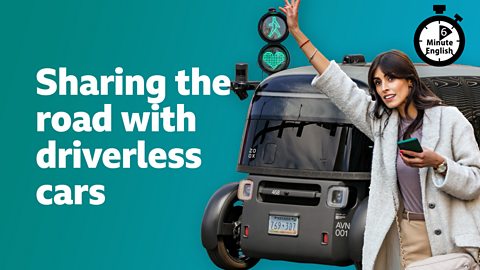
Sharing the road with driverless cars
Episode 260820 / 20 Aug 2026
Would you trust a robot to drive you around a city?

Who does the housework?
Episode 260813 / 13 Aug 2026
When you were growing up, did your mum or dad do more household chores?
How do climate scientists make predictions?
Episode 260806 / 06 Aug 2026
What is the difference between a prediction and a projection?
The Enhanced Games
Episode 260730 / 30 Jul 2026
Would you watch a sport if you knew the athletes had taken drugs?
What's in a footballer's brain?
Episode 260716 / 09 Jul 2026
How do footballers cope with high-pressure scenarios like penalties and corners?


Stress-free family meals
Episode 260625 / 25 Jun 2026
What foods did you dislike when you were growing up?
Limiting screen time for children
Episode 260618 / 18 Jun 2026
Children are spending too much time with electronic devices.

How advertisers make us spend money
Episode 260611 / 11 Jun 2026
When was the last time you bought something you didn't need?


How reading shapes your brain
Episode 260514 / 14 May 2026
Can learning to read alter the way your brain works?

Searching for life on another planet
Episode 260507 / 07 May 2026
Does life on another planet exist?
Should we eat ultra-processed food?
Episode 260430 / 30 Apr 2026
Ultra-processed food can be tasty, but what is it doing to our health?




Weight loss drugs
Episode 260326 / 26 Mar 2026
How do weight loss drugs like Ozempic and Mounjaro help people lose weight?
How do we adapt to the cold?
Episode 260319 / 19 Mar 2026
Would you prefer to be too hot or too cold?

Should we pay more for chocolate?
Episode 260312 / 12 Mar 2026
Is chocolate becoming more expensive?
Why are some animals black and white?
Episode 260305 / 05 Mar 2026
The answer is not as black and white as you might think!




Why are billionaires building bunkers?
Episode 260129 / 29 Jan 2026
Is the end of the world closer than we thought?

Scared of speaking English?
Episode 260122 / 22 Jan 2026
Beth and Pippa talk about why we often find speaking a new language scary.
What English phrases really mean
Episode 260115 / 15 Jan 2026
Why don't British people say what they mean, or mean what they say?