


Wider picture
Indeed, we know from a detailed analysis of 404 sets of parish records in England that there was a nationwide mortality crisis during the late 1720s - one of the biggest mortality crises known to have occurred since the 16th century, with death rates up to 100 per cent above normal for three consecutive years.
We also know that across England the harvest of 1728 was a poor one, which may well have caused food shortages in the Bolton locality.
Finally we have contemporary reports from several parts of the country of unusual levels of various infections, with doctors in 1729 noting outbreaks of 'suffocating cough', catarrh, 'inflammatory fevers' (any of which might be the result of 'flu), whooping cough, chicken pox and smallpox.
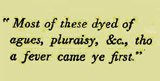
And there's one further bit of evidence from the Deane parish register. Alongside some of the monthly lists of burials in these years there are marginal notes written by the vicar, James Rothwell. Against June 1729 he wrote:
'Most of these dyed of agues, pluraisy, etc, tho a fever came ye first.'
Agues meant chills and sweats, 'pluraisy' an inflammation of the lungs. Could this be influenza? In another note the vicar wrote that:
' ... in some respects ye disorder resembled ye Plague and continued amongst us above two years.'
'The upward trend in deaths may have begun with an outbreak of infectious disease - perhaps influenza - in 1727 ...'
Putting together all these pieces of evidence, it seems most likely that what happened in Deane was the result of a combination of factors. The upward trend in deaths may have begun with an outbreak of infectious disease - perhaps influenza - in 1727, but this was then compounded by widespread famine after the bad harvest of 1728, boosting the number of deaths and cutting the number of births.
Finally, a by now severely weakened population easily succumbed to another round of infections, perhaps including a virulent strain of 'flu, the following year. It is this combination of factors that best explains both the severity and the unusual duration of the crisis.
This is how historians work, whatever aspect of history they're studying. They take a piece of historical evidence, and ask what it might mean, what could explain it, why it is there. Then they put it into the context of whatever other evidence there is - comparing, contrasting, seeing how it fits in. And finally they arrive, however tentatively, at a conclusion which best explains all the evidence as he or she sees it.
About the author
Dr Geoff Timmins is Principal Lecturer in History at the University of Central Lancashire. His publications include Made in Lancashire: a History of Regional Industrialisation and The Last Shift: the Decline of Handloom Weaving in Nineteenth-Century Lancashire.
Published: 2005-01-31
