


Mortality crisis
You can see that in most years the number of baptisms was greater than the number of burials. However, during the late 1720s and early 1730s, the position was reversed. At this time, burials greatly exceeded baptisms, with the burial graph rising to a very high peak indeed.
In fact, in the six years from 1727 to 1732, 430 people were baptised at Deane, but more than twice as many - 904 in total - were buried. Plainly we are looking at what population historians call a 'mortality crisis'.
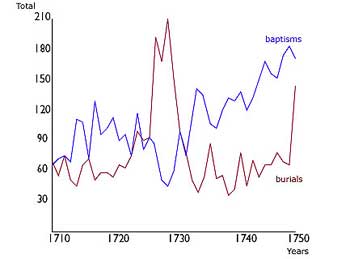
Comparing the numbers of baptism at Deane with those of burials gives a very good indication of how the parish's total population was changing over time. In the years when baptisms exceeded burials it's likely the population was rising, though account should be taken of possible losses through emigration or gains through immigration.
There are no figures available on these, but Deane was become a centre of the handloom industry at this time, with new jobs being created. It seems probable that more people moved into the parish than moved out.
In the years when burials exceeded baptisms, on the other hand, the population of Deane parish probably fell considerably, the more so because the number of baptisms (and therefore, presumably, of births) also dipped sharply. But what were the factors behind these sudden changes?
Published: 2005-01-31
