Words of wisdompublished at 12:49 BST 6 September 2017
 Dr Sally Marlow
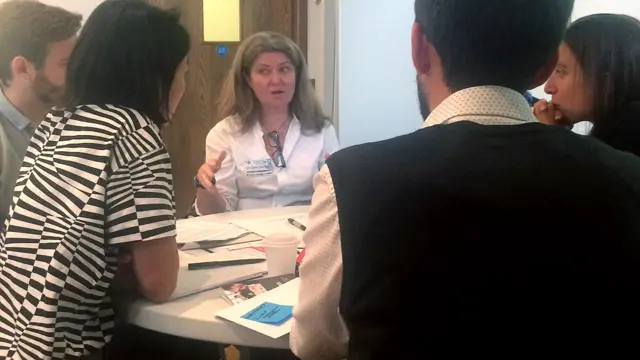
Expert witness Dr Sally Marlow is offering some advice to Table One...
Quote MessageTake care of statistical blips...
Each week on The Fix we try to solve an intractable social problem through innovative policy design
We gathered 12 of the country's brightest young minds from a range of disciplines to try and get people to drink less
Thank you for sending in all your suggestions on how to drink less via Facebook and Twitter @BBCRadio4 #BBCTheFix
Tune in to Radio 4 from 8pm to listen to the pitches and find out what the winning solution is
Dr Sally Marlow
Expert witness Dr Sally Marlow is offering some advice to Table One...
Quote MessageTake care of statistical blips...
Ancient beer jugs from the Neolithic period suggest that the British have been boozing for at least 12,000 years. The Romans introduced wine (watered down initially), then a thick soupy ale provided much needed carbohydrates for our forefathers.
And in the 1700s, The Gin Craze swept the nation. At first gin was considered medicinal and an important factor in breaking the British dependence on tea. And gin still appears to be a staple in many people's lives with new bespoke distilleries springing up all the time.
Are our current drinking habits informed by our ancestry?
Radio 4's In Our Time investigated the original Gin Craze - Find our much more here
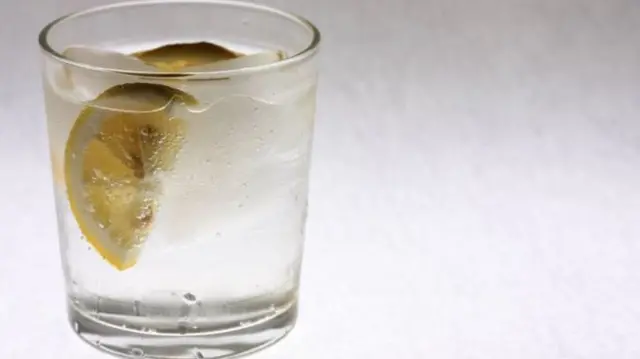
A gin and tonic
 Image source, Getty Images
Forget a dash of tonic with lemon and lime - gin has been spiriting its way into our mealtimes, with supermarkets now selling gin-flavoured foods, from yoghurt to fish. Tubs of gin-flavoured yoghurt - containing 0.25% alcohol - went on sale in Sainsbury's this summer, which says more gin foods are on their way.
Kate Palmer takes a look at the "ginaissance" of British food.
Each table has been assigned a different persona to consider when finding solutions
Table One is looking at "Jim"
Jim works as project manager for a building development company and is divorced with two children, aged 7 and 5. The children live with his ex-wife two hours’ drive away, and this makes life tough on several fronts. He sees the children one weekend a month and in the holidays. He’d like to see them more, but he sometimes works weekend shifts and his ex-wife isn’t keen on accommodating his changing work patterns.
She says she is worried about the children when they are with him. She says he drinks too much and is worried he might drink and drive, or forget to feed them which he thinks is ridiculous. She doesn’t call him an alcoholic, but says he is ‘alcohol dependent’.
What solutions would you suggest for someone like Jim? Send them to us on Twitter using #BBCTheFix, external or leave a comment on Facebook for us
Helena Conibear from the Alcohol Education Trust cites several programmes and types of intervention that were not successful at building character or encouraging young people to stop problematic alcohol consumption:
Is stress affecting how much alcohol we drink? Would more open-minded approaches to anxiety help to reduce the amount we drink? And could an alternative to the pub lead to less consumption?
You can tell us what you think on Twitter, external using the hashtag #BBCTheFix
Allow X content?
This article contains content provided by X. We ask for your permission before anything is loaded, as they may be using cookies and other technologies. You may want to read X’s cookie policy, external and privacy policy, external before accepting. To view this content choose ‘accept and continue’.
Would adopting European style drinking habits help to change our attitude towards booze, as Jeremy on Facebook suggests?
Head to the The Radio 4 Facebook Page, external and tell us what you think.

Some police forces are introducing sobriety tags - which uses ankle bracelets to detect alcohol levels in offenders who commit crimes while under the influence of alcohol.
Rather than being considered a 'punishment', the tags were designed to adapt behaviour.
Could curbing alcohol use reduce reoffending rates?
A similar trial in London claimed 92% of those tagged complied with the order.
Find out more about the scheme
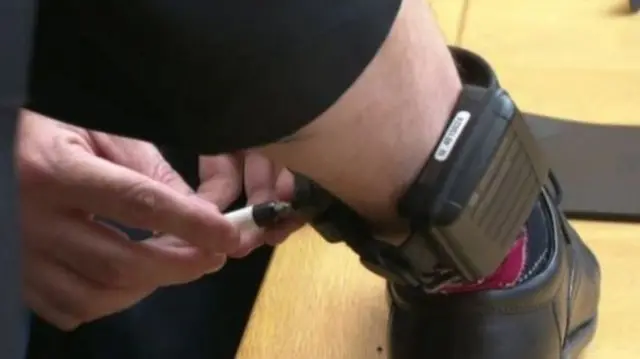
Sobriety tag
Quote MessageRe-offending rates are much higher for people where alcohol plays a role in the offence, by tackling that we can reduce the likelihood of them re-offending.
Marc Jones, Lincolnshire Police and Crime Commissioner
The team's have digested the data, but what did they make of it?
Will any of these factors figure in group's thinking?
Roscoe Williamson
Roscoe Williamson is currently Head of Sonic Branding at leading music agency MassiveMusic. A keen futurist with a vision for establishing an innovative brand sound, this year Roscoe worked with Samsung to develop their latest voice assistant, Bixby. Within his repertoire, he has also worked on Cannes Lion award winning interactive audio projects for ASOS.

Un Jeong Ko
Un Jeong Ko is a Service Designer at Innovation Unit with a particular interest in how design can drive complex social change for improving people’s health and well-being. Un Jeong spends her time delivering and building design capabilities within organisations, with a focus on understanding the needs and aspirations of people.
 Image source, Anna Williams
Anna Williams
Anna Williams is a freelance consultant and PhD student at Goldsmiths University London investigating how science and technology policy makers can be more creative when thinking about the future.
As a pub owner and businessman George Scott-Welsh has first-hand experience of the ever evolving nature of the alcohol debate.
Hashi Mohamed
Hashi Mohamed is a barrister at No5 Chambers and a part-time broadcaster at the BBC. He presents documentaries on BBC Radio 4, most recently on terrorism and how nations react, and also on the lack of social mobility in Britain entitled ‘Adventures in Social Mobility’. He was called to the Bar in 2010 and practices in public law and human rights related cases, though his main area of focus is Planning & Environmental law.
Nate Tkacz is an associate professor in the Centre for Interdisciplinary Methodologies at Warwick University. His work investigates the political, economic and organisational dimensions of technology, with a specific focus on networked and digital forms.
Emily Goldhill
Emily Goldhill is a strategist and research leader at creative youth network Livity. She has expertise in working with the youth audience to uncover truths that have informed policy, strategy, marcomms and offline programme developments.
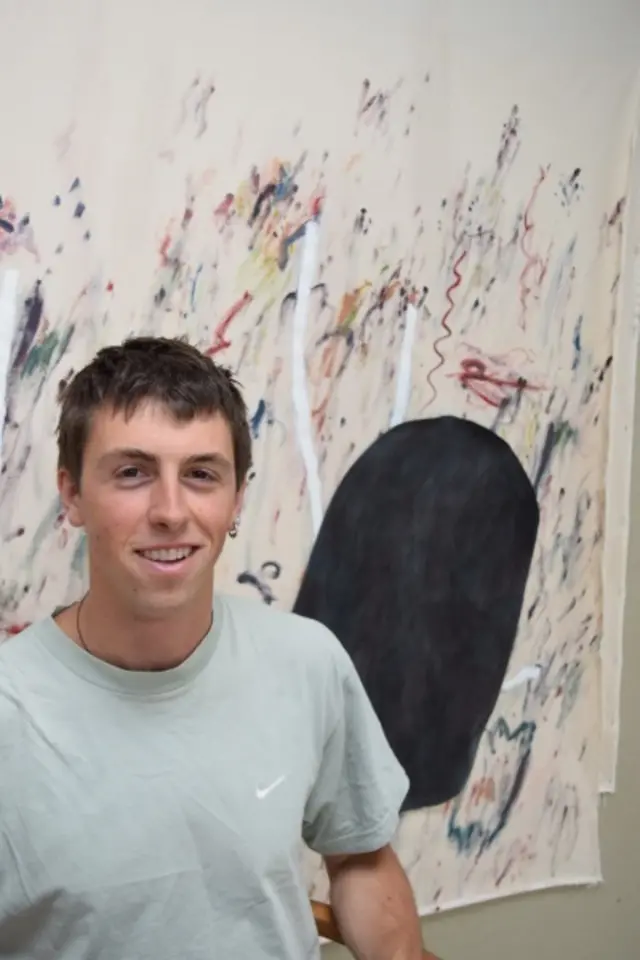
George Ridgway
George Ridgway is an artist based in Glasgow. Recipient of the Fleming-Wyfold Bursary 2016, and selected for Bloomberg New Contemporaries 2016. Recent exhibitions include, New Scottish Artists, David Roberts Art Foundation, 2017; Bloomberg New Contemporaries, ICA, 2016/17.
So who are these brilliant young minds that are going to solve the nation's drinking problem over the course of the next few hours? Meet the first team...

Amanda Gore
Amanda Gore is co-director of The Liminal Space, a creative engagement consultancy whose mission is to educate and engage people in important social and strategic issues.

Matt Tinsley
Matt Tinsley is a Senior Economist with consultancy firm Oxford Economics. He specialises in analysing a range of microeconomic issues and holds a master’s degree in economics from the University of Bristol.

Naho Matsuda
Naho Matsuda is currently working as a design researcher at the Interaction Research Studio at Goldsmith, as a art director at Hellicar Studio and pursuing her own practice with the artist development scheme of FutureEverything in Manchester. She investigates the social and cultural issues found within contemporary technological practice through a range of design outputs, processes and methodologies.

Cara O’Sullivan
Cara O’Sullivan is an inventor from the UK with a background in ethnographic research and human factors. She specialises in design for social impact and has worked with organisations across Peru and Africa to develop sustainable products such as locally-manufactured wheelchairs and walking aids.
The team members are introducing themselves and also revealing some of their own drinking habits.
"I drink when my boyfriend drinks and he drinks quite a lot..."
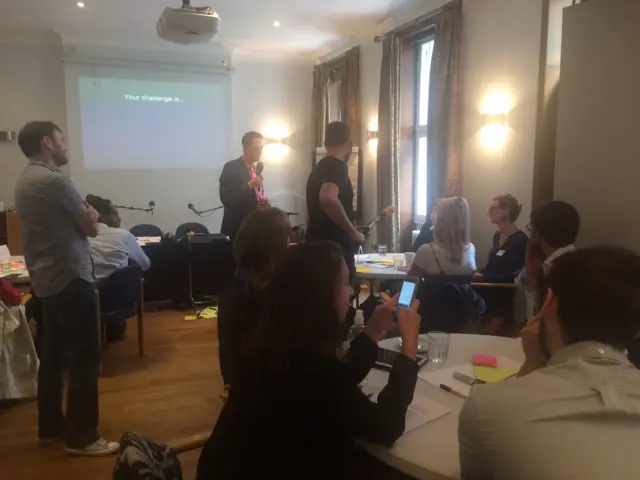
Matthew puts the question to our participants
The correct answer is 6 units. Which means beyond 3 pints or two thirds of a bottle of wine, you're officially a binge drinker.
Do you know how many units you can safely drink in a week? Do you even know what a unit is? A pint? A hogshead? A flagon?
The government's recommended imbibing amount has changed a number of times over the years, but are the benefits and harms of alcohol being judged correctly? It's now suggested that we consume 14 units per week - but what does that even mean and how damaging would, let's say, 15 units be?
Radio 4's More or Less team delved into the figures, poked around the stats and tried to find the answer...
Are there problems with the way we judge the harms from alcohol? Tim Harford finds out.
Our presenter, Matthew Taylor, is giving our participants the rundown for the day (or possibly hitchhiking, we're not sure). He's just mentioned the live pitching that will take place later, so there are a few nervous faces.
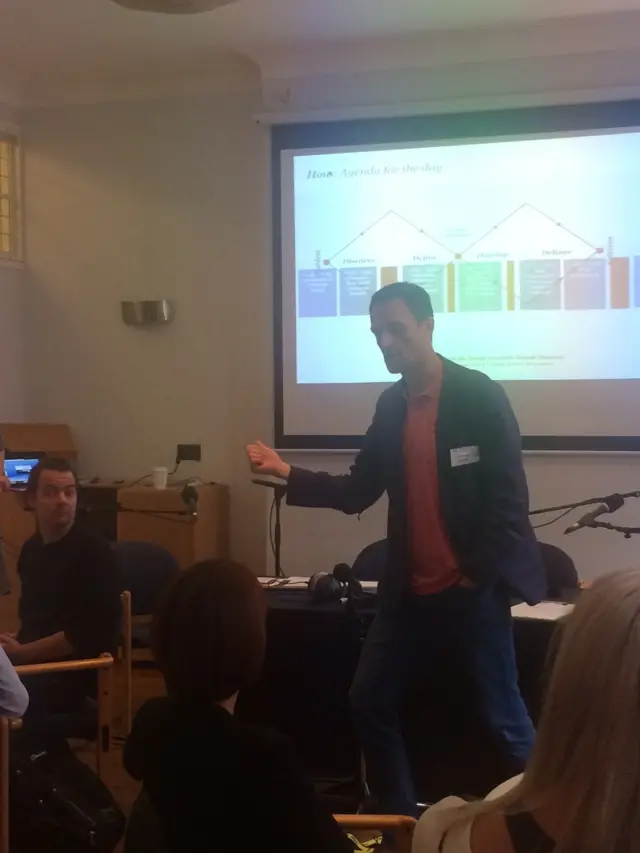
Matthew Taylor
Providing insight and first-hand knowledge to help our teams in their research will be our expert witnesses.
Laura Willoughby MBE is the co-founder of Club Soda, a start-up that is trying to help people to become sober. After being, by her own admission, ‘ a pretty big drinker’ she decided that she didn’t like who she was and decided to give up drinking. She is now helping others to do the same.
Allow X content?
This article contains content provided by X. We ask for your permission before anything is loaded, as they may be using cookies and other technologies. You may want to read X’s cookie policy, external and privacy policy, external before accepting. To view this content choose ‘accept and continue’.
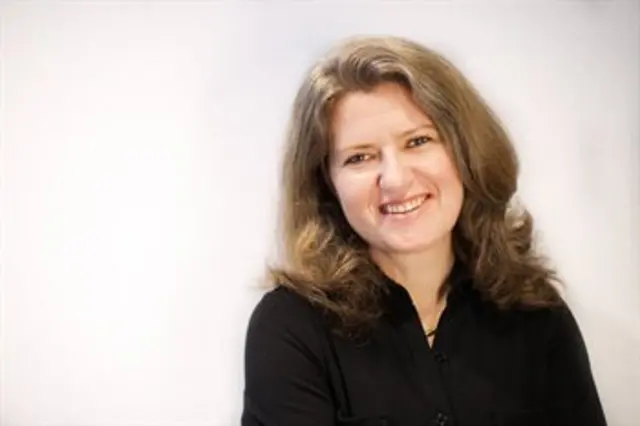 Image source, Sally Marlow
Dr Sally Marlow studies in the Addictions Department, the Institute of Psychiatry, Psychology and Neuroscience and King’s College London and is part of the Alcohol Health Alliance. Her interests include addiction and its links to mental health, particularly in women; mental health issues in children and adolescents and how the arts can contribute to addiction and mental health in innovative ways.
Exciting!
Our thinkers, experts and facilitators are all assembling, ready for today's session. Soon the serious business of problem solving will begin.
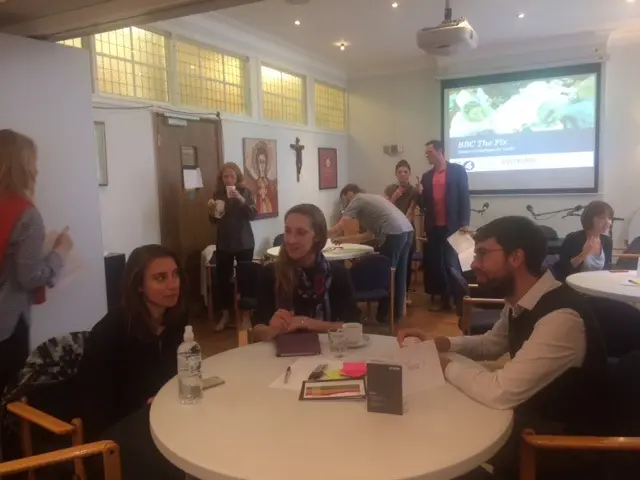
Presenter Matthew Taylor (in red) is about to brief the teams
But first, tea...
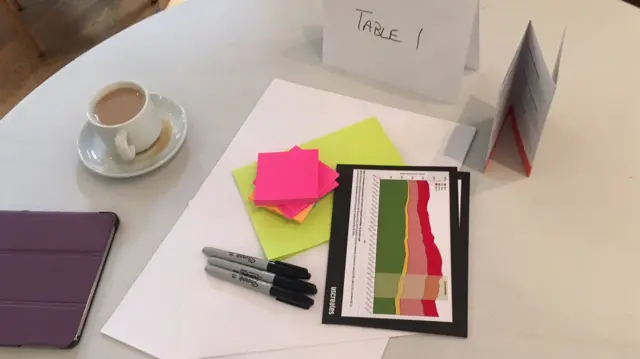
According to Demos, research increasingly shows that character as well as social and emotional skills are not only vital to young people's future success, but lead to far healthier behaviours around alcohol consumption.
Character skills include, but are not limited to:
Not only did studies show children with greater self-control had less substance (alcohol) dependence, but interventions which sought to improve social and life skills were shown to significantly reduce young people's use of alcohol.
The teams were also asked to read a report from leading cross-party think-tank Demos entitled 'Character & Moderation' which investigated the reasons behind a decline in drinking among young Britons. The proportion of young adults (aged 16.24) who reported binge drinking fell from 29% to 18%, the percentage of school pupils who reported drinking alcohol at least once fell from 61% in 2003 to 39% in 2013.
 Image source, Getty Images
Quote MessageAn increased awareness in the health consequences of drinking was cited most commonly as a reason for the decline in young people drinking
The report concludes that although young people cite several reasons for the decline in alcohol consumption, the reality is we don't really know what the driving factors behind the decline are. More research needs to be done in order to promote activities and interventions that could see an even greater reduction in alcohol consumption.
The Guardian recently reported, external the proportion of over-65s that drink hasn't changed while there has been a 64% increase in alcohol-related hospital admissions in the last decade, totalling 1.1 million admissions in 2015/2016. So there's still a huge need to reduce drinking in order to reduce harm and save lives.