|
For those
with strong nerves there's a little add on to the walk here. Keep your
eyes peeled for a narrow walkway called 'Giddy Ledge' which winds around
a section of the cliff and even though this is not the highest buttress
of the tor, the situation is impressive.
 We took a walk through time on Otober 16th.
Take a look at the pictures. We took a walk through time on Otober 16th.
Take a look at the pictures.
Take extreme care if you choose to explore Giddy Ledge, there's a handrail
but the ground is quite uneven.
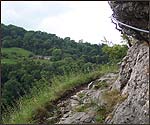 |
| Giddy
Ledge |
After your
Giddy Ledge adventure it might be an idea to chill out and enjoy some
of the botanic delights of the area.
Depending
what time of year you visit you may be lucky to see a selection of plants
that are peculiar to the area because of the toxicity of the ground.
Look out
for Eyebright (Euphrasia officinalis). It's an elegant little plant, two
to eight inches high. Eyebright flowers from July to September, with deeply-cut
leaves and numerous, small, white or purplish flowers variegated with
yellow.
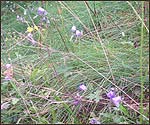 |
| Harebells |
There's also
the beautiful little Harebells (Campanula Rotundifolia) or Scottish Bluebells
as they're sometimes known. Fairy stories insist that Harebells are collected
by imps and nymphs to wear as hats on midsummer nights. A little fun fact
to delight the kids with!
Derbyshire
has its own orchid too and you'll see it in July and August on this walk.
The Broadleaf Hellebore is quite unusual to the area. It's another one
that thrives on the lead content. Unlike its tropical counterpart, the
flower's possibly a bit insignificant but none the less a special plant
for this area.
|
Discover
more...
Local Geology expert Robin Jeffcoats tells us more about the plants
that thrive in Matlock's toxic soils
 Listen
as Robin talks the talk as we walk the walk Listen
as Robin talks the talk as we walk the walk
|
At this point
you'll also see a classic example of Victorian folly. The little lovers
nook and bench is a perfect place to shelter if it rains or just to catch
your breath. Make a bit of time here to look for little fossels in the
limestone and chert before the climb up onto High Tor.
|



 PREVIOUS

![Email your comments to [sitename_email]@bbc.co.uk](/staticarchive/5ec3db937412b12fbb10f1ebb3b864f002f93812.gif)




 Realplayer
required
Realplayer
required