|

YOUR
NEW NOVEL IS SET IN A GLOOMY NORTHERN TOWN. IS IT IN WEST YORKSHIRE?
No,
it's what we could call the North West, I think. It's got more to
do with cotton textiles.
IS
A SENSE OF PLACE REALLY IMPORTANT TO YOU?
I suppose
it must be. I still live only four or five miles from where I grew
up. I like it in West Yorkshire. I suppose I don't really know that
I'm writing about these places because it seems like the world to
me but I guess other people make a distinction. If you write about
the North you are a northern writer but if you write about the South
you are a writer.
YOU
HAVE NOT MOVED AWAY?
Everything
I need is here. There might have been a time a s a writer when there
might have been a requirement to be nearer London or spend more
time there but these days if you've got all the various gadgets
you don't need to be there.
WHAT
ARE THE REWARDS AND PROBLEMS OF WRITING POETRY FOR TELEVISION?
I think
the rewards are that you meet other people. You hear different ideas.
You can become a bit narrow I think, just sitting there writing
poems and thinking poetically all the time. It does you good to
get out and to cross-fertilise with people. You can't write poems
all the time. Who would want to read them? I just don't feel in
a poetic mood everyday and I'm curious about art, and the way it
works, and about writing and I'm interested in seeing how far I
can extend what I can do to other art forms.
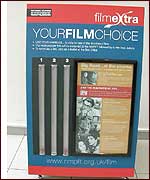 |
| A
novel way to choose a film... |
DO
YOU THINK A WRITER'S JOB IS TO SHOCK?
Not
necessarily to shock but to challenge. Pornography was a film about
women working in the industry - that word just seems to set people
on fire. We got some amazing reviews and some incredible hostility
whereas all we did was really to allow people to tell their stories
and to show us what they do.
WOULD
YOU ADVISE ANYONE WHO WANTS TO BE A POET TO PERSEVERE?
No,
I don't want any competition. They should go away and work in a
shoeshop. What I would say is it is a very rewarding thing to do
but it's a very available thing. It's not like putting an opera
on or throwing a pot. It's very simple by comparison. You just need
to be able to read and write and most of us can do that. I suppose
I think that if you can achieve some kind of success or progress
with your writing it allows you the kind of freedom to say what
you want and to be heard and that's quite a rare commodity and you
don't have to make a big song and dance about it either. It's just
one voice, somebody saying something that they really mean.
IN
THE PAST YOU SEEM TO HAVE GOT IDEAS FROM ACTIVITIES LIKE GOING CLUBBING.
Inspiration
can come from anywhere. I guess if I look back through my earlier
books they describe a fairly free and easy lifestyle and I can see
that domestication has come through time and I don't necessarily
write about the same subjects. I think its less about inspiration,
it's more about exhilaration and that can come from overhearing
a little bit of language, it ca be a passionate political idea or
it could be an idea escalating and becoming inflamed in your imagine
but it's a kind of rush, a buzz that you want to follow up with
words and language and trap on a page.
I don't
think you have to go to exotic locations to be able to write. I
often say to students if you can write about everyday things you
are on the way to having an audience of hundreds and thousands of
people who have shared these experiences. I think for me it's a
way of trying to see everyday events not in a new way but in a way
that only I can experience them because I am not like everybody
else and that's absolutely true for everybody. It's about trying
to find the right words to express that.
(Simon
Armitage's first novel Little Green Man is about to come to the
big screen.)
DO
YOU THINK GREAT BOOKS MAKE GREAT FILMS?
They
can do. I think there is a complex relationship between the two...
People become completely loyal to books. They have a personal relationship
with a novel and go along and see the film and say it wasn't really
as good as the book. It hasn't got the same relationship but I think
films work best when they don't try and recreate the book, when
they try and do something artistic like Trainspotting which I thinks
was one of the best British films ever made. I think the book's
great as well but they are two completely different vehicles really.
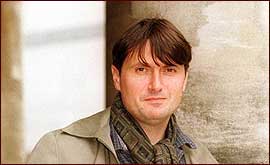
Simon
Armitage was in Bradford as a guest of Film Extra, a new film and
book club where audiences are given the chance to choose a film
adaptation to be screened at the National Museum of Photography,
Film and Television. So far 700 nominations have been received with
the most popular film being To Kill A Mockingbird. This film now
goes up against David Copperfield chosen by this year's Special
Guest at the Bradford Film Festival Ian Carmichael and Wuthering
Heights suggested by Festival Director Tony Earnshaw.
If
you are in the museum look out for the ingenious way you can cast
your vote!
Simon
Armitage's The White Stuff is published by Penguin Viking.
|