How will the weather affect the opening games of the World Cup?

England's warm-up match in Florida was delayed by an hour on Wednesday night after a storm hit
- Published
Storms causing delays to some of the warm-up matches this week have already shown how extreme weather will affect this World Cup.
And with more storms forecast, some of the opening games are likely to be affected with the biggest risk to play coming by Monday.
Then for England, the Texas heat may be uncomfortable for fans leading up to their first match against Croatia in Dallas on Wednesday.
Here's what to expect in the coming days.
How could extreme weather affect World Cup 2026?
- Published10 May
Is England v Costa Rica delay a sign of things to come?
- Attribution
- Published11 June
Miami heat and storms a concern
On Monday, Saudi Arabia take on Uruguay at 18:00 ET in Miami where the temperature will be around 30C (86F). With high humidity forecast, it will feel more like 40C (104F).
According to the heat index used by Fifa and other sporting organisations to measure how temperature affects the health and body of a person - called the Wet Bulb Global Temperature (WBGT) - a value of above 28C (82F) is widely considered the threshold at which heat stress becomes a significant concern for elite athletes.
On Monday, the WBGT is forecast to be around 30C in Miami. This represents a high-risk or extreme environment at a level that Fifpro considers to be unsafe for play.
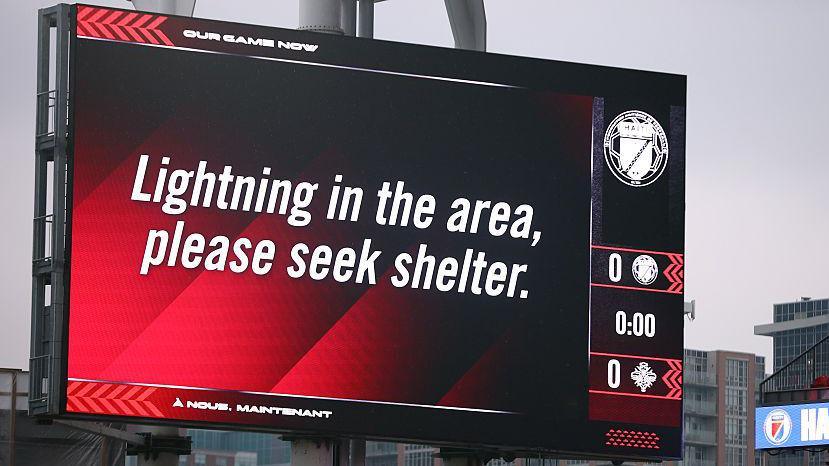
Storms are also in the forecast. If they were to develop within eight miles of the stadium, the match would need to be suspended for at least 30 minutes.
This allows players, officials and fans to seek shelter and stay safe from threat of being struck by lightning.
Play can resume 30 minutes after the last lightning strike in the area.
Texan heat for England

While the Dallas stadium hosting England v Croatia has air conditioning with a roof, it will be a hot day and build up for fans.
Texas is one of the hottest states in the US and England fans waiting for their team's first match to begin will be experiencing typical hot weather on Wednesday afternoon.
Temperatures into the low thirties are expected and while it should be dry and sunny, there is a chance cloud cover could increase with a few showers.
While no thunderstorms are currently forecast, the cloud cover and increased atmospheric moisture will raise the humidity.
The 'feels like' temperature is therefore expected to approach 40C.
However, the Dallas stadium is one of the World Cup stadiums with a retractable roof and air-conditioning.
This will make it much more comfortable - and safer - for players and fans when inside the stadium during the game.
To see the latest weather for these and all other World Cup locations, check the searchable forecast here or use the BBC Weather app.
- Attribution
- Published11 June
- Attribution
- Published5 June