Slot, Nuno and Kelleher pay heartfelt tributes to 'wonderful' Jota
- Published
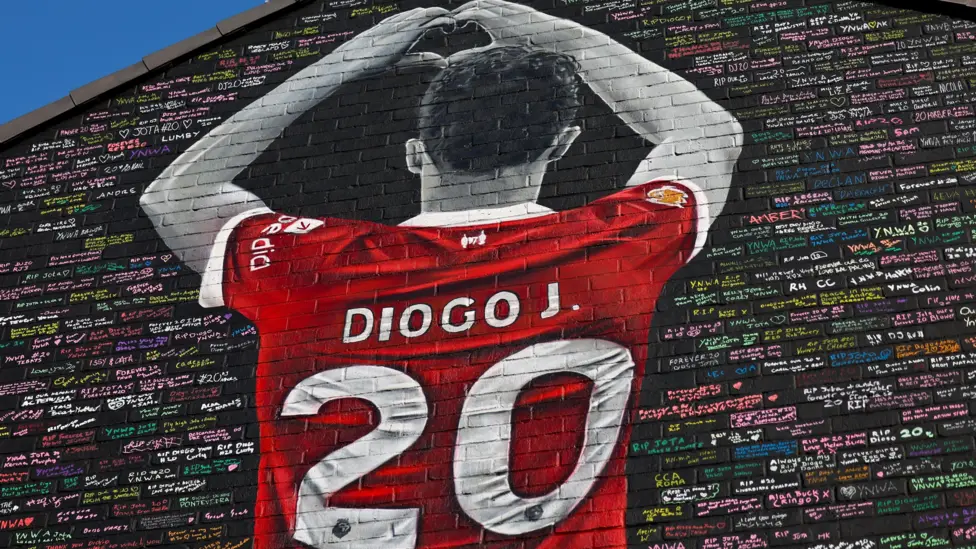
A year ago today, the football world was stunned by the death of Liverpool forward Diogo Jota and his brother Andre Silva in a car crash.
Jota, 28, had won the Premier League title with the Reds just weeks before his tragic passing - and also married his long-term partner Rute Cardoso, with whom he had three children, 11 days earlier.
He scored 65 goals in 182 appearances for Liverpool, helping them win the FA Cup and League Cup in 2022, as well as the top flight in 2024-25.
Jota began his career at Portuguese side Pacos de Ferreira before joining Atletico Madrid in 2016, although he never played a game for them as he was loaned to Porto for a season and then to Wolves, completing a permanent deal in 2018.
Across three seasons with the club, he scored 44 goals in 131 games.
Jota made his international debut for Portugal in 2019, replacing Cristiano Ronaldo in a 6-0 win against Lithuania, and won 49 caps, scoring 14 goals.
He played his last match for his country on 8 June 2025, as they beat Spain in the Nations League final on penalties.
But for all Jota achieved on the pitch, it is the character off it that is most fondly remembered by those who worked with him during his career.
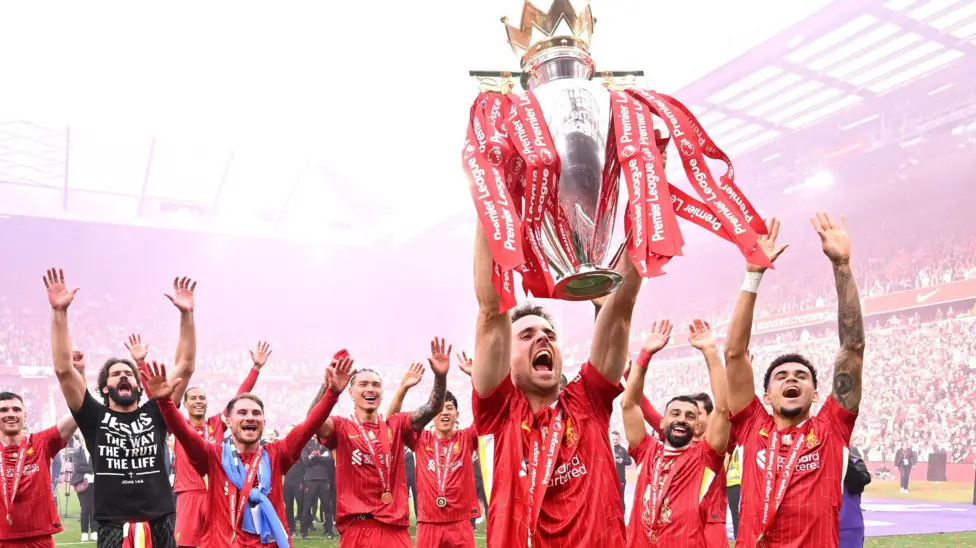
Diogo Jota won the Premier League title with Liverpool in 2025 just weeks before his death
Former Liverpool goalkeeper Caoimhin Kelleher, who played with Jota from 2020 to 2025, told BBC Sport:
I think about Jots (Jota) often. He was a wonderful guy and definitely one of a kind. He was always himself and stayed true to himself. He didn't care that he was a super famous footballer. He saw himself as a normal guy and stuck to his morals and that's why he mixed with everyone and why everyone at the club got on with him.
The first time that I met him was actually at the old training ground in Melwood. Due to the pandemic, we were all split into different changing rooms into fives and he was part of our five. Our friendship started there and developed over time, especially off the pitch.
He was into a lot of sports, like myself. And into things that I wouldn't expect a Portuguese footballer to be into like horse racing, darts and snooker - typical British and Irish stuff.
Me and Andy Robertson organised a trip to Cheltenham for the races because it aligned with our days off and to be honest, we didn't even have him pinned to go initially but Jots got wind of it and came over and was like, 'When are we going to Cheltenham?'. That's the kind of guy he was and I'll always remember that.
He had such an enthusiasm for whatever he did and he looked the part with his Peaky Blinders cap, a full three-piece suit and even a pocket watch. They're all such fond memories to look back on.
Honestly, he was non-stop. He was big into watching darts and even started playing it, although he wasn't any good. Some days, he'd be watching live gaming and I just admired how passionate he was.
He'd always get these strange injuries that we'd always say, 'Only Jots could get these injuries', because he'd throw himself into things that no-one else would. He had that competitive nature about him and would do anything to win and I guess that's what all the lads loved about him. You saw that in the way he played the game.
There's so many memories. On tour with Liverpool, we'd get a suitcase with the club badge and your number on it, but it wasn't massive so he couldn't fit all his gaming essentials and he ended up taking a bigger suitcase.
That ended up being a fine and most of the squad had an hour argument with him because he didn't agree with the fine. He had us all in tears when he kept saying 'sweet case' instead of suitcase.
Thinking back, I'm so happy to have had the chance to go to his wedding that took place a week before he passed away and meet all his closest friends and family. After you experience something like that, you get even closer. They're cherished memories now and I'm very grateful to have known him.
Victorious Portugal pay emotional tribute to Jota
- Published15 hours ago
'A symbol of hope & inspiration - Jota was a Portuguese hero'
- Published3 July 2025
Humble, generous and a star - Jota left his mark on everyone he met
- Published10 August 2025
Former Liverpool boss Arne Slot, who won the Premier League with Jota, told BBC Sport:
I first met Diogo on our tour to America. Like many of the players, he arrived a little later because of the Euros. Over the months that followed, he showed us all what kind of person and player he was.
Diogo wasn't someone who only had two or three close friends within the group. He got along with everyone. Whether it was a team-mate or a member of staff, he always had time for people and made everyone feel valued.
He always put the team first and, whenever he was needed, he was ready to fight for his team-mates and for the club he loved playing for.
After we lost him, I told the players the best way we could honour Diogo was by trying to be a little like him. For me, that's how he'll always be remembered.
People will probably expect me to say that the goal against Everton was my favourite memory, and of course it was a special moment.
But when I think about Diogo now, that's not the first thing that comes to mind. I always think about the photograph he chose after we won the Premier League.
Out of all the pictures available, he picked the one with the entire team and staff in front of the Kop singing You'll Never Walk Alone. That was Diogo.
He always put the team before himself. That simple choice told you everything about the person he was, and it's the memory that stays with me.
Jota's final goal for Liverpool wins Merseyside derby
Former Wolves boss Nuno Espirito Santo, who signed Jota on loan and then permanently for the club, told BBC Sport:
He was a young lad [when he arrived at Wolves], but a very special one - warm, humble and determined to repay the faith and effort that had been invested in him.
Like every player, he found it difficult at first. The Championship is an extremely tough competition, especially for someone arriving from abroad. But it was precisely that challenge that helped shape Diogo into the player he went on to become.
He never gave up, and when things didn't go his way, he never let his head drop.
At the risk of sounding like a cliche, it's simply the truth. Everyone loved Diogo, absolutely everyone. Everyone at the club, everyone in the dressing room. Everyone.
Even now, it's difficult to think about him without feeling sad. He was an extraordinary young man, and we all miss him very much.
Former Wolves defender Conor Coady, who won the 2018 Championship title with Jota, told BBC Sport:
With Diogo, it's all good memories. The biggest memory isn't winning games and scoring goals but more within the dressing room and what a friend he was. He was an incredible human being with such honesty and humility and someone I will remember forever.
He was actually a dream team-mate to have and you add on top that he was an incredible footballer, then he was everything you wanted.
He's one of the biggest team players I've ever seen. Every day with us, he showed that selfless nature. From the first day he came in at Wolves, you saw the competitive nature that set him apart too.
He was desperate to win, even in head tennis. When the Portuguese boys came in, it helped create a culture that none of us had really seen and he was the first one to bring that. Diogo was a different animal, an absolute beast.
Even before I knew him, I admired him and Ruben Neves for making that shift from Portugal at such a young age. To drop out of one of the biggest teams, Porto, in Portugal like Ruben did and come to the Championship is a massive jump.
But them players coming to Wolves changed my life for the better. They made me a better player and a better person and anybody in the Wolves dressing room at the time will tell you the same things.
I remember when he first came over and I was thinking, 'I don't think he knows how hard the Championship is going to be', because a lot of people come and think, 'oh it's only the second division'.
But Diogo was totally different. He was professional, committed and a really clever fella. Straight from the get-go, you knew he meant business and you saw that when we got promoted at the first attempt.
Sometimes when players come from different countries, they stick to themselves a bit. I don't know what I'd be like if I moved abroad.
But him and the Portuguese lads that came were different. They mingled, they were getting in with the lads, organising things off the pitch and inviting everyone else. He threw himself into absolutely everything.
Whenever I think about Diogo, I think about his goal in the FA Cup quarter-final for Wolves against Manchester United, with a place at Wembley on the line. We were on the counter-attack, he took off on the halfway line, shrugged off Luke Shaw then Diogo, who was mainly right-footed, dragged it onto his left foot and smashed it into the near post.
That goal was made for Diogo Jota because not many players could score a goal like that. But he could. I admired that tenacity.
I was over the moon for him on a personal level when he moved to Liverpool. It was a bit strange because when he missed our game, that got the lads talking because Diogo would never not play.
The rumour mill in the dressing room went into overdrive and then Ruben [Neves] told us. Sometimes when team-mates leave, you're devastated and I was, of course, as his team-mate, but this was such a huge opportunity to go to a football club like Liverpool.
I couldn't have been happier for him for what he achieved and when he came back to the training ground, we took a big picture with him. If you were to pick any club for Diogo, you would pick Liverpool just ahead of Wolves. He gave everything and more for both those clubs.
To have shared a dressing room with Diogo was an absolute honour.
Ronaldo wears Jota's shirt at full time
Paulo Goncalves, technical secretary at Pacos de Ferreira, Jota's boyhood club, told BBC Sport:
My most vivid memory of Diogo Jota is from his professional debut with FC Pacos de Ferreira at the age of 17.
When coach Paulo Fonseca called him up for the Portuguese Cup match in October 2014, he immediately displayed his class, scoring a goal and winning man of the match in the 4–0 victory over Atletico de Reguengos.
I remember that, after scoring, he ran toward the stands where his parents were sitting and embraced his mother, who was moved to tears by such a special and significant moment.
I have a clear mental image of that moment and what it meant to him, as his parents had always been deeply involved in supporting his career - as had his girlfriend at the time, Rute, who had been with him since their school days. That family unity was essential to his career, which is why I highlight this moment.
Interestingly, when he signed his professional contract, the club offered to arrange a house for him to live in alone, but he said it wasn't necessary, preferring instead to keep living with his fellow youth academy team-mates.
I spoke with him a few times while he was still with the under-19s and later, after he signed his professional contract, we would talk every day at training. I remember the scramble to get him registered for the first team. Since he was only 17, the decision to register him was made quite late in the August transfer window.
However, during his physical examination, the doctor requested an additional heart test. The results confirming his health came through only in the final hours of the last day for registration with the Portuguese League.
It was a race against time, as coach Fonseca was very keen to have him in the squad for that season, and we only managed to complete the registration right at the deadline.
It was a fortunate success, as it allowed him to make his debut in the Portuguese Cup with a goal - paving the way for the fantastic career that followed.
From an early stage, younger fans idolised Diogo - not only because he came up through the club's academy and made his professional debut at 17, but also because everyone could see his career had all the makings of reaching the highest levels of world football.
That is why, whenever we took players to schools to promote club activities, everyone asked for Diogo to be among those chosen. He would always say yes and make himself available.
He enjoyed answering the youngsters' questions and playing football with them at the school before signing autographs for students who, in some cases, were barely younger than he was.
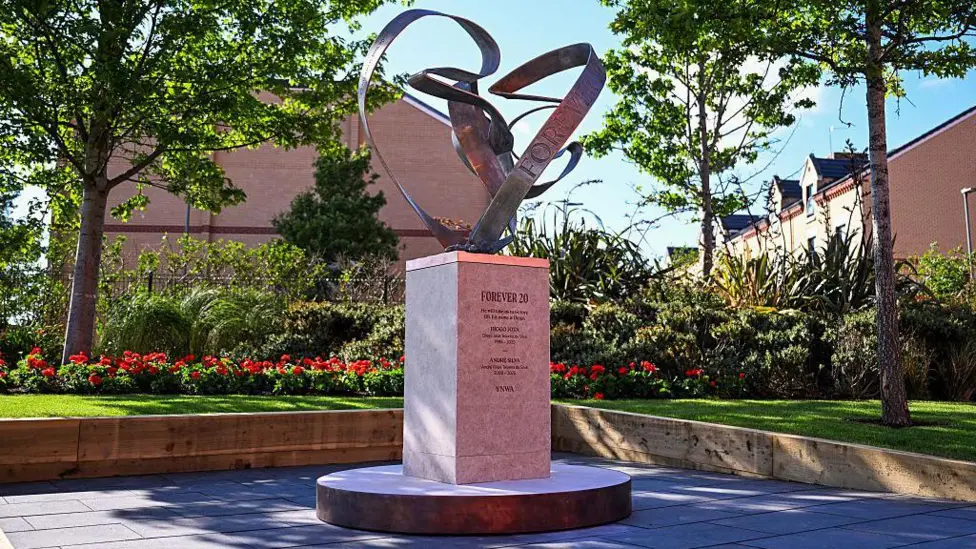
Liverpool have unveiled a memorial to Diogo Jota and Andre Silva at Anfield
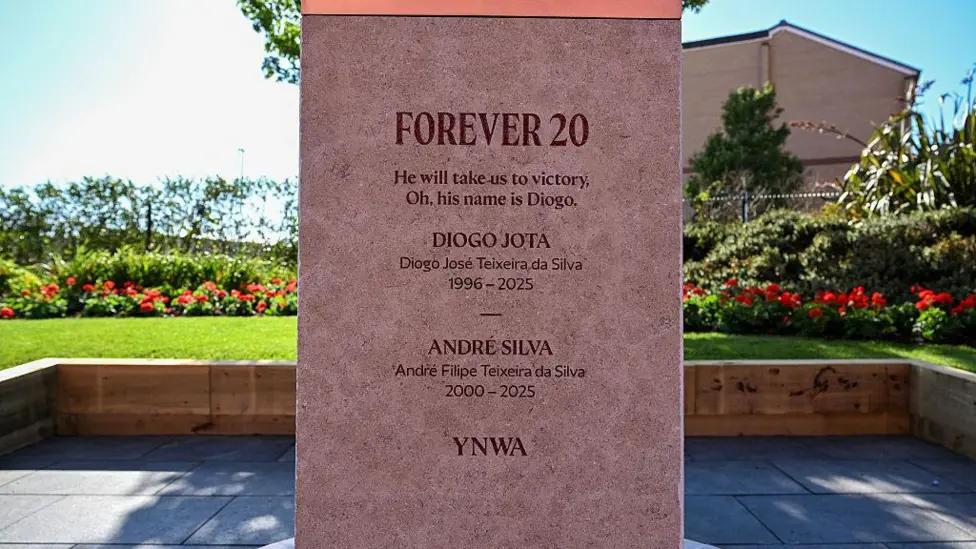
The sculpture has been installed close to where tributes - including flowers, scarves, and cards - were placed in the immediate aftermath of their deaths