|
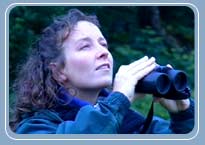
Zoologist and presenter Julie joined us after the
final episode of Scotland the Wild on Wednesday 14th of May. We
received many comments about Julie's enthusiasm for the subject
and telling us how much you all enjoyed the show. Thank you for
those, we have passed them to Julie and to the production team.
Here is the transcript of the interview.
|
|
First
question from mcm 1207: Hi Julie - Did you enjoy filming the series?
Julie:
Yes, tremendously. It was a great experience compared to my usual work
in Kenya. I learned lots of new things and saw many new creatures!
Question
from LB: Hi i am a crazi orca lover and i have always wanted to go
2 the Shetlands but my dad wont let me coz he sed its too cold! is it
really cold?!
Julie:
No... you can have a great trip if you time it right. During our filming
in June and July the weather was glorious! It's well worth the trip.
Question
from Jennifer: Hi Julie, I am Jennifer and am 8 years old. My dad
says a killer whale is the length of a bus. is he right?
Julie:
It could be even bigger! They can be quite scary to see up close. They
are amazing creatures to see in the wild... its incredible that
such a huge mammal can look so graceful in the water.
Question
from mcm 1207: Is there much life on Orkney? I always thought it was
just empty fields...
Julie:
There is loads to see and do in Orkney. There's a huge variety of birdlife,
and on the marine side, there are dolphins, seals and whales. Not to mention
some great standing stones and other historical sites. A great mix of
things to see and do. Go see it.
BBC
McHost ...we believe there's some interesting night life too! ;0)
Question
from muzza: What time of day were the shots of deer in the Necropolis
in Glasgow taken?
Julie:
Best time is early morning. Kind of 8 o'clock.
Question
from walker: I read once that there were Sea Eagles and Falcons in
the olden days on Shetland. Why do we not see them any more?
Julie:
The main reason has been the persecution of these great birds. Landowners
were worried about their grouse stocks. They used to poison them and shoot
them, causing rapid decline in the species' number.
Question
from nicole: How long did it take to film tonights show and
all of the shows?
Julie:
The show tonight took just two weeks. A lot of these programmes take
months to get together because we have to film the animals doing their
things at different times of the year. We need to film in different parts
of the country at different parts of the year.
Question
from GavRox: What is your favourite Scottish animal?
Julie:
It has to be otters. Oh and I was also blown away by the orcas, getting
that close to a magnificent beast. Wow. I also became far more interested
in birds after filming the series. In Scotland you can see some of the
most amazing seabird colonies in the UK and we have some of the most majestic
birds of prey too.
Question
from alastair: When I was working in the States, I once came face
to face with a black bear in the wild, pretty scary. What's the most scary
encounter you've had?
Julie:
Tricky one... let me think. From all my work abroad the most un-nerving
experience had to be bumping into an elephant in Kenya. Oh, and far scarier
than that was being swooped upon by those pesky bonxies in Shetland!
Question
from walker: Were you ever sea -sick whilst filming on all those boats?
I know I would be!!!
Julie:
Nope! Julie: I'm normally quite good. I tend to spend a lot of time on
boats. It was a real treat to do so while filming.
Question
from Clyderanger: I'm a seasonal ranger at Clyde Muirshiel Regional
Park. Can you briefly explain how you got to where you are in your career?
Julie:
First, a degree in zoology at Edinburgh Uni. Next I spent four years
managing primate conservation projects in Africa... access to that was
through a voluntary organisation. Im currently in the middle of
a PhD in primatology. The presenting job came up purely by chance. I was
discovered in Kenya when a BBC crew came out to film my primate project
in East Africa. They wanted someone Scottish who was a qualified zoologist
to present this series.
Question
from david: If they asked you again to do another series would you
take them up on it?
Julie:
Definitely! I thoroughly enjoyed my experience, especially travelling
around the country that I love. I'd love to go more in-depth, to discover
more about the great creatures that are right on our doorstep. This programme
merely touched the tip of the iceberg on what's on offer in Scotland.
Question
from jandobie: I once saw an otter on Tiree, which was beige colour.
Is this unusual?
Julie:
Sounds very unusual to me, but in nature lots of quirky variations on
animal coat colours, sizes and adaptations occur. You even get albino
otters, you know.
Question
from Adam: I'm an aquaculture consultant in Scotland. What is your
opinion of fish farming in Scotland?
Julie:
There is two sides to this and I really don't know enough about the industry
to form a concrete opinion about it. It's important for local communities
and I know they do try to be environmentally friendly. They try to stop
otters and seals from eating the fish. But the amounts of chemicals, steroids
and genetic modification that goes into these creatures is affecting the
wild population. I have mixed feelings on this.
Question
from GavRox: I'm thinking about being a ranger or something to do
with animals when I'm older. What is it like?
Julie:
Very rewarding. If you're an outdoors type of person it's great for you.
You're contributing to the conservation of the habitat. Youll also
be involved in motivating children to get interested in conservation,
which is lots of fun. Check the websites for Scottish Conservation Volunteers
out. Try a search for Scotland + conservation + volunteer and see what
it throws up. You can also volunteer to help country rangers in your area.
Go along and see if you like it.
Question
from graeme: I work for Scottish Natural Heritage - in Edinburgh -
how would you solve the hedgehog problem on Uist?
Julie:
Controversial stuff. People caused the problem in the first place
by bringing them across. Introduced species proliferate in these islands
and can decimate native populations. They have to be controlled in one
way or another. The hedgehogs have to be removed. Where do you put them
if you take them off? They'd compete with existing animals wherever they
went.
Question
from sootypooty: Hi julie I saw your programme a few weeks back when
you showed us the bearded tit, can i spot them in fife?
Julie:
Unsure about the extent of the distribution outwith the Tay reed beds.
They need a specific habitat... the reed beds. They are well worth seeing.
Question
from pat: If you hadn't become a zoologist what would you have liked
to do as a job?
Julie:
Clinical psychology! I'm interested in the brain and how it works. I'm
interested in people and animals.
Question
from Bill McLaughlin: Terrific Programme Julie, thanks to your enthusiasm
I enjoy it . How long did you have to wait to get the shots of the killer
whales?
Julie:
This is no lie. We arrived on the very day that we saw them. We got off
our flight, and we were filming the introduction sequence and come 5pm
as we were driving back to our B+B we spotted them on the coastline. It
was on the Sound of Moussa, on the east coast Shetland. Were helped by
Scottish Natural Heritage who phoned to say they were passing through.
We found a boat and got out there quickly to see them. We were really
lucky. Check the SNH website for details of where they might be.
Comment
from Bill McLaughlin: Maybe I should come along with you next time,
I've been to Vancouver Island and spent two weeks there with no luck!!
Julie:
Try to get up there in time to catch them. You must have been absolutely
gutted to have missed them in Vancouver.
Question
from big ben: What part or parts of Scotland do you think are still
real wildernesses?
Julie:
By far the Flow country, the far north. I was amazed to travel through
such an untouched, sparsely populated land. You get a real sense of peace
and serenity up there. You're in the middle of true wilderness. Similarly,
the Highlands are also fantastic. They are my two "hot spots".
Question
from MAGGOT: If you had a time machine which ancient animals and times
would you like to visit?
Julie:
I would love to go back to the Jurassic period! I was obsessed with dinosaurs
when I was a child. I would have done anything to see that world. I'd
love to have seen Scotland when we had polar bears and lynx. It would
have been a bit cold, though!
Question
from Sandy: Which kind of animals do you think have the most amazing
lifecycles?
Julie:
The most amazing creatures are the solitary insects who know, upon hatching,
how to get fertilised and where to lay their eggs. They do this without
any learning from others.
Question
from Julia: Where do you see your career going now - what are your
ambitions?
Julie:
My ambitions at present are to finish my doctorate and then to keep
helping international conservation projects. However, after taking part
in the series I'd love to get more involved in conservation here in Scotland.
Thanks
to everyone for watching the programme. I hope you enjoyed it. Please,
please, please go out to see these things for yourself. They are really
accessible. SNH, RSPB are good sources of information, as is the Scotland
the Wild website.
Let's
celebrate Scotland's wildlife!
|