|
<<
Page 1, Page2 >>
Established Alien Species
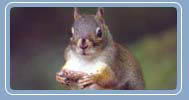
Grey squirrel
Brought to Scotland in 1892, within 20 years they had spread over 300 square
miles. There are now an estimated 200,000 grey squirrels in Scotland, outnumbering
the native reds by 20:1. The greys gradually out-compete reds in mixed and broad-leaved
woodland.
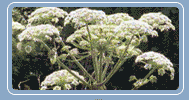
Giant hogweed
A native of southwest Asia, this huge plant can grow up to 4m tall and produce
100,000 seeds each year. Since its introduction in Victorian times, it has spread
along water courses in much of lowland Scotland.
Sika deer
This medium-sized deer was introduced to several areas of Scotland in the late
19th and early 20th century. These deer interbreed with native red deer, which
may eventually lead to the extinction of native deer, except on Scottish islands.
American mink
Brought here in the 1920s for fur farms, escapes and releases have since established
them in the wild. They have had an impact on ground-nesting birds, and are thought
to be responsible for the declining water vole population.
New Zealand flatworm
First recorded in 1960, the worm was thought to have come into Scotland in the
soil surrounding the roots of garden plants. Since then it has been widely recorded
in lowland Scotland. The worm eats our native earthworms.
Return of the Natives
Conservation has had a few successes. Some of the species driven
to the brink of extinction in earlier centuries are now flourishing.
Red squirrel
It is contested whether red squirrels ever completely disappeared from Scotland.
However, their numbers were certainly low enough to prompt a reintroduction
from England.
Osprey
Another casualty of the 19th Century, ospreys returned to Scotland in 1954.
They have increased in number and distribution since then. By 2002 there were
150 breeding pairs of ospreys in Scotland.
Sea eagle
The last pair of breeding sea eagles was shot in 1916. Attempts to bring them
back began in the 1950s, but it was not until 1975 that the birds were successful.
In 2002, 25 pairs were counted living along the Atlantic seaboard.
Capercaillie
Disappearing in 1785 as a result of hunting and habitat loss, it was reintroduced
from Sweden in 1837, and spread rapidly. In recent years, the bird has again
been facing a steep decline in numbers.
Beaver
There is frequent discussion of plans to reintroduce some of our large, native
mammals. One such plan is to bring the beaver back to Scotland. These days any
such proposal must follow strict guidelines, set out by the World Conservation
Union (IUCN). Beavers were hunted out of existence here in about 1550. In the
past 40 years, they have been successfully returned to 20 other European countries.
Scotland has yet to decide on the proposal.
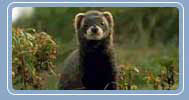
Polecat
Polecats were released in Argyll during the 1980s and early 1990s. Recent evidence
suggests that they have hybridised with feral ferrets.
It is hard to be positive about the future for Scotland's remaining
endangered species. Conservation efforts continue, but for so many lost species
it is already too late. Unfortunately, our greatest legacy to Scotland's ecology
may be to keep future fossil hunters in business.
<<
Page 1, Page2 >>
|