SARS: the True Story - transcript
NARRATOR (JACK FORTUNE): These Canadian ambulance workers are the frontline in the battle against SARS. They live with the threat of the disease everyday. But just how dangerous is it?
VOICE ...Some have said it's a bigger threat than AIDS
VOICE ...That it could kill millions.
VOICE ...Others believe it is nothing to worry about at all.
VOICE ...SARS has caused panic.
VOICE ...Stock markets have collapsed.
VOICE ...Borders have been closed.
VOICE ...But was it all an overreaction?
VOICE ...This is the film that provides the answers... the real story of SARS,
VOICE ...seen from the inside by the people who are actually fighting the disease.
NARRATOR: When he visited a new patient at a clinic, in Hanoi Vietnam, Dr Carlo Urbani had no idea that he was also meeting the instrument of his own death. Urbani only knew that his patient, Johnny Cheng an American businessman was in a critical condition.
DR JULIE HALL: In the space of four days, he'd gone from being a fairly fit healthy man to somebody having incredible difficulty breathing, and really struggling.
NARRATOR: Cheng had a raging fever, a hacking cough and his lungs were filling up with fluid. He had all the symptoms of a deadly virus and no drugs seemed to work. Alarmed, Urbani contacted his bosses at the World Health Organisation
DR JULIE HALL: When he first called us he said, 'this is unusual, this is something quite different, I've not seen anything quiet like this before, we've got somebody very young getting sick very quickly what should I do?'
NARRATOR: Little did he know but the mystery disease was spreading through the hospital. Within three weeks, 60 of the staff were sick. Cheng, a nurse and another doctor were dead. Days later, Dr Urbani fell ill. He too would die of the lethal virus that he had been the first to identify, the virus that causes what we now know as SARS.
NARRATOR: A deadly contagious virus has long been one of the greatest fears stalking modern medicine.
VOICE ...Viruses can lead to diseases that race round the world at ferocious speed killing millions of people.
VOICE ...Diseases like lethal forms of flu, smallpox and AIDS.
VOICE ...It's all because viruses are the ultimate parasite.
DR ANDREW SIMOR: Viruses are really like the Trojan horse because they inject themselves into human cells and use human DNA in order to replicate and multiply and then spread to the next cell to the next cell to the next cell...
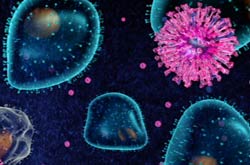
NARRATOR: When a virus enters your body it penetrates a cell. Then, it takes over the cell's own materials and uses these to reproduce. Once the cell is overloaded, the virus particles break out, attacking other cells throughout your body - spreading infection.
DR ANDREW SIMOR: I think of a virus as a microscope piece of trouble. They cause a whole wide range of human disease. They spread relatively easy from person to person and that just makes it that much more difficult to keep track of them to keep up to speed with them.
NARRATOR: For years scientists around the world have been on constant alert for any major killer outbreaks. SARS would turn out to be their first real challenge of the 21st century.
NARRATOR: In early February, a month before Dr. Urbani died, rumours came that something deadly was stirring in China; the place where Johnny Cheng had been travelling before he went to Vietnam. There was talk of a virulent disease spreading through the Province of Guangdong, just over the border from Hong Kong.
DR DAVID HEYMANN: When the government did report the disease to us they reported that there were 305 cases, but that the epidemic was now being controlled. They also told us that they had worked in their laboratories and had ruled out many infectious diseases such as anthrax, such as the haemorrhagic fevers like Ebola or Lassa. But we still didn't understand completely what was going on.
NARRATOR: At this stage no one took any action. Then came more worrying news. The mystery illness had apparently crossed into Hong Kong, killing two people. What made this so disturbing is that Hong Kong is a gateway to the rest of the world.
DR DAVID HEYMANN: Travel is very rapid out of Hong Kong and this could spread the disease throughout the world in a very short period of time.
NARRATOR: But it was already too late. As the calls from Dr. Urbani in Vietnam showed the disease had escaped and was on the loose. When the headquarters of the World Health Organisation received Urbani's warnings they swung into action. The WHO is the world's health watchdog. Its task is simple; to cut off any new disease and wipe it out, before it spreads.
DR MIKE RYAN: International transmission of any unknown disease is a worry. Once a new disease gets beyond a certain point it may be very difficult to control. Your best opportunity in controlling an unknown, or a new disease is to contain it at point source.
NARRATOR: In their time, the WHO has won battles against many lethal viruses - from Smallpox to Ebola. At this stage they knew very little about this new disease, except it had all the hallmarks of a deadly flu epidemic. So the WHO did what it had hoped never to do.
DR JULIE HALL: We have a document which is our war plan, our plan for fighting a new flu outbreak.
NARRATOR: The war plan had never been used before. It was reserved for only the worst situations.
DR JULIE HALL: I was sitting next to somebody who had actually been involved in writing it, and she thought we'd never have to use it.
NARRATOR: The war plan laid out a detailed series of tasks designed to identify, isolate and eradicate a major outbreak. But it also contained a warning... Should the disease escape, the result could be social and economic collapse, and millions dead. The stakes could not be higher.
DR JULIE HALL: I remember thinking gosh if this is the start of something, then a year from now the world would look quite different - ten percent or more of the world could be actually dead.
NARRATOR: The war plan's first instruction was to identify the mystery disease. This task was given to Dr Klaus Stohr, the WHO's flu specialist. So he set about getting samples from patients in Dr Urbani's hospital in Vietnam.
DR KLAUS STOHR: What we needed were samples samples from the lungs, samples from the nose, from the throat of those patients. But samples alone are not useful you have to get them, get them to a laboratory.
NARRATOR: Soon the lab results started coming through. The good news was it wasn't the most contagious of all known viruses, a vicious strain of flu.
DR KLAUS STOHR: The lab results were negative for influenza which was completely surprising to all of us.
NARRATOR: But then came the bad news.
DR JULIE HALL: I remember sitting with Klaus and turning to him and saying, "if we knew what this was we would know by know wouldn't we?".
DR KLAUS STOHR: The lab results were all negative. They were negative for Haemorrhagic Fevers...
DR JULIE HALL: Ebola, Mar burgh, Hanta virus.
DR KLAUS STOHR: Lasso fever, onyong fever, you name it.
NARRATOR: And so it dawned on them... they had no idea what they were up against.
DR JULIE HALL: At that point I knew that we were dealing with something unknown, something new and that was an incredibly scary moment.
NARRATOR: Meanwhile whatever it was, was spreading - 25 new cases in Hong Kong, 26 in Vietnam - and Singapore was added to the list. Then came disturbing news from Canada. At the Toronto Health Authority, they received information about a mother and son who had died of a strange illness.
DR SHEELA BASRUR: I will never forget the day I got that first phone call about a handful of cases of a mysterious respiratory illness that had affected a family whose members had recently returned from Hong Kong
NARRATOR: Next they got calls that four more of the family had fallen sick.
DR SHEELA BASRUR: Clearly this was something that was highly communicable, at least in the household setting. And yes we had major concerns that it could spread beyond that household to affect other people...
NARRATOR: Just how vicious the disease was, was experienced first hand by Pat Tamlin. She is a nurse who had been looking after a patient suffering from the mysterious illness. The consequence of that encounter meant that we could only film her through glass.
PAT TAMLIN: I was working one night in the intensive care when I noticed I was unusually warm. So I happened to take my temperature and it was 38.7C which is significantly high. And I knew that I was getting more ill as time went on.
NARRATOR: She had been infected with the strange bug. Within days, she was hospitalised.
PAT TAMLIN: My chest felt extremely tight and quite somewhat burning. My breathing was difficult. I had nausea, I had vomiting, I had cramps, severe abdominal cramps I was so weak I was unable to lift my head actually off the bed. This was the severest illness that I have ever had in my life.
NARRATOR: In Canada there was now real alarm.
DR SHEELA BASRUR: As medical officer of health for the largest city in the country - with two and a half million people, from every corner of the globe - I was extremely concerned.
NARRATOR: In just two weeks the disease had escaped Asia and reached the West. At this stage no one knew what it was, how it spread or how dangerous it might turn out to be. It was time for the WHO to deploy its most powerful weapon.
NARRATOR: On the 15th March, the WHO announced "a World Wide Alert".
DR MIKE RYAN: We were now dealing with a completely different situation than we were dealing with 24 hours previously. And we really felt at this point we had to put an alert out to the world. Watch out something very serious is happening, something very new, something we don't understand and you need to be ready.
NARRATOR: This was something the WHO had never done before. The alert meant the mystery virus was now declared an official threat to everyone on the planet.
DR DAVID HEYMANN: We didn't know what caused it, we didn't know how it would spread, we didn't know what it would do internationally and we knew that it had a significant amount of death associated with it.
NARRATOR:First they had to make the disease easy to identify. So they gave it a name.
DR MIKE RYAN: It's very good to name the demon that worries you or scares you.
DR DAVID HEYMANN: So we named the disease Severe Acute Respiratory Syndrome, SARS
NARRATOR: Next the team drew up a list of symptoms so that everyone would know what to look for.
DR MIKE RYAN: The key features of the disease were fever, a dry cough, but importantly people progressed onto the pneumonia rather quickly.
NARRATOR: Then they compiled guidelines for hospitals... how to construct isolation units, what protective clothing to wear, what to do in the event of an outbreak. Once the information was together, they sent it out to the world.
NARRATOR: The response to the alert was swift. Within 24 hours, over 150 suspected SARS cases were identified. It had spread to Indonesia, the Philippines, Thailand, even Germany. Hong Kong seemed to be the epicentre of the outbreak, with over 100 reported cases. Around the world, hospitals set up quarantine wards in anticipation of a rush of SARS victims. Meanwhile, the hunt for whatever was causing SARS began. It was not going to be easy.
All anyone knew was that it was probably a virus, but there are hundreds of different kinds of virus...
DR ANDREW SIMOR: There's Herpes Simplex Virus.
DR MIKE LEAHY: Rhinoviruses, Picornaviruses.
DR ANDREW SIMOR: There's Respiratory Centrishial Virus.
DR MIKE LEAHY: Cardioviruses.
DR ANDREW SIMOR: There's Adenovirus.
DR MIKE LEAHY: One thing people I think don't realise is that finding a virus, tracking it down and diagnosing it is incredibly difficult. It's like fumbling around in an enormous box blindfold because unless you know what you're looking for, you really have no tools to find it.
NARRATOR: And even if they could discover the type of virus, they would then have to identify the precise strain of that virus. Viruses are coated with tiny proteins, which they use to attach themselves to their victim's cells. Just a tiny variation in this protein coating could make all the difference about how a disease spreads and how it affects its victims. It was clear that this task could take months, even years. So Klaus Stohr decided to do something unprecedented.
DR KLAUS STOHR: We had to react to an urgent public health need.
So we were all very worried and we knew that this was a race against time, we had to find very quickly the causative agent for this disease.
NARRATOR: He contacted the world's top microbiologists from America to Beijing and asked them, just for once, to work together.
DR KLAUS STOHR: These scientists are competitive by nature but we called upon eleven laboratories in ten countries...
AUDIO OF HELLOS FROM ... CENTER FOR DISEASE CONTROL IN AMERICA... HAMBURG UNIVERSITY IN GERMANY... ROTTERDAM UNIVERSITY IN THE NETHERLANDS... THE CHINESE UNIVERISTY AND GOVERNMENT VIRUS UNIT IN HONG KONG... GUANGZHOU UNIVERSITY AND CENTRE FOR DISEASE CONTROL IN CHINA... INSTITUTE PASTEUR IN FRANCE... TOKYO UNIVERSITY IN JAPAN... THE COLINDALE LABORATORY IN UK...
NARRATOR: 24 hours later, all the labs had agreed to forgo their rivalries and collaborate. For the first time in history, the full force of the world's scientific might was united in focusing on identifying... just one disease. Then in Hong Kong came the first real breakthrough; clues to how SARS was spreading. Thomas Tsang - one of a team of investigators working with the WHO, was trying to trace the so-called index case - the person who was the original source of the disease.
DR THOMAS TSANG: Finding the first person who got the disease, what we call the index case is extremely important because we will be able to map out how the disease spreads among persons.
NARRATOR: So Tsang and his colleagues began the task of tracking down the first SARS victims.
DR THOMAS TSANG : For the cases in Hong Kong, we interviewed them, and sometimes it's difficult to interview patients if they are in an ICU intensive care unit, so what we did was to ask also the relatives and friends you know about their movements.
NARRATOR: And slowly, when they concentrated on just eight key cases, they began to see a pattern.
DR THOMAS TSANG: Sometimes in this sort of investigation you need a little bit of luck. We were very you know thrilled indeed to establish a link between these 8 cases.
NARRATOR: That link was a hotel in Hong Kong... ... The Metropole. In an extraordinary feat of detective work they realised that Johnny Cheng, the man who had brought the disease to Vietnam had stayed at the Metropole. An airhostess who had been the first case in Singapore had stayed at the Metropole. The woman who had taken the disease to Toronto - she too had stayed at the Metropole. And all had stayed at there at the same time, and on the same floor.
DR THOMAS TSANG: All of these cases were actually staying on the ninth floor of that hotel during only a 2 day period.
NARRATOR: Eventually, it all led to just one man who had also stayed there at the same time and on the same floor. He was the first person to die of SARS in Hong Kong - a Chinese doctor called Dr Liu Jianlun. They had found the index case.
DR THOMAS TSANG: Seldom can we go back and find a common source like this. In my 10 years of disease investigation this is you know one of the weirdest things that has ever happened to me.
NARRATOR:With this knowledge they could now work out how Dr Liu must have infected the others at the hotel.
DR THOMAS TSANG: It's not easy to reconstruct what actually happened alright because we don't have a videotape you know to identify which residents were in touch with which residents.
NARRATOR: But because everyone had stayed on the same floor at the same time, it suggested SARS spread by some form of close contact.
DR THOMAS TSANG: The hotel was not a big one, and they could have stayed at a particular place you know for a certain time, like waiting at a lift lobby or inside an elevator.
NARRATOR: So perhaps Dr Liu coughed on them in a lift. Perhaps he left the virus behind on a lift button. It is now believed the virus is passed in droplets that someone coughs out and another person breathes in. So if someone touched that lift button and then their mouths, they could become infected.
NARRATOR: The Metropole was a revelation. The theory now is that SARS mainly spreads like the common cold - you cough and someone inhales it - unlike flu, which is so infectious because it can hang suspended in the air. It means the simple policy of wearing protective clothing and putting people into isolation should eventually defeat SARS.
DR JULIE HALL: The pattern of spread that we were seeing meant that we would be able to contain it. We'd be able get on top of this and hopefully stop it spreading any further.
NARRATOR: But the Metropole saga also explained why the disease had been so hard to contain in its earliest stages. Those first carriers had scattered all over the world before anyone even knew about SARS. It was something the WHO war plan could have done nothing about. But as the detective work progressed, the disease continued to spread. By the 20th March, 306 people around the world were infected. SARS had reached the US, Taiwan and Britain. All places linked to Hong Kong by regular flights.
DR MIKE RYAN: So far this disease has mainly moved in an East West direction along the big airline trade routes For the most part it's arrived in industrialised countries with the capacity to deal with it.
NARRATOR: And a disturbing statistic was emerging; SARS killed about 4% of its victims, one in twenty five. But then came more encouraging news. There was a breakthrough in the hunt for cause of SARS. The WHO global network of laboratories was up and running. Every morning, they reported their progress.
DR KLAUS STOHR: After several telephone conferences where various different hypotheses were pushed back and forth we had a real breakthrough on the 21st of March.
NARRATOR: A team in Hong Kong had isolated a virus from a SARS patient. Using a technique called Random Polymerase Chain Reaction scientists then tried to identify this virus. They took tiny strands of DNA from hundreds of different known viruses and began testing them one after another, to see if any of them matched the mystery virus. They struck lucky, and to their surprise the cause of SARS was a Corona virus. The Corona virus is the Cinderella of the virus world; always regarded as rather dull and so often overlooked. All that is known is that in humans it causes the common cold.
DR MIKE LEAHY: It was a complete surprise because traditionally the corona virus is a nothing virus. It causes sniffles, it causes colds but this corona virus is clearly something very different, it's turned nasty.
NARRATOR: So why had this apparently innocuous virus turned into a global killer? The answer probably lies China, and in particular the Guandong Province where SARS seems to have originated. Here millions of people live side by side with a whole menagerie of animals. Basic rules of hygiene are not observed. And many of these animals are known to carry the corona virus.
DR MIKE LEAHY: A large proportion of the population live in agricultural areas and in those areas, domestic fowl are kept in close proximity to pigs which in turn live in very close proximity to human beings so it gives the ideal opportunity for a virus to jump from one species to a human being.
NARRATOR: Normally an animal virus can't infect a human. The proteins coating the animal virus are not compatible with those coating our cells. So, the animal virus cannot latch on and find a way in.
DR MIKE LEAHY: These surface proteins have got to interact with the cell in some way to allow the virus in. Now if these surface proteins don't adhere to a certain cell they're not going to get in, they're just banging at a closed door.
NARRATOR: However, virus proteins can mutate. When this happens, the mutant animal virus may alter its whole character - enabling it to penetrate a human cell.
DR MIKE LEAHY: That means a species jump can occur, and a virus that we've lived alongside for 1000s of years can suddenly infect human beings.
NARRATOR: These viruses that jump across from animals to people can be utterly lethal. Our immune systems are simply unprepared for the threat of the new. It's how most killer diseases come into existence. And it may well be how SARS was unleashed on the world.
NARRATOR: By the end of March - only four weeks after the warning call from Dr. Urbani - the WHO seemed to be winning the war against SARS. They now had a profile of the disease. They knew how it spread. They knew what it was. And they suspected they knew where it came from and why it was deadly. They had all the information needed to stop it dead in its tracks. But then, came a series of hammer blows. First China announced it had been lying.
It didn't have 40 SARS cases, but nearly 400. And the disease had spread beyond Guandong into four more provinces.
DR MIKE RYAN: We were gravely concerned. After a number of weeks of hard work, it was like, you know getting to the bottom of the hill and seeing an even bigger mountain in front of you.
NARRATOR: Then came a report that the SARS death rate was not 4%, but perhaps twice as deadly, nearly one in ten. And then in Canada, there was trouble. Despite all their precautions, the disease was still spreading.
DR SHEELA BASRUR: We had to quarantine an entire hospital. Close it down so that no patients could go in. With a case of SARS in the school, we had to close the school. We had to quarantine the entire school.
NARRATOR: Journalists looking for a story after the war in Iraq found no shortage of pundits prepared to say the WHO had lost control.
DIXON: They are struggling to contain the epidemic. We've gone from 1000 to 2000 to 3000 to 4000 cases in just the course of a month.
NARRATOR: Panic mounted. The worst scenario envisaged in the WHO War Plan, of meltdown and economic collapse, appeared to be coming true. And then unexpectedly, it all calmed down, for one simple reason. The WHO's tactics were actually starting to work. All over the world, countries co-ordinated their fight back against the disease.
DR JULIE HALL: It really is a good news, tingly, human story, just seeing the world which is often so fragmented pulling together to really try and fight this common cause.
NARRATOR: In Singapore, anyone entering or leaving the country was screened with thermal imaging equipment. Those appearing hot enough to be running a fever were sent for a medical examination. Members of parliament - including the prime minister - had their temperature taken as they arrived for work. Even children were taught how to use a thermometer to take daily readings.
TEACHER: Class I want you to take out your thermometer and let's get ready for our temperature checking. Put them in your mouth, close your mouth. Does anyone have a temperature of 37.6 degrees or higher?
NARRATOR: Vietnam - the poorest country with cases of SARS - was the first to be declared free of it.
MIKE RYAN: The lesson from Vietnam is that all countries can contain SARS if they apply the simple measures aggressively and consistently. Vietnam sends a message to the rest of the world that countries in development can contain SARS.
NARRATOR: In Hong Kong, there was drastic action. Several apartment blocks were emptied, with hundreds shipped off to quarantine. And even in Canada the disease has peaked. Hospitals started to reopen, but every doctor, nurse and visitor was screened on entry.
DR ANDREW SIMOR: The disaster plans that have been put in place have turned our hospitals inside and out and topsy turvy. We've created SARS units for these patients using very strict infection control, precautions, isolation, gloves, gowns, masks, eye protection. On the health care system at large the burden has been absolutely enormous.
NARRATOR:
Outside the hospitals, the epidemic was brought under control by mass quarantine.
DR ANDREW SIMOR: More than 10,000 individuals in the city of Toronto have been asked to go on voluntary quarantine.
NARRATOR: This level of vigilance will have to be maintained for weeks. These ambulance workers must take the strictest precautions.
AMBULANCE WORKER: That involves gown, mask, face shield and gloves.
NARRATOR: All the kit is necessary, last week there was a cluster of over ten new cases, some fourteen hundred people were quarantined and three hospitals were closed. Canada has won a major battle against SARS but the war is not yet over. Meanwhile Doctors like Andrew Simor are slowly learning to slowly combat the disease.
DR ANDREW SIMOR: These are not infections that people recover from quickly - it's not just a matter of days. Most of these patients are quite sick for many weeks at a time.
NARRATOR:
With no effective anti-SARS drugs available, doctors focus simply on keeping patients alive, hoping their own immune systems will eventually fight back.
DR ANDREW SIMOR: The treatments we have available to us now really are just buying time to allow the person to recover their own defence mechanisms. These treatments are supportive measures like making sure the person can breathe properly.
NARRATOR: SARS attacks the patient's lungs making them inflamed and causing them to produce liquid. The liquid then fills the lungs, and the patient effectively drowns. Doctors have experimented with steroids to help slow this process.
DR ANDREW SIMOR: Steroids reduces inflammation. We hope that by decreasing the inflammation we can decrease the fluids and allow the lungs to breathe properly and the oxygenation to occur normally.
NARRATOR: If the steroids fail, one last resort remains. Patients are put on a ventilator that breathes for them. It's a last ditch measure to win enough time for the patient to recover on their own. Meanwhile laboratories all over the world are on a hunt for a cure including the US Centre for Disease Control and the American military.
DR KLAUS STOHR: We need a drug now and quickly and the best thing we can do now is see if any of the existing drugs would work.
NARRATOR: Over half a million experimental chemical compounds are being tested to see if any of them could be used to treat SARS. There have been a few promising leads - but it's very early days. It is possible that none of these drugs will work.
NARRATOR: But the WHO's worldwide network of laboratories has enabled one important medical advance. On the 12th of April - just twenty days after the discovery of the SARS Corona virus - a team in Canada announced they had cracked the virus's entire genetic code. Never in the history of science has a new disease been sequenced so quickly.
DR KLAUS STOHR: We have been able within four weeks to detect the culprit, to nail it down, to sequence it I have never seen anything like this before. It has been staggering how quickly we are moving.
NARRATOR: It could be a huge step towards designing a cure. Already the genetics has thrown up some hopeful news. The virus is barely mutating at all. It is virtually the same from Hong Kong to Canada. That means it should be easy to design specific drugs for it, as unlike a virus like AIDS, it's not a rapidly moving target.
DR KLAUS STOHR: From what we know so far it looks as though the virus would be stable enough that vaccine development is a viable option.
NARRATOR:Crucially, the genetic information is so precise that it is now possible to identify weak points in how the Corona virus uses its proteins to latch on to human cells. These are weak points that a vaccine or a drug could target.
DR KLAUS STOHR: The drugs can have different targets. They can prevent the docking of the virus onto the cell surface so that the virus cannot penetrate. Other drugs might prevent the reproduction of the virus in this cell and there are also other drugs which might kill the virus directly.
NARRATOR: Nevertheless, it could be years before vaccines come rolling off the production line.
DR KLAUS STOHR: To develop a vaccine will take a long time. It has to be tested in humans and volunteers. It takes between three to six years, it costs between five hundred and eight hundred million dollars.
NARRATOR: So the world should not hold its breath for any effective treatment against SARS. With the fight back has come some proper perspective on how dangerous SARS really is. The mortality rate is high, with the weak and elderly particularly vulnerable.
DR KLAUS STOHR: SARS causes deaths in more than 15% of its patients. It's a very high case fatality rate which we don't see in many other diseases.
NARRATOR: But, in the two months since SARS reached Canada, it has claimed just over 700 lives worldwide. 5000 people die from flu each year in Britain alone. SARS is serious, but it is nothing like as contagious or as dangerous as the worst forms of flu.
DR JULIE HALL: If SARS was as infectious as influenza, we would have stopped counting, because there would have been a hundred, thousand times more cases than we're seeing right now.
NARRATOR: Horrible though it is, SARS is not the killer outbreak of the WHO War Plan. It was a dress rehearsal, not the real thing. But even so, there is still one huge reason to worry.
NARRATOR: In Taiwan and especially China, the disease is still on the loose. In China, people fleeing infected areas have spread it throughout the country -
from Guandong - to Shinxi - to Beijing - to Inner Mongolia.
DR JULIE HALL: The number of cases being reported from China is increasing day on day; the number of deaths occurring in China is increasing day on day.
NARRATOR: While the Chinese government is controlling the outbreak in some areas, it is failing in others. It is now thought some 8000 people may be infected.
DR MIKE RYAN: The situation in China is, is unpredictable. I think things have got better in certain areas and that gives us hope. We really have a fear that the disease extend to other provinces, particularly the poor ones then we may have a real problem on our hands.
NARRATOR: These images are a warning to the world should SARS ever escape again. The task now facing the world is to keep SARS contained in China. Stopping it from spreading is the only way the disease can be defeated forever.
DR JULIE HALL: We have a window of opportunity to eradicate SARS to send it back to nature to wherever it came from. That window is getting shorter and shorter by the day. China remains the last question mark. And I think if we can get on top of things in China, then we can get rid of SARS.
NARRATOR: It makes this border with Hong Kong, and others like it, the front line. Unless SARS is wiped out, then one day - perhaps years from now - someone carrying the disease will almost certainly come through here again. And if that happens, SARS could once more spread around the world.
DR JULIE HALL: The last thing we want to do with SARS is to become complacent and stop being vigilant, because any opportunity this virus will grab.
NARRATOR: It is a huge challenge. Not just for the World Health Organisation, but for every government. But we can take some comfort. So far we have shown that we can hold SARS at bay.