'She be my life': A mother mission to help Nigerians wit cerebral palsy
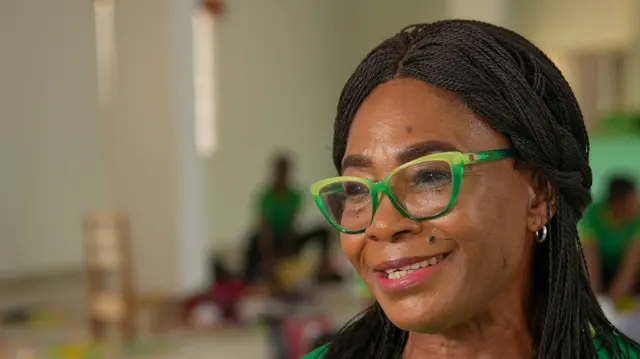
Wia dis foto come from, Joyce Liu / BBC
- Author, Nkechi Ogbonna
- Role, BBC News, Lagos
- Published
- Read am in 5 mins
Although Babatunde Fashola, wey dem dey call Baba, dey 22 years old, im dey less dan 70cm (2ft 4in) tall.
E get cerebral palsy and require lifelong care. E no fit tok or waka and dem dey feed am with a tube wey dey attached to im stomach.
As a baby, im parents bin leave am 10 years ago, e find a home for di Cerebral Palsy Centre for Lagos.
"Baba dey weigh about 12kg [26lb]. E dey do well," di facility founder, Nonye Nweke, tell me wen I visit.
Ms Nweke and her staff work dey around di clock to support im and oda young pipo wey dey live with permanent brain damage.
Although lack of official data dey, cerebral palsy dey believed to be one of di most common neurological disorders in Nigeria. In 2017, a medical professor from di University of Lagos say 700,000 pipo get di condition.
For many of those wey dey live wit cerebral palsy in di kontri, dia condition dey caused by a common phenomenon among newborns - neonatal jaundice.
Wetin dey cause am na a build-up of bilirubin, a yellow substance, wey dey inside blood, meaning di baby skin get yellow tinge.


End of Di one wey oda users dey read well well
Professor Chinyere Ezeaka, a paediatrician for di Lagos University Teaching Hospital, tell di BBC say more dan 60% of all babies suffer from jaundice.
Most babies recover within days. More severe cases need further medical intervention - and even den di condition dey easily treatable.
Children dey basically exposed to ultra-violet light to dissolve di excess bilirubin in dia red blood cells. Di treatment last for few days depending on di seriousness.
However, for Nigeria dis treatment no too dey like dat, wey make di kontri dey among odas wit di most neurological disorders sake of untreated jaundice in di world, according to data from di World Health Organization (WHO).
Any treatment for neonatal jaundice "must occur within di first 10 days of life if not, [di condition] fit cause permanent brain damage and severe cerebral palsy", Prof Ezeaka tok.
To make matters worse, di West African kontri lack facilities to care for those wit neurological disorders. Na just three cerebral palsy centres, all privately run, dey Nigeria, wey get population of more dan 200 million.
Ms Nweke - a single mother - set up di Cerebral Palsy Centre after struggling to find support for her own daughter, Zimuzo.
"Wen I carry her go day-care [centre], dem ask me to take her back becos oda mothers go withdraw dia children. As a mum, I must say e bin make me sad," Ms Nweke tell di BBC.
Zimuzo now dey 17, and Ms Nweke Cerebral Palsy Centre dey provide full-time support for odas wit similar experiences.
On di day I visit, dem arrange colourful playtime mats and toys on di floor. Mickey Mouse and im friends dey tok ontop television for di lounge.
Twelve youngsters, some as young as five, dey look di TV. All of dem dey no dey move and dem no dey tok.
Wia dis foto come from, Joyce Liu / BBC
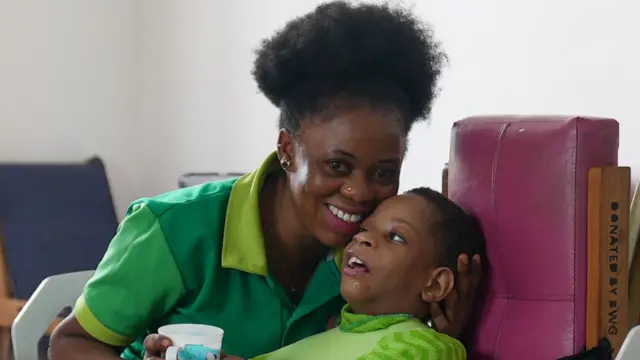
At lunchtime, caregivers go help di youngsters chop. Some dey take liquified food through tubes attached to dia stomachs.
Carefully and slowly, di carers go support dia heads wit pillows and push di contents of dia syringes into di tubes.
Dem dey feed di youngsters evri two hours and require regular massages to prevent stiffness.
But dem be di lucky 12 wey dey receive free care from di Cerebral Palsy Centre, wey dey funded exclusively by donors.
Di facility get a long waiting list - Ms Nweke don receive more dan 100 applications.
But taking on more youngsters go require extra financial support. Di cost of caring for one pesin for di centre na at least $1,000 (£790) a month - big money for kontri wia di national minimum wage na about $540 a year.
"As a mama, I must say di responsibility plenty. You get moments of depression, e dey give you heartaches and e dey quite expensive - in fact na di most expensive congenital disorder to manage," Ms Nweke tok.
"And den of course, e dey keep you away from pipo becos you no dey discuss di same tins. Dem go dey tok of dia babies, dey waka, dey enjoy dos baby moments. You no dey tok. You dey sad," she add.
Ms Nweke explain say she adopt Zimuzo from an orphanage.
A few months afta taking her new daughter home, Ms Nweke realise say Zimuzo no dey develop in di same way as di children around her dey do. Dem assess her for hospital and diagnose her wit cerebral palsy.
Dem tell Ms Nweke say she fit take Zimuzo, wey bin dey just a few months old den, back to di orphanage and adopt anoda baby instead, but she no gree.
"I decide to keep her and I begin research wetin di disorder dey about, di treatment and type of care my child go need - she be my life.
"Doctors tell me say she no go live beyond two years. Well here we dey - 17 years later," na so a smiling Ms Nweke tok.
A lack of awareness and adequate medical support dey hinder diagnosis and treatment of neonatal jaundice in Nigeria.
Ms Nweke also say di common local belief be say children wit congenital disorders dey spiritually damaged or bewitched and dis dey lead to stigmatisation.
Some children wit neurological disorders - mostly for Nigeria rural areas - dey labelled as witches. In some cases, dem dey abandoned in prayer houses or cast out of dia families.
Wia dis foto come from, Joyce Liu / BBC
Ms Nweke no dey alone in her mission to dismiss myths and improve care.
Di Oscar Project - a charity wey dey wan improve di diagnosis and treatment of neonatal jaundice - recently begin to operate for Lagos.
Di project dey named after Vietnamese-born British disability advocate, Oscar Anderson, wey untreated jaundice cause im cerebral palsy.
"We dey equip health facilities at di primary, secondary and tertiary levels wit di equipment to treat jaundice, primarily light boxes, but also detection and screening equipment," Toyin Saraki, wey oversee di launch, tell di BBC.
Project Oscar, backed by consumer health firm Reckitt, dey train 300 health workers in Lagos. Di hope over di first year na to reach 10,000 mothers, screen 9,000 children and introduce new protocols to try prevent babies with jaundice from developing cerebral palsy.
In a country wia hardly any public care dey available, di goment dey back di Oscar project goals but get little to say about dia own plans.
Treatment for neonatal jaundice dey significantly cheaper dan di cost of lifelong care, doctors tok.
First launched in Vietnam in 2019, Project Oscar don help about 150,000 children for di Asian country.
Mr Anderson, 22, say im want to prevent oda children experiencing wetin im don go through.
"No underestimate pipo wit disabilities," e tell di BBC.
E dey work to ensure say screening dey for evri newborn infant for neonatal jaundice, and, wit di support and courage of mums, midwives and medical professionals, ensure say dem get a better understanding and quicker treatment.
However, to achieve am na a very ambitious goal for Africa most-populous kontri, wia thousands of babies dey born each year wit neonatal jaundice.
Regardless, Mr Anderson dey determined to defy di odds.
"Di work no go stop until evri baby dey protected against neonatal jaundice," e tok.

Wia dis foto come from, Getty Images/BBC