|
As you cross from St Sepulchre Street on to Princess
Street the road opens out with shops and a car parking area. Although
the age of the buildings is a real mix, the layout here probably hasn't
changed a great deal as buildings have been demolished and rebuilt on
the same plot.
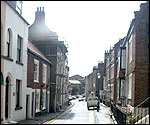 |
| Looking along Princess Street towards
the Market Hall. The building shown here with Scaffolding is an example
of a re-fronted medieval house. |
Many of the buildings on Princess street may not be quite
what they appear. Medieval buildings often had the gable pointing to the
road, doing so meant the owner paid less tax.
Over time fashions, and tax systems, changed and in the
Georgian period many buildings had new fronts built on. So what may look
like a brick built Georgian house, may in fact be a timber framed medieval
structure underneath.
Many of these houses could also be well travelled. When
ships reached the end of their working life they would be left on the
beach and quarried for useful timbers. It's not unusual to find timbers
that were once part of a ship now holding up the floors in a house.
It's possible you might see another example of a problem
vagrant plant while on Princess Street: Himalayan balsam - from the Indian
Himalayas
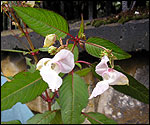 |
| Himalayan Balsam - a vagrant plant
that's threatening native species in some areas. |
It's an attractive plant which, like Japanese Knotweed,
was originally imported as an ornamental garden plant but has now successfully
naturalized in this country.
It's a serious problem on riversides. In places like
Helmsley on the Rye, native flora is under threat from Himalayan Balsam.
The vagrant grows quickly in large clumps and soon takes over an area,
shading the ground so native plants can't grow.
At the top of Casltegate you reach Paradise. This isn't
an attempt to make excessive claims for the town, but a term that was
used to describe an enclosed monastic garden.
There wasn't actually a monastery here, but it's known
the Cistercians had a house on the site and this would have had a walled
garden. The Cistercians were great traders who also had the tithe of the
church so they had a presence in the town to keep control of this.
|



 PREVIOUS





 Realplayer
required
Realplayer
required