|
In the Beginning...
It
is perhaps hard to imagine that Ballynahinch was once
a centre
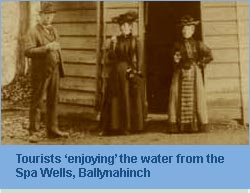
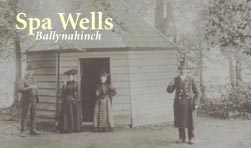
for tourism, with visitors
flocking to the town to take advantage of the much
lauded health benefits from the three wells at Spa.
The medicinal properties of the water had been rumoured
upon since the 18th Century, with many people reporting
how drinking it had cured them of their ills. Walter
Harris, in his history of County Down in the 1740’s
told the story of a Presbyterian clergyman afflicted
with psoriasis and arthritis, who after spending
a week at the Spa wells and drinking the waters,
was
soon cured and back to full health.
At the turn of the century, David Ker, with his financial
instincts, saw the commercial possibilities of the
Spa, and resolved to use this natural resource to bring
prosperity back to a town badly in need of it after
the ravages of battle. Historically, modern tourism
is reputed to have begun after Napolean’s
invasion of Egypt in 1798, an event which alerted Europe to the culture of
the near East and to other places in general. If this is true, then Ballynahinch
and Spa were in at the start of the tourist revolution, as it was in 1810 that
David Ker installed two pumps at Spa to bring the water to the surface and
to the health needs of the masses.
According to Horace Reid, these pumps are
still in existence, having been restored by Councillor Harvey Bicker. On
the front there is a little brass plate which states
that they were installed by
David Ker having been imported from Joseph Branagh in London, who of course
was a pioneer of the flushing lavatory. These pumps would have been the latest
in cutting edge technology during the regency period. As the wells became
popular, Ker developed the leisure amenities in the
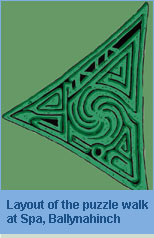
area, installing a maze in 1815.
So, after a morning drinking the waters, the patients could continue their
bid for good health by exercising in the maze. The recommended regime for
the waters was to drink between three and six pints
per day. It was described as
tasting like burned gun-powder and in Walter Harris’ words, ‘Some
it vomiteth, some it purgeth’. Horace jokes that perhaps you had to be
in good health in the first place in order to survive the regime.
|
|
|
More
and more tourists
In 1840, another member of the Ker family built
a ball-room at Spa called the assembly rooms, now
known as the Spa road-house. Originally the health
tourists came and stayed in Bed and Breakfast accommodation
in houses around the Spa district, but by the early
19th Century it was deemed insufficient for the great
numbers descending on the area. And later, just further
up the road, a Temperance hotel was built to accommodate
them, described as having “splendid accommodation
for visitors, containing numerous large, lofty, and
well-ventilated Drawing, Dining and Bedrooms”.
The railway arrived in 1859 bring a flood of tourists
from Presbyterian Belfast and in 1873 a new church
was built for them at Spa, funded by a Belfast Presbyterian
by the name of McCutcheon. |
The end was in
sight
Alas, all good things come to an end, and with the
arrival of the railway in Newcastle, the popularity
of the wells began to wilt. Newcastle was now accessible
to Belfast tourists and the beach became preferable
to the wells. However the tourist industry at Spa
continued right up to the dawn of the second world
war and collectors in Ballynahinch have postcards
sent from that period. The industry adapted and catered
for every whim of the tourists as it came along,
providing croquet lawns and building a golf course,
still thriving today. The hotel became known as the
Spa Hydro hotel, and Horace jokes that this was perhaps
one of the world’s first ‘jacuzzi’s’! |
|
Unfortunately there is little trace of the tourists. The
hotel still exists but is now a home and the maze was sadly
bulldozed a long time ago when the developers moved in.
Do
you remember anything about the days when Spa welcomed
tourists? Did you ever walk around the maze?
If you remember anything or have a story to tell,
please let us know.
Your Response...
Anita O' Farrell - July '08
Have you any other infornation on this Temperance hotel, we believe our great grandmother Mary Rogan owned a hotel in belfast and we were told it was the Temperance Hotel. This was a long time ago, Annie O' Farrell her daughter would be well over 120, and her mother older. My father mentioned ballynahinch often. Is there anyone who can help with history regarding hotel ownership in Belfast over the last centuries?
|



 print version





















 POST
A COMMENT ON THIS ARTICLE
POST
A COMMENT ON THIS ARTICLE